Kiev
Anne of Kiev
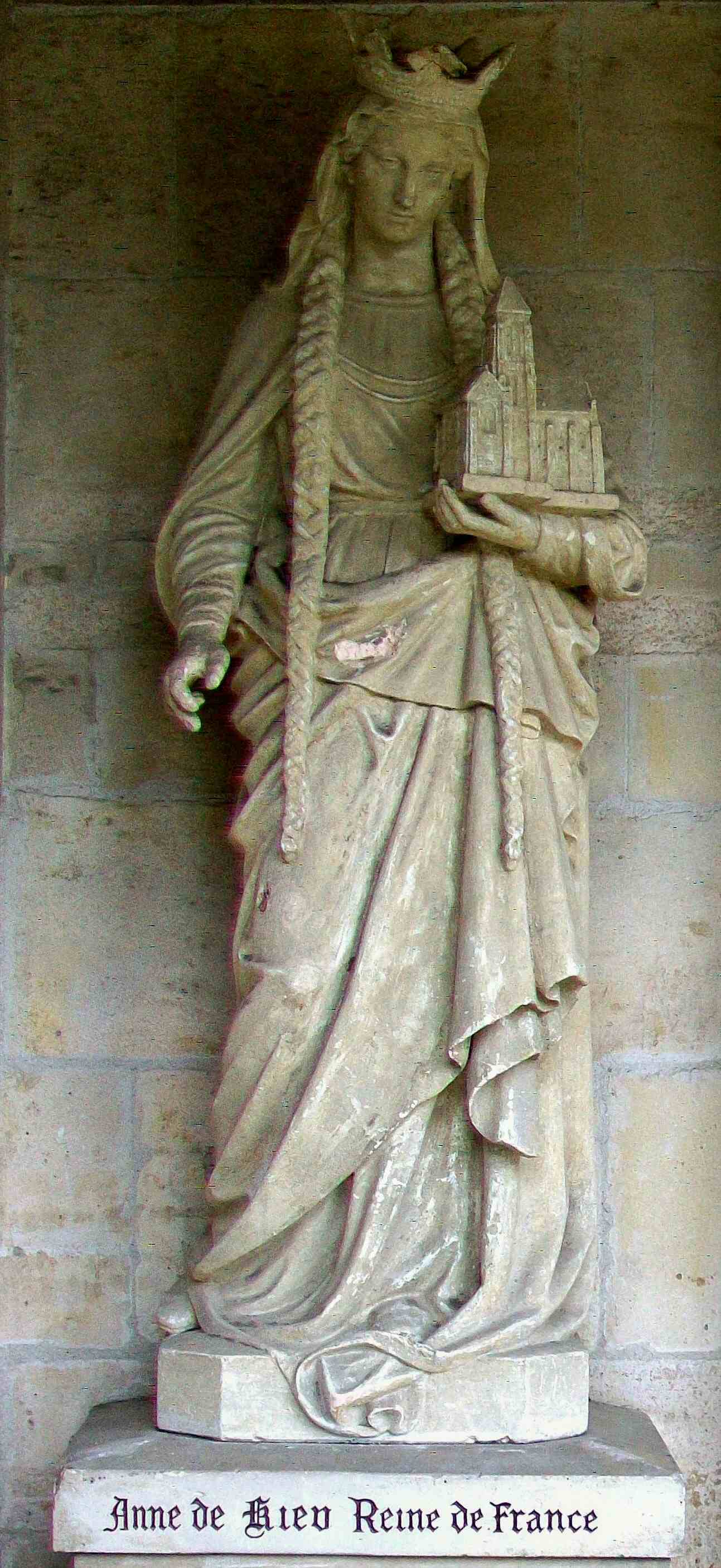 |
|
Statue of Anne of Kiev in the abbey of
Saint Vincent at Senlis, to which Anne was a foundational
benefactress
|
Yaroslav I "the
Wise"
Ingegerd
Henry
I of France on 19 May 1051
Hugonis
Floriacensis Modernorum Regum Francorum Actus in Monumenta
Germaniæ Historica SS 9 pp388-9 (ed. G. H. Pertz, 1851)
… Rex etiam accepit in coniugium filiam regis Russorum Annam, quae ei
tres genuit filios, Philippum videlicet, Hugonem atque Rotbertum.
Quorum Rotbertus inmatura morte decessit.
This roughly translates as:
… The king
also took in marriage Anna, daughter of the king of the Russians, who
bore him three sons: namely Philip, Hugh, and Robert. Of these, Robert
died an untimely death.
Raoul
II of Valois in 1062
Hugonis
Floriacensis Modernorum Regum Francorum Actus in Monumenta
Germaniæ Historica SS 9 p389 (ed. G. H. Pertz, 1851)
11. Philippus igitur regnum assecutus est Francorum anno incarnationis
divinae 1059, regnavitque annis ferme 40. Cuius mater Anna, Henrici
relicta, nupsit Rodulfo comiti, viro nobili et generoso.
This roughly translates as:
11.
Philip therefore attained the kingdom of the Franks in the year of the
divine incarnation 1059, and he reigned for nearly 40 years. His mother
Anna, the relict of Henry, married count Ralph, a man noble and
generous.
De S. Simone Comite et Monachio in Acta
Sanctorum Septembris vol 8 pp722-3 (ed. G. H. Pertz, 1851)
quando
Rodulfus pater repudiata, ut supra vidimus, secunda conjuge, Simonis
noverca, tertiam duxit, de qua hæc collegit Chiffletius in
Observationibus Mss.: Fuit igitur tertia ejus conjux Anna,
Jaroslai Russorum regis filia, Henrici I Francorum regis relicta: quam
duxisse videtur anno 1061, expleto anno luctus reginæ viduæ. Propter
has autem nuptias sacris interdictus est Rodulfus. Sic enim ait
Clarius monachus in Chronico Senonensi S. Petri Vivi: “Mortuo autem
Hainrico rege apud Vitriacum castrum in Brieria et sepulto in basilica
sancti Dionysii, Rodulfus comes, consanguineus, ejusdem regis duxit
uxorem in conjugio contra jus et fas; unde fuit excommunicatus.
Balduinus vero comes Flandrensis regem parvulum Philippum aluit, et
Franciam gubernavit.” Duxerat videlicet Annam Rodulfus in gradu
affinitatis lege ecclesiastica tunc prohibito. Nam, ut notum est, ante
concilium Lateranense anno 1215 sub Innocentio III, vetita erant
matrimonia intra septem gradus sive consanguinitatis, sive
affinitatis: erat autem Rodulfus Henrici regis consanguineus in quinto
gradu; adeoque Annæ reginæ in eodem gradu affinis
This roughly translates as:
when
[Simon's] father Rodolfo, having been divorced, as we have seen above,
from his second wife, Simon's stepmother, he married a third, Simon's
stepmother, of whom Chiffletius collected the following in his
Observations on Mss.: His third wife was therefore Anna, daughter
of Yaroslav, king of the Russians, left by Henry I, king of the Franks:
whom he seems to have married in 1061, after the year of mourning for
the widowed queen had expired. Because of this marriage, Rodolphe was
forbidden to perform sacred rites. For thus says the monk Clarius in the
Chronicle of Senon of St. Peter Vivi: “When King Henry died at the
castle of Vitria in Brier and was buried in the basilica of St. Denis,
Count Rodolphe, a blood relative of the same king, married the wife of
the same king in a marriage contrary to law and custom; wherefore he was
excommunicated. But Baldwin, Count of Flanders, raised the young king
Philip and governed France.” Rodolphe had married Anne in a degree of
affinity then forbidden by ecclesiastical law. For, as is known, before
the Lateran Council in 1215 under Innocent III, marriages within seven
degrees of consanguinity or affinity were forbidden: but Rodolphe was a
blood relative of King Henry in the fifth degree; and therefore related
to Queen Anne in the same degree
Queen of France
Anne of Kiev was a princess of Kievan
Rus', the daughter of Yaroslav the Wise, the Grand
Prince of Kiev, and a Swedish princess, Ingegerd. Her arrival in the
West marked one of the most distant and prestigious marital alliances of the
middle ages, bringing the sophisticated culture of the Kievan Rus' to the
comparatively rustic Capetian court.
Following the death of his first wife, king Henry I was desperate for
an heir. Because of the strict incest laws of the Church, he could find no
suitable bride among the local nobility who was not a close relative. In
1051, he sent an embassy thousands of miles east to Kiev. Anne was chosen
for her high lineage, her reputed beauty, and her literacy, a rare trait
among the Frankish nobility of the time. She was married to Henry I in Reims
in 1051. Her influence was not merely domestic. When Henry I died in 1060,
Anne became the first queen of France to act as regent for her minor son,
Philip I. However, her life took a dramatic turn in 1062 when she fell in
love with count Ralph (Raoul) of Valois. Ralph was a powerful count, but he
was already married. He repudiated his wife on false charges of adultery to
marry Anne. The marriage caused a massive scandal and Pope Alexander II
excommunicated Ralph. Despite this, Anne remained by Ralph's side, and her
son Philip I eventually welcomed his mother back to the court. After Ralph’s
death in 1074, Anne returned to the royal court as the queen mother. She
founded the abbey of Saint-Vincent in Senlis, where her statue still stands,
depicting her holding a model of the church she built.
In 1061 Anne made a substantial donation to the foundation of St. Vincent at
Senlis, from her own possessions and from the dower from her marriage to
Henry. This donation is cited in a later document in which king Philip
records a debt to the same church.
Recueil des Actes de Philippe I, Roi de France
vol 139 pp330-331 (ed. Maurice Prou, 1908)
Notum
est omnibus sancte aecclesiae filiis quoniam universitatis creator
omnia ad ornatum compositionemque sacratissimarum nuptiarum unigeniti
sui Deus pater condidit, nec solum genitor sed et ipse genitus,
concordia Sancti Spiritus, sibi sponsam aptavit, sicut ipse in
Canticis Canticorum eidem sponsae dicit: «Veni de Libano, sponsa mea,
veni de Libano, veni et coronaberis de capite Amana, de vertice Sanir
et Hermon.» Ego autem Anna, corde intelligens, mente pertractans
tantam pulchritudinem tantumque decus atque recolens illud quod
scriptum est: « Beati qui ad cenam Agni vocati sunt», et quod ipsa
Christi sponsa alias « Qui elucidant me vitam aeternam habebunt»,
deliberavi apud me quomodo illarum epularum illiusque beatitudinis ac
vitae aeternae particeps existere possem, cumque demum sublevatum
esset cor meum ad fabricandum Christo aecclesiam, ut intus incorporari
et quodlibet membrum illius sanctae societatis, que fide Christo
adjuncta est, connecti valuissem, in honore sanctae Trinitatis et piae
Dei genitricis Mariae et precursoris Domini et sancti Vincentii
martyris, Christo eam fabricavi et dedicare precepi atque dans
deputavi ibi de facultatibus meis, et de his, que in matrimonio
Henricus rex, conjux meus, michi dederat, que omnia, favore filii mei
Philippi, Dei gratia regis, et omnium optimatum sui regni consilio
attitulari concedo, quatinus ibi quieti et tranquilli religiosi viri
Deo servientes, mundo renuntiantes, regularem, id est sanctorum
apostolorum et beati Augustini, que scripta est, vitam canonice
amplectentes, vivere valeant et pro peccatis Henrici regis ac filiorum
et amicorum meorum atque meis die ac nocte Deum exorent, et ut sine
macula aut ruga, sicut a Christo aptatur aecclesia suis precibus me
Deo exhibeant: terram scilicet quam juxta aecclesiam Ivo prepositus
sidebat, ab ipso pretio emptam, cum furno et omnibus consuetudinibus
quas terra reddere solet; novem hospites, cum omni consuetudine, quos
prius in eodem loco possidebam; de censu monete, tres libras; pediter
civitatis, in cujus suburbio prefata constructa est aecclesia, et quod
ad civitatem pertinet; molendinum unum in villa que dicitur Guvils;
villam unam que dicitur Mansionale Blavum; in territorio Laudunensi,
alodium unum in villa que dicitur Crespis, sed ne quis deinceps eis
molestus sit, concedo omnes omnino consuetudines sancto Vincentio et
canonicis ejus.
The letter is translated at Epistolæ:
Medieval Women's Letters as:
LETTER 120
It is known to all the sons of the holy church that the creator of the
universe, God the father, formed all things for the construction and
adornment of the most holy nuptials of his only son. Not only the father
but also his son, in harmony with the Holy Spirit, prepared the bride for
him, as he says in the Song of Songs to that bride: “Come from Lebanon, my
bride, come from Lebanon, come and you will be crowned from the height of
Amana, from the peak of Senir and Hermon.” But I, Anne, understanding in
my heart and going over in my mind such beauty and such splendor and
remembering what is written: “Blessed are those who are called to the
feast of the Lamb,” and what that bride of Christ [says] elsewhere “Those
who light me will have eternal life,” I deliberated with myself how I
might be a participant of those feasts and of that beatitude and eternal
life. Then my heart was lifted to build a church for Christ, so that I
might be connected, incorporated within it with any member of that holy
society which is joined to Christ by faith, in honor of the holy Trinity
and the pious mother of God, Mary, and the precursor of the Lord and the
martyr St. Vincent. I built it and ordered it to be dedicated to Christ
and as a gift from my goods and those which king Henry, my husband, gave
me at our marriage, all of which, with the favor of my son Philip, king by
the grace of God, and the counsel of all the magnates of his kingdom, I
granted to be assigned to it, so that religious men serving God,
renouncing the world, embracing the regular life, that is the written
[rule] of the holy apostles and blessed Augustine, might live quiet and
tranquil, and pray God day and night for the sins of king Henry and my
sons and friends and my own, that they might by their prayers present me
to God without stain or wrinkle, as was desired by Christ for the church.
Namely the land which provost Yves possessed beside the church, bought at
that price, with the oven and all the revenues which that land usually
renders; the nine tenants, with all the revenues which I possessed in that
place before; the path around the city in the suburb of which the church
was constructed and which belongs to the city; a mill in a town called
Gouvieux,; a town called Blancmesnil; a property in the territory of Laon
in a town called Crespy. But so that no one harms them from now on, I
grant all the revenues of any kind to St. Vincent and his canons.
Excerptum Historicum in Recueil
des historiens des Gaules et de la France vol 11 p157 (1871)
Ex Collectione Freheri, pag. 515, et ex Ms. Regio num. 8394.
… Post cujus obitum Rex sibi quærens conjugii solatium, ad Rutenorum
Regem Galterum, cognomine Saveir, Meldensem Episcopum direxit,
postulans ut ei suam mitteret filiam. Quod et factum est. Hujus nomen
erat Anna. Convocatâ igitur regni sui Procerum multitudine, sicut
decet tantum virum, illam celebriter duxit in uxorem. Hæc autem Deo
devota, plus de futuris quàm de præsentibus cogitans, in æterna vita
mutuum multipliciter recipere credens, apud Sylvanectum Ecclesiam in
honore S. Vincentii construxit. Cum qua Rex feliciter vivens, ex ea
genuit tres filios, Philippum videlicet, Robertum, et Hugonem
cognomine Magnum. Iste Hugo genuit Rodulfum Viromanduorum Comitem.
This roughly translates as:
From the Freher Collection, page 515, and from Royal Manuscript no.
8394.
… After her death, the King, seeking for himself the solace of marriage,
sent Walter, the Bishop of Meaux, surnamed "Saveir", to the King of the
Rus, requesting that he send him his daughter. And so it was done. Her
name was Anna. Therefore, having called together a multitude of the
nobles of his realm, as befits such a man, he married her in a
celebrated ceremony. She, however, being devoted to God and thinking
more of future things than present ones, believing that she would
receive a manifold return in eternal life, built a church at Senlis in
honor of St. Vincent. Living happily with her, the King fathered three
sons by her: namely Philip, Robert, and Hugh, surnamed the Great. This
Hugh fathered Ralph, Count of Vermandois.
Anne de Russie, reine de France p23 (Le
Vicomte de Caiz de Saint Aymour, 1896)
Anne … était fille de Iaroslav Vladimirovitch, grand-duc ou plutôt
grand-prince (velikii kniaz) des Ruthènes ou Russes, qu’un historien
appelle le Charlemagne de la Russie, et dont les exploits
contre Boleslas, roi ou duc de Pologne, avaient porté le nom jusqu’aux
confins de l’Occident. Son aïeul, Vladimir le Grand, s’était élevé à
un haut degré de puissance, et, en introduisant le christianisme parmi
ses peuples, en 988, il leur avait fait prendre place au milieu des
nations civilisées. Sa mère, Ingegerde, était la fille d’Olaüs, roi de
Norwège, surnommé Skotkonung.
This roughly translates as:
Anne...
was the daughter of Yaroslav Vladimirovich, grand-duke or rather
grand-prince (velikii kniaz) of the Ruthenians or Russians, whom
one historian calls the Charlemagne of Russia, and whose
exploits against Bolesław, king or duke of Poland, had carried his name
to the far reaches of the West. Her grandfather, Vladimir the Great, had
risen to a high degree of power, and, by introducing Christianity among
his people in 988, he had enabled them to take their place among the
civilized nations. Her mother, Ingegerd, was the daughter of Olaf, king
of Norway, nicknamed "King of the Scots".
pp35-36
Ayant résolu de demander la main de la fille de Iaroslav, le roi Henri
Ier chargea de cette mission Gauthier Saveyr (le Sage ou le
Savant) évêque de Meaux, et Goscelin de Chalignac, auxquels il
adjoignit plusieurs autres grands du royaume. Partis au commencement
de l’année 1048, les ambassadeurs revinrent avec la princesse en 1049,
et le mariage fut célébré à Reims le 14 mai de la même année, jour de
la Pentecôte.
Anne de Russie, née en 1024, avait alors vingt-cinq ans. Nous
avons dit qu’elle était d’une beauté remarquable; elle appartenait, de
plus, à une race féconde, et tout permettait d’espérer qu’elle ferait
reverdir sans retard le jeune tronc capétien. Un temps assez long
s’écoula cependant sans que cet espoir se réalisât et l’inquiétude
commença à s’emparer de la jeune reine.
This roughly translates as:
Having
resolved to ask for the hand of Yaroslav's daughter, king Henry I
entrusted this mission to Walter Saveyr (the Wise or the Learned),
bishop of Meaux, and Goscelin de Chalignac, to whom he added several
other great men of the kingdom. Having departed at the beginning of
1048, the ambassadors returned with the princess in 1049, and the
marriage was celebrated in Reims on May 14th of the same year, Pentecost
Sunday.
Anne of Russia, born in 1024, was then twenty-five years old. We
have said that she was remarkably beautiful; moreover, she belonged to a
fertile lineage, and everything suggested that she would quickly
revitalize the young Capetian dynasty. However, a considerable time
passed without this hope being realized, and anxiety began to take hold
of the young queen.
pp42-46
Henri
Ier mourut, en effet, à Vitry-aux-Loges, près d’Orléans, le
4 août 1060. Si sa veuve ne prit pas alors les rênes du gouvernement
elle conserva tout au moins la tutelle et la garde du jeune roi et de
ses autres enfants, et elle se retira immédiatement avec eux au
château de Senlis, vieille ville royale que sa proximité de Paris, la
loyauté de ses habitants pour leurs souverains et les belles forêts
qui l’entouraient de toutes parts, avaient suffisamment désignée à sa
maternelle prévoyance.
… Anne aimait beaucoup ce séjour de Senlis, nous dit un vieux
manuscrit (1), « tant par la bonté de l’air qu’on y respire que pour
les agréables divertissements de la chasse, à laquelle elle prenait un
singulier plaisir.»
Peut-être aussi avait-elle déjà choisi ce lieu pour y réaliser
enfin le vœu qu’elle avait fait autrefois de construire un monastère,
vœu qu’elle avait résolu d’accomplir sans retard, maintenant qu’elle
était libre d’y consacrer, tant ses biens propres, que ceux qu’elle
tenait de la munificence de son époux.
Il existait précisément à Senlis au faubourg de Vietel ou
Vitel, une petite chapelle « ruinée de vieillesse et réduite en masure
», placée sous le vocable de Saint-Vincent. Autour de cette chapelle
s’étendait un vaste pré, appelé le Pré du Roi, qui sous le nom d’ «
aleu royal » constituait un domaine particulier relevant directement
du souverain. En établissant son abbaye sur ce terrain, avec la
permission de Philippe Ier, son fils, Anne
l’affranchissait, par là même, de toute autre juridiction temporelle
que celle du roi lui même.
(1) Manuscrit de Nicolas Quesnel. sous-prieur de
Saint-Vincent vers 1670, cité par l’abbé MAGNE: Notice
sur l’Abbaye de Saint-Vincent, in-8, Beauvais et Paris (1860).
This roughly translates as:
Henry I
died, in fact, at Vitry-aux-Loges, near Orléans, on August 4, 1060.
While his widow did not immediately assume the reins of government, she
at least retained guardianship and care for the young king and his other
children, and she immediately retired with them to the Château de
Senlis, an old royal town whose proximity to Paris, the loyalty of its
inhabitants to their sovereigns, and the beautiful forests that
surrounded it on all sides, had sufficiently drawn her to her maternal
foresight.
… Anne greatly enjoyed her stay at Senlis, an old manuscript (1) tells
us, “both for the freshness of the air and for the pleasant pastimes of
hunting, in which she took singular pleasure.”
Perhaps she had already chosen this place to finally fulfill the
vow she had once made to build a monastery, a vow she resolved to
accomplish without delay, now that she was free to dedicate to it both
her own possessions and those she received from the munificence of her
husband.
There existed in Senlis, in the suburb of Vietel or Vitel, a
small chapel, “ruined by old age and reduced to a hovel,” dedicated to
Saint Vincent. Around this chapel lay a vast meadow, called the King’s
Meadow, which, under the name of “royal allodial land,” constituted a
private domain directly under the sovereign’s jurisdiction. By
establishing her abbey on this land, with the permission of Philip I,
her son, Anne thereby freed it from any temporal jurisdiction other than
that of the king himself.
(1) Manuscript of Nicolas Quesnel. sub-prior of Saint-Vincent
around 1670, cited by Abbot MAGNE: Notice sur
l’Abbaye de Saint-Vincent, in-8, Beauvais and Paris (1860).
pp53-62
Cependant, l’accomplissement de ses de voirs de mère et l’exécution
de son pieux dessein, la fondation de l’abbaye de Saint-Vincent,
n’absorbait pas tellement la reine qu’elle ne pût prendre quelques
distractions purement mondaines. Parmi ces distractions, la
promenade et la chasse dans les belles forêts qui entouraient sa
résidence, tenaient la première place. Tous les seigneurs du
voisinage venaient aussi lui faire leur cour ainsi qu’au jeune roi:
et plus d’un, parmi eux, apportait ses hommages, non seulement à la
reine, mais aussi à la femme. Il ne faut pas oublier, en effet,
qu’Anne de Russie n’avait, à la mort de son époux, que trente-cinq
ou trente-six ans, qu’elle était renommée pour sa beauté, et que,
chez beaucoup de femmes de son pays, cet âge est celui du plus
complet épanouissement de leurs charmes.
Parmi les seigneurs qui se trouvaient ainsi attirés le plus
assidûment à Senlis, était Raoul III, dit le Grand, comte de Crépy
et de Valois, du Vexin d’Amiens, de Bar-sur-Aube, de Vitry, de
Péronne et de Montdidier. Ce prince, descendant de Charlemagne, par
Hildegarde, dame de Crépy, était, nous dit l’historien du Valois, «
l’un des plus puissants seigneurs et des plus absolus qui aient
existé en France… »; il « ne reconnaissait de puissance au-dessus de
la sienne que celle qu’il pouvait faire servir à l’accomplissement
de ses desseins », et « il ne craignait ni les armes du roi, ni les
censures de l’Eglise… »
Plus âgé que la reine de quelques années, Raoul avait eu déjà
deux femmes: Adèle ou Alix, fille de Nautcher, comte de
Bar-sur-Aube, qui lui avait laissé en mourant, en 1053, avec deux
fils et deux filles, cette seigneurie et celle de Vitry, et Aliénor
qui vivait encore, mais qu’il soupçonnait d’adultère et qu’il
songeait à répudier.
Il mit son projet à exécution dès qu’il eut la certitude que
la reine partageait l’amour qu’il avait conçu pour elle: et pour que
rien ne manquât à ce petit roman d’histoire royale, un jour qu’Anne
de Russie se promenait dans la forêt de Senlis, sous les ombrages de
laquelle ils se rencontraient assez souvent, il l’enleva comme une
simple bergère et l’emmena à Crépy-en-Valois, sa capitale, où
quelque prêtre complaisant ou terrorisé les maria.
Ceci se passa très probablement dans la première moitié de
l’année 1063, car la dernière charte dans laquelle Anne est traitée
de « reine » est datée de cette année, la deuxième du règne de son
fils.
On peut penser au scandale que fit cette escapade princière,
quel chagrin en eurent le jeune roi Philippe, et ses frères et
quelle indignation en conçut le Régent. Tout ce réunissait pour
condamner cette union: la mort très récente de Henri Ier;
la jeunesse des petits princes qui avaient encore besoin de leur
mère; enfin la situation respective d’Anne et de Raoul aussi bien
que la manière dont ils s’y étaient pris pour arriver à la
satisfaction de leur passion réciproque. Non seulement le comte de
Valois était déjà marié, mais la proche parenté de ce seigneur avec
Henri, premier époux d’Anne de Russie, aurait suffi, d’après les
mœurs du temps, pour entacher de nullité un mariage contracté entre
eux. Mais rien ne prévalut contre la fougue emportée de l’amant et
contre la faiblesse déraisonnable de l’amante.
Quoi qu il en soit, tout se serait peut-être arrangé, tant
était grande la puissance du comte de Valois et la crainte qu’il
inspirait, sans la protestation hardie de l’épouse qu’il avait
abandonnée.
Celle-ci, en effet, ne se résigna pas à son sort. Outrée de
fureur et ne respirant que la vengeance, elle partit pour Rome dès
qu’elle sut l’usage que son volage époux avait fait de sa liberté
reconquise par la répudiation violente dont elle avait été la
victime, et elle alla porter directement ses plaintes au Pape
Alexandre II. Celui-ci l’ayant accueillie avec bienveillance, elle
revint de Rome avec une lettre du Saint-Père pour Gervais,
archevêque de Reims, ordonnant à ce prélat de faire une enquête. Et
l’archevêque ayant peu après confirmé les faits allégués par
l’épouse répudiée, Alexandre II enjoignit à Raoul de renvoyer la
reine et de reprendre Aliénor. Puis sur son refus, il l’excommunia
et déclara nul son mariage.
Bravant les censures ecclésiastiques, le comte de Valois
continua à vivre avec sa troisième femme. On s’habitua peu à peu à
cette union irrégulière. Le roi lui-même, sans doute par crainte de
s’aliéner son puissant beau-père, et peut-être aussi mû par un
sentiment de tendresse pour sa mère, qui, jusqu’à l’éclosion de
cette malheureuse passion n’avait jamais failli à aucun de ses
devoirs, fit probablement taire son juste ressentiment. Nous voyons,
en effet, dès l’année 1065, Raoul et ses deux fils accompagner
Philippe Ier à Corbie et signer avec lui un diplôme en
faveur de l’abbaye de Hasnon. Néanmoins, nous ne trouvons plus Anne
nommée dans aucune charte donnée par son fils depuis son union avec
le comte de Valois, sauf dans celle qu’il octroya à Senlis, en 1069,
au monastère de Saint Vincent. Mais cette exception se justifie
suffisamment par le fait que la mère du roi était la fondatrice de
ce couvent et qu’il était, pour ainsi dire, impossible de ne pas le
rappeler dans une charte concernant cette fondation et donnée dans
la ville même où s’élevait l’abbaye due à sa piété.
Cette réserve n’empêchait pas d’ailleurs les bonnes relations
de la mère et du fils, et Raoul de Crépy étant mort à Montdidier le
8 septembre 1074, sa veuve reparut immédiatement à la cour de
Philippe Ier.
… Revenue auprès de son fils, nous la voyons apposer sa
signature en 1075, à un vidimus de Philippe, par lequel il confirma,
en son palais de Paris, la charte de fondation du monastère de
Notre-Dame de Pontlevoy. Un détail du libellé de cet acte nous
montre, néanmoins, que la position d’Anne de Russie, à la cour,
avait subi une grande modification. Elle ne signe plus, en effet,
comme autrefois, Regina, mais seulement: Signum Annae
matris Philippi Regis. Elle ne reprit donc jamais auprès de
son fils le rang duquel l’avait fait déchoir son union romanesque et
irrégulière avec le comte de Valois, et elle ne fut plus traitée par
lui que comme une mère bien-aimée à qui on pardonne ses écarts, et
non comme une reine qui vous a donné le jour et que l’on associe à
la puissance royale et à l’exercice de la souveraineté.
Cette signature de 1075 est, d’ailleurs, la dernière mention
que nous trouvons d’Anne de Russie
This roughly translates as:
However, fulfilling her maternal duties and carrying out her pious
project, the founding of the abbey of Saint Vincent, did not so absorb
the queen that she could not indulge in some purely worldly pastimes.
Among these, walking and hunting in the beautiful forests surrounding
her residence held first place. All the local lords also came to pay
their respects to her and the young king; and more than one of them
offered homage not only to the queen, but also to the woman. It must
not be forgotten, in fact, that Anne of Russia was only thirty-five or
thirty-six years old at the death of her husband, that she was
renowned for her beauty, and that, for many women of her country, this
age is that of the fullest blossoming of their charms.
Among the lords who were thus most assiduously drawn to Senlis
was Raoul III, known as the Great, count of Crépy and Valois, of the
Vexin of Amiens, of Bar-sur-Aube, of Vitry, of Péronne and of
Montdidier. This prince, a descendant of Charlemagne through
Hildegarde, lady of Crépy, was, the historian of Valois tells us, "one
of the most powerful and absolute lords who ever existed in France..."
He "recognized no power above his own except that which he could use
to accomplish his designs," and "he feared neither the king's arms nor
the Church's censures..."
A few years older than the queen, Raoul had already had two
wives: Adèle or Alix, daughter of Nautcher, count of Bar-sur-Aube, who
had left him, upon her death in 1053, along with two sons and two
daughters, this lordship and that of Vitry; and Eleanor, who was still
alive, but whom he suspected of adultery and whom he was considering
divorcing.
He put his plan into action as soon as he was certain that the
queen shared the love he had conceived for her. And so that nothing
would be lacking in this little tale of royal history, one day, while
Anne of Russia was strolling in the forest of Senlis, in whose shade
they often met, he abducted her like a simple shepherdess and took her
to Crépy-en-Valois, his capital, where some compliant or terrified
priest married them.
This most likely took place in the first half of 1063, for the
last charter in which Anne is addressed as "queen" is dated that year,
the second of her son's reign.
One can imagine the scandal caused by this princely escapade,
the grief felt by the young king Philip and his brothers, and the
indignation of the Regent. Everything conspired to condemn this union:
the very recent death of Henry I; the young princes, still dependent
on their mother, were young; and Anne and Raoul's respective
situations, as well as the manner in which they had sought to satisfy
their mutual passion, were all factors. Not only was the count of
Valois already married, but his close kinship with Henry, Anne of
Russia's first husband, would have been sufficient, according to the
customs of the time, to invalidate any marriage between them. But
nothing prevailed against the lover's impetuous passion and the
beloved's unreasonable weakness.
In any case, everything might have been resolved, so great was
the count of Valois's power and the fear he inspired, had it not been
for the bold protest of the wife he had abandoned.
She, indeed, refused to resign herself to her fate. Overcome
with fury and consumed by a thirst for revenge, she left for Rome as
soon as she learned of how her fickle husband had used his newfound
freedom, regained through the violent repudiation of which she had
been the victim. She went directly to Pope Alexander II to lodge her
complaints. He received her favorably, and she returned from Rome with
a letter from the Holy Father to Gervais, archbishop of Reims,
ordering him to conduct an investigation. The archbishop soon
confirmed the facts alleged by the repudiated wife, and Alexander II
ordered Raoul to dismiss the queen and take Eleanor back. Upon his
refusal, he excommunicated him and declared their marriage null and
void.
Defying ecclesiastical censures, the count of Valois continued
to live with his third wife. People gradually became accustomed to
this irregular union. The king himself, no doubt fearing to alienate
his powerful father-in-law, and perhaps also moved by a feeling of
tenderness for his mother, who, until the blossoming of this
unfortunate passion, had never failed in any of her duties, probably
silenced his justifiable resentment. Indeed, we see Raoul and his two
sons accompanying Philip I to Corbie as early as 1065 and signing a
charter with him in favor of the abbey of Hasnon. Nevertheless, we
find Anne mentioned in no charter issued by her son after her marriage
to the count of Valois, except in the one he granted to the monastery
of Saint Vincent at Senlis in 1069. But this exception is sufficiently
justified by the fact that the king's mother was the founder of this
convent, and it was practically impossible not to mention this in a
charter concerning its foundation, issued in the very town where the
abbey, established in gratitude for her piety, stood.
This reservation, however, did not prevent good relations
between mother and son, and Raoul de Crépy having died at Montdidier
on September 8, 1074, his widow immediately reappeared at the court of
Philip I.
… Having returned to her son, we see her affixing her signature in
1075 to a vidimus of Philip, by which he confirmed, in his palace in
Paris, the charter of foundation of the monastery of Notre-Dame de
Pontlevoy. A detail in the wording of this document shows us, however,
that Anne of Russia's position at court had undergone a significant
change. She no longer signed, as before, Regina, but only: Signum
Annae matris Philippi Regis. She therefore never regained with
her son the rank from which her romantic and irregular union with the
count of Valois had caused her to fall, and she was henceforth treated
by him only as a beloved mother whose indiscretions are forgiven, and
not as a queen who gave birth to him and whom one associates with
royal power and the exercise of sovereignty.
This signature of 1075 is, moreover, the last mention we find
of Anne of Russia.
The Encyclopaedia Britannica 11th edition vol
13 pp290-1 (ed. Hugh Chisholm, 1911)
HENRY
I. (1008-1060), king of France … In 1051 Henry married the
Russian princess Anne, daughter of Yaroslav I., grand duke of Kiev.
She bore him two sons, Philip, his successor, and Hugh the great,
count of Vermandois.
See … de Caiz de Saint Aymour, Anne de Russie, reine de
France (1896)
5 September, although the year is not
known
Anne de Russie, reine de France p50 (Le
Vicomte de Caiz de Saint Aymour, 1896)
Chaque
année, ils célébraient « un obit solennel » au jour du décès de leur
bienfaitrice, qui était le lendemain de l’octave de Saint Augustin: et
pour que les malheureux eussent, leur part de la fête donnée en sou
venir de la bonne Reine, l’abbé offrait à dîner, après la messe, à
treize pauvres femmes veuves.
This roughly translates as:
Each year they
celebrated "a solemn obit" on the day of the death of their
benefactress, which was the day after the octave of Saint Augustine [5
September]: and so that the unfortunate would have their share of the
feast given in memory of the good Queen, the abbot offered dinner, after
mass, to thirteen poor widowed women.
- Hugonis Floriacensis Modernorum Regum Francorum
Actus in Monumenta Germaniæ
Historica SS 9 pp385 (ed. G. H. Pertz, 1851); Anne de Russie, reine de France p23 (Le
Vicomte de Caiz de Saint Aymour, 1896); The Encyclopaedia Britannica 11th edition vol
13 pp290-1 (ed. Hugh Chisholm, 1911); Medieval
Lands (ANNA Iaroslavna); wikipedia
(Anne of Kiev)
- Hugonis Floriacensis Modernorum Regum Francorum
Actus in Monumenta Germaniæ
Historica SS 9 pp385 (ed. G. H. Pertz, 1851); Anne de Russie, reine de France p23 (Le
Vicomte de Caiz de Saint Aymour, 1896); Medieval
Lands (ANNA Iaroslavna); wikipedia
(Anne of Kiev)
- Hugonis Floriacensis Modernorum Regum Francorum
Actus in Monumenta Germaniæ
Historica SS 9 p388 (ed. G. H. Pertz, 1851); Excerptum Historicum in Recueil
des historiens des Gaules et de la France vol 11 p157
(1871); The Encyclopaedia Britannica 11th edition vol
13 pp290-1 (ed. Hugh Chisholm, 1911); The
Henry Project: The Ancestors of King Henry II of England (Robert II le
Pieux (the Pious)); Medieval
Lands (HUGUES de France); wikipedia
(Henry I of France)
- Hugonis Floriacensis Modernorum Regum Francorum
Actus in Monumenta Germaniæ
Historica SS 9 pp388-9 (ed. G. H. Pertz, 1851); Excerptum Historicum in Recueil
des historiens des Gaules et de la France vol 11 p157
(1871); The ecclesiastical history of England and Normandy
by Ordericus Vitalis vol 2 p348 (trans. Thomas Forester,
1853); The Encyclopaedia Britannica 11th edition vol
13 pp290-1 (ed. Hugh Chisholm, 1911); Medieval
Lands (HUGUES de France); wikipedia
(Henry I of France)
- Hugonis Floriacensis Modernorum Regum Francorum
Actus in Monumenta Germaniæ
Historica SS 9 p389 (ed. G. H. Pertz, 1851); The ecclesiastical history of England and Normandy
by Ordericus Vitalis vol 1 p456n (trans. Thomas Forester,
1853); Medieval
Lands (ANNA Iaroslavna); wikipedia
(Anne of Kiev); Medieval
Lands (RAOUL [III] “le Grand” de Valois); wikipedia
(Ralph IV of Valois)
- Anne de Russie, reine de France (Le
Vicomte de Caiz de Saint Aymour, 1896); Medieval
Lands (ANNA Iaroslavna); wikipedia
(Anne of Kiev)
- Recueil des Actes de Philippe I, Roi de France
vol 139 pp330-331 (ed. Maurice Prou, 1908); Hugonis Floriacensis Modernorum Regum Francorum
Actus in Monumenta Germaniæ
Historica SS 9 pp387-9 (ed. G. H. Pertz, 1851); Excerptum Historicum in Recueil
des historiens des Gaules et de la France vol 11 p157
(1871); Anne de Russie, reine de France (Le
Vicomte de Caiz de Saint Aymour, 1896); The Encyclopaedia Britannica 11th edition vol
13 pp290-1 (ed. Hugh Chisholm, 1911); Medieval
Lands (ANNA Iaroslavna); wikipedia
(Anne of Kiev)
- Anne de Russie, reine de France p50 (Le
Vicomte de Caiz de Saint Aymour, 1896); wikipedia
(Anne of Kiev)
Igor
?
Rurik, an earlier ruler of the region, is named in The Russian Primary Chronicle - Laurentian Text
p60 as Igor's father, but this is questioned by modern historians.
Ancient Russia p366 (George Vernadsky,
1946)
According to the tradition of the Book of Annals Riurik left in
Novgorod an infant son, Igor, in whose name his kinsman Oleg ruled at
first. The name Igor occurs in the Skioldung clan. The ancestor of the
Skioldungs—Riurik’s great-great-great-grandfather—was called Ivar, which
may be considered another form of the name Ingvar, or Igor. According to
the chronicles, Riurik’s son was the same Igor who became Prince of Kiev
after Oleg’s death and who reigned, according to the tradition, from 912
to 945. The identity of the two Igors is hardly acceptable, however. In
that case Igor of Kiev would have had to be over 70 at the time of his
death (born not later than 873, died 945). Meanwhile there is no
indication in the chronicles that Prince Igor was that old. In 941-44 he
personally led a campaign, full of hardships, against the Byzantine
Empire. In 945 he also personally directed a raid on the Drevlianians,
during which he was killed. In addition, his son Sviatoslav was born in
942. In view of these considerations we may suggest that between Riurik
of Novgorod and Igor of Kiev there was at least one intermediary
generation, possibly two.
Olga
This marriage is stated in The Russian Primary Chronicle - Laurentian Text
p64 to have occurred in 903, but see Vernadsky's analysis above
regarding Igor's father, that there are likely two Igor's of different
generations, and that the marriage in 903 reported in the chronicle likely
refers to the earlier one.
Prince of Kiev
As with Igor's marriage, the Igor who became price of Kiev in 913 is likely
from an earlier generation from the Igor who fathered Svyatoslav around 942
and was also later prince of Kiev until his death around 945.
Igor’s reign was defined by his relationship with the "Greeks." Like
his son Sviatoslav after him, he saw the Byzantine Empire as a source of
both immense wealth and military humiliation. In 941 Igor launched a massive
naval assault on Constantinople. However, the Byzantines used Greek Fire—a
terrifying liquid flame—to incinerate the Rus' fleet. As the chronicle says,
the Rus' "jumped into the sea to escape the flames, but those who did not
drown were slaughtered." Undeterred, Igor returned in 944 with an even
larger army. Rather than risk another battle, the Emperor Romanos I
Lekapenos offered a lucrative trade treaty.
Igor is often portrayed as a "transitional" figure—less mythical than
Rurik and less saintly than his grandson Vladimir. However, his treaty of
944 is a vital historical document; it contains a list of names of his
envoys, proving that the Rus' elite was already a mix of Norse (Viking) and
Slavic cultures.
The Russian Primary Chronicle - Laurentian Text
pp60-61 (trans. Samuel Hazzard Cross, 1953)
6378-6387 (870-879). On his deathbed, Rurik bequeathed his realm to Oleg
who belonged to his kin and entrusted to Oleg’s hands his son Igor’, for
he was very young.22
6388-6390 (880-882). Oleg set forth, taking with him many
warriors from among the Varangians, the Chuds, the Slavs, the Merians
and all the Krivichians. He thus arrived with his Krivichians before
Smolensk, captured the city, and set up a garrison there. Thence he went
on and captured Lyubech, where he also set up a garrison. He then came
to the hills of Kiev, and saw how Askold and Dir reigned there. He hid
his warriors in the boats, left some others behind, and went forward
himself bearing the child Igor’. He thus came to the foot of the
Hungarian hill, and after concealing his troops, he sent messengers to
Askold and Dir, representing himself as a stranger on his way to Greece
on an errand for Oleg and for Igor’, the prince’s son, and requesting
that they should come forth to greet them as members of their race.
Askold and Dir straightway came forth. Then all the soldiery jumped out
of the boats, and Oleg said to Askold and Dir, “You are not princes nor
even of princely stock, but I am of princely birth.” Igor’ was then
brought forward, and Oleg announced that he was the son of Rurik. They
killed Askold and Dir, and after carrying them to the hill, they buried
them there
22. In the light of subsequent chronology, it is doubtful whether
Igor was Rurik’s son since he is stated to have married Olga in 903;
though the birth of Svyatoslav, his own son, is set in 942; cf.
Vernadsky, Ancient Russia, p. 366.
p64
6411
(903). As Igor’ grew up, he followed after Oleg, and obeyed his
instructions. A wife, Olga by name, was brought to him from Pskov.32
6412-6415 (904-907) Leaving Igor’ in Kiev, Oleg attacked the
Greeks.
32. Hagiographical tradition characterized Olga as of
Scandinavian origin and of non-noble birth. Makariy, Istoriya
Russkoy Tserkvi, I, 3rd ed. (Spb., 1889), 268; Golubinsky, Ist.
Russ. Tserkvi, I, i, 74.
pp71-78
6421
(913). Igor’ succeeded Oleg and began his reign. At the same time began
the reign of Constantine, son of Leo and son-in-law of Romanus. The
Derevlians offered resistance to Igor’ after Oleg’s death.
6422 (914). Igor’ attacked the Derevlians, and after conquering
them, he imposed upon them a tribute larger than Oleg’s. In the same
year, Symeon of Bulgaria attacked Tsar’grad, and when peace was made, he
returned to his own country.
6423 (915). The Pechenegs entered the land of Rus’ for the first
time, but when they made peace with Igor’, they went their way to the
Danube.
… 6424-6428 (916-920). … Igor’ waged war against the Pechenegs
… 6443-6449 (935-941). Igor’ attacked the Greeks, and the
Bulgarians sent word to the Emperor that the Russes were advancing upon
Tsar’grad with ten thousand vessels. The Russes set out across the sea,
and began to ravage Bithynia. They waged war along the Pontus as far as
Heraclea and Paphlagonia, and laid waste the entire region of Nicomedia,
burning everything along the gulf. Of the people they captured, some
they butchered, others they set up as targets and shot at, some they
seized upon, and after binding their hands behind their backs, they
drove iron nails through their heads. Many sacred churches they gave to
the flames, while they burned many monasteries and villages, and took no
little booty on both sides of the sea. Then, when the army came out of
the east, Pantherius the Domestic with forty thousand men, Phocas the
Patrician with the Macedonians, and Theodore the General with the
Thracians, supported by other illustrious nobles, surrounded the Russes.
After taking counsel, the latter threw themselves upon the Greeks, and
as the conflict between them was desperate, the Greeks experienced
difficulty in winning the upper hand. The Russes returned at evening to
their companions, embarked at night upon their vessels, and fled away.
Theophanes pursued them in boats with Greek fire, and dropped it through
pipes upon the Russian ships, so that a strange miracle was offered to
view.
Upon seeing the flames the Russians cast themselves into the
seawater, being anxious to escape, but the survivors returned home. When
they came once more to their native land, where each one recounted to
his kinsfolk the course of events and described the fire launched from
the ships, they related that the Greeks had in their possession the
lightning from heaven, and had set them on fire by pouring it forth, so
that the Russes could not conquer them. Upon his return Igor’ began to
collect a great army, and sent many messengers after the Varangians
beyond the sea, inviting them to attack the Greeks, for he desired to
make war upon them.
… 6452 (944) After collecting many warriors among the Varangians,
the Russes, the Polyanians, the Slavs, the Krivichians, the Tivercians,
and the Pechenegs, and receiving hostages from them, Igor’ advanced upon
the Greeks by ship and by horse, thirsting for revenge.50 The
Khersonians, upon hearing of this expedition, reported to Romanus that
the Russes were advancing with innumerable ships and covered the sea
with their vessels. Likewise the Bulgarians sent tidings to the effect
that the Russes were on the way, and that they had won the Pechenegs for
their allies. When the Emperor heard this news, he sent to Igor’ his
best boyars to entreat him to come no nearer, but rather to accept the
tribute which Oleg had received, and to the amount of which something
should even be added. He likewise sent palls and much gold to the
Pechenegs.
Now Igor’, when he came to the Danube, called together his
retinue, and after some reflection communicated to them the Emperor’s
offer. Igor’s retinue then replied, “If the Emperor speaks thus, what do
we desire beyond receiving gold, silver, and palls without having to
fight for them? Who knows who will be victorious, we or he? Who has the
sea for his ally? For we are not marching by land, but through the
depths of the sea. Death lies in wait for us all.” Igor’ heeded them,
and bade the Pechenegs ravage Bulgaria. He himself, after receiving from
the Greeks gold and palls sufficient for his whole army, returned again
and came to Kiev in his native land.
6453 (945). Romanus, Constantine, and Stephen sent envoys to
Igor’ to renew the previous treaty, and Igor’ discussed the matter with
them. Igor’ sent his own envoys to Romanus, and the Emperor called
together his boyars and his dignitaries. The Russian envoys were
introduced and bidden to speak, and it was commanded that the remarks of
both parties should be inscribed upon parchment. A copy of the agreement
concluded under the most Christian princes Romanus, Constantine, and
Stephen follows:
“We are the envoys from the Russian nation: Ivar, envoy of Igor’,
Great Prince of Rus’, and the general envoys as follows: Vefast
representing Svyatoslav, son of Igor’; Isgaut for the Princess Olga;
Slothi for Igor’, nephew of Igor’; … : sent by Igor’ Great Prince of
Rus’, and from each prince and all the people of the land of Rus’, by
whom is ordained the renewal of the former peace to the confusion of the
devil, who hates peace and loves discord, and to the establishment of
concord between Greeks and Russes for many years to come.
[the treaty] … If any of the princes or any Russian subject, whether
Christian or non-Christian, violates the terms of this instrument, he
shall merit death by his own weapons, and be accursed of God and of
Perun because he violated his oath. So be it good that the Great Prince
Igor’ shall rightly maintain these friendly relations that they may
never be interrupted, as long as the sun shines and the world endures
henceforth and forever more.”
The agents sent by Igor’ returned to him with the Greek envoys,
and reported all the words of the Emperor Romanus. Then Igor’ called the
Greek envoys before him, and bade them report what injunction the
Emperor had laid upon them. The Emperor’s envoys replied, “The Emperor
has sent us. He loves peace, and desires to maintain concord and amity
with the Prince of Rus’. Your envoys have received the pledge of our
Emperors, and they have sent us to receive your oath and that of your
followers.” Igor’ promised to comply with their request.
In the morning, Igor’ summoned the envoys, and went to a hill on
which there was a statue of Perun. The Russes laid down their weapons,
their shields, and their gold ornaments, and Igor’ and his people took
oath (at least, such as were pagans), while the Christian Russes took
oath in the church of St. Elias, which is above the creek, in the
vicinity of the Pasÿncha square and the quarter of the Khazars. This
was, in fact, a parish church, since many of the Varangians were
Christians.
Igor’ after confirming the treaty with the Greeks, dismissed
their envoys, bestowing upon them furs, slaves, and wax, and sent them
away. The envoys then returned to the Emperor, and reported all the
words of Igor’ and his affection for the Greeks. Thus Igor’ began to
rule in Kiev, enjoying peaceful relations with all nations. But when
autumn came, he thought of the Derevlians, and wished to collect from
them a still larger tribute.
6453 (945). In this year, Igor’s retinue said to him, “The
servants of Sveinald are adorned with weapons and fine raiment, but we
are naked. Go forth with us, oh Prince, after tribute, that both you and
we may profit thereby.” Igor’ heeded their words, and he attacked Dereva
in search of tribute. He sought to increase the previous tribute and
collected it by violence from the people with the assistance of his
followers. After thus gathering the tribute, he returned to his city. On
his homeward way, he said to his followers, after some reflection, “Go
forward with the tribute, I shall turn back, and rejoin you later.” He
dismissed his retainers on their journey homeward, but being desirous of
still greater booty he returned on his tracks with a few of his
followers.
The Derevlians heard that he was again approaching, and consulted
with Mal, their prince, saying, “If a wolf come among the sheep, he will
take away the whole flock one by one, unless he be killed. If we do not
thus kill him now, he will destroy us all.” They then sent forward to
Igor’ inquiring why he had returned, since he had collected all the
tribute. But Igor’ did not heed them, and the Derevlians came forth from
the city of Iskorosten’ and slew Igor’ and his company, for the number
of the latter was few. So Igor’ was buried, and his tomb is near the
city of Iskorosten’ in Dereva even to this day.
50. Practically all modern investigators consider Igor’s second
expedition unhistorical, e.g. Shakhmatov, Razÿskaniya, p. 395:
“Igor’s expedition of 944 after the attack of 941 appears clearly as
invented to cover up the inglorious event of which the annalist learned
from the continuator of Hamartolus.” So also Hrushevsky, Istoriya
Ukrainÿ-Rusi, I (Kiev, 1913), p. 442-ff; and Laehr, op. cit.
pp. 101-103. Vasiliev, however, Hist., p 322, accepts the
chronicle account. In view of the terms of the treaty of 945, which
makes no reference whatever to a war-like prelude, and the manifest
effort of the annalist to place Igor’ on a par with his descendants as a
match for the Greeks, the item of 944 is best regarded as an
invention.
945, killed while collecting tribute
from the Drevlians,
near the city of Iskorosten,
Dereva, Kievan Rus
The Russian Primary Chronicle - Laurentian Text
p78 (trans. Samuel Hazzard Cross, 1953)
The
Derevlians heard that he was again approaching, and consulted with Mal,
their prince, saying, “If a wolf come among the sheep, he will take away
the whole flock one by one, unless he be killed. If we do not thus kill
him now, he will destroy us all.” They then sent forward to Igor’
inquiring why he had returned, since he had collected all the tribute.
But Igor’ did not heed them, and the Derevlians came forth from the city
of Iskorosten’ and slew Igor’ and his company, for the number of the
latter was few. So Igor’ was buried, and his tomb is near the city of
Iskorosten’ in Dereva even to this day.
Leonis Diaconi Caloënsis Historiae book 9 p106
(ed. Charles Benoît Hase, 1826)
Nec
te oblitum existimo cladis patris tui Ingoris, qui cum, iuratas
pactiones pro nihilo putans, ingenti apparatu magnaque lintrium vi
infesta navigatione petiisset reginam urbium, ipse domesticae cladis
nuncius factus, aegre cum naviculis decem ad Cimmerium Bosporum est
reversus. Praetereo luctuosum eius interitum, cum bello Germanis
illato ab ipsis captus est, ad arborumque truncos alligatus in duas
partes discerptus.
This roughly translates as:
[John Augustus
to Svyatoslav] Nor do I think you have forgotten the death of your
father Ingor, who, considering sworn agreements as nothing, had sought
the queen of cities with a vast array and a large force of ships by
hostile navigation, when he himself became the messenger of a domestic
disaster, he returned with difficulty with ten small boats to the
Cimmerian Bosporus. I pass over his lamentable death, when he was
captured by the Germans during the war, and tied to the trunks of trees,
was torn in two.
in a tomb near the city of Iskorosten,
Dereva, Kievan Rus
Olga
Igor
This marriage is stated in The Russian Primary Chronicle - Laurentian Text
p64 to have occurred in 903, but see Vernadsky's analysis above
regarding Igor's father, that there are likely two Igor's of different
generations, and that the marriage in 903 reported in the chronicle likely
refers to the earlier one.
Olga was the first woman to rule the Kievan Rus' and is remembered as
one of the most formidable figures in medieval history. Her reign
transitioned the Rus' from a loose collection of Viking-led raiding parties
into a centralized, sophisticated state.
Olga’s political career began in blood. After her husband Igor was
brutally executed by the Drevlians, their prince Mal sent envoys to Kyiv
suggesting that Olga marry him to unite their lands. Olga responded with a
series of legendary, calculated traps that decimated the Drevlian elite. She
had the first envoys carried in their boat to her court, then had them
dropped into a trench and buried alive. She invited the next group of
high-ranking Drevlians to bathe before meeting her, then locked the doors
and burned the bathhouse to the ground. Then she traveled to the Drevlian
capital for a funeral feast (tryzna) for her husband, waited until the
Drevlians were drunk, and ordered her men to slaughter 5,000 of them. In the
final siege of Iskorosten, she requested a small tribute of pigeons and
sparrows from every house. She tied sulfur and cloth to their feet, lit
them, and released them; the birds flew back to their nests, burning the
entire city. Once her revenge was complete, Olga proved she was more than a
warlord. She realized that Igor had died because the tax system was
arbitrary and dangerous. She established specific administrative districts
and trading posts and fixed amounts of tribute, ensuring that collectors
didn't over-extort the tribes. These reforms created the first stable
internal structure for the Kievan Rus', allowing it to function even when
the prince was away at war.
Olga was the first Rurikid ruler to embrace Christianity. Around 957,
she traveled to Constantinople and was baptized by the emperor Constantine
VII Porphyrogenitus and the Patriarch.
In 1547, the Church officially recognized her as Isapostolos
(Equal to the Apostles). She remains the patron saint of widows and
converts, standing as the "Dawn" of the Christian era in the East.
The Russian Primary Chronicle - Laurentian Text
p64 (trans. Samuel Hazzard Cross, 1953)
6411
(903). As Igor’ grew up, he followed after Oleg, and obeyed his
instructions. A wife, Olga by name, was brought to him from Pskov.32
6412-6415 (904-907) Leaving Igor’ in Kiev, Oleg attacked the
Greeks.
32. Hagiographical tradition characterized Olga as of
Scandinavian origin and of non-noble birth. Makariy, Istoriya
Russkoy Tserkvi, I, 3rd ed. (Spb., 1889), 268; Golubinsky, Ist.
Russ. Tserkvi, I, i, 74.
pp78-87
6453
(945). … the Derevlians came forth from the city of Iskorosten’ and slew
Igor’ and his company, for the number of the latter was few. So Igor’
was buried, and his tomb is near the city of Iskorosten’ in Dereva even
to this day.
But Olga was in Kiev with her son, the boy Svyatoslav. His tutor
was Asmund, and the troop commander was Sveinald, the father of Mstikha.
The Derevlians then said, “See, we have killed the Prince of Rus’. Let
us take his wife Olga for our Prince Mal, and then we shall obtain
possession of Svyatoslav, and work our will upon him.” So they sent
their best men, twenty in number, to Olga by boat, and they arrived
below Borichev in their boat. At that time, the water flowed below the
heights of Kiev, and the inhabitants did not live in the valley, but
upon the heights. The city of Kiev was on the present site of the
residence of Gordyata and Nicephorus, and the prince’s palace was in the
city where the residence of Vratislav and Chudin now stands, while the
hunting grounds were outside the city. Without the city stood another
palace, where the palace of the Cantors is now situated, behind the
Church of the Holy Virgin upon the heights. This was a palace with a
stone hall.
Olga was informed that the Derevlians had arrived, and summoned
them to her presence with a gracious welcome. When the Derevlians had
thus announced their arrival, Olga replied with an inquiry as to the
reason of their coming. The Derevlians then announced that their tribe
had sent them to report that they had slain her husband, because he was
like a wolf, crafty and ravening, but that their princes who had thus
preserved the land of Dereva, were good, and that Olga should come and
marry their Prince Mal. For the name of the Prince of Dereva was Mal.
Olga made this reply, “Your proposal is pleasing to me; indeed,
my husband cannot rise again from the dead. But I desire to honor you
tomorrow in the presence of my people. Return now to your boat, and
remain there with an aspect of arrogance. I shall send for you on the
morrow, and you shall say, ‘We will not ride on horses nor go on foot;
carry us in our boat.’ And you shall be carried in your boat.” Thus she
dismissed them to their vessel.
Now Olga gave command that a large deep ditch should be dug in
the castle with the hall, outside the city. Thus, on the morrow, Olga,
as she sat in the hall, sent for the strangers, and her messengers
approached them and said, “Olga summons you to great honor.” But they
replied, “We will not ride on horseback nor in wagons, nor go on foot;
carry us in our boats.” The people of Kiev then lamented, “Slavery is
our lot. Our Prince is killed, and our Princess intends to marry their
prince.” So they carried the Derevlians in their boat. The latter sat on
the cross-benches in great robes, puffed up with pride. They thus were
borne into the court before Olga, and when the men had brought the
Derevlians in, they dropped them into the trench along with the boat.
Olga bent over and inquired whether they found the honor to their taste.
They answered that it was worse than the death of Igor’. She then
commanded that they should be buried alive, and they were thus buried.
Olga then sent messages to the Derevlians to the effect that, if
they really required her presence, they should send after her their
distinguished men, so that she might go to their Prince with due honor,
for otherwise her people in Kiev would not let her go. When the
Derevlians heard this message, they gathered together the best men who
governed the land of Dereva, and sent them to her. When the Derevlians
arrived, Olga commanded that a bath should be made ready, and invited
them to appear before her after they had bathed. The bathhouse was then
heated, and the Derevlians entered in to bathe. Olga’s men closed up the
bathhouse behind them, and she gave orders to set it on fire from the
doors, so that the Derevlians were all burned to death.
Olga then sent to the Derevlians the following message, “I am now
coming to you, so prepare great quantities of mead in the city where you
killed my husband, that I may weep over his grave and hold a funeral
feast for him.” When they heard these words, they gathered great
quantities of honey and brewed mead. Taking a small escort, Olga made
the journey with ease, and upon her arrival at Igor’s tomb, she wept for
her husband. She bade her followers pile up a great mound and when they
had piled it up, she also gave command that a funeral feast should be
held. Thereupon the Derevlians sat down to drink, and Olga bade her
followers wait upon them.
The Derevlians inquired of Olga where the retinue was which they
had sent to meet her. She replied that they were following with her
husband’s bodyguard. When the Derevlians were drunk, she bade her
followers fall upon them, and went about herself egging on her retinue
to the massacre of the Derevlians. So they cut down five thousand of
them; but Olga returned to Kiev and prepared an army to attack the
survivors.
6454 (946). Olga, together with her son, Svyatoslav, gathered a
large and valiant army, and proceeded to attack the land of the
Derevlians. The latter came out to meet her troops, and when both forces
were ready for combat, Svyatoslav cast his spear against the Derevlians.
But the spear barely cleared the horse’s ears, and struck against his
leg, for the prince was but a child. Then Sveinald and Asmund said, “The
prince has already begun battle; press on, vassals, after the prince.”
Thus they conquered the Derevlians, with the result that the latter
fled, and shut themselves up in their cities.
Olga hastened with her son to the city of Iskorosten’, for it was
there that her husband had been slain, and they laid siege to the city.
The Derevlians barricaded themselves within the city, and fought
valiantly from it, for they realized that they had killed the prince,
and to what fate they would in consequence surrender.
Olga remained there a year without being able to take the city,
and then she thought out this plan. She sent into the town the following
message: “Why do you persist in holding out? All your cities have
surrendered to me and submitted to tribute, so that the inhabitants now
cultivate their fields and their lands in peace. But you had rather die
of hunger, without submitting to tribute.” The Derevlians replied that
they would be glad to submit to tribute, but that she was still bent on
avenging her husband. Olga then answered, “Since I have already avenged
the misfortune of my husband twice on the occasions when your messengers
came to Kiev, and a third time when I held a funeral feast for him, I do
not desire further revenge, but am anxious to receive a small tribute.
After I have made peace with you, I shall return home again.”
The Derevlians then inquired what she desired of them, and
expressed their readiness to pay honey and furs. Olga retorted that at
the moment they had neither honey nor furs, but that she had one small
request to make. “Give me three pigeons,” she said, “and three sparrows
from each house. I do not desire to impose a heavy tribute, like my
husband, but I require only this small gift from you, for you are
impoverished by the siege.” The Derevlians rejoiced, and collected from
each house three pigeons and three sparrows, which they sent to Olga
with their greetings. Olga then instructed them, in view of their
submission, to return to their city, promising that on the morrow she
would depart and return to her own capital. The Derevlians re-entered
their city with gladness, and when they reported to the inhabitants, the
people of the town rejoiced.
Now Olga gave to each soldier in her army a pigeon or a sparrow,
and ordered them to attach by a thread to each pigeon and sparrow a
piece of sulphur bound with small pieces of cloth. When night fell, Olga
bade her soldiers release the pigeons and the sparrows. So the birds
flew to their nests, the pigeons to the cotes, and the sparrows under
the eaves. Thus the dove-cotes, the coops, the porches, and the haymows
were set on fire. There was not a house that was not consumed, and it
was impossible to extinguish the flames, because all the houses caught
fire at once. The people fled from the city, and Olga ordered her
soldiers to catch them. Thus she took the city and burned it, and
captured the elders of the city. Some of the other captives she killed,
while she gave others as slaves to her followers. The remnant she left
to pay tribute.
She imposed upon them a heavy tribute, two parts of which went to
Kiev, and the third to Olga in Vÿshgorod; for Vÿshgorod was Olga’s city.
She then passed through the land of Dereva, accompanied by her son and
her retinue, establishing laws and tribute. Her trading posts and
hunting-preserves are there still. Then she returned with her son to
Kiev, her city, where she remained one year.
6455 (947). Olga went to Novgorod and along the Msta she
established trading-posts and collected tribute. She also collected
imposts and tribute along the Luga. Her hunting-grounds, boundary posts,
towns, and trading-posts still exist throughout the whole region, while
her sleighs stand in Pskov to this day. Her fowling preserves still
remain on the Dnieper and the Desna, while her village of Ol’zhichi is
in existence even now. After making these dispositions, she returned to
her city of Kiev, and dwelt at peace with it.
6456-6463 (948-955). Olga went to Greece, and arrived at
Tsar’grad. The reigning Emperor was named Constantine, son of Leo. Olga
came before him, and when he saw that she was very fair of countenance
and wise as well, the Emperor wondered at her intellect. He conversed
with her and remarked that she was worthy to reign with him in his city.
When Olga heard his words, she replied that she was still a pagan, and
that if he desired to baptize her, he should perform this function
himself; otherwise she was unwilling to accept baptism. The Emperor,
with the assistance of the Patriarch, accordingly baptized her.
When Olga was enlightened, she rejoiced in soul and body. The
Patriarch, who instructed her in the faith, said to her, “Blessed art
thou among the women of Rus’, for thou hast loved the light, and quit
the darkness. The sons of Rus’ shall bless thee to the last generation
of thy descendants.” He taught her the doctrine of the Church, and
instructed her in prayer and fasting, in almsgiving, and in the
maintenance of chastity. She bowed her head, and like a sponge absorbing
water, she eagerly drank in his teachings. The Princess bowed before the
Patriarch, saying, “Through thy prayers, Holy Father, may I be preserved
from the crafts and assaults of the devil!” At her baptism she was
christened Helena, after the ancient Empress, mother of Constantine the
Great. The Patriarch then blessed her and dismissed her.
After her baptism, the Emperor summoned Olga and made known to
her that he wished her to become his wife. But she replied, “How can you
marry me, after yourself baptizing me and calling me your daughter? For
among Christians that is unlawful, as you yourself must know.” Then the
Emperior said, “Olga, you have outwitted me.” He gave her many gifts of
gold, silver, silks, and various vases, and dismissed her, still calling
her his daughter.
… Thus Olga arrived in Kiev, and the Greek Emperor sent a message to
her, saying, “Inasmuch as I bestowed many gifts upon you, you promised
me that on your return to Rus’ you would send me many presents of
slaves, wax, and furs, and despatch soldiery to aid me.” Olga made
answer to the envoys that if the Emperor would spend as long a time with
her in the Pochayna as she had remained on the Bosporus, she would grant
his request. With these words she dismissed the envoys.
Now Olga dwelt with her son Svyatoslav, and she urged him to be
baptized, but he would not listen to her suggestion, though when any man
wished to be baptized, he was not hindered, but only mocked.
… Olga remarked oftentimes, “My son, I have learned to know God,
and am glad for it. If you know him, you too will rejoice.” But he did
not heed her exhortation answering, “How shall I alone accept another
faith? My followers will laugh at that.” But his mother replied, “If you
are converted, all your subjects will perforce follow your example.”
Svyatoslav did not heed his mother, but followed heathen usages, for he
did not know that whoever does not obey his mother shall come to
distress.
… But notwithstanding, Olga loved her son Svyatoslav, and said,
“So be the will of God. If God wishes to have pity upon my kin and upon
the land of Rus’, let him lead my son’s heart to return to God, even as
God has granted me to do.” Thus saying, she prayed night and day for her
son and for the people, while she brought him up to manhood and adult
age.
… 6476 (968). While Svyatoslav was at Pereyaslavets, the Pechenegs
invaded Rus’ for the first time. So Olga shut herself up in the city of
Kiev with her grandsons, Yaropolk, Oleg, and Vladimir. The nomads
besieged the city with a great force. They surrounded it with an
innumerable multitude, so that it was impossible to escape or send
messages from the city, and the inhabitants were weak from hunger and
thirst. Those who had gathered on the other side of the Dnieper in their
boats remained on that side, and not one of them could enter Kiev, while
no one could cross over to them from the city itself.
… But the people of Kiev sent to Svyatoslav, saying, “Oh Prince,
you visit and frequent foreign lands. But while you neglect your own
country, the Pechenegs have all but taken us captive, along with your
mother and your children as well. Unless you return to protect us, they
will attack us again, if you have no pity on your native land, on your
mother in her old age, and on your children.” When Svyatoslav heard
these words, he quickly bestrode his charger, and returned to Kiev with
his retinue. He kissed his mother and his children, and regretted what
they had suffered at the hands of the Pechenegs. He therefore collected
an army, and drove the Pechenegs out into the steppes. Thus there was
peace.
6477 (969). Svyatoslav announced to his mother and his boyars, “I
do not care to remain in Kiev, but should prefer to live in
Pereyaslavets on the Danube, since that is the centre of my realm, where
all riches are concentrated; gold, silks, wine, and various fruits from
Greece, silver and horses from Hungary and Bohemia, and from Rus’ furs,
wax, honey, and slaves.” But Olga made reply, “You behold me in my
weakness. Why do you desire to depart from me? For she was already in
precarious health. She thus remonstrated with him and begged him first
to bury her and then to go wheresoever he would. Three days later Olga
died.70 Her son wept for her with great mourning, as did
likewise her grandsons and all the people. They thus carried her out,
and buried her in her tomb. Olga had given command not to hold a funeral
feast for her, for she had a priest who performed the last rites over
the sainted Princess.
… She was the first from Rus’ to enter the kingdom of God, and the
sons of Rus’ thus praise her as their leader, for since her death she
has interceded with God in their behalf.
70. July 11, 969, cf supra, n. 62.
The Encyclopaedia Britannica 11th edition vol
20 p80 (ed. Hugh Chisholm, 1911)
OLGA,
wife of Igor, prince of Kiev, and afterwards (from 945) regent for
Sviatoslav her son, was baptized at Constantinople about 955 and died
about 969. She was afterwards canonized in the Russian church, and is
now commemorated on the 11th of July.
Butler’s Lives of the saints vol 3 p72
(ed. Herbert Thurston, 1962)
July
11.
ST OLGA, WIDOW (A.D.
969)
ST OLGA is venerated with her grandson St
Vladimir as the first-born of the new Christian people of Russia: the
monk Jacob in the eleventh century grandiloquently refers to them as
“the new Helen and the new Constantine, equals of the Apostles”. Olga
was before her conversion no less cruel and barbarous than Vladimir; her
husband, Prince Igor of Kiev, was assassinated, and she punished his
murderers by scalding them to death with hot steam and treacherously
slew hundreds of their followers.
Olga is popularly regarded as the first in Russia ever to be
baptized. This is now seen to be far from the truth; but it is still
generally held that her baptism took place at Constantinople, about 957.
Nevertheless she does in some measure represent the Germanic element in
Russia’s evangelization, for she about 959 sent a request for
missionaries for “the land of Kiev’” to the emperor Otto I, which
resulted in the abortive mission of St Adalbert of Magdeburg. Her
efforts for the conversion of her own son, Svyatoslav, came to nothing:
“My men would laugh at me if I took up with a strange religion”, he
declared feelingly.
St Olga died at an advanced age in 969. Her feast is observed by
the Russians, Ukrainians and others.
Among the scattered sources are Constantine Porphyrogenitus, De
cerimoniis aulae byzantinae, ii, 15, in PG., vol. cxii, and the
chronicle of Cedrenus, p. 329 of vol. ii in the Bonn edition. See the
bibliography of St Vladimir, July 15.
The Chronicle of John Skylitzes: A Synopsis of
Byzantine History, 811-1057 p231 (trans. John Wortley, 2010)
6. [240]
The wife of the Russian chieftain who had once sailed against Roman
territory, Olga by name, came to Constantinople after her husband died.
She was baptised and she demonstrated fervent devotion. She was honoured
in a way commensurate with her devotion, then she went back home.31
31 There has been a great deal of
discussion of the visit of Olga, wife of Igor and mother of Sviatoslav,
concerning both the date (946 or 957) and the object of the visit. A
Christian community was already in existence at Kiev. Olga received
baptism having made a personal decision to do so, then she returned home
accompanied by some Greek priests, but her conversion provoked no
sympathetic movement towards Christianity among the Russian aristocracy:
(most recently) O. Kresten, ‘Staatsempfänger’ im Kaiserpalast von
Konstantinopel um die Mitte des 10. Jahrhunderts. Beobachtungen zu
Kapitel II 15 des sogennante ‘Zeremonienbuches’ (Vienna, 2000),
opining that there were two visits of Olga to Constantinople but that
Olga was baptised in 946. Zuckerman, ‘Olga’, 660-9, argues on the basis
of a study of the structure of Constantines Porphyrogenitus, De
caerim, ed. Reiske, 11, 15, that Olga only came once to
Constantinople, 946-7, the object of the visit being to discuss the
commercial relations of Byzantium with the Russians laid out in the
treaty of 944. She remained several months in the Christian metropolis
and it was in the course of this, her one and only visit there, that she
received baptism. See also M. Featherstone, ‘Olga’s visit to
Constantinople in the De Cerimoniis’, REB, 61 (2003), 241-51,
arguing (as others have done) that the baptism took place in 957.
11 July 969, in Kiev, Kievan Rus’
in Kiev, Kievan Rus’
Olga's remains were moved to the Desyatynna
Church (also called the church of the Holy Virgin or the church of
Tithes) in Kiev between 1004 and 1007.
The Russian Primary Chronicle - Laurentian Text
p86 (trans. Samuel Hazzard Cross, 1953)
Her son wept for her with great mourning, as did likewise her grandsons
and all the people. They thus carried her out, and buried her in her tomb.
Olga had given command not to hold a funeral feast for her, for she had a
priest who performed the last rites over the sainted Princess.
p124
6512-6515 (1004-1007). The saints were brought to the Church of Holy
Virgin.115
p251
115.
This item refers primarily to the ceremonial interment of the relics of
the Princess Olga in the Desyatinnaya. As the Chronicle recounts under
969, Olga had requested only a simple funeral, and even later
compilations, which dwell at length on her life and virtues (e.g., the Stepennaya
Kniga and its sources) retain no tradition of the place of her
first burial. As there were no other Russian saints at the moment, it is
to be assumed that the relics of Pope St Clement (cf. supra, n.
99) were translated to the Desyatinnaya at the same time with those of
Olga.
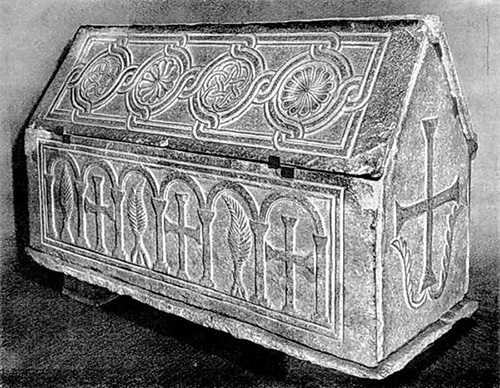 |
|
The slate sarcophagus that is possibly
that of Olga, now held in St Sophia Cathedral, Kyiv
from History of Ukrainian art. Kyiv
vol. 1, p229 (Naukova Dumka, 1966) posted on wikipedia
|
A slate sarcophagus discovered by architect Nikolai Efimov in the Desyatynna
Church (also called the church of the Holy Virgin or the church of
Tithes) in Kiev in 1826 is possibly that of Olga, although this attribution
is subject
to debate amongst historians.
Svyatoslav
Igor
Olga
Unknown
Svyatoslav's wife, and mother of Yarolpols and Oleg, is not named in The Russian Primary Chronicle. Some researchers
have speculated that her name was Predslava
and that she was the daughter of prince Tormas of Hungary.
Malusha
Prince of Kiev, from the death
of his father between 944 and 946, when Sviatoslav was still a minor and his
mother acted as regent, until his own death in 972.
Sviatoslav I, the father of Vladimir the Great, was the last and greatest of
the pagan "Viking" princes of the Rus'. Known as "the Brave," he was a
nomadic warrior-king who spent his entire reign on horseback, expanding the
borders of the Kievan Rus' to their greatest extent while stubbornly
rejecting the Christian faith of his mother, princess Olga. Following his
father’s assassination by the Drevlians, his mother ruled as regent. While
Olga famously converted to Christianity and visited Constantinople,
Sviatoslav remained a devoted follower of Perun, the god of thunder. The Russian Primary Chronicle describes him as a
spartan figure: he traveled without tents or kettles, slept on a
horse-blanket with a saddle for a pillow, and lived on strips of horsemeat
seared on coals.
Sviatoslav’s most significant military achievement was the total
destruction of the Khazar Khaganate, a powerful empire that had dominated
the steppes for centuries. By sacking the capital of Atil and the fortress
of Sarkel, he opened the vast trade routes of the Volga river to the Rus'.
This victory effectively removed a major buffer between the forest-dwellers
of the North and the nomadic tribes of the East. Sviatoslav was so obsessed
with conquest that he attempted to move his capital from Kyiv to
Pereyaslavets on the Danube (in modern-day Bulgaria). This southward
expansion brought him into direct conflict with the Byzantine Empire. The
Byzantine emperor John Tzimiskes viewed Sviatoslav as a "northern barbarian"
threat. After a brutal siege at Dorostolon in 971, Sviatoslav was forced to
surrender his Balkan conquests and swear an oath to return to Kyiv. He never
reached home. While he was navigating the Dnieper River rapids (the
cataracts), he was ambushed by the Pechenegs. According to the chronicles,
the Pecheneg prince Kurya killed Sviatoslav and had his skull fashioned into
a ceremonial drinking cup, gilded with gold and inscribed with the words:
"He who seeks the property of others often loses his own."
Sviatoslav’s reign was a whirlwind of destruction that cleared the
path for the future. By destroying the Khazars, he changed the map of
Eurasia forever. However, his refusal to establish a stable administration
left his sons to inherit a fractured empire in the midst of a bloody civil
war.
The Russian Primary Chronicle - Laurentian Text
pp78-80 (trans. Samuel Hazzard Cross, 1953)
6453
(945). … the Derevlians came forth from the city of Iskorosten’ and slew
Igor’ and his company
… But Olga was in Kiev with her son the boy Svyatoslav. His tutor
was Asmund, and the troop commander was Sveinald, the father of Mstikha.
The Derevlians then said, “See, we have killed the Prince of Rus’. Let
us take his wife Olga for our Prince Mal, and then we shall obtain
possession of Svyatoslav, and work our will upon him.”
… 6454 (946). Olga together with her son Svyatoslav, gathered a large
and valiant army, and proceeded to attack the land of the Derevlians.
The latter came out to meet her troops, and when both forces were ready
for combat, Svyatoslav cast his spear against the Derevlians. But the
spear barely cleared the horse’s ears, and struck against his leg, for
the prince was but a child. Then Sveinald and Asmund said, “The prince
has already begun battle; press on, vassals, after the prince.” Thus
they conquered the Derevlians, with the result that the latter fled, and
shut themselves up in their cities.
Olga hastened with her son to the city of Iskorosten’, for it was
there that her husband had been slain, and they laid siege to the city.
pp83-86
6456-6463 (948-955)
… Now Olga
dwelt with her son Svyatoslav, and she urged him to be baptized, but he
would not listen to her suggestion, though when any man wished to be
baptized, he was not hindered, but only mocked.
… Olga remarked oftentimes, “My son, I have learned to know God, and am
glad for it, If you know him, you too will rejoice.” But he did not heed
her exhortation, answering, “How shall I alone accept another faith? My
followers will laugh at that.” But his mother replied, “If you are
converted, all your subjects will perforce follow your example,”
Svyatoslav did not heed his mother, but followed heathen usages, for he
did not know that whoever does not obey his mother shall come to
distress.
… 6464-6472
(956-964). When Prince Svyatoslav had grown up and matured, he began to
collect a numerous and valiant army. Stepping light as a leopard, he
undertook many campaigns. Upon his expeditions he carried with him
neither wagons nor kettles, and boiled no meat, but cut off small strips
of horseflesh, game, or beef, and ate it after roasting it on the coals.
Nor did he have a tent, but he spread out a horse-blanket under him, and
set his saddle under his head; and all his retinue did likewise. He sent
messengers to the other lands announcing his intention to attack them.
He went to the Oka and the Volga, and on coming in contact with the
Vyatichians, he inquired of them to whom they paid tribute. They made
answer that they paid a silver-piece per ploughshare to the Khazars.
6473 (965). Svyatoslav sallied forth against the Khazars. When
they heard of his approach, they went out to meet him with their Prince,
the Kagan, and the armies came to blows. When the battle thus took
place, Svyatoslav defeated the Khazars and took their city of Bela
Vezha. He also conquered the Yasians and the Kasogians.
6474 (966). Svyatoslav conquered the Vyatichians and made them
his tributaries.
6475 (967). Svyatoslav marched to the Danube to attack the
Bulgarians. When they fought together, Svyatoslav overcame the
Bulgarians, and captured eighty towns along the Danube. He took up his
residence there, and ruled in Pereyaslavets, receiving tribute from the
Greeks.
6476 (968). While Svyatoslav was at Pereyaslavets, the Pechenegs
invaded Rus’ for the first time. So Olga shut herself up in the city of
Kiev with her grandsons, Yaropolk, Oleg, and Vladimir.
… But the people of Kiev sent to Svyatoslav, saying, “Oh Prince, you
visit and frequent foreign lands. But while you neglect your own
country, the Pechenegs have all but taken us captive, along with your
mother and your children as well. Unless you return to protect us, they
will attack us again, if you have no pity on your native land, on your
mother in her old age, and on your children.” When Svyatoslav heard
these words, he quickly bestrode his charger, and returned to Kiev with
his retinue. He kissed his mother and his children, and regretted what
they had suffered at the hands of the Pechenegs. He therefore collected
an army, and drove the Pechenegs out into the steppes. Thus there was
peace.
6477 (969). Svyatoslav announced to his mother and his boyars, “I
do not care to remain in Kiev, but should prefer to live in
Pereyaslavets on the Danube, since that is the centre of my realm, where
all riches are concentrated; gold, silks, wine, and various fruits from
Greece, silver and horses from Hungary and Bohemia, and from Rus’ furs,
wax, honey, and slaves.” But Olga made reply, “You behold me in my
weakness. Why do you desire to depart from me?” For she was already in
precarious health. She thus remonstrated with him and begged him first
to bury her and then to go wheresoever he would. Three days later Olga
died. Her son wept for her with great mourning, as did likewise her
grandsons and all the people.
pp87-90
6478
(970). Svyatoslav set up Yaropolk in Kiev and Oleg in Dereva. At this
time came the people of Novgorod asking for themselves a prince. “If you
will not come to us,” said they, “then we will choose a prince of our
own.” Svyatoslav replied that they had need of a prince, but Yaropolk
and Oleg both refused, so that Dobrÿnya suggested that the post should
be offered to Vladimir. For Vladimir was son of Malusha, stewardess of
Olga and sister of Dobrÿnya. Their father was Malk of Lyubech and
Dobrÿnya was thus Vladimir’s uncle. The citizens of Novgorod thus
requested Svyatoslav to designate Vladimir to be their prince, and he
went forth to Novgorod with Dobrÿnya, his uncle. But Svyatoslav departed
thence to Pereyaslavets.
6479 (971). Svyatoslav arrived before Pereyaslavets, and the
Bulgarians fortified themselves in the city. They made one sally against
Svyatoslav; there was great carnage, and the Bulgarians came off
victors. But Svyatoslav cried to his soldiery, “Here is where we fall!
Let us fight bravely, brothers and companions!” Toward evening,
Svyatoslav finally gained the upper hand, and took the city by storm. He
then sent messages to the Greeks, announcing his intention to march
against them and capture their city, as he had taken Pereyaslavets. The
Greeks replied that they were in no position to offer resistance, and
therefore begged him to accept tribute instead for himself and his
soldiery, requesting him to notify them how many Russes there were, so
that they might pay so much per head. The Greeks made this proposition
to deceive the Russes, for the Greeks are crafty even to the present
day. Svyatoslav replied that his force numbered twenty thousand, adding
ten thousand to the actual number, for there were really but ten
thousand Russes. So the Greeks armed one hundred thousand men to attack
Svyatoslav, and paid no tribute.
Svyatoslav advanced against the Greeks, who came out to meet the
Russes. When the Russes perceived their approach, they were terrified at
the multitude of the Greek soldiery, and Svyatoslav remarked, “Now we
have no place whither we may flee. Whether we will or no, we must give
battle. Let us not disgrace Rus’, but rather sacrifice our lives, lest
we be dishonored. For if we flee, we shall be disgraced. We must not
take to flight, but we will resist boldly, and I will march before you.
If my head falls, then look to yourselves.” Then his warriors replied,
“Wherever your head falls, there we too will lay down our own.” So the
Russes went into battle, and the carnage was great. Svyatoslav came out
victor, but the Greeks fled. Then Svyatoslav advanced toward the capital
fighting as he went, and destroying towns that stand deserted even to
the present time.
The Emperor summoned his boyars to the palace, and inquired what
they should do, for they could not withstand Svyatoslav’s onslaught. The
boyars advised that he should be tempted with gifts, to discover whether
Svyatoslav liked gold and silks. So they sent to Svyatoslav gold and
silks, carried by a clever envoy. To the latter they gave command to
look well upon his eyes, his face, and his spirit. The envoy took the
gifts, and went out to Svyatoslav. It was reported to the Prince that
Greeks had come bringing greetings, and he ordered that they should be
introduced. They then came near and greeted him, laying before him the
gold and the silks. Svyatoslav, without noticing the presents, bade his
servants keep them. So the envoys returned before the Emperor; and the
Emperor summoned his boyars. Then the envoys reported that when they had
come before Svyatoslav and offered their gifts, he had taken no notice
of them, but had ordered them to be retained. Then another courtier
said, “Try him a second time; send him arms.”
This suggestion was adopted, and they sent to Svyatoslav a sword
and other accoutrements which were duly brought before him. The Prince
accepted these gifts, which he praised and admired, and returned his
greetings to the Emperor. The envoys went back to the Emperor and
reported what had occurred. Then the boyars remarked, “This man must be
fierce, since he pays no heed to riches, but accepts arms. Submit to
tribute.” The Emperor accordingly requested Svyatoslav to approach no
nearer, but to accept tribute instead. For Svyatoslav had indeed almost
reached Tsar’grad. So the Greeks paid him tribute, and he took also the
share of those Russes who had been slain, promising that their families
should receive it. He accepted many gifts besides and returned to
Pereyaslavets with great acclaim.
Upon observing the small number of his troops, Svyatoslav
reflected that if haply the Greeks attacked him by surprise, they would
kill his retinue and himself. For many warriors had perished on the
expedition. So he resolved to return to Rus’ for reinforcements. He then
sent envoys to the Emperor in Silistria (for the Emperor was then at
that place) indicating his intention to maintain peaceful and friendly
relations. When the Emperor heard this message, he rejoiced, and sent to
Svyatoslav gifts even more valuable than the former ones. Svyatoslav
accepted these gifts, and on taking counsel with his retinue declared,
“If we do not make peace with the Emperor, and he discovers how few of
us there are, the Greeks will come and besiege us in our city. Rus’ is
far away, and the Pechenegs are hostile to us. So who will give us aid?
Let us rather make peace with the Emperor, for the Greeks have offered
tribute; let that suffice. But if the Emperor stops paying tribute, we
shall once more collect troops in Rus’ in still greater numbers, and
march again on Tsar’grad.” His speech pleased his followers, and they
sent their chief men to the Emperor. The envoys arrived in Silistria,
and reported to the Emperor. He summoned them before him on the
following day, and gave them permission to state their errand. They then
replied, “Thus says our Prince: ‘I desire to maintain true amity with
the Greek Emperor henceforth and forever.’ ” The Emperor rejoiced, and
commanded his scribe to set down on parchment the words of Svyatoslav.
One envoy recited all his words, and the scribe wrote them down. He
spoke as follows:
“This is a copy of the treaty concluded by Svyatoslav, Prince of
Rus’ and by Sveinald, with Johannes surnamed Tzimiskes, written down by
Theophilus the secretary in Silistria during the month of July, in the
year 6479 (971), the fourteenth of the indiction. I, Svyatoslav, Prince
of Rus’, even as I previously swore, now confirm by oath upon this
covenant that I desire to preserve peace and perfect amity with each of
the great Emperors, and particularly with Basil and Constantine, and
with their successors inspired of God, and with all their subjects. In
this resolve concur all Russes under my sway, both boyars, and commons,
forever. I will therefore contemplate no attack upon your territory, nor
will I collect an army or foreign mercenaries for this purpose, nor will
I incite any other foe against your realm or against any territory
pertaining thereto, and particularly the district of Kherson, or the
cities adjacent, or against Bulgaria. But if any foe plans to attack
your realm, I will resist him and wage war upon him. And even as I have
given oath to the Greek Emperors in company with my boyars and all my
subjects, so may we preserve this treaty inviolate. But if we fail in
the observance of any of the aforesaid stipulations, either I or my
companions, or my subjects, may we be accursed of the god in whom we
believe, namely of Perun and Volos, the god of flocks, and we become
yellow as gold, and be slain with our own weapons. Regard as truth what
we have now covenanted with you, even as it is inscribed upon this
parchment and sealed with our seals.”
After making peace with the Greeks, Svyatoslav journeyed by boat
to the cataracts of the Dnieper, and the general, Sveinald, advised him
to ride the falls on horseback, for the Pechenegs were encamped in the
vicinity. The Prince did not heed him, but went on by boat. The people
of Pereyaslavets informed the Pechenegs that Svyatoslav was returning to
Rus’ after seizing from the Greeks great riches and im mense booty, but
that his troop was small. When the Pechenegs heard this news, they
ambuscaded the cataracts, so that when Svyatoslav arrived it was
impossible to pass them. So the Prince decided to winter in Belobereg,
but the Russes had no rations, so that there was a severe famine, and
they paid as much as half a grivna for a horse’s head. But
Svyatoslav wintered there nevertheless.
When spring came in, 6480 (972), Svyatoslav approached the
cataracts, where Kurya, Prince of the Pechenegs, attacked him; and
Svyatoslav was killed. The nomads took his head, and made a cup out of
his skull, overlaying it with gold, and they drank from it. But Sveinald
returned to Yaropolk in Kiev. Now all the years of Svyatoslav’s reign
were twenty eight.
Leo the Deacon's account of Svyatoslav's actions against the Bulgarians in
871, and his subsequent defeat against the Byzantine empire.
Leonis Diaconi Caloënsis Historiae book 9
pp105-111 (ed. Charles Benoît Hase, 1826)
10. Sphendoslabus, Bulgarica victoria elatus, et barbara audacia
magnos spiritus sumens (iam enim firme regionem tenebat), cum timidos
Bulgaros attonitosque insita crudelitate reddidisset (nam, cum
Philippopolim bello cepisset, hominum millia viginti in oppido
comprehensorum crudeliter more barbaro palis suffixisse dicitur,
sicque, quoscunque ad illum diem restitissent, vehementer perculsos in
deditionem accepisse), superba et audacia responsa legatis Romanorum
dedit: „Nunquam fore, ut regione fertili se abstineret, nisi post
grandis pecuniae pensionem, factaque redemtione oppidorum et
captivorum, quotquot bello cepissent. Quam si pecuniam Romani pendere
nollent, quin decederent illico ex Europa, in quam ius haberent
nullum, in Asiam transirent: non aliter sese putare, Russos cum
Romanis pacem facturos.” Ioannes Augustus ubi a Scytha hoc responsum
tulerat, per remissos legatos haec renunciat: „Pacem iam usque a
patrum tempore ad nos perductam, quamque inconcussam interventu suo
Deus conservavit, minime a nobis arbitramur dissolvi debere: quod
credimus providentiam esse cuncta administrantem, quodque
Christianorum statuta profitemur. Quare suademus vobis ut amicis, et
hortamur, e provincia neutiquam ad vos pertinente statim abeatis, sine
ulla mora aut recusatione, persuasissimum habentes, salutari huic
consilio si minus vos obsequentes exhibueritis, non nos, sed
vosmetipsos, turbare pacem antiquitus confectam. Neque arrogantius hoc
nos responsum reddere putandum est. Nam in Christo Deo immortali
futurum esse confidimus, uti, nisi sponte ex regione decedatis, vel
inviti inde a nobis eiiciamini. Nec te oblitum existimo cladis patris
tui Ingoris, qui cum, iuratas pactiones pro nihilo putans, ingenti
apparatu magnaque lintrium vi infesta navigatione petiisset reginam
urbium, ipse domesticae cladis nuncius factus, aegre cum naviculis
decem ad Cimmerium Bosporum est reversus. Praetereo luctuosum eius
interitum, cum bello Germanis illato ab ipsis captus est, ad
arborumque truncos alligatus in duas partes discerptus. Neque teipsum,
si Romanam armaturam contra te proficisci coëgeris, domum reversurum
esse reor, sed in illa ipsa regione una cum omnibus copiis deletum iri
adeo, ut ne una quidem ignifera navis in Scythiam sit elapsura, quae
diros casus vestros nunciet.” Sphendoslabus, stomachatus tali
responso, barbaricoque furore atque insania abreptus, ita respondit:
„Nullam equidem necessitatem video Imperatorem Romanorum cogentem, ut
ad nos veniat; quapropter ne defatigetur, in hanc terram proficiscens:
namque ipsi mox ad Byzantii portas collocabimus tabernacula, munito
vallo urbem cingemus, ipsum erumpentem, si pergit tantae aerumnae
obniti, fortiter excipiemus, factisque ipsis docebimus, non ex faece
sellulariorum manibusque victitantium nos esse, sed viros sanguinis,
armis hostes debellantes; si quidem iste per imprudentiam ex
mulierculis per umbracula latitantibus Russicum robur existimat, utque
lactentes pueros larvis nescio quibus, huiusmodi nos minis terrere
tentet.”
11. Imperator, cum illius tam vesanum responsum auribus
accepisset, intellexit, non cunctandum esse, sed summo studio omnia ad
bellum paranda, ut illius invasionem praeveniret, eique aditum
praecluderet ad reginam urbium. Statim turma generosorum adolescentium
eligitur: hos immortales nominat: ad latus sibi praesto esse iubet …
Russi, novo hoc portentosoque ictu territi ululatu sublato solutis
ordinibus fugae sese mandant. Quos persecuti Romani ad serum usque
crepusculum sine misericordia ceciderunt. Fama est, hoc praelio e
Romanis mortuos esse milites quinque et quinquaginta, sauciatos quam
multos, equorum plerosque confossos: Scytharum plus viginti millia
periisse. Hunc finem habuit Romanorum cum Russis tunc commissa pugna.
This roughly translates as:
10. Sviatoslav,
elated by his Bulgarian victory and assuming great spirits with
barbarian audacity (for he now held the region firmly), since he had
reduced the timid and astonished Bulgarians with his innate cruelty (for
it is said that when he had captured Philippopolis in war, he cruelly
impaled twenty thousand men captured in the town in the barbarian
manner, and thus accepted the surrender of those who had resisted up to
that day, being vehemently struck with terror), gave haughty and
audacious responses to the legates of the Romans: “Never would it be
that he would abstain from the fertile region unless after a payment of
a great sum of money, and the redemption of the towns and captives, as
many as they had captured in war. If the Romans were unwilling to pay
this money, they should depart immediately from Europe, in which they
had no right, and cross over into Asia: not otherwise did he think the
Russians would make peace with the Romans.” When John Augustus had
received this response from the Scythian [Sviatoslav], he sent back this
message through the returning legates: “We think that the peace which
has been brought down to us from the time of our fathers, and which God
has preserved unshaken by his intervention, ought by no means to be
dissolved by us: because we believe it is Providence that administers
all things, and because we profess the statutes of Christians.
Therefore, we advise you as friends, and we exhort you, that you depart
immediately from the province that in no way belongs to you, without any
delay or refusal, being most fully persuaded that if you show yourselves
less compliant with this salutary counsel, it is not we, but you
yourselves, who disturb the ancient peace. Nor should we think that we
are giving this reply more arrogantly. For we trust in Christ God that
it will be so, that unless you voluntarily depart from the region, or
are unwillingly expelled from it by us. Nor do I think you have
forgotten the death of your father Ingor, who, considering sworn
agreements as nothing, had sought the queen of cities with a vast array
and a large force of ships by hostile navigation, when he himself became
the messenger of a domestic disaster, he returned with difficulty with
ten small boats to the Cimmerian Bosporus. I pass over his lamentable
death, when he was captured by the Germans during the war, and tied to
the trunks of trees, was torn in two. Nor do I think that you yourself,
if you force the Roman army to march against you, will return home, but
that you will be destroyed in that very region together with all your
forces, so that not even a single fiery ship will escape to Scythia,
which will announce your dire fate.” Sphendoslabus, disgusted by such an
answer, and carried away by barbaric fury and madness, replied thus: “I
see no necessity compelling the Emperor of the Romans to come to us;
therefore, lest he should be weary, setting out for this land: for we
ourselves will soon pitch our tents at the gates of Byzantium, surround
the city with a fortified rampart, and if he breaks out, if he continues
to resist such hardship, we will bravely receive him, and by our deeds
we will teach him that we are not the dregs of sedentary people and the
hands of conquerors, but men of blood, fighting the enemy with arms; if
indeed he imprudently thinks that Russian strength comes from little
women hiding in the shadows, and tries to terrify us with threats of
this kind, such as those of the infant boys, with masks of I know not
what kind.”
11. The Emperor, when he had heard his so mad answer, understood
that he should not hesitate, but should prepare everything for war with
the utmost diligence, in order to prevent his invasion and prevent his
access to the queen of cities. Immediately a group of noble youths is
chosen: he names them immortals: he orders them to be ready at his side
… [the battle] The Russians, terrified by this new and portentous blow,
howling and breaking ranks, give themselves up to flight. The Romans,
pursuing them until late at nightfall, fell without mercy. It is said
that in this battle fifty-five Roman soldiers died, many were wounded,
and most of the horses were stabbed: more than twenty thousand Scythians
perished. This was the end of the battle that the Romans then engaged in
with the Russians.
Leo the Deacon's first hand account of the meeting between Sviatoslav and
the emperor John Tzimiskes
includes and interesting physical description of Sviatoslav.
Leonis Diaconi Caloënsis Historiae book 9
pp156-7 (ed. Charles Benoît Hase, 1826)
Foedere firmato, Sphendosthlabus in Imperatoris colloquium ut venire
liceret postulavit. Non respuit is conditionem: armatura inaurata
tectus, ad ripam Istri adequitavit, catervam innumerabilem equitum
auro armisque nitentium adducens. Contra Sphendosthlabus processerat
in navicula Scythica flumen devectus, remo se applicans, et ipse cum
caeteris lintrem propellens, ut unus de multis. Specie autem erat
huiusmodi: statura iusta, neque praeter modum in altum expressa, neque
in nimiam brevitatem contracta: superciliis spissis, oculis caesiis,
naso simo, barba rara, praeter labrum superius, densis et in
longitudinem promissis capillis bene pilosum. Capite item erat admodum
glaber; nisi quod ad utrumque latus cincinnus dependebat, nobilitatem
generis declarans, cervicibus firmis, pectore lato, caeteris quoque
membris aequalis sane et congruens; tristitiam nihilominus
feritatemque aliquam ore repraesentabat. Ex altera auricula aurea
dependebat ei inauris, duabus margaritis ornata, carbunculo intermedio
illis interiecto. Veste erat candida, nulla alia re nisi munditia a
caeteris differente. Sic pauca de pace, transtro naviculae insidens,
cum Imperatore collocutus, ad suos se recepit. Bellum quod a Romanis
cum Scythis gestum est, hunc finem habuit.
12. Sphendosthlabus, Dorystolo relicto captivisque insuper ex
foedere redditis, cum copiis quae supererant naves solvit, inque
patriam cursum habere coepit. Enaviganti Patzinacae insidias
posuerunt, gens pastoralis, frequens, pediculivora, domiporta, in
carris plerumque victitans. Hi cum Scythas fere omnes occiderunt, tum
ipsum quoque oppresserunt Sphendosthlabum una cum caeteris, ut ex
tanto Russorum exercitu admodum pauci domum incolumes pervenirent.
This roughly translates as:
Once the treaty
was confirmed, Sviatoslav requested permission to come for a conference
with the Emperor. He [the Emperor] did not reject the condition: covered
in gilded armor, he rode to the bank of the Ister [Danube], leading an
innumerable troop of horsemen shining with gold and arms.
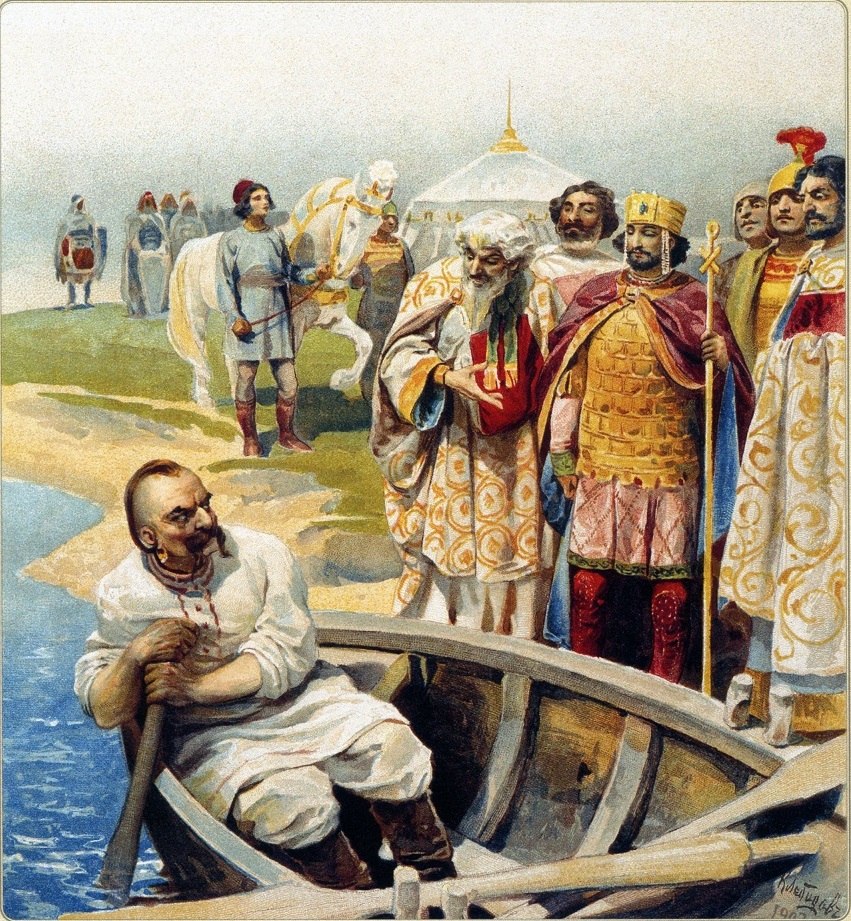 |
Svyatoslav's
meeting with Emperor John, painted by Klavdy
Lebedev based on the description by Leo the Deacon
|
On the other side, Sviatoslav advanced, carried
down the river in a Scythian boat, applying himself to an oar and
propelling the vessel along with the others, just like one of the many.
His appearance was of this kind: of moderate height, neither excessively
tall nor contracted into too much shortness; with thick eyebrows, blue
eyes, a flat nose, and a sparse beard, except for the upper lip, which
was well-covered with thick hair allowed to grow to a great length. His
head was likewise quite bald, except that on each side a lock of hair
hung down, declaring the nobility of his race; his neck was firm, his
chest broad, and his other limbs were indeed well-proportioned and
fitting; nevertheless, his face represented a certain gloom and
ferocity. From one ear hung a golden earring, adorned with two pearls
with a carbuncle [ruby] placed between them. His clothing was white,
differing from the others in no other way except for its cleanliness.
Sitting thus on the rowing bench of the boat, he spoke briefly with the
Emperor about peace and then returned to his own people. The war which
was waged by the Romans [Byzantines] with the Scythians [Rus'] had this
end.
12. Sviatoslav, having left Dorystolon and returned the prisoners
according to the treaty, set sail with the forces that remained and
began his journey to his homeland. As he sailed, the Patzinaks
[Pechenegs], a pastoral people, numerous, lice-eating, carrying their
homes with them, and living mostly in wagons, laid an ambush. These
people killed almost all the Scythians and also overwhelmed Sviatoslav
himself along with the rest, so that from such a great army of Russians,
very few reached home safely.
The Chronicle of John Skylitzes: A Synopsis of
Byzantine History, 811-1057 pp293-294 (trans. John Wortley,
2010)
18.
Sviatoslav had now tried every possible device and had been worsted
every time. Realising there was no hope left for him, he contemplated
coming to terms. He sent a delegation to the emperor asking for
assurance that he could be counted among the allies and friends of the
Romans; that he would be allowed to return in safety to his homeland
with his men and that any Scyth who wished to do so could freely visit
[the empire] for trade purposes. The emperor received the delegation
and, repeating the famous saying that it was the custom of the Romans to
conquer their enemies with alms rather than with arms, agreed to all the
requests.70 When the treaty had been ratified, Sviatoslav
asked also to speak with the emperor and this was agreed to. When he
arrived for the interview they met each other, spoke of whatever they
pleased and then parted.71 The emperor also conceded this at
Sviatoslav’s request: that a delegation be sent to the Patzinaks
inviting them too to become friends and allies; allies who would not
cross the Danube to prey on the Bulgars but who would allow the Russians
to pass through their lands unharmed on their way home. It was
Theophilos, bishop of Euchaita who discharged this mission. When the
Patzinaks received the delegation, they agreed to all the other terms
but they would not allow free passage to the Russians. … When Sviatoslav
was making his way back home, as he passed through the land of the
Patzinaks, he fell into ambushes already prepared to take him.78
He and the entire host that accompanied him were completely annihilated,
so angry were the Patzinaks with him for having made a treaty with the
Romans.
70 Leo the Deacon also attributes the terms of the agreement
between Sviatoslav and Tzimiskes to imperial generosity. In fact, it
looks as though the emperor was not on the point of taking Dristra and
that the better course was negotiation with a view to restoring the
situation that obtained prior to the initiative of Nikephoros Phokas,
especially as this would leave the emperor in control of Bulgaria.
71 That the two men met in person may explain why Leo the
Deacon, ed. Hase, 156-7, depending on official documentation, has left
us an unflattering portrait of the Russian chieftain’s physical
appearance.
78 His skull was made into a drinking cup, a tradition among
nomad peoples.
This excerpt from De Administrando Imperio
("On Administering the Empire"), written in Greek by 10th-century Byzantine
Emperor Constantine
VII Porphyrogenitus, is about trade in monoxyla (dugout canoes), but
serves to document Sviatoslav's father.
Constantine Porphyrogenitus De Administrando Imperio
p57 (trans. Romilly Jenkins, 1967)
The ‘monoxyla’
which come down from outer Russia to Constantinople are from Novgorod,
where Sviatoslav, son of Igor, prince of Russia, had his seat, and
others from the city of Smolensk and from Teliutza and Chernigov and
from Vyshegrad.
972 in the Dnieper
Rapids, Kievan Rus', killed in an ambush
The Russian Primary Chronicle - Laurentian Text
p90 (trans. Samuel Hazzard Cross, 1953)
When spring
came in, 6480 (972), Svyatoslav approached the cataracts, where Kurya,
Prince of the Pechenegs, attacked him; and Svyatoslav was killed. The
nomads took his head, and made a cup out of his skull, overlaying it
with gold, and they drank from it. But Sveinald returned to Yaropolk in
Kiev. Now all the years of Svyatoslav’s reign were twenty eight.
- Constantine Porphyrogenitus De Administrando
Imperio p57 (trans. Romilly Jenkins, 1967); The Russian Primary Chronicle - Laurentian Text
p73 (trans. Samuel Hazzard Cross, 1953); Medieval
Lands (SVIATOSLAV); wikipedia
(Sviatoslav I)
- The Russian Primary Chronicle - Laurentian Text
p78 (trans. Samuel Hazzard Cross, 1953); wikipedia
(Sviatoslav I)
- Medieval
Lands (SVIATOSLAV); wikipedia
(Sviatoslav I)
- The Russian Primary Chronicle - Laurentian Text
p139 (trans. Samuel Hazzard Cross, 1953); Medieval
Lands (SVIATOSLAV); wikipedia
(Sviatoslav I)
- The Russian Primary Chronicle - Laurentian Text
p87 (trans. Samuel Hazzard Cross, 1953); Medieval
Lands (SVIATOSLAV); wikipedia
(Sviatoslav I)
- The Russian Primary Chronicle - Laurentian Text
pp80-90 (trans. Samuel Hazzard Cross, 1953); Leonis Diaconi Caloënsis Historiae book 9
pp156-7 (ed. Charles Benoît Hase, 1826); Medieval
Lands (SVIATOSLAV); wikipedia
(Sviatoslav I)
- The Russian Primary Chronicle - Laurentian Text
pp78-90 (trans. Samuel Hazzard Cross, 1953); Leonis Diaconi Caloënsis Historiae book 9
pp105-111 pp156-7
(ed. Charles Benoît Hase, 1826); The Chronicle of John Skylitzes: A Synopsis of
Byzantine History, 811-1057 pp293-294 (trans. John
Wortley, 2010); Medieval
Lands (SVIATOSLAV); wikipedia
(Sviatoslav I)
- The Russian Primary Chronicle - Laurentian Text
p90 (trans. Samuel Hazzard Cross, 1953); Leonis Diaconi Caloënsis Historiae book 9
p157 (ed. Charles Benoît Hase, 1826); The Chronicle of John Skylitzes: A Synopsis of
Byzantine History, 811-1057 p294 (trans. John Wortley,
2010)
Vladimir I
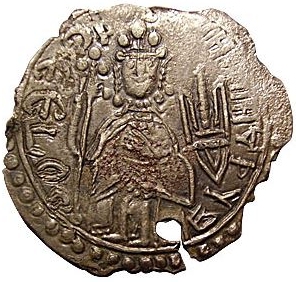 |
Reverse of a silver srebrenik
with an image of Vladimir I, now held in the Odesa Numismatics
Museum. He is crowned in the Byzantine style, holding a
cross-mounted staff in one hand and a trident in the other. photograph by Влад Федченко posted on
wikipedia
|
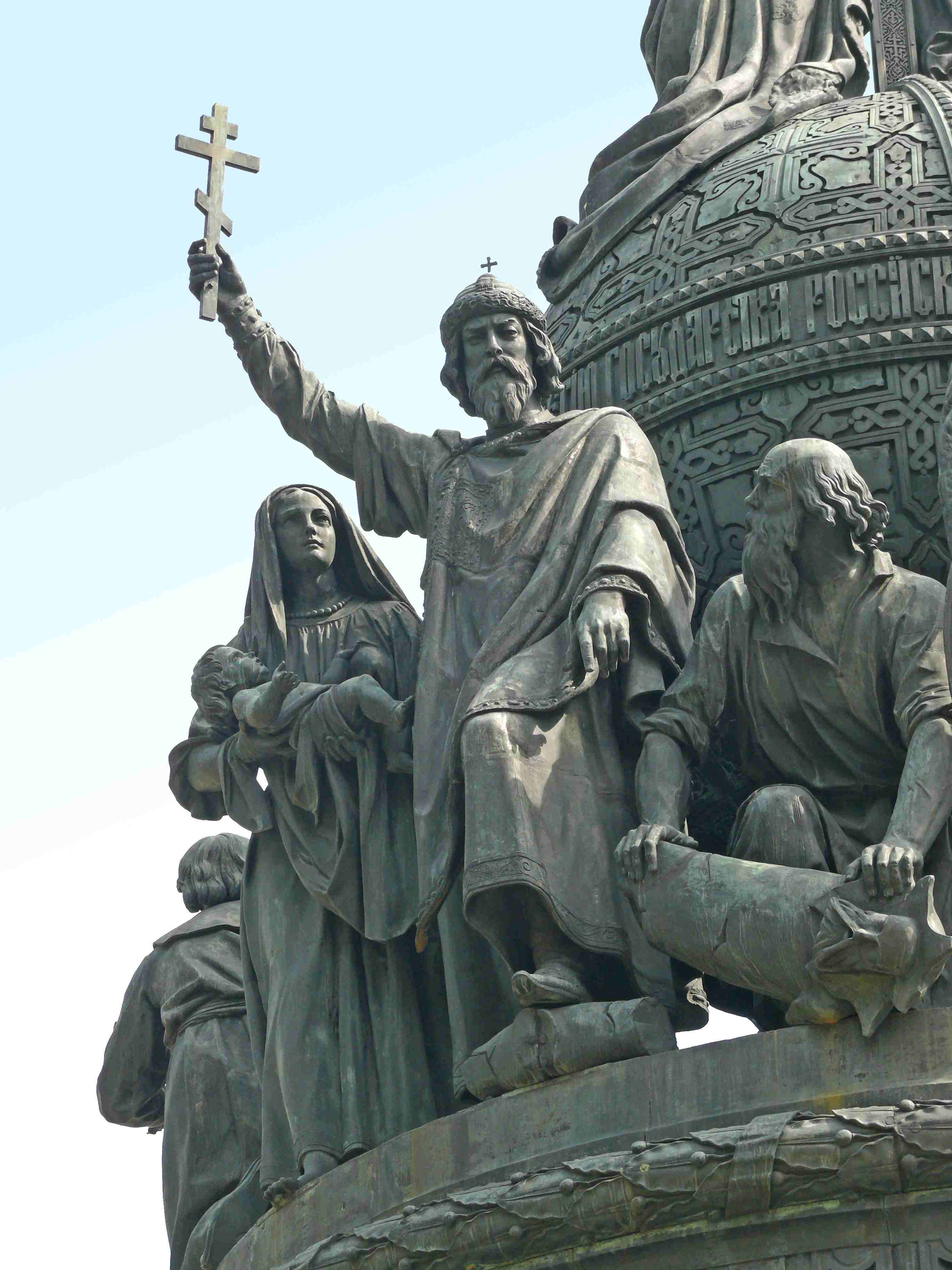 |
|
Statue of Vladimir I on the Monument
"Millennuim of Russia" in Veliky Novgorod
|
Svyatoslav
Malusha
Rogned
in 978
The Russian Primary Chronicle - Laurentian Text
p94 (trans. Samuel Hazzard Cross, 1953)
[Vladimir's]
lawful wife was Rogned whom he settled on the Lÿbed’, where the village
of Predslavino now stands. By her he had four sons: Izyaslav, Mstislav,
Yaroslav, and Vsevolod, and two daughters.
Anna
Porphyrogenita
Anna was born on 13 March 963, the daughter of Byzantine emperor Romanos
II and the empress Theophano.
She was also the sister of emperors Basil
II and Constantine
VIII. She died in Kievan Rus' and was buried in a sarcophagus in Desyatynna
Church (also called the church of the Holy Virgin or the church of
Tithes), Kiev, Kievan Rus'. The Russian Primary Chronicle - Laurentian Text
p124 states that she died between 1008 and 1011, but The Chronicle of John Skylitzes: A Synopsis of
Byzantine History, 811-1057 p347 states that Vladimir
predeceased her.
The Chronicle of John Skylitzes: A Synopsis of
Byzantine History, 811-1057 p319 (trans. John Wortley, 2010)
the emperor
fitted out some ships by night and embarked some Russians in them, for
he had been able to enlist allies among the Russians and he had made
their leader, Vladimir,99 his kinsman by marrying him to his
sister, Anna.100
99
The son of Sviatoslav; he became the master of Russia c. 978 by
eliminating his brothers.
100 The marriage of the princess Anna Porphyrogenita to the
prince of Kiev took place on condition that the bridegroom would accept
baptism. For his part, Vladimir sent his new brother-in-law a contingent
of fighting men, four or six thousand depending on the sources. Much has
been written on this event on account of its connection with the
conversion of Russia: (most recently, with bibliography) Franklin and
Shepard, Rus, 160-3; also V. Vodoff, Naissance de la
chrétienté russe (Paris, 1988), 63-107.
The Russian Primary Chronicle - Laurentian Text
p124 (trans. Samuel Hazzard Cross, 1953)
6516-6519 (1008-1011). The Princess Anna wife of Vladimir passed away.
The Chronicle of John Skylitzes: A Synopsis of
Byzantine History, 811-1057 p347 (trans. John Wortley, 2010)
46.
Anna, the emperor’s sister, died in Russia, predeceased by Vladimir, her
husband.
Vladimir probably had no children with Anna but he did previously have a
number of other children with other women. The Russian Primary Chronicle - Laurentian Text
p94 states that he "had three hundred concubines at Vÿshgorod, three
hundred at Belgorod, and two hundred at Berestovo" and names additional
children by some of his mistresses including the Greek widow of his brother
Yaropolk whom he had murdered - "The Greek woman bore him Svyatopolk: by one
Czech he had a son Vÿsheslav; by another, Svyatoslav and Mstislav; and by a
Bulgarian woman, Boris and Gleb."
- Vÿsheslav, whose mother was a Czech woman
- Svyatopolk
( ? - 1019), whose Greek mother was the widow of Vladimir's brother,
Yoropolk
- Svyatoslav, whose mother was a different Czech woman to Vÿsheslav's
mother
- Boris,
whose other was a Bulgarian woman
- Gleb, who
had the same mother as Boris
- Stanislav
- Pozvizd
- Sudislav
Prince of Novgorod from 970 and
Grand Prince of Kiev from 978 until his death in 1015. The Catholic Church
and the Eastern Orthodox Church both canonised him as Saint Vladimir.
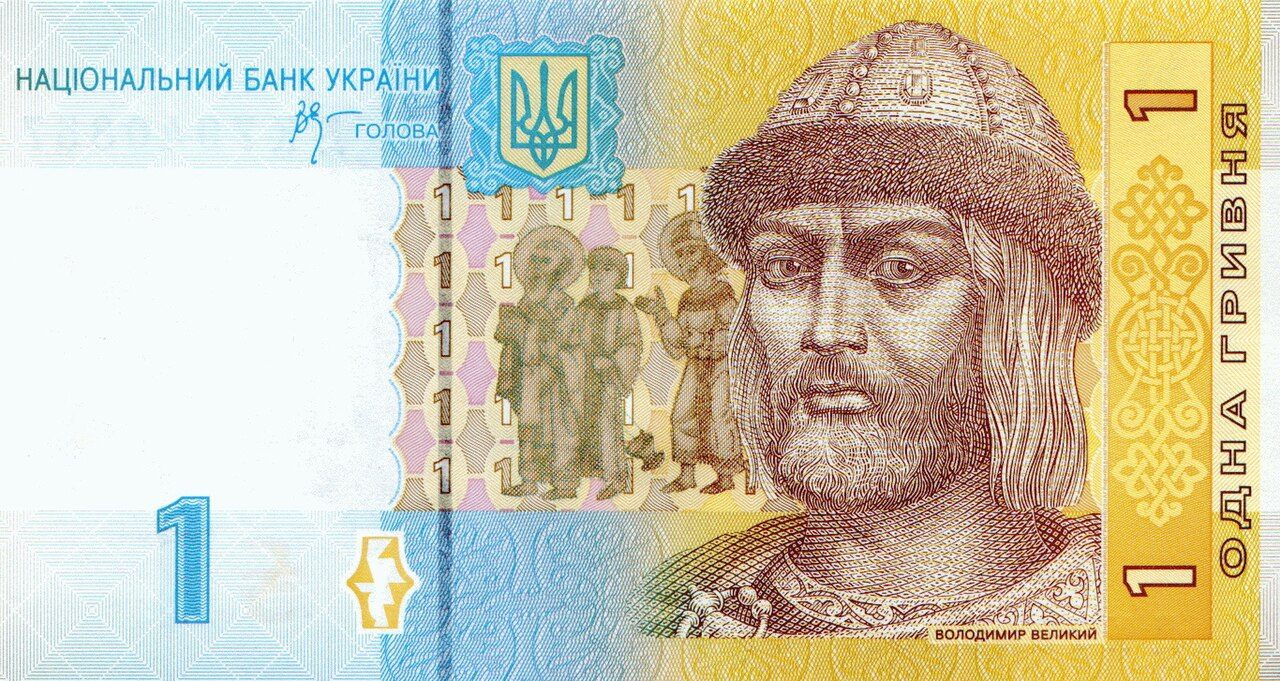 |
|
Ukrainian 1-hryvnia banknote featuring
Vladimir I
|
Vladimir I, known to history as Vladimir the Great, was the
foundational architect of the Kievan Rus'. He transformed a loose collection
of warring pagan tribes into a unified Christian state, effectively bridging
the cultural gap between the Byzantine East and the Latin West. Vladimir was
the youngest son of Sviatoslav I and Malusha, his mother's stewardess.
Because of his low-born mother, he was initially seen as an underdog.
Following his father’s death, a brutal civil war broke out between Vladimir
and his older brothers, Oleg and Yaropolk. Forced to flee to Scandinavia,
Vladimir returned with a massive Varangian (Viking) mercenary army. By 980,
he had defeated his brothers and consolidated power in Kyiv, becoming the
sole Grand Princes. In his early reign, Vladimir was a staunch defender of
Slavic paganism. He famously erected a pantheon of idols on a hill in Kyiv,
dominated by a silver-headed statue of Perun, the god of thunder. Chronicles
from this period paint him as a fierce warrior with an "immense" appetite
for concubines and conquest. The most famous legend of Vladimir’s life is
his "Testing of the Faiths." Dissatisfied with paganism, he reportedly sent
envoys to examine Islam, Judaism, and Western and Eastern Christianity. His
envoys were overwhelmed by the beauty of the Hagia Sophia in Constantinople,
claiming they "did not know if they were in heaven or on earth." Vladimir
demanded the hand of Anna Porphyrogenita, sister of the Byzantine Emperor
Basil II. To marry the princess, Vladimir agreed to be baptized. Following
his baptism in Chersonesus, Vladimir returned to Kyiv and ordered the
dramatic destruction of the idols he had once built. He initiated the
Christianization of Kyiv by ordering the population into the Dnieper River
for mass baptism. He dedicated a tenth of his revenue to building the first
stone church in Kyiv, the Desyatynna Church. He abolished the death penalty
for a time (replacing it with fines) and established schools and charitable
institutions, a radical shift from his "warrior" days. Vladimir died in 1015
at his residence in Berestovo. His death sparked another power struggle
among his many sons, but the Christian foundation he laid remained. He was
buried in a marble sarcophagus in the Church of the Tithes, and he is
venerated as Isapostolos ("Equal to the Apostles") for his role in
bringing the Rus' into the Christian world.
The Russian Primary Chronicle - Laurentian Text
p85 (trans. Samuel Hazzard Cross, 1953)
6476
(968). While Svyatoslav was at Pereyaslavets, the Pechenegs invaded Rus’
for the first time. So Olga shut herself up in the city of Kiev with her
grandsons, Yaropolk, Oleg, and Vladimir.69 The nomads
besieged the city with a great force. They surrounded it with an
innumerable multitude, so that it was impossible to escape or send
messages from the city, and the inhabitants were weak from hunger and
thirst.
… Then their general, Pretich by name, announced, “Tomorrow we shall
approach by boat, and after rescuing the Princess and the young Princes,
we shall fetch them over to this side. If we do not bring this to pass,
Svyatoslav will put us to death.” When it was morning, they embarked
before dawn in their boats, and blew loudly on their trumpets. The
people within the city raised a shout, so that the Pechenegs thought the
Prince himself had returned, and accordingly fled from the city in
various directions. Thus Olga went forth with her grandsons and her
followers to the boats.
69. Vladimir, as the son of Malusha, Olga’s stewardess, was not a
son of the same mother with Yaropolk and Oleg, and there is a good
possibility that Malusha was also Scandinavian; Stender-Petersen, Die
Varägersage, pp. 14-16; cf infra, n. 114.
p87
6478
(970). Svyatoslav set up Yaropolk in Kiev and Oleg in Dereva. At this
time came the people of Novgorod asking for themselves a prince. “If you
will not come to us,” said they, “then we will choose a prince of our
own.” Svyatoslav replied that they had need of a prince, but Yaropolk
and Oleg both refused, so that Dobrÿnya suggested that the post should
be offered to Vladimir. For Vladimir was son of Malusha, stewardess of
Olga and sister of Dobrÿnya. Their father was Malk of Lyubech and
Dobrÿnya was thus Vladimir’s uncle. The citizens of Novgorod thus
requested Svyatoslav to designate Vladimir to be their prince, and he
went forth to Novgorod with Dobrÿnya, his uncle.
pp91-96
6484-6485 (976-977). … When Vladimir in Novgorod heard that Yaropolk had
killed Oleg, he was afraid, and fled abroad. Then Yaropolk sent his
lieutenants to Novgorod and was thus the sole ruler in Rus’.
6486-6488 (978-980). Vladimir returned to Novgorod with Varangian
allies, and instructed the lieutenants of Yaropolk to return to the
latter and inform him that Vladimir was advancing against him prepared
to fight. He remained in Novgorod, and sent word to Rogvolod in Polotsk
that he desired his daughter to wife. Rogvolod inquired of his daughter
whether she wished to marry Vladimir. “I will not,” she replied, “draw
off the boots of a slave’s son, but I want Yaropolk instead.” Now
Rogvolod had come from overseas, and exercised the authority in Polotsk
just as Turÿ, from whom the Turovians get their name, had done in Turov.
The servants of Vladimir returned and reported to him all the words of
Rogned, the daughter of Rogvolod, Prince of Polotsk. Vladimir then
collected a large army, consisting of Varangians, Slavs, Chuds, and
Krivichians, and marched against Rogvolod. At this time the intention
was that Rogned should marry Yaropolk, But Vladimir attacked Polotsk,
killed Rogvolod and his two sons, and after marrying the prince’s
daughter, he proceeded against Yaropolk.
Vladimir came to Kiev with a large force. Yaropolk could not
resist him, but shut himself up in Kiev with his people and with Blud.
Vladimir came to a halt at Dorogozhich, and entrenched himself between
there and Kapich; his earthwork is there to this day. Vladimir then sent
treacherous proposals to Blud, Yaropolk’s general, saying, “Be my
friend; if I kill my brother, I will regard you as my father, and you
shall have much honor from me. It was not I who began to fight with my
brother, but he, and I was for that reason overcome by fear, and
therefore have come out against him.” Blud replied to the messengers of
Vladimir that he would join with him in sincere friendship.
… Blud shut himself up with Yaropolk with the intention of betraying
him, and he sent frequent messages to Vladimir, urging him to storm the
city while he himself planned how he might kill Yaropolk. But on account
of the citizens, it was not possible to kill him. So Blud, not being
able to destroy him thus, contrived it by means of a ruse, while he
urged the prince not to go forth from the city to fight. Thus he
craftily suggested to Yaropolk that the people of Kiev were sending
messages to invite Vladimir to attack the town so that they might be
tray Yaropolk into his hands, and advised him to flee from the city.
Yaropolk heeded his suggestion, and he fled from Vladimir. He then shut
himself up in the city of Rodnya at the mouth of the Ros’, while
Vladimir entered the city of Kiev, and then laid siege to Yaropolk at
Rodnya. There was a great famine there, and we have to this day a
proverb which speaks of famine as in Rodnya.
Blud then said to Yaropolk, “Do you see what a large force your
brother has? We cannot overcome them. Make peace with your brother.” He
spoke thus as he plotted treachery against him. But Yaropolk assented.
Blud then sent world to Vladimir that he would bring Yaropolk before
him, in accordance with his wishes. Vladimir, upon hearing these
tidings, went to his father’s castle with the hall, of which we
previously made mention, and settled there with his retinue. Blud next
induced Yaropolk to appear before his brother and express his readiness
to accept any terms he might offer. Yaropolk thus went in person to
Vladimir, though he had been previously warned by Varyazhko not to go.
“My Prince,” said he, “they will kill you. Flee rather to the Pechenegs
and collect an army.” But the prince heeded him not. Yaropolk came
accordingly before Vladimir, and when he entered the door, two
Varangians stabbed him in the breast with their swords, while Blud shut
the doors and would not allow his men to follow him. Thus Yaropolk was
slain. When Varayazhko saw that Yaropolk was murdered, he fled from the
castle to the Pechenegs, in whose company he fought long against
Vladimir till the latter won him over only with difficulty by means of a
sworn pledge.
Now Vladimir had intercourse with his brother’s wife, a Greek
woman, and she became pregnant and from her was born Svyatopolk. From a
sinful root evil fruit is produced, inasmuch as his mother had been a
nun, and besides Vladimir had intercourse with her without having
married her. Svyatopolk was therefore born in adultery, and for this
reason his father did not love him; for he had two fathers, Yaropolk and
Vladimir.
… Vladimir then began to reign alone in Kiev, and he set up idols
on the hills outside the castle with the hall: one of Perun, made of
wood with a head of silver and a mustache of gold, and others of Khors,
Dazh’bog, Stribog, Simar’gl, and Mokosh. The people sacrificed to them,
calling them gods, and brought their sons and their daughters to
sacrifice them to these devils. They desecrated the earth with their
offerings, and the land of Rus’ and this hill were defiled with blood.
But our gracious God desires not the death of sinners, and upon this
hill now stands a church dedicated to St. Basil, as we shall later
narrate.
But let us return to our subject.
Vladimir had appointed his uncle Dobrÿnya to rule over Novgorod.
When Dobrÿnya came to Novgorod, he set up an idol beside the river
Volkhov, and the people of Novgorod offered sacrifice to it as if to God
himself. Now Vladimir was overcome by lust for women. His lawful wife
was Rogned, whom he settled on the Lÿbedÿ, where the village of
Predslavino now stands. By her he had four sons: Izyaslav, Mstislav,
Yaroslav, and Vsevolod, and two daughters. The Greek woman bore him
Svyatopolk: by one Czech he had a son Vÿsheslav; by another, Svyatoslav
and Mstislav; and by a Bulgarian woman, Boris and Gleb. He had three
hundred concubines at Vÿshgorod, three hundred at Belgorod, and two
hundred at Berestovo in a village still called Berestovoe. He was
insatiable in vice. He even seduced married women and violated young
girls, for he was a libertine like Solomon.
… 6489 (981). Vladimir marched upon the Lyakhs and took their
cities: Peremÿshl, Cherven, and other towns, all of which are subject to
Rus’ even to this day. In the same year, he conquered the Vyatichians,
and imposed upon them tribute according to the number of their ploughs,
just as his father had done.
6490 (982). The Vyatichians went to war, but Vladimir attacked
them and conquered them a second time.
6491 (983). Vladimir marched on the Yatvingians, conquered them
and seized their territory. He returned to Kiev, and together with his
people made sacrifice to the idols. The elders and the boyars then
proposed that they should cast lots for a youth and a maiden, and
sacrifice to the gods whomsoever the lot should fall upon.
… 6492 (984). Vladimir attacked the Radimichians. His general was
named Wolf’s Tail, and Vladimir sent him on ahead. He met the
Radimichians by the river Pishchan’, and overcame them. Therefore the
Russes ridiculed the Radimichians, saying that the men on the Pishchan’
fled in the presence of a wolf’s tail. Now the Radimichians belong to
the race of the Lyakhs. They had come and settled in these regions, and
pay tribute to the Russes, an obligation which they maintain to the
present day.
6493 (985). Accompanied by his uncle Dobrÿnya, Vladimir set out
by boat to attack the Bulgars. He also brought Torks overland on
horseback, and conquered the Bulgars. Dobrÿnya remarked to Vladimir, “I
have seen the prisoners, who all wear boots. They will not pay us
tribute. Let us rather look for foes with bast shoes.” So Vladimir made
peace with the Bulgars, and they confirmed it by oath. The Bulgars
declared, “May peace prevail between us till stone floats and straw
sinks.” Then Vladimir returned to Kiev.
pp111-113
After a
year had passed, in 6496 (988), Vladimir proceeded with an armed force
against Kherson, a Greek city, and the people of Kherson barricaded
themselves therein.94
… He gave orders straightway to dig down above the pipes, and the water
supply was thus cut off. The inhabitants were accordingly overcome by
thirst and surrendered.
Vladimir and his retinue entered the city, and he sent messages
to the Emperors Basil and Constantine, saying, “Behold, I have captured
your glorious city. I have also heard that you have an unwedded sister.
Unless you give her to me to wife, I shall deal with your own city as I
have with Kherson.” When the Emperors heard this message they were
troubled, and replied, “It is not meet for Christians to give in
marriage to pagans. If you are baptized, you shall have her to wife,
inherit the kingdom of God, and be our companion in the faith, Unless
you do so, however, we cannot give you our sister in marriage.” When
Vladimir learned their response, he directed the envoys of the Emperors
to report to the latter that he was willing to accept baptism, having
already given some study to their religion, and that the Greek faith and
ritual, as described by the emissaries sent to examine it, had pleased
him well. When the Emperors heard this report, they rejoiced, and
persuaded their sister Anna to consent to the match. They then requested
Vladimir to submit to baptism before they should send their sister to
him, but Vladimir desired that the Princess should herself bring priests
to baptize him. The Emperors complied with his request, and sent forth
their sister, accompanied by some dignitaries and priests. Anna,
however, departed with reluctance. “It is as if I were setting out into
captivity,” she lamented; “better were it for me to die at home.” But
her brothers protested, “Through your agency God turns the land of Rus’
to repentance, and you will relieve Greece from the danger of grievous
war. Do you not see how much harm the Russes have already brought upon
the Greeks? If you do not set out, they may bring on us the same
misfortunes.” It was thus that they overcame her hesitation only with
great difficulty. The Princess embarked upon a ship, and after tearfully
embracing her kinfolk, she set forth across the sea and arrived at
Kherson. The natives came forth to greet her, and conducted her into the
ctiy, where they settled her in the palace.
By divine agency, Vladimir was suffering at that moment from a
disease of the eyes, and could see nothing, being in great distress. The
Princess declared to him that if he desired to be relieved of this
disease, he should be baptized with all speed, otherwise it could not be
cured. When Vladimir heard her message, he said, “If this proves true,
then of a surety is the God of the Christians great,” and gave order
that he should be baptized. The Bishop of Kherson, together with the
Princess’s priests, after announcing the tidings, baptized Vladimir, and
as the Bishop laid his hand upon him, he straightway received his sight.
Upon experiencing this miraculous cure, Vladimir glorified God, saying,
“I have now perceived the one true God.” When his followers beheld this
miracle, many of them were also baptized.
Vladimir was baptized in the Church of St. Basil, which stands at
Kherson upon a square in the center of the city where the Khersonians
trade. The palace of Vladimir stands beside this church to this day, and
the palace of the Princess is behind the altar. After his baptism
Vladimir took the Princess in marriage. Those who do not know the truth
say he was baptized in Kiev, while others assert this event took place
in Vasil’ev, while still others mention other places.
94. Kherson (Gk. Chersonesus; Old R. Korsun’), on the Crimean
coast facing north at a point some three kilometers west of modern
Sebastopol, and founded as colony of Heraclea Pontica (hence Dorian)
about the fifth century B.C.
pp116-117
As a wedding
present for the Princess, he gave Kherson over to the Greeks again, and
then departed for Kiev.
When the Prince arrived at his capital, he directed that the
idols should be overthrown, and that some should be cut to pieces and
others burned with fire. He thus ordered that Perun should be bound to a
horse’s tail and dragged down Borichev to the stream.
… Thereafter Vladimir sent heralds throughout the whole city to
proclaim that if any inhabitants, rich or poor, did not betake himself
to the river, he would risk the Prince’s displeasure. When the people
heard these words, they wept for joy, and exclaimed in their enthusiasm,
“If this were not good, the Prince and his boyars would not have
accepted it.” On the morrow, the Prince went forth to the Dnieper with
the priests of the Princess and those from Kherson, and a countless
multitude assembled. They all went into the water: some stood up to
their necks, others to their breasts, and the younger near the bank,
some of them holding children in their arms, while the adults waded
farther out. The priests stood by and offered prayers.
… he ordained that wooden churches should be built and established where
pagan idols had previously stood. He thus founded the Church of St.
Basil on the hill where the idol of Perun and the other images had been
set, and where the Prince and the people had offered their sacrifices.
He began to found churches and to assign priests throughout the cities,
and to invite the people to accept baptism in all the cities and towns.
p119
Vladimir
was enlightened, and his sons and his country with him. For he had
twelve sons: Vÿsheslav, Izyaslav, Yaroslav, Svyatopolk, Vsevolod,
Svyatoslav, Mstislav, Boris, Gleb, Stanislav, Pozvizd, and Sudislav. He
set Vÿsheslav in Novgorod, Izyaslav in Polotsk, Svyatopolk in Turov, and
Yaroslav in Rostov. When Vÿsheslav, the oldest, died in Novgorod, he set
Yaroslav over Novgorod, Boris over Rostov, Gleb over Murom, Svyatoslav
over Dereva, Vsevolod over Vladimir, and Mstislav over Tmutorakan. Then
Vladimir reflected that it was not good that there were so few towns
round about Kiev, so he founded forts on the Desna, the Oster’, the
Trubezh, the Sula, and the Stugna. He gathered together the best men of
the Slavs, and Krivichians, the Chuds, and the Vyatichians, and peopled
these forts with them. For he was at war with the Pechenegs, and when he
fought with them he often overcame them.
6497 (989). After these events, Vladimir lived in the Christian
faith. With the intention of building a church dedicated to the Holy
Virgin, he sent and imported artisans from Greece. After he had begun to
build, and the structure was completed, he adorned it with images, and
entrusted it to Anastasius of Kherson. He appointed Khersonian priests
to serve in it, and bestowed upon this church all the images, vessels,
and crosses which he had taken in that city.
6499 (991). Vladimir founded the city of Belgorod, and peopled it
from other towns, bringing to it many settlers. For he was extremely
fond of this city.
p124
6520-6522 (1012-1014). When Yaroslav was in Novgorod, he paid two
thousand grivnÿ a year as tribute to Kiev, and another thousand
was given to his garrison in Novgorod. All the lieutenants of Novgorod
had always paid like sums, but Yaroslav ceased to render this amount to
his father. Then Vladimir exclaimed, “Repair roads and build bridges,”
for he proposed to attack his son Yaroslav, but he fell ill.
6523 (1015). While Vladimir was desirous of attacking Yaroslav,
the latter sent overseas and imported Varangian reinforcements, since he
feared his father’s advance. But God will not give the devil any
satisfaction. For when Vladimir fell ill, Boris was with him at the
time. Since the Pechenegs were attacking the Russes, he sent Boris out
against them, for he himself was very sick, and of this illness he died
on July 15. Now he died at Berestovo, but his death was kept secret, for
Svyatopolk was in Kiev. But at night his companions took up the flooring
between two rooms, and after wrapping the body in a rug, they let it
down to the earth with ropes, After they had placed it upon a sledge,
they took it away and laid it in the Church of the Virgin that Vladimir
himself had built.
When the people heard of this, they assembled in multitude and
mourned him, the boyars as the defender of their country, the poor as
their protector and benefactor. They placed him in a marble coffin, and
buried the body of the sainted Prince amid their mourning.
Thietmari
Chronicon Liber VII in Monumenta
Germaniæ Historica SS 3 p859 (ed. G. H. Pertz, 1851)
52. Amplius progrediar disputando, regisque Ruscorum Wlodemiri
accionem, iniqnam perstringendo. Hic a Grecia ducens uxorem, Helenam
nomine, tertio Ottoni desponsatam, sed ei fraudulenta calliditate
subtractam, christianitatis sanctae fidem eius ortatu suscepit, quam
iustis operibus non ornavit. Erat enim fornicator immensus et
crudelis, magnamque vim Danais mollibus ingessit. Hic tres habens
filios, uni eorum Bolizlavi ducis nostrique persecutoris filiam in
matrimonium duxit, cum qua missus est a Polenis Reinbernus, presul
Salsae Cholbergiensis.
This roughly translates as:
52. I
shall proceed further in my discourse, briefly touching upon the wicked
action of the king of the Rus, Vladimir. This man, taking a wife from
Greece [Byzantium], Helena by name, who had been betrothed to Otto III
but was withdrawn from him by fraudulent cunning, received at her urging
the faith of holy Christianity, which he did not adorn with just works.
For he was an immense and cruel fornicator, and he inflicted great
violence upon the soft Greeks. This man, having three sons, gave the
daughter of the duke Bolesław, our persecutor, in marriage to one of
them; with her was sent by the Poles Reinbern, prelate of Salz-Kolberg.
The Encyclopaedia Britannica 11th edition vol
28 p168 (ed. Hugh Chisholm, 1911)
VLADIMIR,
ST (c. 956-1015), grand duke of Kiev and of all Russia, was
the youngest son of Svyatoslav I. and his mistress Malushka. In 970 he
received Great Novgorod as his apanage. On the death of Svyatoslav in
972, a long civil war took place between his sons Yaropolk and Oleg, in
which Vladimir was involved. From 977 to 984 he was in Scandinavia,
collecting as many of the viking warriors as he could to assist him to
recover Novgorod, and on his return marched against Yaropolk. On his way
to Kiev he sent ambassadors to Ragvald, prince of Polotsk, to sue for
the hand of his daughter Ragnilda. The haughty princess refused to
affiance herself to “the son of a bondswoman,” but Vladimir attacked
Polotsk, slew Ragvald, and took Ragnilda by force. Subsequently (980) he
captured Kiev also, slew Yaropolk by treachery, and was proclaimed
prince of all Russia. In 981 he conquered the Chervensk cities, the
modern Galicia; in 983 he subdued the heathen Yatvyags, whose
territories lay between Lithuania and Poland; in 985 he led a
fleet along the central rivers of Russia to conquer the Bulgarians of
the Kama, planting numerous fortresses and colonies on his way. At this
time Vladimir was a thoroughgoing pagan. He increased the number of the
trebishcha, or heathen temples; offered up Christians (Theodore
and Ivan, the proto-martyrs of the Russian Church) on his altars; had
eight hundred concubines, besides numerous wives; and spent his whole
leisure in feasting and hunting. He also formed a great council out of
his boyars, and set his twelve sons over his subject principalities. In
the year 987, as the result of a consultation with his boyars, Vladimir
sent envoys to study the religions of the various neighbouring nations
whose representatives had been urging him to embrace their respective
faiths. The result is amusingly described by the chronicler Nestor. Of
the Mussulman Bulgarians of the Volga the envoys reported “there is no
gladness among them; only sorrow and a great stench; their religion is
not a good one.” In the temples of the Germans they saw “no beauty”; but
at Constantinople, where the full festival ritual of the Orthodox Church
was set in motion to impress them, they found their ideal. “We no longer
knew whether we were in heaven or on earth, nor such beauty, and we know
not how to tell of it.” If Vladimir was impressed by this account of his
envoys, he was yet more so by the offer of the emperor Basil II. to give
him his sister Anna in marriage. In 988 he was baptized at Kherson in
the Crimea, taking the Christian name of Basil out of compliment to his
imperial brother-in-law; the sacrament was followed by his marriage with
the Roman princess. Returning to Kiev in triumph, he converted his
people to the new faith with no apparent difficulty. Crypto-Christians
had been numerous in Kiev for some time before the public recognition of
the Orthodox faith. The remainder of the reign of Vladimir was devoted
to good works. He founded numerous churches, including the splendid Desyatinnuy
Sobor or “Cathedral of the Tithes” (989), established schools,
protected the poor and introduced ecclesiastical courts. With his
neighbours he lived at peace, the incursions of the savage Petchenegs
alone disturbing his tranquillity. His nephew Svyatpolk, son of his
brother and victim Yaropolk, he married to the daughter of Boleslaus of
Poland. He died at Berestova, near Kiev, while on his way to chastise
the insolence of his son, Prince Yaroslav of Novgorod. The various parts
of his dismembered body were distributed among his numerous sacred
foundations and were venerated as relics. The university of Kiev has
rightly been named after the man who both civilized and Christianized
ancient Russia. His memory was also kept alive by innumerable folk
ballads and legends. With him the Varangian period of Russian history
ceases and the Christian period begins.
See Memorials (Rus.) published by the Commission for the
examination of ancient documents (Kiev, 1881, &c.); I. Komanin and
M. Istomin, Collection of Historical Materials (Rus.) (Kiev,
1890, &c.); O. Partitsky, Scandinavianism in Ancient Russia
(Rus.) (Lemberg, 1897); A. Lappo-Danilevsky, Scythian Antiquities
(Rus.) (Petersburg, 1887); J. Macquart, Osteuropäische u.
ostasiatische Streifzüge (Leipzig, 1903); L. C. Goetz, Das
Kiever Höhlenkloster als Kulturzentrum des vormongolischen Russlands
(Passau, 1904). (R. N. B.)
Butler’s Lives of the saints vol 3 pp110-111
(ed. Herbert Thurston, 1962)
July
15.
ST VLADIMIR OF KIEV (A.D.
1015)
The earliest saints of Russia, princes and monks, were connected
with Kiev in the south-west, “the God-protected mother of Russian
cities”, now the capital of what we call The Ukraine and in those days
centre of a principality whose Finnish-SIav people were ruled by princes
of Scandinavian origin, Varangians, who as pirates and traders had
penetrated into Russia by its waterways. During the last quarter of the
tenth century the grand-prince of Kiev was Vladimir, a man not only
reared in idolatry but one who freely indulged in the barbarous excesses
that were available to one in his position: he was brutal and
bloodthirsty, and a contemporary Arabian chronicler, ibn-Foslan,
comments on his five wives and numerous female slaves, which supports
the statement of the Chronicle of Nestor that Vladimir’s “desire for
women was too much for him”. The circumstances of this prince’s
conversion to Christianity have been and still are much debated, but
converted he was, probably in the year 989, when he was about
thirty-two; and he then received in marriage Anne, daughter of the
emperor Basil II at Constantinople—the two events were closely
connected. And the conversion of the Russian people is dated from then.
The fact that pious writers have attributed perfect purity of
motive to Vladimir, when undoubtedly he was moved in great measure by
the prospect of political and economic advantages from an alliance with
the Byzantines and the Christian Church, must not be allowed to obscure
that, once having accepted Christianity, he is said to have been
wholehearted in his adherence to it. He put away his former wives and
mistresses and amended his life; he had idols publicly thrown down and
destroyed; and he supported the Greek missionaries with energy and
enthusiasm—indeed, with an excess of energy, for at times he did not
stop short of “conversion” by force: to refuse baptism was to incur
penalties. But quite apart from that sort of thing, the speed with which
the Russians became Christian has been much exaggerated, and during the
reign of Vladimir the new religion probably did not penetrate far beyond
the Kievan nobility and wealthy merchants. Nor was its subsequent
spreading so fast as has been represented: paganism gave ground but
slowly. Nevertheless he was revered in after years not only because he
was a sinner who repented but because he brought about the
reconciliation of the Russian people with God, he was the Apostle of
Russia, chosen from on high for that end.
“The Devil was overcome by fools and madmen”, says the Chronicle
of Nestor, and emphasizes that St Vladimir received God’s grace and
forgiveness, while “many righteous and godly men strayed from the path
of uprightness and perished”. And it would seem that his repentance and
understanding of his new obligations were of that simple,
straightforward kind which will forever remain at the heart of the most
developed and complex Christianity: “When he had in a moment of passion
fallen into sin he at once sought to make up for it by penitence and
almsgiving”, says a chronicler. It is said that he even had scruples
whether, now that he was a Christian, he was entitled to punish robbers
or even murderers by putting them to death. Such ideas astonished the
sophisticated Greek ecclesiastics, who appealed to examples in the Old
Testament and Roman history to show that punishment of the wicked was
the duty of a Christian prince. But Vladimir seems to have been only
half convinced.
The circumstances of Vladimir’s conversion brought his people
within the Byzantine patriarchate, but he was not particularist. He
exchanged ambassadors with the apostolic court of Rome; he helped the
German bishop St Boniface (Bruno) of Querfurt in his mission to the
Pechenegs; and he even borrowed certain canonical features from the
West, notably the institution of tithes, which were unknown to the
Byzantines. Not till the Mongol invasions was Christian Russia cut off
from the West.
St Vladimir died in 1015, after, as is said, giving away all his
personal belongings to his friends and to the poor. His feast is
solemnly celebrated by the Russians, Ukrainians and others.
The original Russian sources are indicated in some detail in the
bibliography of vol. iv of the Cambridge Medieval History, pp.
819-821. The Chronicle of Nestor has been translated by S. H. Cross, The
Russian Primary Chronicle (1930). See N. de Baumgarten, Orientalia
Christiana, vol. xxiv, no. i, 1931 (Olaf Tryggwison …) and
vol. xxvii, no. i, 1932 (St Vladimir …); G. Fedotov, “Le baptême
de St. Vladimir …” in Irénikon, t. xv (1938), pp. 417 seq,;
M. Jugie, “Les origines romaines de l’Église russe” in Échos
d’Orient, no. 187 (1937). Summaries in Fliche and Martin, Histoire
de l’Église, vol. vii, pp. 444-451, and DTC., s.v. Russie. For
Christians before Vladimir, see also M. de Taube, Rome et la Russie
…, vol. i (1947). And see F. Dvornik, The Making of Central and
Eastern Europe (1949), pp. 170 seq.
15 July 1015 in Berestovo, Kievan
Rus'
Desyatynna
Church (also called the church of the Holy Virgin or the church of
Tithes), Kiev, Kievan Rus'
The Russian Primary Chronicle - Laurentian Text
p124 (trans. Samuel Hazzard Cross, 1953)
6523
(1015). … For when Vladimir fell ill, Boris was with him at the time.
Since the Pechenegs were attacking the Russes, he sent Boris out against
them, for he himself was very sick, and of this illness he died on July
15. Now he died at Berestovo, but his death was kept secret, for
Svyatopolk was in Kiev. But at night his companions took up the flooring
between two rooms, and after wrapping the body in a rug, they let it
down to the earth with ropes, After they had placed it upon a sledge,
they took it away and laid it in the Church of the Virgin that Vladimir
himself had built.
When the people heard of this, they assembled in multitude and
mourned him, the boyars as the defender of their country, the poor as
their protector and benefactor. They placed him in a marble coffin, and
buried the body of the sainted Prince amid their mourning
The Desyatynna Church was destroyed in a Mongol invasion in 1240, burying
Vladimir’s marble tomb under mounds of rubble. In 1635, the Metropolitan of
Kyiv, Peter Mohyla, excavated the ruins. He claimed to have found two
sarcophagi: one believed to be that of Princess Anna and the other
containing the remains of Vladimir. Only his head and the right hand were
found in the grave and what happened to the rest of the body is unknown.
Later the head of the prince was placed in the main temple of the Kiev
Pechersk Lavra, and his hand in the Kiev Sophia Cathedral and other parts
are in the Assumption Cathedral in Moscow. However, modern researchers
question the authenticity of these relics.
- The Russian Primary Chronicle - Laurentian Text
p85 (trans. Samuel Hazzard Cross, 1953); Medieval
Lands (VLADIMIR Sviatoslavich); wikipedia
(Vladimir the Great)
- The Russian Primary Chronicle - Laurentian Text
p87 (trans. Samuel Hazzard Cross, 1953); Medieval
Lands (VLADIMIR Sviatoslavich); wikipedia
(Vladimir the Great)
- The Russian Primary Chronicle - Laurentian Text
p91
p94 (trans. Samuel Hazzard Cross, 1953) - although the Chronicle
dates this event only to 978-980, see note 74 (p242)
that Vladimir's subsequent entry to Kiev has been dated from other
sources to 11 June 978; The Encyclopaedia Britannica 11th edition vol
28 p168 (ed. Hugh Chisholm, 1911); Medieval
Lands (VLADIMIR Sviatoslavich); wikipedia
(Vladimir the Great)
- The Russian Primary Chronicle - Laurentian Text
p94 (trans. Samuel Hazzard Cross, 1953); Medieval
Lands (VLADIMIR Sviatoslavich); wikipedia
(Vladimir the Great)
- The Russian Primary Chronicle - Laurentian Text
pp111-113 (trans. Samuel Hazzard Cross, 1953); The Chronicle of John Skylitzes: A Synopsis of
Byzantine History, 811-1057 p319 (trans. John Wortley,
2010); Medieval
Lands (VLADIMIR Sviatoslavich); wikipedia
(Vladimir the Great); Anna birth, parents from The Chronicle of John Skylitzes: A Synopsis of
Byzantine History, 811-1057 p245 (trans. John Wortley,
2010); Anna death from The Russian Primary Chronicle - Laurentian Text
p124 (trans. Samuel Hazzard Cross, 1953) and The Chronicle of John Skylitzes: A Synopsis of
Byzantine History, 811-1057 p347 (trans. John Wortley,
2010); Anna burial from wikipedia
(Anna Porphyrogenita)
- The Russian Primary Chronicle - Laurentian Text
p94, p119
(trans. Samuel Hazzard Cross, 1953); Medieval
Lands (VLADIMIR Sviatoslavich); wikipedia
(Vladimir the Great)
- The Russian Primary Chronicle - Laurentian Text
pp87-124 (trans. Samuel Hazzard Cross, 1953); Medieval
Lands (VLADIMIR Sviatoslavich); wikipedia
(Vladimir the Great)
- The Russian Primary Chronicle - Laurentian Text
pp85-124 (trans. Samuel Hazzard Cross, 1953); Thietmari Chronicon Liber VII in Monumenta
Germaniæ Historica SS 3 p859 (ed. G. H. Pertz,
1851); The Encyclopaedia Britannica 11th edition vol
28 p168 (ed. Hugh Chisholm, 1911); Butler’s Lives of the saints vol 3
pp110-111 (ed. Herbert Thurston, 1962); "Pagan
into Saint" in the New York Times 13
April 1986 section 7 p26; Medieval
Lands (VLADIMIR Sviatoslavich); wikipedia
(Vladimir the Great)
- The Russian Primary Chronicle - Laurentian Text
p124 (trans. Samuel Hazzard Cross, 1953)
- The Russian Primary Chronicle - Laurentian Text
p124 (trans. Samuel Hazzard Cross, 1953); wikipedia
(Vladimir the Great); Secrets
of Prince Vladimir of Kiev
Yaroslav I "the Wise"
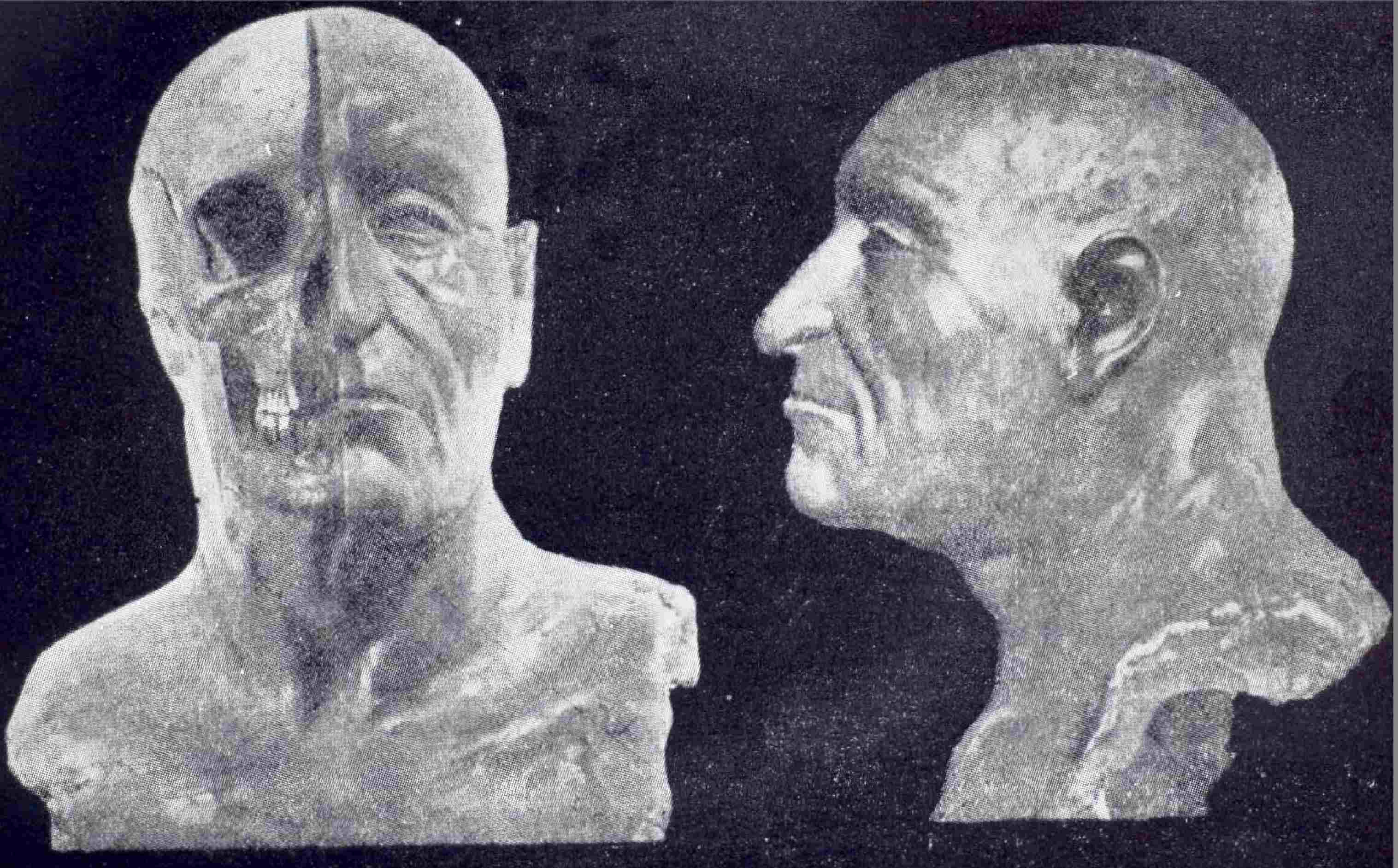 |
Facial reconstruction of Yaroslav the Wise
made by Mikhail
Gerasimov using a mould of the now-lost skull, 1940 |
Vladimir I
Rogned
The Russian Primary Chronicle - Laurentian Text
p94 (trans. Samuel Hazzard Cross, 1953)
[Vladimir's]
lawful wife was Rogned whom he settled on the Lÿbed’, where the village
of Predslavino now stands. By her he had four sons: Izyaslav, Mstislav,
Yaroslav, and Vsevolod, and two daughters.
Ingegerd in 1019
Grand Prince of Kiev from
1016-1018, and from 1018 until his death in 1054. He was previously prince
of Rostov from 988 to 1010 and then prince of Novgorod from 1010 until 1034.
Yaroslav I, better known as Yaroslav the Wise (c. 978–1054), was the
Grand Prince of Kyiv during the "Golden Age" of Kyivan Rus'. He is
remembered as a brilliant diplomat, a pioneer of law, and a prolific builder
who transformed Kyiv into one of Europe’s most magnificent cities. Yaroslav
was one of the many sons of Volodymyr the Great (the ruler who Christianized
Rus'). After his father's death in 1015, a bloody fratricidal war broke out.
Yaroslav, then ruling from Novgorod, eventually defeated his brother
Svyatopolk "the Accursed" to take the throne in Kyiv in 1019. Among his
achievements were that he codified the Russkaya Pravda, the first formal
legal system for the East Slavic people. It replaced blood feuds with
financial fines and established a structured social order. To rival the
beauty of Constantinople, Yaroslav built the Saint Sophia Cathedral in Kyiv
and the Golden Gate, which served as the city's main ceremonial entrance. He
was a scholar who spoke several languages, established the first library in
Kievan Rus' and promoted the translation of Greek religious texts into Old
Church Slavonic.
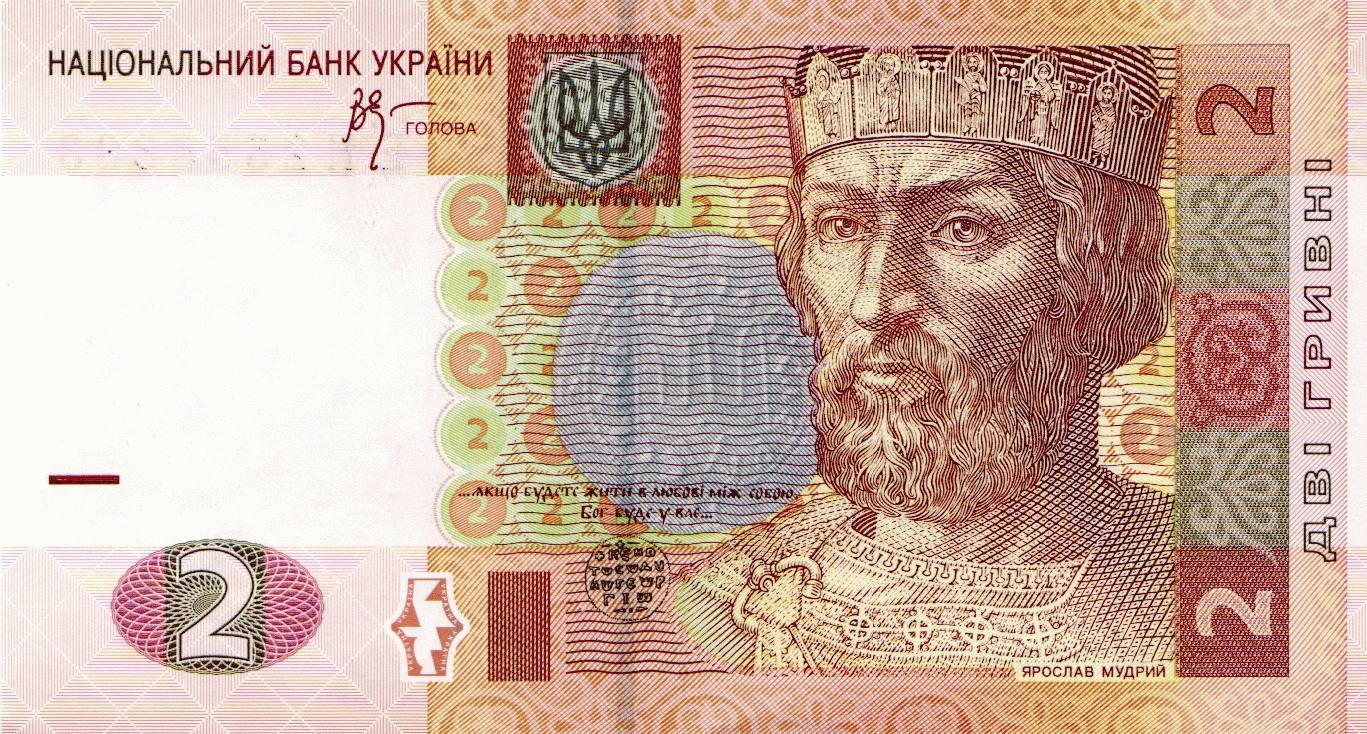 |
|
Ukrainian 2-hryvnia banknote featuring
Yaroslav the Wise
|
Yaroslav used strategic marriages to cement alliances with powerful European
dynasties. His daughters and sons married into the royal houses of France,
Hungary, Norway, and Byzantium. His daughter Anna of Kyiv famously became
the queen of France. Yaroslav died in 1054 and was buried in a white marble
sarcophagus in Saint Sophia Cathedral. He left behind a prosperous,
literate, and powerful state. Today, his image appears on the Ukrainian
2-hryvnia bill, and he remains a foundational figure in the national
histories of both Ukraine and Russia.
In addition to his translation of the Russian
Primary Chronicle, Samuel Hazzard Cross wrote a paper of Yaroslav
titled "Yaroslav the Wise in Norse Tradition", published in Speculum vol 4 pp 149-247 (April 1929).
The Russian Primary Chronicle - Laurentian Text
p119 (trans. Samuel Hazzard Cross, 1953)
Vladimir
was enlightened, and his sons and his country with him. For he had
twelve sons: Vÿsheslav, Izyaslav, Yaroslav, Svyatopolk, Vsevolod,
Svyatoslav, Mstislav, Boris, Gleb, Stanislav, Pozvizd, and Sudislav. He
set Vÿsheslav in Novgorod, Izyaslav in Polotsk, Svyatopolk in Turov, and
Yaroslav in Rostov. When Vÿsheslav, the oldest, died in Novgorod, he set
Yaroslav over Novgorod, Boris over Rostov, Gleb over Murom, Svyatoslav
over Dereva, Vsevolod over Vladimir, and Mstislav over Tmutorakan.
p124
6520-6522 (1012-1014). When Yaroslav was in Novgorod, he paid two
thousand grivnÿ a year as tribute to Kiev, and another thousand
was given to his garrison in Novgorod. All the lieutenants of Novgorod
had always paid like sums, but Yaroslav ceased to render this amount to
his father. Then Vladimir exclaimed, “Repair roads and build bridges,”
for he proposed to attack his son Yaroslav, but he fell ill.
6523 (1015). While Vladimir was desirous of attacking Yaroslav,
the latter sent overseas and imported Varangian reinforcements, since he
feared his father’s advance.
pp130-133
While
Yaroslav had not yet heard of his father’s death, he had many Varangians
under his command, and they offered violence to the inhabitants of
Novgorod and to their wives. The men of Novgorod then rose and killed
the Varangians in their market place. Yaroslav was angry, and departing
to Rakom, he took up his abode in the castle. Then he sent messengers to
Novgorod with the comment that the death of his retainers was beyond
remedy, but at the same time he summoned before him the chief men of the
city who had massacred the Varangians, and craftily killed them. The
same night news came from Kiev sent by his sister Predslava to the
effect that his father was dead, that Svyatopolk had settled in Kiev
after killing Boris, and was now endeavoring to compass the death of
Gleb, and she warned Yaroslav to be exceedingly on his guard against
Svyatopolk. When Yaroslav heard these tidings, he grieved for his father
and his retainers.
On the morrow he collected the remnant of the men of Novgorod and
regretfully lamented, “Alas for my beloved retainers, whom I yesterday
caused to be killed! You would indeed be useful in the present crisis.”
He wiped away his tears, and informed his subjects in the assembly that
his father was dead, and that Svyatopolk had settled in Kiev after
killing his brethren. Then the men of Novgorod said, “We can still fight
for you, oh Prince, even though our brethren are slain.” So Yaroslav
collected one thousand Varangians and forty thousand other soldiers, and
marched against Svyatopolk. He called on God as his witness and
protested, “It was not I who began to kill our brethren, but Svyatopolk
himself. May God be the avenger of the blood of my brothers inasmuch as
Svyatopolk, despite their innocence, has shed the just blood of Boris
and Gleb. Perhaps he will even visit the same fate upon me. But judge
me, oh Lord, according to the right, that the malice of the sinful may
end.” So he marched against Svyatopolk. When Svyatopolk learned that
Yaroslav was on his way, he prepared an innumerable army of Russes and
Pechenegs, and marched out toward Lyubech on one side of the Dnieper,
while Yaroslav was on the opposite bank.
6524 (1016). The beginning of the principate of Yaroslav at Kiev.
Yaroslav arrived and the brothers stood over against each other on both
banks on the Dnieper, but neither party dared attack. They remained thus
face to face for three months. Then Svyatopolk’s general rode out along
the shore and scoffed at the men of Novgorod, shouting, “Why did you
come hither with this crooked-shanks129, you carpenters? We
shall put you to work on our houses.” When the men of Novgorod heard
this taunt, they declared to Yaroslav, “Tomorrow we will cross over to
them, and whoever will not go with us we will kill.” Now it was already
beginning to freeze. Svyatopolk was stationed between two lakes, and
caroused with his fellows the whole night through. Yaroslav on the
morrow marshaled his troops, and crossed over toward dawn. His forces
disembarked on the shore, and pushed the boats out from the bank. The
two armies advanced to the attack, and met upon the field. The carnage
was terrible. Because of the lake the Pechenegs could bring no aid, and
Yaroslav’s troops drove Svyatopolk with his followers toward it. When
the latter went out upon the ice, it broke under them, and Yaroslav
began to win the upper hand. Svyatopolk then fled among the Lyakhs,
while Yaroslav established himself in Kiev upon the throne of his father
and his grandfather. Yaroslav had then been in Novgorod twenty eight
years.
6525 (1017). Yaroslav took up his abode in Kiev, and in the same
year the churches were burned.
6526 (1018). Boleslav attacked Yaroslav with Svyatopolk and his
Lyakhs. After collecting Russes, Varangians, and Slavs, Yaroslav marched
forth against Boleslav and Svyatopolk, and upon arriving at Volyn’, they
camped on either side of the river Bug. Now Yaroslav had with him his
guardian and general, Budÿ by name. He scoffed at Boleslav, remarking,
“We shall pierce your fat belly with a pike.” For Boleslav was big and
heavy, so that he could scarcely sit a horse, but he was crafty, So
Boleslav said to his retainers, “If you do not avenge this insult, I
will perish alone,” and leaping upon his horse, he rode into the river
and his retainers after him, while Yaroslav had no time to align his
troops, so that Boleslav vanquished him.
Then Yaroslav fled with four men to Novgorod, and Boleslav
entered Kiev in company with Svyatopolk. Boleslav ordered that his force
should be dispersed to forage throughout the cities, and so it was done.
When Yaroslav arrived at Novgorod in his flight, he planned to escape
overseas, but the lieutenant Constantine, son of Dobrÿnya, together with
the men of Novgorod, destroyed his boat, protesting that they wished to
fight once more against Boleslav and Svyatopolk. They set out to gather
funds at the rate of four kunÿ per commoner, ten grivnÿ
from each elder, and eighteen grivnÿ from each boyar.
With these funds they recruited Varangians whom they imported,
and thus collected for Yaroslav a large army.
While Boleslav was settled in Kiev, the impious Svyatopolk
ordered that any Lyakhs found in the city should be killed, and so the
Lyakhs were slain. Then Boleslav fled from Kiev, taking with him the
property and the boyars of Yaroslav, as well as the latter’s two
sisters, and made Anastasius steward of the property, for the latter had
won his confidence by his flattery. He took with him a large company,
and having appropriated to himself the cities of Cherven, he returned to
his native land. Svyatopolk thus reigned alone in Kiev, but Yaroslav
attacked him again, and Svyatopolk fled among the Pechenegs.
6527 (1019). Svyatopolk advanced with a large force of Pecheneg
supporters, and Yaroslav collected a multitude of soldiery, and went
forth against him to the Al’ta River. Yaroslav halted at the site where
Boris had been slain and, lifting up his hands to heaven, exclaimed,
“The blood of my brother cries aloud to thee, oh Lord. Avenge the blood
of this just man. Visit upon this criminal the sorrow and terror that
thou didst inflict upon Cain to avenge the blood of Abel.” Then he
prayed and said, “My brethren, although ye be absent in the body, yet
help me with your prayer against this persumptuous assassin.” When he
had thus spoken, the two armies attacked, and the plain of the Al’ta was
covered with the multitudinous soldiery of both forces. It was then
Friday. As the sun rose, they met in battle, and the carnage was
terrible, such as had never before occurred in Rus’. The soldiers fought
hand to hand and slaughtered each other. Three times they clashed, so
that the blood flowed in the valley. Toward evening Yaroslav conquered,
and Svyatopolk fled.
129 The “crooked-shanks” was Yaroslav himself, who,
according to tradition had been lame from birth (PSRL., II, 1st
ed., 258)
p137
6545
(1037). Yaroslav built the great citadel at Kiev, near which stands the
Golden Gate. He founded also the metropolitan Church of St. Sophia, the
Church of the Annunciation over the Golden Gate, and also the Monastery
of St. George and the convent of St. Irene. During his reign, the
Christian faith was fruitful and multiplied, while the number of monks
increased, and new monasteries came into being. Yaroslav loved religious
establishments and was devoted to priests, especially to monks. He
applied himself to books, and read them continually day and night He
assembled many scribes, and translated from Greek into Slavic. He wrote
and collected many books through which true believers are instructed and
enjoy religious education.
Anne de Russie, reine de France p23 (Le
Vicomte de Caiz de Saint Aymour, 1896)
Anne … était fille de Iaroslav Vladimirovitch, grand-duc ou plutôt
grand-prince (velikii kniaz) des Ruthènes ou Russes, qu’un historien
appelle le Charlemagne de la Russie, et dont les exploits
contre Boleslas, roi ou duc de Pologne, avaient porté le nom jusqu’aux
confins de l’Occident. Son aïeul, Vladimir le Grand, s’était élevé à
un haut degré de puissance, et, en introduisant le christianisme parmi
ses peuples, en 988, il leur avait fait prendre place au milieu des
nations civilisées. Sa mère, Ingegerde, était la fille d’Olaüs, roi de
Norwège, surnommé Skotkonung.
This roughly translates as:
Anne...
was the daughter of Yaroslav Vladimirovich, grand-duke or rather
grand-prince (velikii kniaz) of the Ruthenians or Russians, whom
one historian calls the Charlemagne of Russia, and whose
exploits against Bolesław, king or duke of Poland, had carried his name
to the far reaches of the West. Her grandfather, Vladimir the Great, had
risen to a high degree of power, and, by introducing Christianity among
his people in 988, he had enabled them to take their place among the
civilized nations. Her mother, Ingegerd, was the daughter of Olaf, king
of Norway, nicknamed "King of the Scots".
19 February 1054 in Vÿshgorod,
Kievan Rus', aged 76
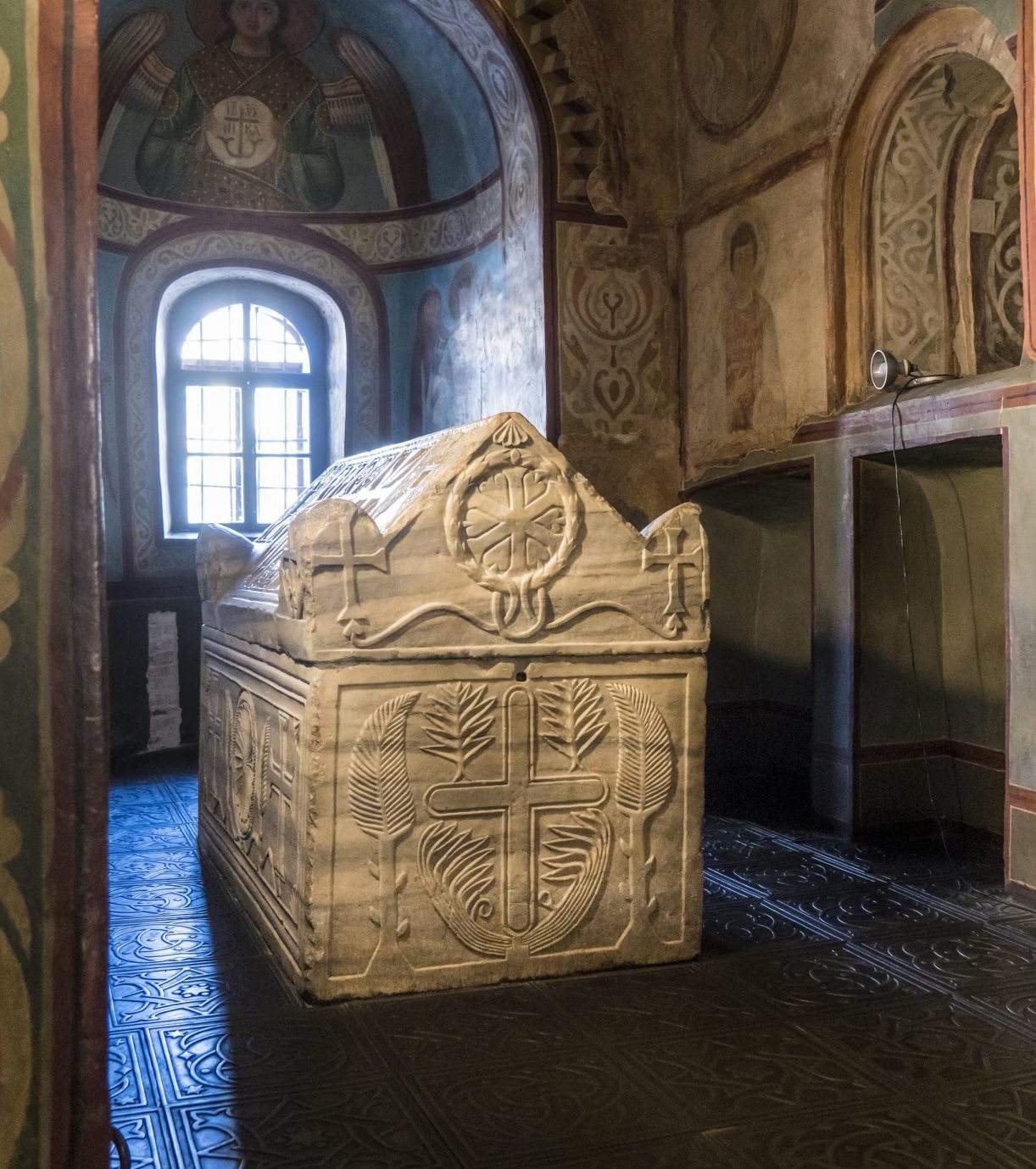 |
|
The sarcophagus of Yaroslov "the Wise" in
Saint Sophia Cathedral, Kiev
|
St.
Sophia Cathedral, Kiev, Kievan Rus'
The Russian Primary Chronicle - Laurentian Text
pp142-143 (trans. Samuel Hazzard Cross, 1953)
6562
(1054). Yaroslav, Great Prince of Rus’, passed away. While he was yet
alive, he admonished his sons with these words: “My sons, I am about to
quit this world. Love one another, since ye are brothers by one father
and mother. If ye abide in amity with one another, God will dwell among
you, and will subject your enemies to you, and ye will live at peace.
But if ye dwell in envy and dissension, quarreling with one another,
then ye will perish yourselves and bring to ruin the land of your
ancestors, which they won at the price of great effort. Wherefore remain
rather at peace, brother heeding brother. The throne of Kiev I bequeath
to my eldest son, your brother Izyaslav. Heed him as ye have heeded me,
that he may take my place among you. To Svyatoslav I give Chernigov, to
Vsevolod Pereyaslavl’, to Igor’ the city of Vladimir, and to Vyacheslav
Smolensk.” Thus he divided the cities among them, commanding them not to
violate one another’s boundaries, not to despoil one another. He laid
upon Izyaslav the injunction to aid the party wronged, in case one
brother should attack another. Thus he admonished his sons to dwell in
amity.
Being unwell, he came to Vÿshgorod, and there fell seriously ill.
Izyaslav at the moment was in Novgorod, Svyatoslav at Vladimir, and
Vsevolod with his father, for he was beloved of his father before all
his brethren, and Yaroslav kept him constantly by his side. The end of
Yaroslav’s life drew near, and he gave up the ghost on the first
Saturday after the feast of St. Theodore [February 19]. Vsevolod bore
his father’s body away, and laying it upon a sled, he brought it to
Kiev, while priests sang the customary hymns, and the people mourned for
him. When they had transported the body, they laid it in a marble
sarcophagus in the Church of St. Sophia, and Vsevolod and all his
subjects mourned him. All the years of his age were seventy-six.
Yaroslav's sarcophagus was opened in 1936 and found to contain the skeletal
remains of Yaroslav and an unidentified female, possibly that of Ingegerd.
The sarcophagus was again opened in 1939 and the remains removed for
research, not being documented as returned until 1964. In 2009, the
sarcophagus was opened again and found to contain only one skeleton, that of
a female. It seems the documents detailing the 1964 re-interment of the
remains were falsified to hide the fact that Yaroslav's remains had been
lost. Subsequent questioning of individuals involved in the research and
re-interment of the remains seems to point to the idea that Yaroslav's
remains were purposely hidden prior to the German occupation of Ukraine and
then either lost completely or stolen and transported to the United States,
where many suspect they are hidden at the Holy
Trinity Russian Orthodox Church in Brooklyn, New York.
- The Russian Primary Chronicle - Laurentian Text
p94 (trans. Samuel Hazzard Cross, 1953); Medieval
Lands (IAROSLAV Vladimirovich); wikipedia
(Yaroslav the Wise)
- The Russian Primary Chronicle - Laurentian Text
p94 (trans. Samuel Hazzard Cross, 1953); Medieval
Lands (IAROSLAV Vladimirovich); wikipedia
(Yaroslav the Wise)
- The Russian Primary Chronicle - Laurentian Text
p263 note 193 (trans. Samuel Hazzard Cross, 1953) date from Saga of Olaf Haraldson - Part 1 (Snorri
Sturluson, c. 1225); Medieval
Lands (IAROSLAV Vladimirovich); wikipedia
(Yaroslav the Wise)
- The Russian Primary Chronicle - Laurentian Text
p263 note 193 (trans. Samuel Hazzard Cross, 1953); Medieval
Lands (IAROSLAV Vladimirovich); wikipedia
(Yaroslav the Wise)
- The Russian Primary Chronicle - Laurentian Text
pp119-137 (trans. Samuel Hazzard Cross, 1953); Medieval
Lands (IAROSLAV Vladimirovich); wikipedia
(Yaroslav the Wise)
- The Russian Primary Chronicle - Laurentian Text
pp119-143 (trans. Samuel Hazzard Cross, 1953); "Yaroslav the Wise
in Norse Tradition" (Samuel Hazzard Cross) in Speculum vol 4 April 1929 pp 149-247; Anne de Russie, reine de France p23 (Le
Vicomte de Caiz de Saint Aymour, 1896); Medieval
Lands (IAROSLAV Vladimirovich); wikipedia
(Yaroslav the Wise)
- The Russian Primary Chronicle - Laurentian Text
p143 (trans. Samuel Hazzard Cross, 1953)
- The Russian Primary Chronicle - Laurentian Text
p143 (trans. Samuel Hazzard Cross, 1953); wikipedia
(Yaroslav the Wise); Yaroslav
the Wise's Contested Legacy, A Visual Timeline - WSJ
Return to Chris Gosnell's Home Page
If you have any comments, additions or modifications to the information on this page, please feel free to email me.
Created and maintained by: chris@ocotilloroad.com


