House of Capet
Adelaide
Hugh Capet
Adelaide's parentage is uncertain. The most likely candidates are William
III, the count of Poitou and duke of Aquitaine, and his wife Gerloc,
the daughter of Rollo. The debate about
this connection is summarised at The
Henry Project: The Ancestors of King Henry II of England (Adélaïde)
Adelaide was involved enough in her husband's government that he proposed
her to negotiate for him with empress
Theophanu for the return from exile of queen
Emma and bishop Adalbero
of Laon. Hugh describes her as his "socia
et particeps nostri regni" (associate and partner in our kingdom),
committing himself beforehand to whatever they determined.
Silvestri II Opera Omnia in Patrologiæ
Latina vol 139 p271 (ed. J.P Migne, 1880)
EPISTOLA
CXX.
… Et hic quidem viderit quid sua sibi prosit pertinacia. Vestram autem
amicitiam ad nos in perpetuum confirmare cupientes, sociam ac
participem nostri regni A. decrevimus vobis occurrere ad villam
Satanicum XI Kal. Sep, Ea quæ inter vos de bono et
æquo sanxeritis, inter nos ac filium vestrum sine dolo et fraude in
perpetuum conservaturi.
This is translated at Epistolæ:
Medieval Women's Letters as:
LETTER 120
… Desiring to
confirm your friendship to us in perpetuity, we have determined that our
companion and participant in the kingdom, A[delaide] will meet you at
Stenay the 11th kalends of September and those things which you
establish between you as good and equitable, we will preserve in
perpetuity between us and your son without deception or fraud.
Adelaide founded the monastery of St Frambold in Senlis,
and the nunnery of Argentuil,
in the county of Paris.
Helgardi Flor. Epitome Vitæ Roberti Regis in Recueil des historiens des Gaules et de la France
vol 10 p104 (1874)
Mater
quoque ejus supradicta Adhelaidis, admiranda satis in sancta devotione
Regina, fecit Monasterium sancti Frambaldi in ciyitate Silvanectensi,
ubi XII ad serviendum Domino clericos misit et de
quibus viverent abundè subministravit. Construxit et Monasterium in
territorio Parisiensi, villa quæ dicitur Argentoilus, ubi numerum
anciUarum Dei non minimum sub norma sancti Benedicti vivere paratas
adunavit.
This roughly translates as:
His mother
also, the aforementioned Adelaide, a Queen to be sufficiently admired in
her holy devotion, made the Monastery of Saint Fraimbault in the city of
Senlis, where she sent twelve clerics to serve the Lord and provided
abundantly the means by which they might live. She also built a
monastery in the territory of Paris, in the village which is called
Argenteuil, where she gathered a no small number of the handmaidens of
God, prepared to live under the rule of Saint Benedict.
This is an interesting view into Adelaide's nature and the breastfeeding
customs at the time.
Hadriani Valesii in Recueil
des historiens des Gaules et de la France vol 10 p74 (1874)
Notandum
autem est morem tum illustribus feminis fuisse, liberos suos suo lacte
nutrire, et Adelhaidem quæ Hugonis nondum quidem Regis, sed certè
tamen Ducis Francorum ac Comitis Parisiorum conjux esset, Rotberto
filio mammas præbuisse, nec ullas parvulo nutrices adhibere voluisse,
ut filii sui tota et intégra mater esset
This roughly translates as:
It should be
noted, moreover, that it was the custom then for illustrious women to
nourish their own children with their own milk; and Adelaide—who was the
wife of Hugh, not yet indeed King, but certainly Duke of the Franks and
Count of the Parisians—offered her breasts to her son Robert, and
refused to employ any nurses for the little one, so that she might be
the total and complete mother to her son.
After Hugh Capet’s death, their son king Robert fell out with Gerbert,
archbishop of Reims, over Robert’s desire to marry Bertha. Gerbert took
refuge with emperor Otto
III from which Adelaide attempted to recall him. His response to that
recall is this
letter, written to Adelaide and the suffragan bishops of Reims,
translated at Epistolæ:
Medieval Women's Letters.
15 June, between 1003, when she
is named in a charter dated Easter 1003 "nostræ
genitricis scilicet Adhelaidis Reginæ", and 1005, when her son gave
a donation for her soul "pro remedio
animæ pii genitoris nostri Domini Hugonis Regis, ac genitricis nostræ
Adelaidæ Reginæ"
Recueil des historiens de la France: Obituaires de la
province de Sens vol 1 p319 (1902)
Abbaye
de Saint-Denis … XVII kal. [jul.] Ob. … Adelaidis
regina (6)
(6) Femme de Hugues Capet.
This roughly translates as:
Abbey of Saint-Denis … 17th Kalends of July [15 June] Died … queen
Adelaide(6)
(6) Wife of Hugh Capet.
Henry I of France
 |
|
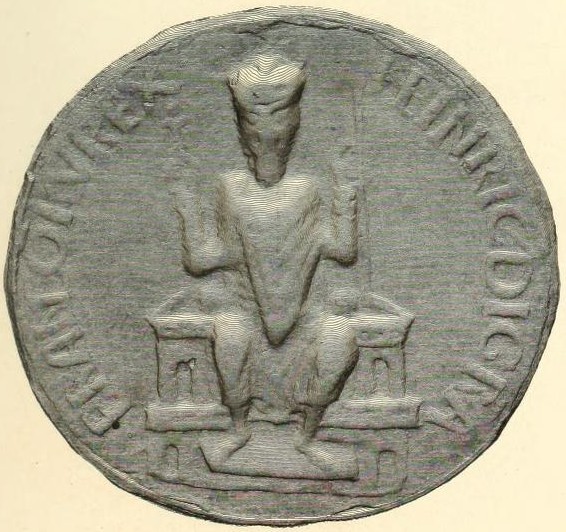
Effigy of king Henry I of France, from his
seal. The inscription reads "HEINRlC[vs] D[e]I GR[ati]A
FRANCORV[m] REX" which translates to "HENRY, BY THE GRACE OF GOD,
KING OF THE FRANKS"
|
 |
|
Henry I of France, as depicted in the
Wolfenbüttel manuscript of the Chronica
sancti Pantaleonis from the second half of the 12th
century
|
Robert II of
France
Constance
of Arles
Mathilda
Mathilda was from a noble family in Germany, but her parents are not known.
She died in 1044 and was buried in the basilica
of Saint-Denis in Paris.
Raoul Glaber: Les cinq livres de ses histoires
(900-1044) book 4 chapter 8 #23 pp111-2 (ed. Maurice Prou,
1886)
imperator
Chounradus … Pactum etiam securitatis et amicitie, veluti Heinricus
cum patre illius egerat, cum rege Francorum Heinrico, filio Roberti,
statuit, cui etiam leonem pergrandem amicitie gratis misit. Qui
postmodum uxorem nomine Mathildem, moribus egregiam, de regno ejus ex
Germanie nobilioribus accepit.
This roughly translates as:
The emperor
Conrad … also established a treaty of security and friendship with
Henry, king of the Franks and son of Robert, just as Henry [II] had done
with Henry's father. To him, he also sent a very large lion as a gift of
friendship. Afterwards, [Henry] took a wife named Matilda, a woman of
excellent character, from among the higher nobility of Germany within
Conrad's realm.
Miracula Sancti Benedicti Book 7 p252
(ed. E. de Certain, 1858)
anno
Dominicæ Incarnationis millesimo quadragesimo quarto, … Quo siquidem
anno, Mahildis regina Parisiis obiit, quam ex Cæsarum progenie
matrimonio sibi asciverat præfatus rex; susceptaque regia ex ea
proie, hominem decessit, monasterio Sancti Dionysii tradita
sepulturae.
This roughly translates as:
In the year
of the Incarnation of the Lord one thousand forty-four, … In which
year, Queen Mahildis died in Paris, whom the aforementioned king had
married from the descendants of the Caesars; and having assumed royal
power from that lineage, she died a virgin, and was given over to the
monastery of Saint Denis for burial.
- unnamed daughter who died young
Anne
of Kiev on 19 May 1051
Hugonis
Floriacensis Modernorum Regum Francorum Actus in Monumenta
Germaniæ Historica SS 9 pp388-9 (ed. G. H. Pertz, 1851)
… Rex etiam accepit in coniugium filiam regis Russorum Annam, quae ei
tres genuit filios, Philippum videlicet, Hugonem atque Rotbertum.
Quorum Rotbertus inmatura morte decessit.
This roughly translates as:
… The king
also took in marriage Anna, daughter of the king of the Russians, who
bore him three sons: namely Philip, Hugh, and Robert. Of these, Robert
died an untimely death.
King of France
Henry was made duke of Burgundy by his father in 1016, and crowned joint
king of France with his father in Reims on 14 May 1027, becoming sole king
when his father died in 1031, and giving the duchy if Burgundy to his
younger brother, Robert, in 1032.
In 1033, Henry was betrothed to five year old Matilda
of Franconia, the daughter of Conrad
II, Holy Roman Emperor and Gisela
of Swabia, but Mathilda died in 1034, before the marriage occurred (Wiponis,
Vita Chuonradi II Imperatoris 32 in Monumenta
Germaniæ Historica SS 11 pp271 (ed. G. H. Pertz, 1854)).
Henry I of France, who reigned from 1031 until 1060, was a
pivotal, though often embattled, sovereign of the early Capetian dynasty.
His reign began in a state of crisis as he was forced to wage a bitter civil
war against his mother, Queen Constance of Arles, who favored his younger
brother Robert for the throne. To secure his crown, Henry was forced to cede
the Duchy of Burgundy to Robert - a concession that weakened the royal
domain but stabilized the dynasty. Much of his subsequent career was defined
by a delicate balancing act among his powerful vassals, most notably the
Normans and the Counts of Blois. Initially a staunch protector of the young
William the Conqueror, Henry famously led an army to save William at the
Battle of Val-ès-Dunes in 1047, though the two would later become bitter
rivals as the Duke’s power grew to threaten the French throne.
Henry’s personal life and legacy were marked by a search for prestige
and continuity. In a notable departure from traditional Frankish alliances,
he married Anne of Kiev, the daughter of Yaroslav the Wise, a move intended
to avoid the strict "incest" laws of the Church by seeking a bride from a
distant land. This union produced the future Philip I and Hugh the Great of
Vermandois, ensuring the survival of the Capetian line. Despite losing
significant territory to the rising territorial princes, Henry was a
tireless administrator who focused on the consolidation of royal authority
within the Île-de-France. He died in 1060 at Vitry-en-Bière and was buried
at Saint-Denis, leaving behind a kingdom that, while physically small, was
legally and dynastically secure enough to survive the minority of his son.
Hugonis
Floriacensis Modernorum Regum Francorum Actus in Monumenta
Germaniæ Historica SS 9 pp387-9 (ed. G. H. Pertz, 1851)
10. Henricus igitur patri suo succesdens in rego anno incarnacionis
dominicae 1032, regnauit annis 27. Huius mater Constantia magnam regni
porcionem post funus mariti in suum conabatur retinere dominium, urbem
scilicet Silvanectensem et Senonensem et castellum Bistisiacum et
Donnum Martinum et Puteolum et Milidunum et Pisciacum et Codiciacum.
Multos etiam Franciae et Burgundiae proceres sibi conciliaverat et a
filii fidelitate seiunxerat. Quod Henricus non tulit, sed adorsus
Pisciacum, mox illud suum retorsit ad dominium. Demum vero Puteolum
obsedit et cepit. Quod cernens Constantia, ab eo dextram expeciit.
Post haec autem aggressus est rex Odonem comitem, et abstulit illi
Gorniacum castrum. Senonicae quoque urbis partem, quam illi regina
Constantia dederat, ad suum postmodum retorsit dominium.
… Interea vero rex Medandicum Galerannum devicit et exheredetavit.
Ipso etiam tempore Hugo Bardulfus, vir non contemnendae virtutis ac
nobilitatis, contra regem Henricum Pitueris castrum munivit. Sed rex
biennio illud obsidens ad dedicionem conpulit, et memoratum Hugonem
honore spoliatum de terra effugavit.
Anno preterea incarnacionis dominicae 1035, comes Rotbertus,
Richardi principis Normannorum heres et filius, a Hierosolima rediens,
apud Niceame, urbem defunctus est, relinquens sibi successorem
Willelmum filium suum. Qui a Normannis exheredatus, ad regem Henricum
venit in Franciam, a quo benigne suscipi et postmodum feliciter meruit
heredari. Anno quippe incarnacionis dominicae 1047, sepedictus rex
Henricus cum tribus tantum milibus armatorum commisit bellum cum 30
milibus Normannorum, et eos superavit, et memoratum adolescentem
Guillelmum eis vi super posuit.
… Rex etiam accepit in coniugium filiam regis Russorum Annam, quae ei
tres genuit filios, Philippum videlicet, Hugonem atque Rotbertum.
Quorum Rotbertus inmatura morte decessit. Ipse proinde rex Henricus
construxit ecclesiam ante menia Parisiacae urbis, in honorem sancti
Martini.
… Rex autem Henricus anno incarnacionis dominicae 1058, Philippum
filium suum duodennem consecrari fecit die pentecostes Remis a
Gervasio archiepiscopo, astantibus viginti duobus Franciae, Burgundiae
et Aquitaniae archiepiscopis et episcopis et abbatibus multis.
Affuerunt eciam duo Nicholai papae legati, Hugo videlicet Bisunciensis
archiepiscopus et Hermenfredus Sedunensis episcopus. Sequenti vero
anno defunctus est rex sepedictus Henricus, et apud Sanctum Dyonisium
tumulatus, relinquens filio suo regi Philippo nondum adulto tutorem
comitem Flandrensium Balduinum, virum sibi fidelissimum et honestum.
This roughly translates as:
10.
Henry, therefore, succeeding his father in the kingdom in the year of
the Incarnation of the Lord 1032, reigned for 27 years. After the death
of her husband, his mother Constance endeavored to retain a great
portion of the kingdom under her own lordship: namely, the cities of
Senlis (Silvanectensem) and Sens (Senonensem), and the
castles of Béthisy, Dammartin, Puteolum, Melun, Pisciacum, and Coucy.
She had even won over many nobles of France and Burgundy to her side and
separated them from loyalty to her son. Henry did not endure this, but
having attacked Pisciacum, he soon twisted it back into his own
lordship. At last, he besieged and captured Puteolum. Seeing this,
Constance sought a truce (dextram) from him. After these things,
the king attacked count Odo and took from him the castle of Gournay.
That part of the city of Sens, which queen Constance had given to [Odo],
he later twisted back into his own lordship.
… Meanwhile, the King conquered and disinherited Waleran of Meulan (Medandicum
Galerannum). At that same time, Hugh Bardoul, a man of no small
virtue and nobility, fortified the castle of Pithiviers against king
Henry. But the king, besieging it for two years, compelled it to
surrender, and having despoiled the aforementioned Hugh of his honor,
drove him from the land.
In the year of the Incarnation of the Lord 1035, moreover, count
Robert [the Magnificent], son and heir of Richard, prince of the
Normans, returning from Jerusalem, died at the city of Nicaea, leaving
as his successor his son William. He [William], having been disinherited
by the Normans, came to king Henry in France, by whom he deserved to be
kindly received and later successfully restored to his inheritance.
Indeed, in the year of the Incarnation of the Lord 1047, the
oft-mentioned king Henry, with only three thousand armed men, joined
battle with thirty thousand Normans, and overcame them, and by force
placed the aforementioned youth William over them.
… The king also took in marriage Anna, daughter of the king of the
Russians, who bore him three sons: namely Philip, Hugh, and Robert. Of
these, Robert died an untimely death. Accordingly, king Henry himself
constructed a church before the walls of the city of Paris in honor of
Saint Martin [St. Martin-des-Champs].
… King Henry, in the year of the Incarnation of the Lord 1058, caused
his twelve-year-old son Philip to be consecrated on the day of Pentecost
at Reims by Archbishop Gervais, with twenty-two archbishops and bishops
of France, Burgundy, and Aquitaine, and many abbots standing by. Also
present were two legates of pope Nicholas, namely Hugh, archbishop of
Besançon, and Hermenfred, bishop of Sion. In the following year, the
oft-mentioned king Henry died and was buried at Saint-Denis, leaving as
guardian for his son king Philip, who was not yet an adult, count
Baldwin of Flanders, a man most faithful and honorable to him.
This passage conflates Henry's earlier betrothal to 5 year old Mathilda,
daughter of emperor Conrad, with his first marriage to another Mathilda who
bore him a child. However, the information that that child died young,
followed shortly by her mother, must apply to the second Mathilda.
Excerptum Historicum in Recueil
des historiens des Gaules et de la France vol 11 p157 (1871)
Ex Collectione Freheri, pag. 515, et ex Ms. Regio num. 8394.
IDEM Rex Henricus neptem (b) Henrici Alamannorum
Imperatoris duxit in uxorem: ex qua filiam unam procreavit; quæ infra
lustrum defuncta est, matre ejus paulò pòst eam subsequente. Post
cujus obitum Rex sibi quærens conjugii solatium, ad Rutenorum Regem
Galterum, cognomine Saveir, Meldensem Episcopum direxit, postulans ut
ei suam mitteret filiam. Quod et factum est. Hujus nomen erat Anna.
Convocatâ igitur regni sui Procerum multitudine, sicut decet tantum
virum, illam celebriter duxit in uxorem. Hæc autem Deo devota, plus de
futuris quàm de præsentibus cogitans, in æterna vita mutuum
multipliciter recipere credens, apud Sylvanectum Ecclesiam in honore
S. Vincentii construxit. Cum qua Rex feliciter vivens, ex ea genuit
tres filios, Philippum videlicet, Robertum, et Hugonem cognomine
Magnum. Iste Hugo genuit Rodulfum Viromanduorum Comitem. Procedente
verò tempore, anno MXLII fames valida cœpit, quæ septem annos duravit.
Philippus autem major Regis filus, vivente patre et jubente,
anno Domini MLIX unctus est in Regem. Rex autem Henricus anno sequente
obiit.
(b) Corrig. sororem Henrici. Mathilda enim filia
erat Conradi Imper. et Giselæ. Ceterùm quæ hic narrantur, conciliari
non possunt cum verbis Wipponis in Vita Conradi Salici.
This roughly translates as:
From the Freher Collection, page 515, and from Royal Manuscript no.
8394.
The same King Henry took to wife the niece of Henry, Emperor of the
Germans: from whom he fathered one daughter; she died before the age of
five, and her mother followed her [in death] shortly thereafter. After
her death, the King, seeking for himself the solace of marriage, sent
Walter, the Bishop of Meaux, surnamed "Saveir", to the King of the Rus,
requesting that he send him his daughter. And so it was done. Her name
was Anna. Therefore, having called together a multitude of the nobles of
his realm, as befits such a man, he married her in a celebrated
ceremony. She, however, being devoted to God and thinking more of future
things than present ones, believing that she would receive a manifold
return in eternal life, built a church at Senlis in honor of St.
Vincent. Living happily with her, the King fathered three sons by her:
namely Philip, Robert, and Hugh, surnamed the Great. This Hugh fathered
Ralph, Count of Vermandois. As time passed, in the year 1042, a great
famine began which lasted seven years.
Moreover, Philip, the King's eldest son, was anointed King in the
year of our Lord 1059, while his father was still living and at his
command. King Henry died the following year.
(b) Correctly sister of Henry. For Mathilda was
the daughter of Conrad the Emperor and Gisela. Moreover, what is
narrated here cannot be reconciled with the words of Wippon in the Vita
Conradi Salici.
The ecclesiastical history of England and Normandy by
Ordericus Vitalis vol 1 p148 (trans. Thomas Forester, 1853)
In the
year of our Lord 1031, Robert, king of the French, died, and Henry his
son, supported by Robert, duke of Normandy, secured the throne
notwithstanding the opposition of Queen Constance and his younger
brother Robert, and others of the French. His reign lasted twenty-nine
years.2
2 King Robert died on the 20th of July, 1031. It is
certain that the succour he received from Robert, duke of Normandy, in
whose court Henry I. sought refuge, enabled that prince to defeat the
intrigues of his mother. He died on the 29th of August, 1060.
p153
In the
year of our Lord 1060, Henry, king of the French, departed this life,
and his son Philip who succeeded him, held the sceptre of France
forty-seven years.1
2[1] Henry I., king of France, died on the 4th of
August, 1060, as already stated. Philip I., his son, having lived until
the 29th of July, 1108, reigned forty-eight years less six days.
The Encyclopaedia Britannica 11th edition vol
13 pp290-1 (ed. Hugh Chisholm, 1911)
HENRY
I. (1008-1060), king of France, son of King Robert and his
queen, Constance of Aquitaine, and grandson of Hugh Capet, came to the
throne upon the death of his father in 1031, although in 1027 he had
been anointed king at Reims and associated in the government with his
father. His mother, who favoured her younger son Robert, and had
retired from court upon Henry’s coronation, formed a powerful league
against him, and he was forced to take refuge with Robert II., duke of
Normandy. In the civil war which resulted, Henry was able to break up
the league of his opponents in 1032. Constance died in 1034, and the
rebel brother Robert was given the duchy of Burgundy, thus founding
that great collateral line which was to rival the kings of France for
three centuries. Henry atoned for this by a reign marked by unceasing
struggle against the great barons. From 1033 to 1043 he was involved
in a life and death contest with those nobles whose territory adjoined
the royal domains, especially with the great house of Blois, whose
count, Odo II., had been the centre of the league of Constance, and
with the counts of Champagne. Henry’s success in these wars was
largely due to the help given him by Robert of Normandy, but upon the
accession of Robert’s son William (the Conqueror), Normandy itself
became the chief danger. From 1047 to the year of his death, Henry was
almost constantly at war with William, who held his own against the
king’s formidable leagues and beat back two royal invasions, in 1055
and 1058. Henry’s reign marks the height of feudalism. The Normans
were independent of him, with their frontier barely 25 m. west of
Paris; to the south his authority was really bounded by the Loire; in
the east the count of Champagne was little more than nominally his
subject, and the duchy of Burgundy was almost entirely cut off from
the king. Yet Henry maintained the independence of the clergy against
the pope Leo IX., and claimed Lorraine from the emperor Henry III. In
an interview at Ivois, he reproached the emperor with the violation of
promises, and Henry III. challenged him to a single combat. According
to the German chronicle—which French historians doubt—the king of
France declined the combat and fled from Ivois during the night. In
1059 he had his eldest son Philip crowned as joint king, and died the
following year. Henry’s first wife was Maud, niece of the emperor
Henry III., whom he married in 1043. She died childless in 1044.
Historians have sometimes confused her with Maud (or Matilda), the
emperor Conrad II.’s daughter, to whom Henry was affianced in 1033,
but who died before the marriage. In 1051 Henry married the Russian
princess Anne, daughter of Yaroslav I., grand duke of Kiev. She bore
him two sons, Philip, his successor, and Hugh the great, count of
Vermandois.
See the Historiae of Rudolph Glaber, edited by M. Prou
(Paris, 1886); F. Sochnée, Catalogue des actes d’Henri Ier
(1907); de Caiz de Saint Aymour, Anne de Russie, reine de France
(1896); E. Lavisse, Histoire de France, tome ii. (1901), and
the article on Henry I. in La Grande Encyclopédie by M. Prou.
4 August 1060, at the castle of
Victria, in Fontainbleu,
France
Annales
Nivernenses in Monumenta Germaniæ
Historica SS 13 p90 (1881)
1060. In hoc anno Henricus rex obiit, Rotberti regis filius, 2 Non.
Augusti
This roughly translates as:
1060. In this year King Henry, son of King
Robert, died on the 2nd Nones of August [4 August].
Ex Chronico S. Petri Vivi Senonensi auctore Clario
monacho in Recueil des historiens des
Gaules et de la France vol 11 p197 (1871)
Anno MLX, obiit Rex Hainricus. Hic regale Præceptum fecit de rebus
Abbatiæ S. Petri, sicut fecerat et pater ejus Rotbertus. Mortuo autem
Hainrico Rege apud Victriacum castrum (b) in Brieria, et
sepulto in Basilica S. Dionysii, Rodulfus Comes, consanguineus ejusdem
Regis, duxit uxorem ejus in conjugio contra jus et fas; unde fuit
excommunicatus. Balduinus verò, Comes Flandrensis, Regem parvulum
Philippum aluit, et Franciam gubernavit.
(b) Hunc locum frustrà in Briegio ponunt recentiores.
Bieria silva nunc Fontis-Blaudi vocatur, ubi ædes regiæ saltem à
tempore Ludovici Junioris. Illic inter. illas ædes et oppidum ad viam,
quæ fert Moretum, visitur Crux Vitriaci hactenus dicta: quo in loco
fortè olim castrum cognomine fuerit, ubi mortuus Henricus. Mabill.
This roughly translates as:
In the
year 1060, King Henry died. He made a royal precept [decree] concerning
the affairs of the Abbey of St. Peter, just as his father Robert had
done. Moreover, with King Henry having died at the castle of Vitry (Victriacum)
in Bière (Brieria), and having been buried in the Basilica of St.
Denis, Count Ralph [of Valois], a kinsman of the same King, took his
[Henry's] wife in marriage against law and divine right (contra jus
et fas); for which reason he was excommunicated. Baldwin, the
Count of Flanders, raised the little King Philip and governed France.
(b) Recent writers [historians] place this location in
Brie (Briegio) in vain. The forest of Bière (Bieria) is
now called Fontainebleau (Fontis-Blaudi), where there have been
royal houses at least since the time of Louis the Younger. There,
between those houses and the town, on the road which leads to Moret, is
seen the Cross, called to this day the Cross of Vitry (Crux Vitriaci):
in which place perhaps there was once a castle of that name, where Henry
died. — Mabillon.
 |
|
|
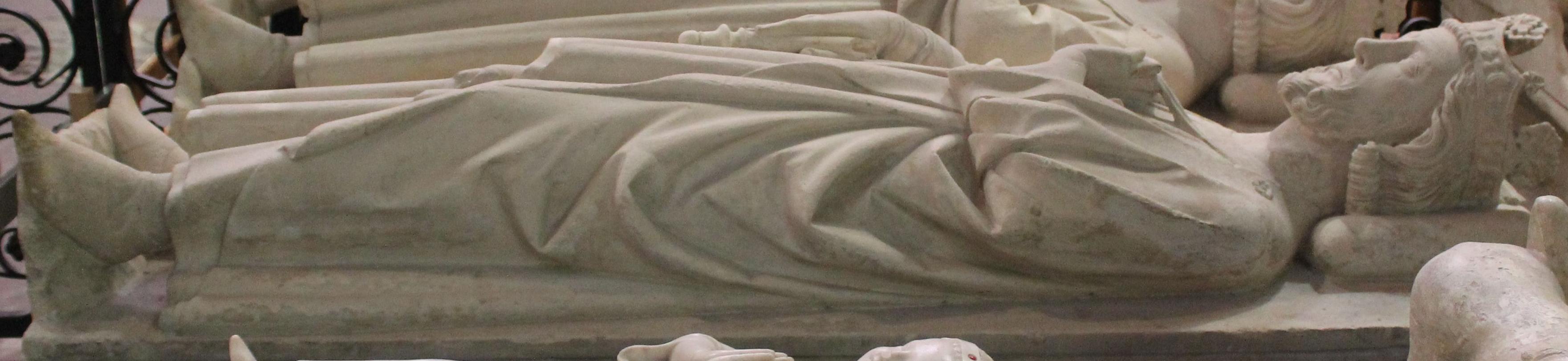
Basilica
of Saint-Denis, Paris, France
Henry's tomb was desecrated during the French Revolution and his bones,
along with those of his ancestors and descendants, were thrown into a common
pit (a mass grave) outside the church. After the restoration of the monarchy
in the 19th century, these remains were gathered and placed in a massive
ossuary in the crypt of the Basilica, where they remain today.
- Hugonis Floriacensis Modernorum Regum Francorum
Actus in Monumenta Germaniæ
Historica SS 9 pp385 (ed. G. H. Pertz, 1851); The Encyclopaedia Britannica 11th edition vol
13 pp290-1 (ed. Hugh Chisholm, 1911); Medieval
Lands (HUGUES de France); wikipedia
(Henry I of France)
- Hugonis Floriacensis Modernorum Regum Francorum
Actus in Monumenta Germaniæ
Historica SS 9 pp385 (ed. G. H. Pertz, 1851); The Encyclopaedia Britannica 11th edition vol
13 pp290-1 (ed. Hugh Chisholm, 1911); Medieval
Lands (HUGUES de France); wikipedia
(Henry I of France)
- Raoul Glaber: Les cinq livres de ses histoires
(900-1044) vol 11 pp111-2 (ed. Maurice Prou, 1886); Excerptum Historicum in Recueil
des historiens des Gaules et de la France vol 11 p157
(1871); The
Henry Project: The Ancestors of King Henry II of England (Robert II le
Pieux (the Pious)); Medieval
Lands (HUGUES de France); wikipedia
(Henry I of France); Mathilda death, burial from Miracula Sancti Benedicti Book 7 p252
(ed. E. de Certain, 1858) and Medieval
Lands (HUGUES de France)
- Excerptum Historicum in Recueil
des historiens des Gaules et de la France vol 11 p157
(1871); Medieval
Lands (HUGUES de France); wikipedia
(Henry I of France)
- Hugonis Floriacensis Modernorum Regum Francorum
Actus in Monumenta Germaniæ
Historica SS 9 p388 (ed. G. H. Pertz, 1851); Excerptum Historicum in Recueil
des historiens des Gaules et de la France vol 11 p157
(1871); The Encyclopaedia Britannica 11th edition vol
13 pp290-1 (ed. Hugh Chisholm, 1911); The
Henry Project: The Ancestors of King Henry II of England (Robert II le
Pieux (the Pious)); Medieval
Lands (HUGUES de France); wikipedia
(Henry I of France)
- Hugonis Floriacensis Modernorum Regum Francorum
Actus in Monumenta Germaniæ
Historica SS 9 pp388-9 (ed. G. H. Pertz, 1851); Excerptum Historicum in Recueil
des historiens des Gaules et de la France vol 11 p157
(1871); The ecclesiastical history of England and Normandy
by Ordericus Vitalis vol 2 p348 (trans. Thomas Forester,
1853); The Encyclopaedia Britannica 11th edition vol
13 pp290-1 (ed. Hugh Chisholm, 1911); Medieval
Lands (HUGUES de France); wikipedia
(Henry I of France)
- Hugonis Floriacensis Modernorum Regum Francorum
Actus in Monumenta Germaniæ
Historica SS 9 pp388-9 (ed. G. H. Pertz, 1851); Medieval
Lands (HUGUES de France); wikipedia
(Henry I of France)
- Hugonis Floriacensis Modernorum Regum Francorum
Actus in Monumenta Germaniæ
Historica SS 9 pp387-9 (ed. G. H. Pertz, 1851); The ecclesiastical history of England and Normandy
by Ordericus Vitalis vol 1 pp148-53 (trans. Thomas
Forester, 1853); The Encyclopaedia Britannica 11th edition vol
13 pp290-1 (ed. Hugh Chisholm, 1911); Medieval
Lands (HUGUES de France); wikipedia
(Henry I of France)
- Annales Nivernenses in Monumenta
Germaniæ Historica SS 13 p90 (1881); Ex Chronico S. Petri Vivi Senonensi auctore Clario
monacho in Recueil des historiens
des Gaules et de la France vol 11 p197 (1871); The ecclesiastical history of England and Normandy
by Ordericus Vitalis vol 1 p153n (trans. Thomas Forester,
1853); The Encyclopaedia Britannica 11th edition vol
13 pp290-1 (ed. Hugh Chisholm, 1911); The
Henry Project: The Ancestors of King Henry II of England (Robert II le
Pieux (the Pious)); Medieval
Lands (HUGUES de France); wikipedia
(Henry I of France)
- Hugonis Floriacensis Modernorum Regum Francorum
Actus in Monumenta Germaniæ
Historica SS 9 p389 (ed. G. H. Pertz, 1851); Ex Chronico S. Petri Vivi Senonensi auctore Clario
monacho in Recueil des historiens
des Gaules et de la France vol 11 p197 (1871); The
Revolutionary Exhumations at St-Denis, 1793 (Suzanne Glover
Lindsay); Medieval
Lands (HUGUES de France); wikipedia
(Henry I of France)
Hugh Capet
 |
|
Hugh Capet, as depicted in the
Wolfenbüttel manuscript of the Chronica
sancti Pantaleonis from the second half of the 12th
century
|
Hugh
the Great
Hedwig
of Saxony
Adelaide
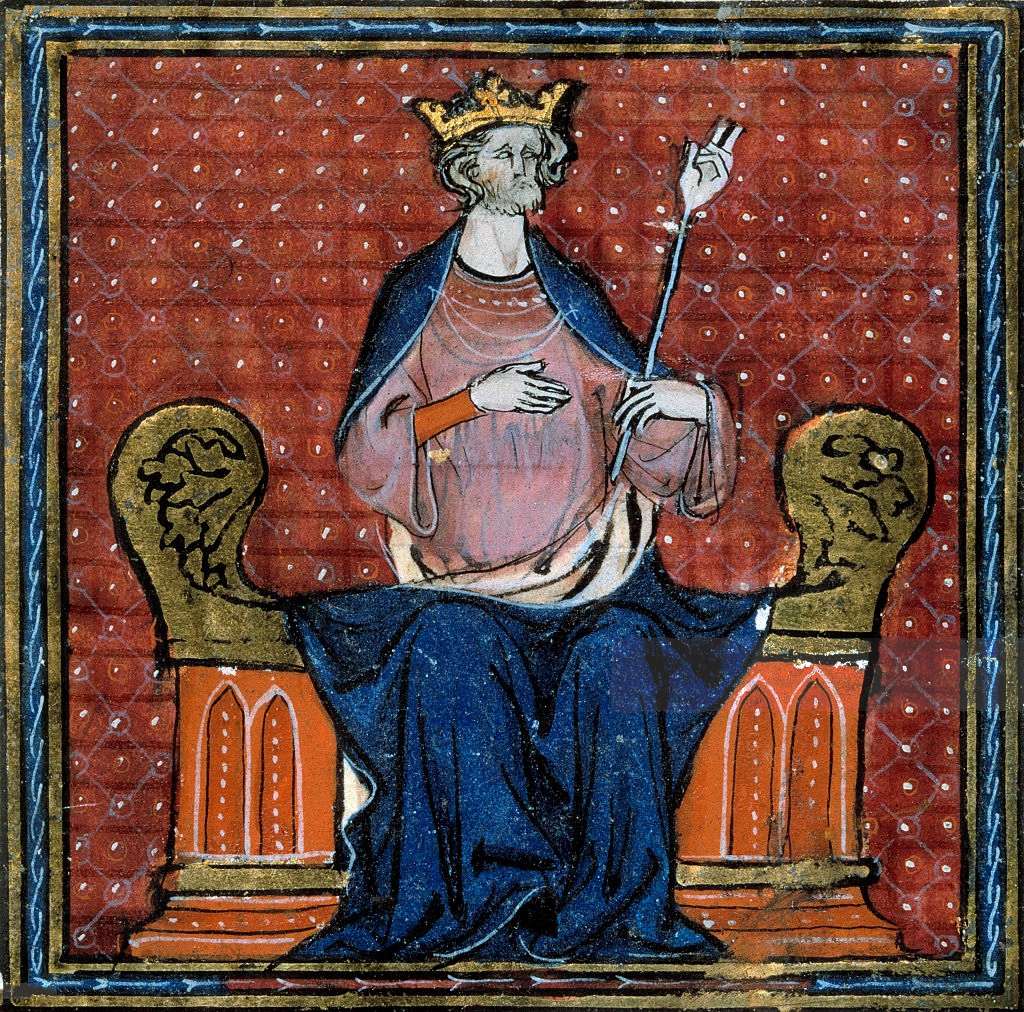 |
|
Illuminated miniature of the coronation of
Hugh Capet in 987, from a manuscript dated to the 13th or 14th
century, now held at the Bibliothèque Nationale de France in
Paris, France.
|
King of France
Hugh was installed as duke of France by Lothaire, king of the West Franks in
960. He was elected king of France by an assembly of nobles at Senlis on 29
May 987, after the death without children of Louis V., and was consecrated
at Noyon on 1 June 987.
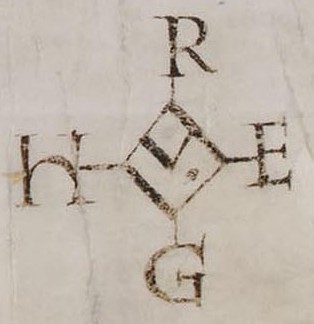 |
|
The signature of Hugh Capet on a charter,
dated 988, in which he donated the estate of Maisons-Alfort to the
abbey of Saint-Maur-des-Fossés
(click for full charter)
|
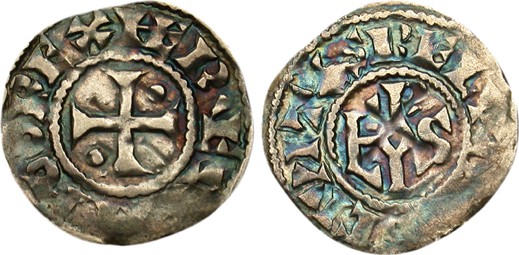 |
|
A silver denier, or penny, from
the reign of Hugh Capet, struck in the city of Beauvais.
It is inscribed "HERVEVS [HV]GO REX" on the obverse and
"BELVA[CVS] CIVITAS" on the reverse.
|
Hugh Capet (c. 941–996) was the first "King of the Franks" from the
eponymous Capetian dynasty, a lineage that would rule France in an unbroken
male line for over three centuries.
Upon the sudden death of the Carolingian king, Louis V, in 987, the
French throne became vacant. Charles of
Lorraine, the uncle of the deceased king, was the direct Carolingian
claimant. However, his candidacy was deeply unpopular with the Frankish
nobility and the influential clergy, particularly the powerful Adalbero
of Reims, who famously argued that the throne was not a hereditary
right but should be given to a man distinguished by "nobility of body and
wisdom of mind". Hugh was elected king by an assembly of nobles in June 987,
effectively bypassed the hereditary claims of Charles of Lorraine.
Charles did not accept the election and launched a military campaign
to seize the crown by force, and in 988 he successfully captured the city of
Laon, a traditional Carolingian stronghold. After several failed attempts by
Hugh to retake the city, Charles was eventually undone by betrayal rather
than battlefield defeat. Bishop
Adalbero of Laon, who had initially pretended to support Charles,
tricked him and handed him over to Hugh Capet in 991. With Charles's
capture, the Carolingian threat was neutralized. Charles was imprisoned in
Orléans, where he eventually died. This victory solidified Hugh Capet's
reign and established the Capetian royal line without further challenge from
the Carolingian line.
Hugh's reign was characterized by a precarious struggle to assert
authority over a fractured kingdom where territorial lords were often more
powerful than the monarch himself. To ensure the survival of his house, he
took the strategic step of crowning his son, Robert the Pious, as associate
king shortly after his own accession, effectively turning an elective
monarchy into a hereditary one.
The ecclesiastical history of England and Normandy by
Ordericus Vitalis vol 1 pp141-2 (trans. Thomas Forester,
1853)
Charles, his
brother, claimed the throne; but Hugh the Great [Hugh Capet], son of
Hugh the Great, opposed him, and, having raised a numerous army, sat
down before Laon, where Charles resided with his queen. The king, full
of indignation, made a sally at the head of the garrison, attacked and
put to flight the army of Hugh, and burnt their huts. The duke,
perceiving that Charles was not to be subdued by open warfare, concerted
measures with Ascelin, bishop of Laon, who was the king’s adviser. The
bishop, forgetting his age and profession, and not considering that
death was approaching, followed the example of Achitophel and Judas, and
did not blush to become a traitor. During the night, when all the
inhabitants were asleep, he admitted Hugh into the town, who made
Charles and his wife, the daughter of Herbert, earl of Troyes,
prisoners, and condemned them to perpetual captivity in the tower of
Orleans. There, Charles became the father of two children, Lewis and
Charles; but from that time the posterity of Charlemagne ceased to reign
in France.1
In the year of our Lord 983, Hugh, the duke, was anointed king at
Eheims. In the same year, Robert his son was crowned king, and reigned
thirty-eight years.2 Hugh was induced by a vision to commit
this great crime. St. Valery appeared to him when he was duke at
Lutetia, the city of the Parisii. He revealed to him in a dream who he
was, and what he wanted, commanding him to undertake an expedition
against Arnold, earl of Flanders, and take his body out of the monastery
of Sithieu, where that of St. Bertin also lies, and restore it to the
convent of Leuconaüs in the Vimeux. He then promised him that, if he
faithfully obeyed his orders, he and his posterity to the seventh
generation should wear the crown of France. Hugh readily obeyed the
orders of the saint, and, by the will of God, terrified Arnold with his
impetuous courage, recovered and reverently restored to their tombs the
bodies of the venerable saints Valery and Riquier, which had been
carried away by a certain clerk named Erchambald, bribed by the offer of
a large sum of money. The duke himself repaired to Leuconaüs with the
great men of his court, and deposited the remains of St. Valery in a
monastery situate on the banks of the Somme, and having driven out the
secular canons, filled their places with regular monks. Not long
afterwards, as already stated, he usurped the throne, which his
descendants have filled to the present day; for four kings of his race
have reigned up to this moment, namely, Robert, Henry, Philip, and
Lewis.1
1 Charles of France, duke of Lorraine, was not
brother of Lewis V., as our author, following Hugh de Fleuri, calls him,
but King Lothaire’s. Hugh Capet never bore the title of Great, which was
exclusively given to his father. It was on Good Friday, April 3, 991,
that Ascalin or Adalbéron, bishop of Laon, opened the gates of that town
to him. Agnes de Vermandois, the second wife of Charles, was the
daughter of Herbert III., count of Vermandois, who was also often called
count of Troyes and Meaux. Their children, Lewis and Charles, who shared
their captivity at Orleans, were still alive in 1009, a period when
mentioned with King Robert, at the commencement of a charter.
2 The coronation of Hugh Capet took place on the 3rd
of July, 987, and that of King Robert, his son, taken by him as his
colleague, on the 1st of January, 988. The computation of the years of
the reign of this last prince, given by our author, is inexact, whether
we include or not those during which he shared the government with his
father; because, in the first case, his reign lasted more than forty-two
years and a half, and in the second, thirty-three years and nine months.
1 For information respecting this vision of Hugh
Capet, and the events that were the consequence of it, see the Acta
SS. ord. S. Benedicti, sæc. v. p. 556, et seq. Leuconaüs was the
primitive name of St. Valéri sur Somme. The relics of the saint were
carried back there by Hugh himself in 981, after he had exacted their
restitution from the Earl of Flanders by threats of an invasion.
The Encyclopaedia Britannica 11th edition vol
13 p858 (ed. Hugh Chisholm, 1911)
HUGH
CAPET (c. 938-996), king of France and founder of the
Capetian dynasty, was the eldest son of Hugh the Great by his wife
Hadwig. When his father died in 956 he succeeded to his numerous fiefs
around Paris and Orleans, and thus becoming one of the most powerful
of the feudatories of his cousin, the Frankish king Lothair, he was
recognized somewhat reluctantly by that monarch as duke of the Franks.
Many of the counts of northern France did homage to him as their
overlord, and Richard I., duke of Normandy, was both his vassal and
his brother-in-law. His authority extended over certain districts
south of the Loire, and, owing to his interference, Lothair was
obliged to recognize his brother Henry as duke of Burgundy. Hugh
supported his royal suzerain when Lothair and the emperor Otto II.
fought for the possession of Lorraine; but chagrined at the king’s
conduct in making peace in 980, he went to Rome to conclude an
alliance with Otto. Laying more stress upon independence than upon
loyalty, Hugh appears to have acted in a haughty manner toward
Lothair, and also towards his son and successor Louis V.; but neither
king was strong enough to punish this powerful vassal, whose clerical
supporters already harboured the thought of securing for him the
Frankish crown. When Louis V. died without children in May 987, Hugh
and the late king’s uncle Charles, duke of Lower Lorraine, were
candidates for the vacant throne, and in this contest the energy of
Hugh’s champions, Adalberon, archbishop of Reims, and Gerbert,
afterwards Pope Sylvester II., prevailed. Declaring that the Frankish
crown was an elective and not an hereditary dignity, Adalberon secured
the election of his friend, and crowned him, probably at Noyon, in
July 987.
The authority of the new king was quickly recognized in his
kingdom, which covered the greater part of France north of the Loire
with the exception of Brittany, and in a shadowy fashion he was
acknowledged in Aquitaine; but he was compelled to purchase the
allegiance of the great nobles by large grants of royal lands, and he
was hardly more powerful as king than he had been as duke. Moreover,
Charles of Lorraine was not prepared to bow before his successful
rival, and before Hugh had secured the coronation of his son Robert as
his colleague and successor in December 987, he had found allies and
attacked the king. Hugh was worsted during the earlier part of this
struggle, and was in serious straits, until he was saved by the wiles
of his partisan Adalberon, bishop of Laon, who in 991 treacherously
seized Charles and handed him over to the king. This capture virtually
ended the war, but one of its side issues was a quarrel between Hugh
and Pope John XV., who was supported by the empire, then under the
rule of the empresses Adelaide and Theophano as regents for the young
emperor Otto III. In 987 the king had appointed to the vacant
archbishopric of Reims a certain Arnulf, who at once proved himself a
traitor to Hugh and a friend to Charles of Lorraine. In June 991, at
the instance of the king, the French bishops deposed Arnulf and
elected Gerbert in his stead, a proceeding which was displeasing to
the pope, who excommunicated the new archbishop and his partisans.
Hugh and his bishops remained firm, and the dispute was still in
progress when the king died at Paris on the 24th of October 996.
Hugh was a devoted son of the church, to which, it is not too
much to say, he owed his throne. As lay abbot of the abbeys of St
Martin at Tours and of St Denis he was interested in clerical reform,
was fond of participating in religious ceremonies, and had many
friends among the clergy. His wife was Adelaide, daughter of William
III., duke of Aquitaine, by whom he left a son, Robert, who succeeded
him as king of France. The origin of Hugh’s surname of Capet,
which was also applied to his father, has been the subject of some
discussion. It is derived undoubtedly from the Lat. capa, cappa,
a cape, but whether Hugh received it from the cape which he wore as
abbot of St Martin’s, or from his youthful and playful habit of
seizing caps, or from some other cause, is uncertain.
See Richerus, Historiarum libri IV., edited by G. Waitz
(Leipzig, 1877); F. Lot, Les Derniers Carolingiens (Paris,
1891), and Études sur le règne de Hugues Capet (Paris, 1900);
G. Monod, “Les Sources du règne de Hugues Capet,” in the Revue
historique, tome xxviii. (Paris, 1891); P. Viollet, La
Question de la légitimité à l’avènement à Hugues Capet (Paris,
1892); and E. Lavisse, Histoire de France, tome ii. (Paris,
1903-1905).
24 October 996, in Les Juifs near Chartres, France,
"covered with papules all over his body", possibly from smallpox
Richeri Historiarum Liber IV in Richer:
Histoire de son temps vol 2 p308 (ed. J. Gaudet, 1845)
Hugo rex papulis toto corpore confectus, in oppido Hugonis Judeis
extinctus est.
This roughly translates as:
King Hugh, covered with papules all over his body, died in Hugh's
town Les Juifs.
Recueil des historiens de la France: Obituaires de la
province de Sens vol 1 p329 (1902)
Abbaye
de Saint-Denis … VIIII kal. [novemb.] Ob. … Hugo rex [996]
This roughly translates as:
Abbey of Saint-Denis … 9th Kalends of November [24 October] Died … king
Hugh [996]
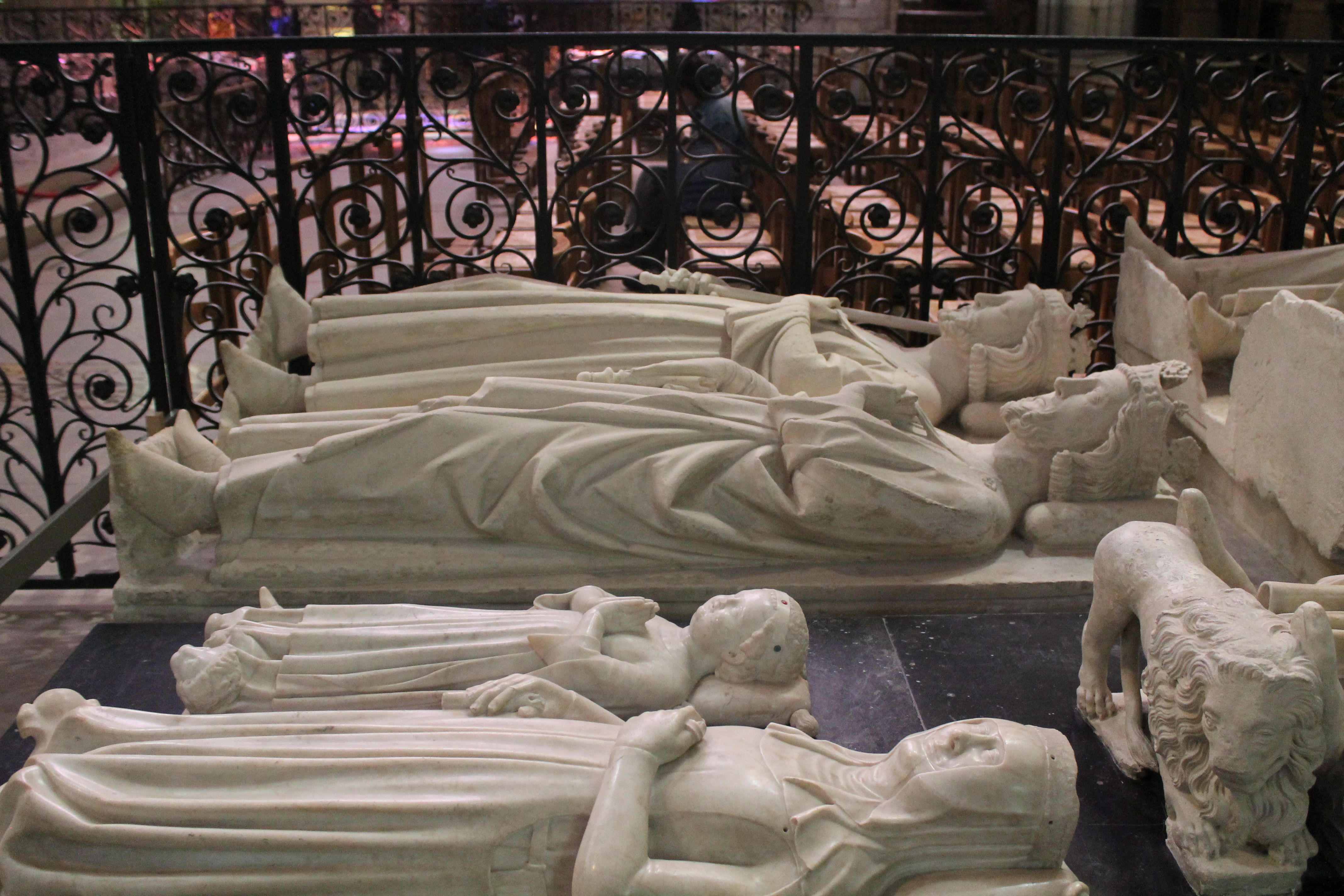
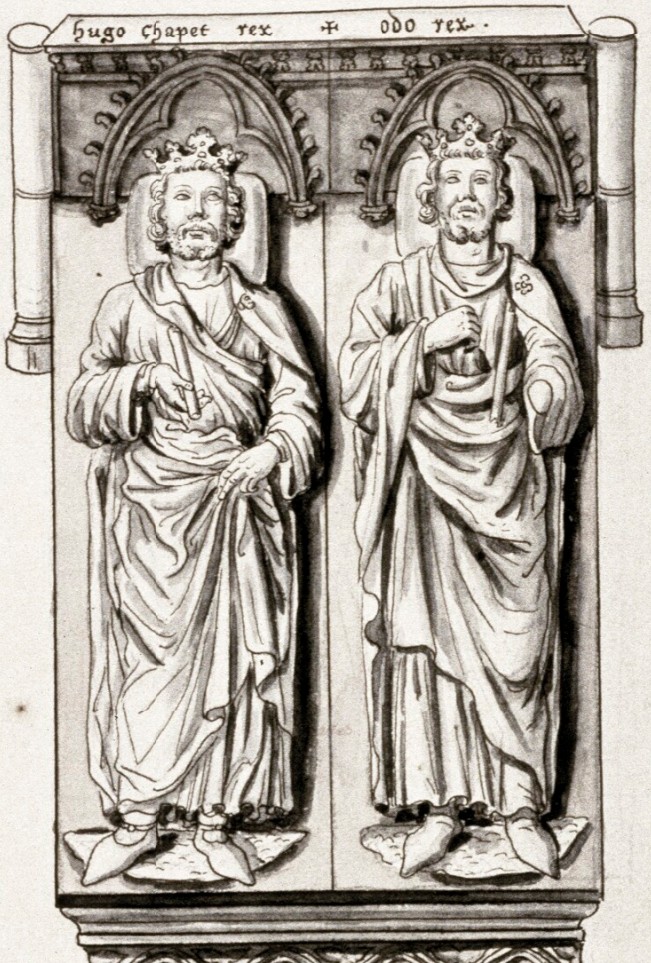 |
Tomb of kings Hugh Capet and Odo in the Abbey
of Saint-Denis, Paris, West Francia
The illustration is noted
"TOMBEAU de pierre a droite du grand Autel dans le Choeur de
l'Eglise de l'Abbaye de S.t Denis. Il est de Hugues Capet mort
l'an 997."
which translates to
"TOMB of stone to the right of the high altar in the Choir of the
Church of the Abbey of Saint-Denis. It is of Hugh Capet, who died
in the year 997."
|
before the altar of the holy
Trinity in the basilica
of Saint-Denis, Paris, France
Hugonis
Floriacensis Modernorum Regum Francorum Actus in Monumenta
Germaniæ Historica SS 9 p385 (ed. G. H. Pertz, 1851)
Porro
rex Francorum Hugo anno regni sui undecimo Miliduni defungitur, et in
ecclesia sancti Dionisii tumulatur, relinquens sibi successorem filium
suum Rotbertum.
This roughly translates as:
Furthermore,
Hugh, King of the Franks, died at Melun in the eleventh year of his
reign, and was entombed in the church of Saint Denis, leaving as his
successor his son Robert.
Hugh's tomb illustrated here was destroyed during the Franch Revolution.
- The Encyclopaedia Britannica 11th edition vol
13 p858 (ed. Hugh Chisholm, 1911); The
Henry Project: The Ancestors of King Henry II of England (Hugues
Capet); Medieval
Lands (HUGUES); wikipedia
(Hugh Capet)
- The Encyclopaedia Britannica 11th edition vol
13 p858 (ed. Hugh Chisholm, 1911); The
Henry Project: The Ancestors of King Henry II of England (Hugues
Capet); Medieval
Lands (HUGUES); wikipedia
(Hugh Capet)
- Helgardi Flor. Epitome Vitæ Roberti Regis
in Recueil des historiens des Gaules et de la
France vol 10 p99 (1874); The Encyclopaedia Britannica 11th edition vol
13 p858 (ed. Hugh Chisholm, 1911); The
Henry Project: The Ancestors of King Henry II of England (Hugues
Capet); Medieval
Lands (HUGUES); wikipedia
(Hugh Capet)
- The
Henry Project: The Ancestors of King Henry II of England (Hugues
Capet); Medieval
Lands (HUGUES); wikipedia
(Hugh Capet)
- The ecclesiastical history of England and Normandy
by Ordericus Vitalis vol 1 pp141-2 (trans. Thomas
Forester, 1853); The Encyclopaedia Britannica 11th edition vol
13 p858 (ed. Hugh Chisholm, 1911); The
Henry Project: The Ancestors of King Henry II of England (Hugues
Capet); Medieval
Lands (HUGUES); wikipedia
(Hugh Capet)
- Études sur le règne de Hugues Capet
(Ferdinand Lot, 1903); The ecclesiastical history of England and Normandy
by Ordericus Vitalis vol 1 pp141-2 (trans. Thomas
Forester, 1853); The Encyclopaedia Britannica 11th edition vol
13 p858 (ed. Hugh Chisholm, 1911); Medieval
Lands (HUGUES); wikipedia
(Hugh Capet)
- Richeri Historiarum Liber IV in Richer:
Histoire de son temps vol 2 p308 (ed. J. Gaudet, 1845); Recueil des historiens de la France: Obituaires de
la province de Sens vol 1 p329 (1902); The Encyclopaedia Britannica 11th edition vol
23 p399 (ed. Hugh Chisholm, 1911); The
Henry Project: The Ancestors of King Henry II of England (Hugues
Capet); Medieval
Lands (HUGUES); wikipedia
(Hugh Capet)
- Hugonis Floriacensis Modernorum Regum Francorum
Actus in Monumenta Germaniæ
Historica SS 9 p385 (ed. G. H. Pertz, 1851); exact place
in the basilica from Adonis archiepiscopi Viennensis chronicon
continuatio altera in Monumenta
Germaniæ Historica SS 2 p326 (ed. G. H. Pertz, 1829); Bodleian
Library MS. Gough Drawings Gaignières 2; The
Henry Project: The Ancestors of King Henry II of England (Hugues
Capet); Medieval
Lands (HUGUES); wikipedia
(Hugh Capet)
Hugh de Vermandois
 |
|
Hugh, count of Vermandois, as depicted in
the Wolfenbüttel manuscript of the Chronica
sancti Pantaleonis from the second half of the 12th
century
|
Henry I of
France
Anne
of Kiev
Hugonis
Floriacensis Modernorum Regum Francorum Actus in Monumenta
Germaniæ Historica SS 9 pp388-9 (ed. G. H. Pertz, 1851)
Rex etiam accepit in coniugium filiam regis Russorum Annam, quae ei
tres genuit filios, Philippum videlicet, Hugonem atque Rotbertum.
This roughly translates as:
In the year 982
The king also married Anna, the daughter of the king of the Russians,
who bore him three sons, namely Philip, Hugh, and Robert.
Adelaide
de Vermandois
Genealogiae
Scriptoris Fusniacensis in Monumenta
Germaniæ Historica SS 13 p253 (1881)
7. Nunc ad Hugonem Magnum revertamur. Hugo cognomento Magnus, frater
Philippi regis Francorum, de Adelaide comitissa Veromandensium genuit
Radulfum comitem Veromandie et Henricum de Chauni et Simonem episcopum
Noviomensem et filias. De quarum una Bonefacius marchio genuit
Bonefacium archidiaconum Noviomensem et filios et filias; quarum una
nupsit Guilelmo de Monte-pessulano. Secunda filia Hugonis Magni ex
Radulfo de Baugenci peperit Simonem eiusdem loci principem. Tercia
filia ex Ioifrido de Firmitate-Galceri genuit uxorem Simonis de
Oisiaco. Quarta filia nupsit comiti de Meslent, cui peperit filios,
quorum unus successit patri in comitatu, alter vero comitatem tenuit
de Cirecestre.
This roughly translates as:
7. Now
let us return to Hugh the Great. Hugh, surnamed the Great, brother of
Philip, king of the Franks, begat by Adelaide, countess of the
Vermandois: Ralph, count of Vermandois; Henry of Chauny; Simon, Bishop
of Noyon; and several daughters. From one of these daughters, Boniface
the marquess begat Boniface, archdeacon of Noyon, as well as other sons
and daughters; one of these daughters married William of Montpellier.
The second daughter of Hugh the Great, by Ralph of Beaugency, gave birth
to Simon, lord of that same place. The third daughter, by Geoffrey of La
Ferté-Gaucher, begat the wife of Simon of Oisy. The fourth daughter
[Isabel] married the count of Meulan, to whom she bore sons: one of
these succeeded his father in the county [Meulan], while the other held
the earldom of Leicester (Cirecestre).
Count of Vermandois, and
crusader
Hugh succeeded to the county of Vermandois on the death of his father-in-law
in 1080
Hugh, count of Vermandois, occupied a unique and often difficult position in
medieval history: he was the son of a king (Henry I of France), the brother
of a king (Philip I), but a man whose own legacy was defined by a desperate
search for redemption.
As the royal representative of the French crown, Hugh was the first
prince to set out for the Holy Land in 1096 as part of the First
Crusade. His journey began with a mix of high-altitude arrogance and
literal disaster. After sending a famous, haughty message to the Byzantine Emperor Alexios I
demanding a grand welcome, his fleet was decimated by a storm in the
Adriatic Sea. Hugh was washed ashore near Dyrrhachium, not as a conquering
hero, but as a shipwrecked castaway.
Despite this humiliating start, he proved himself a capable commander
during the early stages of the crusade. He was a key figure at the Siege
of Nicaea and played a vital role at the Battle
of Dorylaeum, where his timely arrival with reinforcements saved the
vanguard of the army.
Hugh’s reputation took a fatal blow during the grueling Siege
of Antioch (1097–1098). After the city fell to the crusaders but was
immediately besieged by a massive Turkish relief army, the crusaders were
pushed to the brink of starvation. Once the crusaders miraculously broke the
siege, they sent Hugh to Constantinople to ask Emperor Alexios for promised
assistance. When the Emperor declined to move, Hugh, instead of returning to
his starving comrades as they marched on Jerusalem, simply gave up and went
home to France.
To the medieval world, this was an unforgivable betrayal. While the
rest of the army went on to capture Jerusalem in 1099, Hugh was branded a
"vow-breaker" and a coward. He was publicly shamed, and the Church
threatened him with excommunication if he did not return to the East to
fulfill his pilgrimage to the Holy Sepulchre.
In the midst of this social disgrace, Hugh managed a significant
political feat: the marriage of his daughter, Isabel de Vermandois, to the
powerful Robert de Beaumont, count of Meulan. Because Robert and Isabel were
distant cousins (related within the prohibited fourth degree of
consanguinity), the marriage required a papal dispensation. Hugh used his
royal blood and his status as a "crusader in waiting" to navigate the
complex ecclesiastical politics of the time. While the marriage was
initially contested by some church officials, it was eventually allowed to
stand. This union was vital for Hugh; it secured a powerful ally in the
Anglo-Norman world at a time when his own prestige was at its lowest point.
Driven by the need to wipe away his shame, Hugh joined the Crusade
of 1101 (often called the "Crusade of the Faint-Hearted"). This
expedition was a disaster. In September 1101, his forces were ambushed by
the Seljuk Turks at the Battle
of Mersivan (near Heraclea). Hugh fought bravely this time, but he was
severely wounded by an arrow. He managed to escape the slaughter and
retreated to the city of Tarsus. He died there from his wounds on October
18, 1101. Unlike the many crusaders who never received a proper monument,
Hugh was buried with honors in the Church of St. Paul in Tarsus. Though he
never reached Jerusalem, his death in battle was generally accepted as the
"blood penance" that restored his family's honor.
The Alexiad of Anna Comnena Book X pp179-80
(trans. Elizabeth A. Dawes, 1928)
VII. One
Ubus {= Hugh, Count of Vermandois}, brother of the King of France, and
as proud as Novatus of his nobility, riches and power, when on the point
of leaving his native land, ostensibly to go to the Holy Sepulchre, sent
a ridiculous message to the Emperor, with a view to arranging beforehand
that he should have a magnificent reception. "Know, O Emperor," he
wrote, "that I am the king of kings and the greatest of those under
heaven; and it behoves you to meet and treat me on arrival with all pomp
and in a manner worthy of my nobility." At the time that this message
arrived, John, the son of the Sebastocrator Isaac (of whom mention has
been made above) happened to be Duke of Dyrrachium, and Nicolas
Mavrocatacalon, a Duke of the Fleet, had anchored the ships at intervals
round the harbour of Dyrrachium, and made frequent excursions from there
and scoured the seas so that no pirate ships might sail past without his
noticing them. On receipt of this message the Emperor at once sent
letters to these two, commanding the Duke of Dyrrachium to keep watch
over land and sea for the Franks' coming, and to signify the Emperor of
his arrival at once by a swift messenger, bidding him also receive Ubus
with all ceremony, and exhort the Duke of the Fleet in no way to relax
his vigilance or be negligent, but to be on the look-out all the time.
When Ubus had arrived safely at the seaboard of Lombardy, he sent
ambassadors from there to the Duke of Dyrrachium, twenty four in number,
protected with cuirasses and greaves of gold, together with the Count
Tzerpenterius {= Charpentier (?)} and Elias who had deserted from the
Emperor at Thessalonica. They spoke as follows to the Duke, “Be it known
to thee, Duke, that our Lord Ubus is on the point of arriving, and is
bringing with him from Rome the golden standard of Saint Peter.
Understand, too, that he is the leader of the whole Frankish army.
Therefore prepare a reception for him, and the forces under him, which
will be worthy of His Highness, and get ready yourself to meet him.”
While the envoys were thus speaking to the Duke, Ubus, who, as has been
said, travelled through Rome to Lombardy, and was crossing from Bari to
Illyria, was caught in a very severe storm and lost the greater number
of his vessels, crews, soldiers and all, and only the one skiff on which
he was, was spat out, so to say, by the waves on to the coast between
Dyrrachium and a place called Palus, and he on it half-broken. After he
had been thus miraculously saved, two of the men who were on the
look-out for his arrival, found him, and addressing him by name, said,
“The Duke is anxiously looking for your coming, and is most desirous to
see you.” Thereupon Ubus at once asked for a horse, and one of the two
men dismounted and very willingly gave him his horse. Thus the Duke met
him after his deliverance, and welcomed him and asked him about his
journey and his country, and heard about the disaster which overtook him
on his crossing; so he comforted him with fair promises, and finally set
a rich banquet before him. After the feast he detained him and left him,
not without supervision, but certainly free. He speedily acquainted the
Emperor with the facts, and then waited to receive further instructions.
On receipt of the news the Emperor quickly sent Butumites to Epidamnus
(which we have often called Dyrrachium) to fetch Ubus and escort him to
the capital, but not to travel along the direct road, but to deviate
from it, and pass through Philippopolis. For he was afraid of the
Frankish hosts and armies which were coming behind him. The Emperor
received him with all honour and shewed him much friendliness, and by
also giving him a large sum of money he persuaded him to become his
‘man’ at once and to swear thereto by the customary oath of the Latins.
Hugh's imprisonment in Constantinople led to reprisals from the Crusader
forces and his release. He then distinguished himself in battle, but is more
remembered for his failure as an emissary to the emperor Alexios to secure
his assistance to the Crusaders, after whic he returned home to France
rather than rejoining the Crusade.
The history of the crusades pp89-90
(Joseph François Michaud, trans. by W. Robson, 1852)
The
count de Vermandois, cast by a tempest on the shores of Epirus, received
the greatest honours from the governor of Durazzo, and was led a
prisoner to Constantinople by the orders of Alexis. The Greek emperor
hoped that the brother of the king of France would become, in his hands,
a hostage that might protect him from the enterprizes of the Latins; but
he only awakened suspicion, and provoked the hatred of the leaders of
the crusade. Godfrey de Bouillon had arrived at Philippopoli, when he
heard of the captivity of the count de Vermandois. He sent to the
emperor to demand instant reparation for this outrage; and as the
deputies reported but an unfavourable answer, he restrained neither his
own indignation nor the fury of his army. The lands through which they
passed were treated as an enemy’s country, and during eight days the
fertile plains of Thrace became the theatre of war. The crowd of Greeks
who fled towards the capital soon informed the emperor of the terrible
vengeance of the Latins. Alexis, terrified at the fruits of his own
policy, implored the pardon of his prisoner, and promised to restore him
his liberty when the French should have arrived at the gates of
Constantinople. This promise appeased Godfrey, who caused the war to
cease, and resumed his march, treating the Greeks everywhere as friends
and allies.
In the meanwhile, Alexis employed every effort to obtain from the
count de Vermandois the oath of obedience and fidelity, hoping that his
submission would lead to that of the other princes of the crusade, and
that he should have less to fear from their ambition if he could reckon
them in the number of his vassals. The brother of the king of France,
who, on arriving in the territories of the empire, had written letters
filled with pride and ostentation, could not resist the caresses and
presents of the emperor, and took all the oaths that were required of
him. On the arrival of Godfrey, he appeared in the camp of the
Crusaders, who rejoiced at his deliverance, but could not pardon him for
having yielded submission to a foreign monarch. Cries of indignation
arose around him when he endeavoured to persuade Godfrey to follow his
example. The more gentle and submissive he had shown himself in his
captivity, the more strong became the opposition and resistance to the
will of the emperor of his companions, who had drawn their swords to
avenge the insult offered to him.
p142
The whole army
spoke of the lance-thrusts and marvellous feats of arms of the count de
Yermandois and the two Roberts
p170
Two thousand
men of his army, who guarded the passage of the bridge of Antioch, were
cut in pieces by the count de Vermandois.
p177
The
Crusaders sent at the same time an embassy to Constantinople, composed
of Hugh, count of Yermandois, and Baldwin, count of Hainault, The object
of this embassy was to remind the emperor Alexius of the promise he had
made to accompany the Christians with an army to Jerusalem. The count of
Hainault perished, with all his train, in Asia Minor. The count of
Vermandois, who took a different route, arrived safely at
Constantinople; but could obtain nothing from Alexius. Hereupon, whether
he was ashamed of having failed in his mission, or whether he feared to
rejoin an army in which he could not maintain the splendour of his rank,
he determined to return to Europe, where his desertion caused him to be
compared to the raven of the ark.
The ecclesiastical history of England and Normandy by
Ordericus Vitalis vol 3 p149 (trans. Thomas Forester, 1854)
IN
the month of July, after having, by the grace of God, gained the
victory, and established their authority in Antioch, the Christian
chiefs held a council, and by common agreement commissioned Hugh the
Great to proceed to the court of the emperor Alexius at Constantinople
and offer him the immediate possession of the city which they had
purchased for him at the cost of so much suffering, calling upon him at
the same time to observe the terms of the treaty which he had sworn to
on his part, viz., that he would resolutely accompany them in their
march to Jerusalem. Hugh the Great departed on this mission; but
although he had hitherto conducted himself with great ability during the
crusade both in the field and in council, he was very deficient on this
occasion, for, like the raven sent forth from the ark, he never
fulfilled as he ought, his promise of returning again.3
3 According to Ralph of Caen, Hugh the Great had been
wounded in the thigh, and went to Tarsus for the recovery of his health.
The Encyclopaedia Britannica 11th edition vol
27 p1024 (ed. Hugh Chisholm, 1911)
VERMANDOIS.
… Adela, whose first husband was Hugh the Great, the brother of king
Philip I. Hugh was one of the leaders of the first crusade, and died in
1102 at Tarsus in Cilicia. The eldest son of Hugh and Adela was count
Raoul (Rudolph) I. (c. 1120-1152), who married Alix of Guyenne,
sister of the queen, Eleanor, and had by her three children: Raoul
(Rudolph) II., the Leper (count from 1152-67); Isabelle, who possessed
from 1167 to 1183 the countships of Vermandois, Valois and Amiens
conjointly with her husband, Philip of Alsace, count of Flanders; and
Eleanor.
18 October 1101, in Tarsus,
Cilicia, from arrow
wounds received in battle during the Crusade
of 1101
The history of the crusades pp253-4
(Joseph François Michaud, trans. by W. Robson, 1852)
A third
troop, composed, according to the authors of the time, of more than a
hundred and fifty thousand pilgrims, set out from Constantinople under
the orders of the count of Poictiers, the duke of Bavaria, and Hugh de
Vermandois. They took possession of Philomelium and Samalia, and marched
across devastated provinces towards the city of Stankon, where they
expected to unite themselves with the army of the count de Nevers. It
was before this city that the pilgrims heard of the disasters and defeat
of the Christian armies that had preceded them. They advanced towards
Heraclea, and were not long in meeting with the army of Kilidge Arslan,
which was waiting for them in an advantageous position. As they had no
longer anything to hope for except from their courage, they did not seek
to avoid the enemy. A rivulet which separated the Christians from the
infidels, was the signal and the theatre of battle. The Crusaders,
pressed by thirst, rushed towards it in crowds. The Turks immediately
discharged upon them a shower of javelins and arrows. The two armies
were soon completely engaged; but the Christians fighting in a confined
and marshy place, could neither draw up their forces nor make use of the
lance or the sword. Their bravery and their efforts were of no avail
against the skilful manoeuvres ot Kerboghâ and Kilidge Arslan. The Turks
penetrated the Christian army every where; the carnage was horrible;
scarcely a thousand of the Crusaders escaped from either death or
slavery. The margravine of Austria disappeared amidst the tumult of the
battle. Some say that she was crushed under the feet of the horses;
whilst others assert that she fell into the hands of the enemy, and went
to live and die in the harem of the sultan of Mossoul. The greater part
of the women and young girls that followed the Christian army met with
the same fate. The count of Vermandois, pierced by two arrows, fled
across Lycaonia, and arrived with a feeble escort at the city of Tarsus,
where he died of his wounds.
A
History of the Crusades vol 2 p29 (Steven Runciman, 1987)
Hugh of
Vermandois was badly wounded in the battle; but some of his men rescued
him and he too reached Tarsus. But he was a dying man. His death took
place on 18 October and they buried him there in the Cathedral of St
Paul. He never fulfilled his vow to go to Jerusalem.
Church of St. Paul in Tarsus,
Cilicia
Guillelmi Tyrensis Historia Rerum in Patrologiæ
Latina vol 201 p58 (ed. J.P Migne, 1855)
CAPUT
XIII.
… Quibus autem concessum est divinitus hostium manus effugere, hi nudi
vacuique, amissis sarcinis, et omnimoda supellectile perdita, salutem
quocunque modo invenerunt; tandemque casu magis quam industria, in
Ciliciam pervenientes, apud Tarsum ejusdem provinciæ metropolim,
dominum Hugonem Magnum, fatali sublatum necesitate amiserunt: quo in
ecclesia doctoris gentium, qui ex eadem fuit oriundus civitate,
magnifice sepulto, refocillati per dies aliquot, resumpto itinere,
Antiochiam pervenerunt.
This roughly translates as:
Moreover, those
to whom it was granted by divine [will] to escape the hands of the
enemies—these [men], naked and empty-handed, their baggage lost and
every kind of equipment destroyed, found safety in whatever way they
could; and at last, arriving in Cilicia more by chance than by industry
[effort], at Tarsus, the metropolis of that same province, they lost
Lord Hugh the Great, who was taken away by fatal necessity. After he was
magnificently buried in the church of the Teacher of the Gentiles [St.
Paul], who was a native of that same city, [the survivors], having been
refreshed for some days and having resumed their journey, arrived at
Antioch.
- Hugonis Floriacensis Modernorum Regum Francorum
Actus in Monumenta Germaniæ
Historica SS 9 pp388-9 (ed. G. H. Pertz, 1851); Dictionary of national biography vol 59
p374 (ed. Sidney Lee, 1899); The Complete Peerage vol 12 part 1 p496
(George Edward Cokayne, enlarged by Geoffrey H. White, 1953); wikipedia
(Hugh, Count of Vermandois)
- Hugonis Floriacensis Modernorum Regum Francorum
Actus in Monumenta Germaniæ
Historica SS 9 pp388-9 (ed. G. H. Pertz, 1851); wikipedia
(Hugh, Count of Vermandois)
- Genealogiae Scriptoris Fusniacensis in Monumenta Germaniæ Historica SS 13 p253
(1881); Medieval
Lands (HUGUES de France); wikipedia
(Hugh, Count of Vermandois))
- Cartulaire de l'Abbaye de Saint-Corneille de
Compiègne vol 1 p71
(ed. E. Morel, 1904); Genealogiae Scriptoris Fusniacensis in Monumenta Germaniæ Historica SS 13 p253
(1881); Medieval
Lands (HUGUES de France); wikipedia
(Hugh, Count of Vermandois)
- wikipedia
(Hugh, Count of Vermandois)
- The Alexiad of Anna Comnena Book X
pp179-80 (trans. Elizabeth A. Dawes, 1928); The ecclesiastical history of England and Normandy
by Ordericus Vitalis vol 3 p149 (trans. Thomas Forester,
1854); The history of the crusades (Joseph
François Michaud, trans. by W. Robson, 1852); The Encyclopaedia Britannica 11th edition vol
27 p1024 (ed. Hugh Chisholm, 1911); Medieval
Lands (HUGUES de France); wikipedia
(Hugh, Count of Vermandois)
- The history of the crusades pp253-4
(Joseph François Michaud, trans. by W. Robson, 1852); A History of the Crusades vol 2 p29
(Steven Runciman, 1987); wikipedia
(Hugh, Count of Vermandois)
- Guillelmi Tyrensis Historia Rerum in Patrologiæ Latina vol 201 p58 (ed. J.P
Migne, 1855); A History of the Crusades vol 2 p29
(Steven Runciman, 1987); wikipedia
(Hugh, Count of Vermandois)
Isabel de Vermandois
also called Elizabeth
Hugh de
Vermandois
Adelaide
de Vermandois
Robert
de Beaumont, count of Meulan, in 1096
This marriage was opposed by the bishop Ivo
of Chartres on the grounds that Robert and Isabel were related within
a prohibited fourth degree of consanguinity, and in his Letter 45 he forbids
priests from performing the ceremony. Isabel's father used his royal blood
and his status as a "crusader in waiting" to navigate the complex
ecclesiastical politics of the time and obtain a dispensation from Pope
Urban II to allow the marriage and secure his family a rich and
powerful ally.
Epistolae Ivonis Carnotensis in Patrologiæ
Latina vol 162 p58 (ed. J.P Migne, 1889)
EPISTOLA XLV.
Ivo, Dei gratia Carnotensis episcopus, clericis Mellentinis, et
omnibus in. Pixiacensi archidiaconatu, salutem.
Perlatum est ad aures nostras quod Mellentinus comes
ducere velit in uxorem filiam Hugonis Crispeiensis comitis; quod fieri
non. sinit concors deeretorum et canonum sanctio, dicens: «
Conjunctiones consanguineorum fleri prohibemus.» Horum autem
consanguinitas nec ignota est, nec remota, sicut testantur et probare
parati sunt præclari viri de eadem sati prosapia. Dicunt enim quia
Gualterius Albus genuit matrem Gualeranni comitis, qui genuit matrem
Roberti comitis. Item supradictus Gualterius genuit Radulphum patrem
alterius Radulfi, qui genuit Vermandensem comitissam, ex qua nata est
uxor comitis Hugonis cujus filiam nunc ducere vult Mellentinus comes.
Si autem prædicta genealogia ita sibi coheret, legitimum non poterit
esse conjugium, sed incestum contubernium, nec filios poterunt habere
legitimos, sed spurios. Unde vobis ex apostolica et canonica
auctoritate præcipimus, ut tam calumniosum conjugium in ecelesiis
nostri episcopatus nec ipsi conseeretis, neo ab aliquo, quantum in
vobis est, conseerari permittatis, nisi primum in præsentia nostri
consanguinitas hec septimum gradum excessisse legitime fuerit
comprobata. Valete, et has litteras Mellentino comiti transmittite.
This roughly translates as:
Letter 45
Ivo, by the grace of God Bishop of Chartres, to the clergy of
Meulan, and to all in the archdeaconry of Poissy: Greeting.
It has been brought to our ears that the count of Meulan [Robert
de Beaumont] wishes to take as his wife the daughter of Hugh, count of
Crépy [Hugh of Vermandois]; which thing the harmonious authority of
decrees and canons does not allow to happen, saying: "We prohibit the
unions of blood-relatives to be made." Moreover, the consanguinity of
these persons is neither unknown nor remote, as illustrious men born of
the same lineage testify and are prepared to prove. For they say that
Walter Albus begat the mother of count Waleran, who [Waleran] begat the
mother of count Robert. Likewise, the aforementioned Walter begat Ralph,
the father of another Ralph, who begat the countess of Vermandois, from
whom was born the wife of count Hugh, whose daughter the count of Meulan
now wishes to take in marriage. If, however, the aforesaid genealogy so
holds itself together, the marriage cannot be legitimate, but an
incestuous cohabitation (incestum contubernium), nor can they have
legitimate children, but bastards (spurios). Wherefore we command you,
by apostolic and canonical authority, that you yourselves neither
consecrate such a shameful marriage in the churches of our bishopric,
nor permit it to be consecrated by anyone, as much as lies in you,
unless first, in our presence, this consanguinity shall have been
lawfully proved to have exceeded the seventh degree. Farewell, and
transmit these letters to the Count of Meulan.
However, the marriage between the young Isabel and the much older Robert de
Beaumopnt was not successful, despite their many children. Henry of
Huntingdon claims in his letter De Contemptu Mundi
that Isabel was stolen by a count, presumably William de Warenne, leading
Robert into depression, madness and death. The account is questioned by
modern historians, but it is known, nonetheless, that William married Isabel
very shortly after Robert's death on 5 June 1118.
Henrici archidiaconi huntendunensis Historia Anglorum
pp306-7 (ed. Thomas Arnold, 1879)
Epistola de Contemptu Mundi
Fuit igitur and Robertus consul de Mellend in rebus sæcularibus
sapientissimus omnium hinc usque in Jerusalem degentium. Fuit scientia
clarus, eloquio blandus, astutia perspicax, providentia sagax, ingenio
versipellis, prudentia insuperabilis, consilio profundus, sapientia
magnus. Possessiones igitur magnas et varias, quas vulgo vocant
honores, et urbes et castella, vicos et villas, flumina et silvas,
prædictis acquisierat instrumentis. Erant autem honores ejus non solum
in Anglia, sed etiam in Normannia et Francia. Pro libitu suo igitur
reges Francorum et Anglorum nunc concordes uniebantur, nunc discordes
præliabantura. Si adversus aliquem insurgebat, contritus
humiliabatur. Si prodesse volebat, gloriosus exaltabatur. Hinc
thesauri copia, scilicet auri et argenti, gemmarum et palliorum,
incredibiliter ei confluxit.
§ 8. Cum igitur in summo statu gloriæ suæ degeret, contigit
quemdam alium consulem sponsam ei tam factione quam dolosis viribus
arripuisse. Unde in senectute sua mente turbatus et angaria
obnubilatus, in tenebras mœroris incidit; nec usque ad mortem se lætum
vel hilarem sensit. Cum igitur post dies dolori dedicatos in
infirmitatem mortis prænuntiam incidisset, rogatus est ab
archiepiscopo et sacerdotibus, cum ei confessionis purgatorium
impenderent officium, ut terras quas vi vel arte multis abstulerat,
pœnitens redderet, et erratum lacrymis lavaret. Quibus respondens ait:
“Si terras quas aggregavi multifariam divisero, quid miser filiis meis
relinquam?” Cui contra ministri Domini: “Sufficient filiis tuis
hæreditates pristinæ, et quas juste terras acquisisti. Cætera redde.
Alioquin animam devovisti gehennæ.” Respondit autem consul: “Filiis
omnia tradam; ipsi pro salute defuncti misericorditer agant.” Eo autem
defuncto, filii ejus magis injuste congregata injuste studuerunt
augere, quam aliquid pro salute paterna distribuere. Liquet igitur
summam viri sapientiam in fine, quod laus canitur, non solum in summam
stultitiam, sed in cœcam devenisse insaniam.
a For a remarkable illustration of
the influence possessed by the count of Mellent over the mind of William
Rufus, see Ordericus, x., ch. 7. The character given to him by
Malmesbury, except that he says nothing in his dispraise, is in close
agreement with that drawn by Henry. Mellent died in 1118: (Ord. Vit.,
xii. 1).
This roughly translates as:
A Letter
on Contempt for the World
There was, therefore, Robert, Count of Meulan, who in secular affairs
was the wisest of all those living between here and Jerusalem. He was
renowned for his knowledge, smooth in speech, sharp in cunning, shrewd
in foresight, versatile in talent, insuperable in prudence, profound in
counsel, and great in wisdom. By these aforementioned means, he had
acquired great and varied possessions—which are commonly called
"honors"—as well as cities and castles, towns and manors, rivers and
forests. Moreover, his honors were not only in England, but also in
Normandy and France. At his pleasure, the kings of the Franks and the
English were at one moment united in peace, and at the next, clashing in
discord. If he rose up against anyone, they were crushed and humbled; if
he wished to benefit someone, they were gloriously exalted. Because of
this, an incredible abundance of treasure—namely gold and silver, gems
and fine silks—flowed to him.
§ 8. Thus, while he was living at the very peak of his glory, it
happened that a certain other count snatched away his wife, both by
intrigue and by deceitful force. Because of this, in his old age,
troubled in mind and clouded by anguish, he fell into the darkness of
sorrow; nor did he feel glad or cheerful again until the day of his
death. Therefore, when after days dedicated to grief he had fallen into
the sickness that heralded death, he was asked by the archbishop and
priests (as they were performing the office of confession to purge his
soul) that he should penitently return the lands which he had taken from
many by force or craft, and wash away his error with tears. Answering
them, he said: "If I divide up the lands I have gathered in so many
ways, what, wretched man that I am, shall I leave to my sons?" To him
the ministers of the Lord countered: "The ancient inheritances and the
lands you acquired justly will suffice for your sons. Return the rest;
otherwise, you have devoted your soul to Gehenna (Hell)." But the Count
replied: "I will hand over everything to my sons; let them act
mercifully for the salvation of my departed soul." However, once he was
dead, his sons strove to unjustly increase what had been unjustly
gathered, rather than distribute anything for their father's salvation.
It is clear, therefore, that in the end—where the final praise is
sung—the man's great wisdom turned out to be not only great folly, but
blind madness.
The Complete Peerage vol 7 pp523-6 (George
Edward Cokayne, enlarged by Geoffrey H. White, 1953)
LEICESTER
EARLDOM.
I. 1107?.
1. ROBERT DE BEAUMONT,
SEIGNEUR OF BEAUMONT, PONT-AUDEMER,
BRIONNE AND VATTEVILLE in Normandy, and
from 1081 COUNT OF MEULAN in the French
Vexin, s. and h., b. circa 1046. When very young he accompanied
Duke William to England and distinguished himself at the battle of
Hastings, and received large grants of lands in co. Warwick, with
smaller holdings in cos. Leicester, Northants, and Wilts. (g)
On 14 July 1080, as Robert de Bellomonte, he witnessed the
foundation charter of Lessay, and next year he inherited from his
mother’s family the comté of Meulan. (b) Thereafter
he is continuously styled Count (Comes) of Meulan. After the
death of the Conqueror he adhered to William Rufus, and was high in
favour at his court. He quarrelled with Robert of Normandy about the
castellanship of Brionne, in consequence of the exchange of Brionne for
Ivry made by his father. He was imprisoned, but was released at the
intercession of his father Roger, who eventually succeeded in obtaining
Brionne in fee. He succeeded to the greater part of his father’s lands
in Normandy, including Beaumont, Pont- Audemer, Vatteville and Brionne.
This paternal inheritance, added to his French comté and his
great possessions in cos. Warwick and Leicester, made him one of the
most powerful vassals of the Crown. He became one of the chief lay
ministers of William Rufus, with whom he sided against Robert Courtheuse
in 1098, and when William invaded the French Vexin in 1097 he received
his troops in his fortresses of the comté of Meulan. After the
death of William Rufus he became one of the chief advisers of Henry I.
On the death of Ives de Grandmesnil on Crusade, Robert retained his
estates, which Ives had mortgaged to him circa 1102. Thereby he
acquired one-quarter of the town of Leicester, the whole of which was
later granted to him by the King. Robert thus added largely to his
already vast possessions. In 1104 he was one of the Norman barons who
adhered to Henry on his arrival in Normandy. He was present in the
King’s army at Tenchebrai, 28 Sep. 1106. In 1110 he was besieged at
Meulan by Louis VI, who took the castle by storm, but in the following
year he retaliated by a raid on Paris, which he plundered. After
obtaining the whole town of Leicester he is said to have become EARL OF
LEICESTER, but, being already Count of Meulan, was never so styled.
There is no contemporary record that he had the third penny of the pleas
of the county, but he doubtless acquired, with the Grandmesnil fief, the
third penny of the issues of the Mint at Leicester. He m., in
1096, (a) Isabel, called also Elizabeth, da. of Hugh DE
CRÉPI, called Hugh “le Grand,” COUNT OF VERMANDOIS.
(b) He d. 5 June 1118, and was bur. with his
ancestors in the chapter house of Préaux.(c) His widow m.,
very shortly after his death, William (DE WARENNE),
EARL OF SURREY.(d)
(g) At the time of Domesday (1086) his holding in co.
Warwick was very large. It was combined not long after with that of
Turchil of Warwick, and acquired by Robert’s younger brother Henry, who
was created Earl of Warwick (Round, Intro. to Warwickshire Domesday,
V.C.H. Warwick, vol. i). In co. Leicester Robert’s holding was
small, and he had nothing in the town of Leicester, but he held in
demesne Aylestone (just outside the walls, now part of the city); and
Frolesworth, Huncote, Cosby and 6 carucates in Market Bosworth (Domesday
Book, fol. 231 d.). He is the first lay tenant named under Leicester in
the Survey.
(a)
Orderic (vol. ii, p. 404) states that he m., 1stly, Godechilde,
da. of Ralph de Tosny, and that she married, 2ndly, Baldwin of Boulogne,
afterwards King of Jerusalem. This latter marriage, which took place in
1096, when she was still a young girl, is attested by two
writers—namely, Albert of Aix and William of Tyre (Genealogist,
N.S., vol. x, p. 2). The marriage with Robert is therefore highly
improbable, and, moreover, Orderic does not suggest that it was annulled
on the ground of impediment, which would have been necessary to enable
her to marry Baldwin.
(b) Orderic, vol. iii, p. 480; vol. iv, p. 169. Ives,
Bishop of Chartres, wrote to the clergy of Meulan prohibiting the
solemnisation of the marriage on the ground of consanguinity (see G. W.
Watson, Genealogist, N.S., vol. x, where Ives’s letter is
printed at p. 11). At this time the names of Isabel and Elizabeth were
synonymous. The identity of the wife of Robert Count of Meulan with the
wife of William de Warenne is proved by the following charters: “Ego
Willielmus de Warenna et Ysabella Comitissa uxor mea et filii nostri
Willielmus scilicet et Radulfus damus etc. Deo et ecclesiae omnium
Sanctorum Belencombris et infirmis fratribus in ea servientibus etc.
culturas nostras de Sancto Martino etc. et ego Isabella Comitissa do et
concedo supradictis fratribus de haereditate et patrimonio meo de
Wellebosc c sol. Rothomagenses per annum concessu Waleranni Comitis
Mellenti filii mei …” (Mon., vol. vi, p. 1113); “Testibus his …
Gualeranno comite Mellenti, Willelmo comite Warenne fratre eius …”
(Haskins, Norman Institutions, p. 92). Compare also the
Continuation of William of Jumièges by Robert de Torigni, bk. viii, c.
40, 41; Robert de Torigni (ed. Delisle), vol. i, pp. 273, 274; Orderic,
vol. v, p. 128.
(c) Orderic, vol. iv, p. 313; cf. Round, Cal.
Docs., no. 331; Hist. de l’Abbaye de Lyre, par l’abbé Ch.
Guéry, p. 411; H.F., vol. xxiii, p. 487. Robert had three sons
and (according to Orderic, vol. iv, p. 169) five daughters. The sons
were Waleran and Robert, twins born in 1104, and Hugh. Waleran, the
eldest, succeeded to the Norman and French fiefs, and the English lands
held by his grandfather Roger de Beaumont in 1086. See for him and his
successors Appendix I in this volume. Robert succeeded his father as
Earl of Leicester, and Hugh is said to have been cr. Earl of
Bedford. The names of only four of the daughters appear to be
known—Adeline, Aubreye, Maud and Isabel or Elizabeth. Adeline m.
Hugh IV, Seigneur of Montfort-sur-Risle (Orderic, vol. iv, pp. 441,
444). Aubreye m. Hugh II, Seigneur of Châteauneuf-en-Thimerais
(Orderic, vol. iv, p. 441). Maud m. William Louvel, Seigneur of
Ivri and Breval (Orderic, vol. iv, p. 441). Isabel, also called
Elizabeth, was mistress of Henry I, and m. Gilbert de Clare,
Earl of Pembroke. See PEMBROKE.
(d) Her obit was observed at St. Nicaise-de-Meulan on
17 Feb. (H.F., Quarto, Obituaires de la Prov. de Sens, vol. ii,
p. 238 E). Henry of Huntingdon in his epistle to Walter, “De Contemptu
Mundi,” states that she eloped with a certain earl during Robert’s
lifetime, which may refer to some scandal, but the whole trend of the
letter does not inspire confidence in the facts stated therein.
William
de Warenne in 1118
Dictionary of national biography vol 59 pp374-5
(ed. Sidney Lee, 1899)
WARENNE
or WARREN, WILLIAM DE, second EARL OF
SURREY (d. 1138), … married the beautiful
Elizabeth, or Isabel, daughter of Hugh the Great, count of Vermandois, a
son of Henry I of France, and widow of Robert de Beaumont (d.
1118) [q. v.], count of Meulan, from whom he carried her off while
Robert was still living, though she was the mother of eight children (HEN.
HUNT. De Contemptu Mundi, sect. 8). She died on
13 Feb. 1131, and was buried at Lewes. By her he had three sons and two
daughters, William de Warenne (d. 1148) [q. v.], Reginald, and
Ralph (for Ralph see Monasticon, v. 15; the editors are mistaken
in heading Charter No. xi., in which the grantor speaks of Ralph ‘frater
meus,’ as given by William de Warenne (d. 1138), as may be seen
by the teste, one of the witnesses being Ascelin, bishop of
Rochester, who was not consecrated until 1142; the charter was therefore
given by William de Warenne (d. 1148), and Ralph was his
brother). Reginald was assured in the possession of the castles of
Bellencombre and Mortemer by the agreement made between Stephen and Duke
Henry (Henry II) in 1153, the rest of the Warenne inheritance passing to
Stephen’s son William (d. 1159) (Fœdera, i. 18); Reginald
was one of the persecutors of Archbishop Thomas in 1170, and became a
wealthy baron by his marriage with Adeline or Alice, daughter and sole
heir of William de Wormegay in Norfolk (WATSON, i. 67,
following CAMDEN, Britannia, col. 393, ed.
Gibson, maintains that the lord of Wormegay was Reginald, son of William
de Warenne, d. 1088, because in Reginald’s charter to St. Mary
Overy, Southwark—Monasticon, vi. 171— he speaks of ‘Isabella
comitissa domina mea’ as a different person from his mother, but the
Isabella of the charter was doubtless the grantor’s niece, the daughter
of William de Warenne, d. 1148). By Adeline Reginald had a son
William, who founded the priory of Wormegay (ib. vi. 591), and
left as his sole heir his daughter Beatrice, who married (1) Dodo, lord
Bardolf, and (2) Hubert de Burgh [q. v.], earl of Kent. Earl William’s
two daughters were Gundrada, who married (1) Roger de Beaumont, earl of
Warwick, and in 1153 expelled Stephen’s garrison from the castle of
Warwick and surrendered it to Henry; and (2) William, called Lancaster,
baron of Kendal, and, it is said, a third husband: and Ada or Adeline,
who in 1139 married Henry of Scotland [q.v.], son of David I.
The Encyclopaedia Britannica 11th edition vol
28 p324 (ed. Hugh Chisholm, 1911)
WARENNE,
EARLS.
… William, 2nd earl (c. 1071-1138), was a suitor for the hand of
Matilda of Scotland, afterwards queen of Henry I. He was temporarily
deprived of his earldom in 1101 for his support of Robert, duke of
Normandy, but he commanded at the battle of Tenchebrai (1106), and was
governor of Rouen in 1135. He carried off Elizabeth of Vermandois,
granddaughter of Henry I. of France, and wife of Robert, count of
Meulan, and married her in 1118 after her husband’s death.
Early
Yorkshire Charters vol 8 p9 (Charles Travis Clay, 1949)
[William de
Warenne] married shortly after the death of her first husband on 5 June
1118 Isabel, called also Elizabeth, daughter of Hugh count of
Vermandois, younger son of king Henry I of France. Her first husband was
Robert de Beaumont, count of Meulan, lord of Beaumont-le-Roger and Pont
Audemer in Normandy and of lands in England chiefly in cos. Warwick and
Leicester;6 and by him she was the mother of three sons and
four or five daughters.7 The two eldest sons, twins born in
1104, were Waleran, count of Meulan and earl of Worcester,8
and Robert earl of Leicester. She survived her second husband, William
de Warenne; and after his death, with the consent of her son the third
earl, gave the church of Dorking to Lewes priory.9 The terms
of a charter issued by the third earl suggest that she died in his
lifetime.10
6 Complete Peerage, new ed., vii, pp. 523-6.
He is said to have become earl of Leicester, but was never so styled.
7 Ibid., p. 526n.
8 For him and his descendants see ibid., p.
737 (App. I); and for his career in greater detail Mr. G. H. White in R.
Hist. Soc. Transactions, 4th ser., xvii, pp. 19-48.
9 Lewes Chartulary, f. 18v (S.R.S.,
i, 29). In one of the narrative accounts in the same (ii, 18) it is
stated that she died 13 Feb. 1131 in the seventh year before her
husband. More trustworthy evidence from another source shows that her
obit was observed on 17 Feb. (Complete Peerage, new ed., vii, 526n);
and the year 1131 is clearly wrong. Cf. also charter no, 35
below.
10 Charter no. 41.
The Complete Peerage vol 12 part 1 p496
(George Edward Cokayne, enlarged by Geoffrey H. White, 1953)
SURREY
EARLDOM.
II. 1088.
2. WILLIAM (DE WARENNE)
II, EARL OF SURREY … eventually m.
Isabel (or Elizabeth), widow of Robert (DE BEAUMONT),
COUNT OF MEULAN and 1st EARL OF
LEICESTER (d. 5 June 1118),(c) da. of
Hugh DE CRÉPI (styled “the Great”), COUNT
OF VERMANDOIS(d) (yr. s. of HENRY
I, KING OF FRANCE), by Adelaide, da. and
h. of Herbert, COUNT OF VERMANDOIS and VALOIS.
He d. probably 11 May 1138(e) and was bur. at his
father’s feet in the chapter-house at Lewes.(f) Isabel surv.
him and with the consent of her s. the 3rd Earl gave the church of
Dorking to Lewes priory.(g) She d. probably before
July 1147.(h)
(c) According to Henry of Huntingdon, De Contemptu
Mundi (Rolls Ser., p. 307), the death of Isabel’s 1st husband was
hastened by an (unnamed) Earl carrying her off, by force or fraud. The
truth of this story is open to question, cf. ante, vol. vii, p.
526, note “d.”
(d) Will. de Juinieges, ed. Marx (Soc. de l’Hist. de
Normandie), p. 332—additions by R. de Torigny; Orderic, vol. iii, p.
480; vol. iv, p. 169; cf. ante, vol. vii, p. 526, note “b.”
(e) See the discussion on this date in E.Y.C.,
vol. viii, p. 8, note (7).
(f) Idem, p. 8, citing the Lewes Chartulary.
(g) Idem, p. 9. He left 3 sons: William, 3rd
Earl, Ralph, and Rainald, ancestor of the Warennes of Wormegay (Idem,
pp. 26-35); and 2 daughters: (1) Gundred, who m., 1stly, Roger
(de Beaumont), 2nd Earl of Warwick; 2ndly, (as his 2nd wife), William de
Lancaster; (2) Ada, who m. Henry, Earl of Huntingdon, s. of
David I, King of Scotland, by whom she was mother of Malcolm IV and
William the Lion, Kings of Scotland.
(h) I.e. before her s. William, 3rd Earl, went
on crusade in June 1147; see E.Y.C., vol. viii, pp. 9, 91. On 17
Feb., according to the Obituary of St. Nicaise (Recueil der Chartes
de Saint-Nicoise de Meulan, ed. Houth, p. 192).
17 February
Lewes
Priory, Sussex, England
- Dictionary of national biography vol 59
p374 (ed. Sidney Lee, 1899); The Complete Peerage vol 12 part 1 p496
(George Edward Cokayne, enlarged by Geoffrey H. White, 1953)
- The Complete Peerage vol 12 part 1 p496
(George Edward Cokayne, enlarged by Geoffrey H. White, 1953)
- Epistolae Ivonis Carnotensis in Patrologiæ
Latina vol 162 p58 (ed. J.P Migne, 1889); Dictionary of national biography vol 59
p374 (ed. Sidney Lee, 1899); year from The Encyclopaedia Britannica 11th edition vol
28 p324 (ed. Hugh Chisholm, 1911); Robert details, death from Henrici archidiaconi huntendunensis Historia
Anglorum pp306-7 (ed. Thomas Arnold, 1879), The Conqueror and his companions vol 1
pp203-16 (James Robinson Planché, 1874) and The Complete Peerage vol 7 pp523-6
(George Edward Cokayne, enlarged by Geoffrey H. White, 1953)
- The Complete Peerage vol 7 p526n
(George Edward Cokayne, enlarged by Geoffrey H. White, 1953); The Conqueror and his companions vol 1
pp212-6 (James Robinson Planché, 1874); wikipedia
(Elizabeth of Vermandois, Countess of Leicester)
- Dictionary of national biography vol 59
p374 (ed. Sidney Lee, 1899); The Complete Peerage vol 12 part 1 pp495-6
(George Edward Cokayne, enlarged by Geoffrey H. White, 1953)
- Chronica de Mailros p71 (ed. Joseph
Stevenson, 1835); Dictionary of national biography vol 59
pp374-5 (ed. Sidney Lee, 1899); The Complete Peerage vol 12 part 1 pp495-6
(George Edward Cokayne, enlarged by Geoffrey H. White, 1953); wikipedia
(William de Warenne, 2nd Earl of Surrey)
- Dictionary of national biography vol 59
pp374-5 (ed. Sidney Lee, 1899); The Encyclopaedia Britannica 11th edition vol
28 p324 (ed. Hugh Chisholm, 1911); Early Yorkshire Charters vol 8 p9
(Charles Travis Clay, 1949); The Complete Peerage vol 12 part 1 p496
(George Edward Cokayne, enlarged by Geoffrey H. White, 1953); Medieval
Lands (ISABELLE [Elisabeth] de Vermandois); wikipedia
(Elizabeth of Vermandois, Countess of Leicester)
- The Complete Peerage vol 12 part 1 p496
(George Edward Cokayne, enlarged by Geoffrey H. White, 1953); Early Yorkshire Charters vol 8 p9n
(Charles Travis Clay, 1949); Dictionary of national biography vol 59
p374 (ed. Sidney Lee, 1899) has an incorrect date
- Dictionary of national biography vol 59
p374 (ed. Sidney Lee, 1899)
Robert II of France
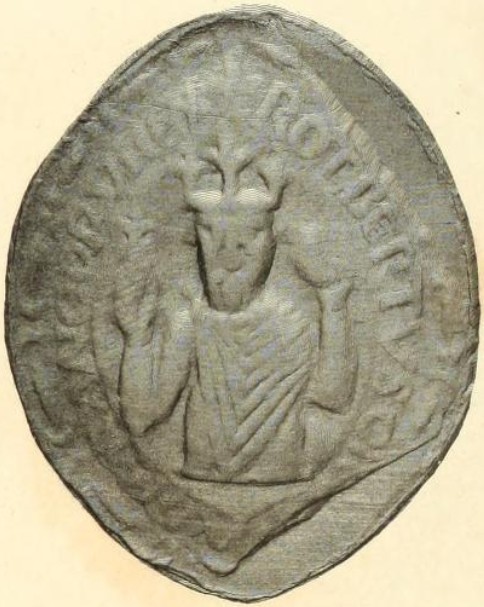 |
|
Effigy of king Robert II of France, from
his seal The inscription reads "✝ ROTBERTVS GR[ati]A D[e]i
FRANCORV[m] REX" which translates to "✝ ROBERT, BY THE GRACE OF
GOD, KING OF THE FRANKS"
|
 |
|
Robert II of France, as depicted in the
Wolfenbüttel manuscript of the Chronica
sancti Pantaleonis from the second half of the 12th
century
|
between 970 and 974, in Orleans,
France
Hugh Capet
Adelaide
Helgardi Flor. Epitome Vitæ Roberti Regis in Recueil des historiens des Gaules et de la France
vol 10 p99 (1874)
fuit
Rex Francorum Rotbertus origine natus nobilissima, patre illustri
Hugone, matre Adhelaide vocitata
This roughly translates as:
Robert was King of the Franks, born of noble birth, of illustrious father
Hugh, and of mother Adelaide.
Rozala
of Italy circa 988
Rozala was the daughter of Berengar
of Ivrea, king of Italy, and Willa
of Tuscany. She married, firstly, Arnulf
II, count of Flanders, and had two children, Baldwin
IV and Mathilda. Arnulf died about 987. Rozala was approximately
twenty years older than the teenaged Robert, and this union did not produce
any children. Robert repudiated her in 989, but controversially he kept the
geographically strategic territory of Montreuil-sur-Mer that she brought to
the marriage as her dowry. Rozala retired back to Flanders where she died in
1003.
Ex Vita S. Bertulfi Abbatis Renticensis in Recueil des historiens des Gaules et de la France
vol 10 p15 (1874)
POST
immaturam (a) Arnulfi Junioris Marchionis mortem, cujus avus
magnus exstitit Arnulfus, Balduinus filius ejus cum matre Rozala
derelictus est parvulus. Hic enim est qui posteà Prolixæ-barbæ dictus
est Balduinus, cujus mater Rozala filia fuit Berengarii Regis Italiæ,
quæ post mortem Arnulfi Principis Roberto Regi Francorum (b)
nupsit, et Susanna dicta, mutato nomine, Regina regnavit.
(a) Arnulfus II Comes Flandris obiit 23 Martii an. 989
juxta hodiernum computandi modum.
(b) DD. Sanmarthani putant hanc à Roberto fuisse
repudiatam: rectiùs autem sensissent, si fabulam esse explodendam
duxissent laudatum Rozalæ matrimonium, cujus nullum apud istius ævi
Scriptores vestigium occurrit.
This roughly translates as:
AFTER the premature (a) death of Arnulf the Younger, the
Marquis [Count], whose grandfather was Arnulf the Great, his son Baldwin
was left behind as a small child with his mother, Rozala. This is the
same Baldwin who was later called 'Baldwin of the Long Beard.' His
mother, Rozala, was the daughter of Berengar, King of Italy; after the
death of Prince Arnulf, she married Robert, King of the Franks (b),
and having changed her name, she was called Susanna and reigned as
Queen.
(a) Arnulf II, Count of Flanders, died on March 23 in the
year 989, according to the modern way of reckoning.
(b) The Messieurs Sainte-Marthe [historians] think she was
repudiated by Robert; however, they would have been more correct if they
had concluded that this celebrated marriage of Rozala should be rejected
as a fable, since no trace of it appears among the writers of that age.
 |
|
Bertha of Burgundy, as depicted in the
Wolfenbüttel manuscript of the Chronica
sancti Pantaleonis from the second half of the 12th
century
|
Bertha
of Burgundy in 996
Bertha was the daughter of king Conrad
I of Burgundy and his wife Matilda,
daughter of king Louis IV of France
and Gerberga of Saxony. She first
married Eudes
I, count of Blois, and had four children - Theobald,
Eudes II,
Agnes and Robert. Eudes I died on 12 March 996.
Bertha of Burgundy was a marriage of genuine passion—one that nearly cost
Robert his throne and his soul. When she and Robert fell in love and wished
to marry in 996, they faced a massive legal obstacle: they were second
cousins. Under the strict canon law of the medieval Church, this was
considered "consanguinity" (incest). Furthermore, Robert was the godfather
of one of Bertha’s children, which created a "spiritual kinship" that also
barred marriage. Robert, usually submissive to the Church, was
uncharacteristically defiant regarding Bertha. He ignored the warnings of
Pope Gregory V and married her anyway. In 998, the Pope placed Robert under
an interdict and excommunicated him. This was a devastating political blow;
it technically meant that Robert's subjects were no longer bound to obey him
and that religious services (including burials and baptisms) could be
suspended across his lands. Despite the pressure, Robert held out for five
years. However, the political isolation became too much to bear. Robert
needed a male heir to secure the Capetian line, and Bertha was struggling to
conceive a living child. Around 1001, Robert finally succumbed to the
Church’s demands, "repudiated" Bertha and married Constance. However, Robert
was still attached to Bertha and he took her to Rome in 1010 to seek
recognition of his marriage to her, but was unsuccessful, and the king was
forced to return to Constance.
Constance
of Arles, about 1002
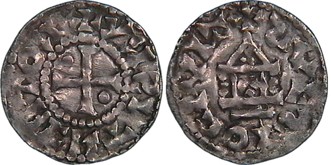 |
|
A silver denier, or penny, from
the reign of Robert II, struck in the city of Soissons.
It is inscribed "+ ROTBERTVS RT" (legend is retrograde) on the
obverse and "+ SVESIO CIVIT" on the reverse.
|
King of France
Robert was crowned joint king with his father in December 987, becoming sole
king when his father died in October 996.
Robert II, known as Robert the Pious (le Pieux), was the second king
of the Capetian dynasty, reigning from 996 to 1031. He was a complex figure
who balanced a reputation for deep religious devotion with a turbulent
political and personal life. Educated by the famous scholar Gerbert of
Aurillac (the future Pope Sylvester II), Robert was a learned man, known for
composing hymns and being a patron of the church. However, his piety did not
prevent him from clashing violently with the papacy over his marriages. His
second marriage to Bertha of Burgundy was deemed incestuous by the Church
because they were second cousins, leading to a temporary excommunication.
Despite this "holy" moniker, he was a king who struggled to maintain order
among his rebellious vassals and within his own family.
The later years of Robert’s reign were marred by a series of bitter
civil wars against his own sons. Following the tradition of his father, Hugh
Capet, Robert had his eldest son, Hugh Magnus, crowned co-king to secure the
succession, but the young man died in 1025. This sparked a dynastic crisis:
Robert favored his second son Henry (the future Henry I) to succeed him,
while his powerful and influential wife, Constance of Arles, conspired to
place their younger son, Robert, on the throne. This internal strife defined
the transition of power in 1031. Ultimately, Robert the Pious laid the
groundwork for the Capetian "miracle"—the long, unbroken line of succession
that would rule France for centuries—by successfully navigating the fragile
balance between the growing power of the feudal lords and the spiritual
authority of the Church.
The ecclesiastical history of England and Normandy by
Ordericus Vitalis vol 2 pp345-7 (trans. Thomas Forester,
1853)
In the
year of our Lord 918, the king Hugh departed this life,1 and
was interred in the church of St. Denys at Paris. He was succeeded by
his son Robert, the most pious and temperate of kings.
In the year of our Lord 999, the venerable Archbishop Sewin began
to restore the abbey of St. Peter at Melun from the foundations, and
establishing there a fraternity of monks, appointed Walter their abbot.
The same year, the knight Walter and his wife betrayed the castle of
Melun to Count Eudes. Upon this, King Robert assembled a strong force
with Count Bouchard, and calling in the Normans under their Duke
Richard, laid siege to Melun. The castle being taken, Walter and his
wife were hung on a gallows, and Melun was restored to Count Bouchard
its former lord.
… In the year of our Lord 1001, Henry duke of Burgundy died without
issue, and the Burgundians rebelled against King Robert, whom they
refused to acknowledge as their sovereign. In consequence, Landri, Comte
de Nevers, occupied the city of Auxerre.1
In the year of our Lord 1003, King Robert having called in the
Normans with their Duke Richard, and assembled a very large army,
ravaged Burgundy and besieged Auxerre for a long time. The Burgundians,
being by no means disposed to submit to him, were unanimous in their
resistance; but he besieged the castle of Avalon for nearly three
months, and at length it was compelled by famine to surrender to King
Robert, who then returned to France.2
… Robert, king
of the Franks, reigned thirty-seven years.2 He married
Constance, a princess celebrated for her wisdom and virtue. She bore him
a noble offspring, Henry, Robert, and Adele. King Robert died in the
year of our Lord 1031, the fourteenth indiction, and Henry his son
reigned nearly thirty years.
1
October 24, 996.
1 Henry the Great died in 1002.—Mabillon.
Otho-William, his son-in-law, and also his adopted heir, took possession
of the duchy. King Robert seized the province in 1003, with the aid of
thirty thousand Normans, commanded by their duke, Richard II.; but he
was compelled to retire without taking Auxerre, which was defended by
Landri, count de Nevers, and son-in-law of Otho-William.
2 The siege and taking of Avalon belong to the
campaign of 1005, in the course of which the king also took Sens, and
besieged Dijon in vain. It was defended by Otho-William in person, and
his most gallant knights.
2 October 24, 996—July 20, 1031. Robert and Constance
had four sons, Hugh, Henry, Robert, and Hugh, and two daughters,
Adelaide, or Havise, and Adele. Henry I. died August 29, 1060, after a
reign of twenty-nine years. Robert I., duke of Burgundy, called the
Elder, received that province of his brother Henry in full sovereignty
in the year 1032.
The Encyclopaedia Britannica 11th edition vol
23 p399 (ed. Hugh Chisholm, 1911)
ROBERT
II. (c. 970-1031), king of France, was a son of Hugh
Capet, and was born at Orleans. He was educated at Reims under
Gerbert, afterwards Pope Silvester II. As the ideal of medieval
Christianity he won his surname of “Pious” by his humility and
charity, but he also possessed some of the qualities of a soldier and
a statesman. His father associated him with himself in the government
of France, and he was crowned in December 987, becoming sole king on
Hugh’s death in October 996. Robert’s reign is chiefly remembered for
its dramatic side. In 988 he had married Rosala, or Susanna, widow of
Arnold II., count of Flanders. This lady, however, was much older than
Robert, who repudiated her in 989, fixing his affections upon Bertha,
daughter of Conrad the Peaceful, king of Burgundy, or Arles, and wife
of Eudes I., count of Blois; and although the pair were related, and
the king had been godfather to one of Bertha’s children, they were
married in 996, a year after the death of Eudes. Pope Gregory V.,
whose favour Robert vainly sought to win by allowing Arnulf, the
imprisoned archbishop, to return to his see of Reims and forcing
Gerbert to flee to the court of the emperor Otto III., excommunicated
the king, and a council at Rome imposed a seven years’ penance upon
him. For five years the king braved all anathemas, but about 1002 he
gave up Bertha and married Constance, daughter of a certain Count
William, an intriguing and ambitious woman, who made life miserable
for her husband, while the court was disturbed by quarrels between the
partisans of the two queens. Still attached to Bertha, Robert took
this lady with him to Rome in 1010, but the pope refused to recognize
their marriage, and the king was forced to return to Constance. By
this wife Robert had four sons, and in 1017, the eldest of these,
Hugh, (1007-1025), was crowned as his father’s colleague and
successor. After Hugh’s death the king procured the coronation of his
second son, Henry, duke of Burgundy, afterwards king of France, a
proceeding which displeased Constance, who wished her third son,
Robert (d. 1075), afterwards duke of Burgundy, to receive the crown.
Robert’s concluding days were troubled by a rising on the part of
these two sons, and after a short war, in which he was worsted, the
king died at Melun on the 20th of July 1031. The notable gain to
France during this reign was the duchy of Burgundy, which Robert
claimed on the death of his uncle, Duke Henry, in 1001. The other
claimant, however, Otto William, count of upper Burgundy, or Franche
Comté, offered so stubborn a resistance that it was not until 1015
that the king secured the duchy, which he gave as an apanage to his
son Henry. Nevertheless, Robert himself kept a close oversight over
its government, and this was one reason which led to the revolt of his
sons in 1030. Owing to family quarrels, he could not prevent the
kingdom of Burgundy, or Arles, from passing into the hands of the
emperor Conrad II., and no serious results followed his interference
in Flanders or in Lorraine. Robert added to the royal domains, and was
greatly aided by the support of Richard II. and Richard III., dukes of
Normandy, the latter of whom was his son-in-law.
His life was written by his chaplain, Helgaud, and this
panegyric, Epitoma vitae Roberti regis, is published by J. P.
Migne in the Patrologia Latina, tome cxli. (Paris, 1844). See
also C. Pfister, Études sur le règne de Robert le Pieux
(Paris, 1885); and E. Lavisse, Histoire de France, tome ii.
(Paris, 1901).
20 July 1031, at the castle of Melun,
France
Raoul
Glaber: Les cinq livres de ses histoires (900-1044) book 3
chapter 9 #36 p85 (ed. Maurice Prou, 1886)
36. Anno quoque sequenti, mense Julio2, Rotbertus rex apud
castrum Meledunense diem clausit extremum; delatumque est corpus ejus
ad ęcclesiam Sancti Dionisii martyris ac in eadem sepultum.
2. Le 20 juillet 1031.
This roughly translates as:
36. Also
in the following year, in the month of July2, king Robert
closed his final day [passed away] at the castle of Melun; and his body
was carried to the church of Saint Denis the Martyr and buried in that
same place.
2. 20 July 1031
The ecclesiastical history of England and Normandy by
Ordericus Vitalis vol 1 p148 (trans. Thomas Forester, 1853)
In the
year of our Lord 1031, Robert, king of the French, died, and Henry his
son, supported by Robert, duke of Normandy, secured the throne
notwithstanding the opposition of Queen Constance and his younger
brother Robert, and others of the French. His reign lasted twenty-nine
years.2
2 King Robert died on the 20th of July, 1031.
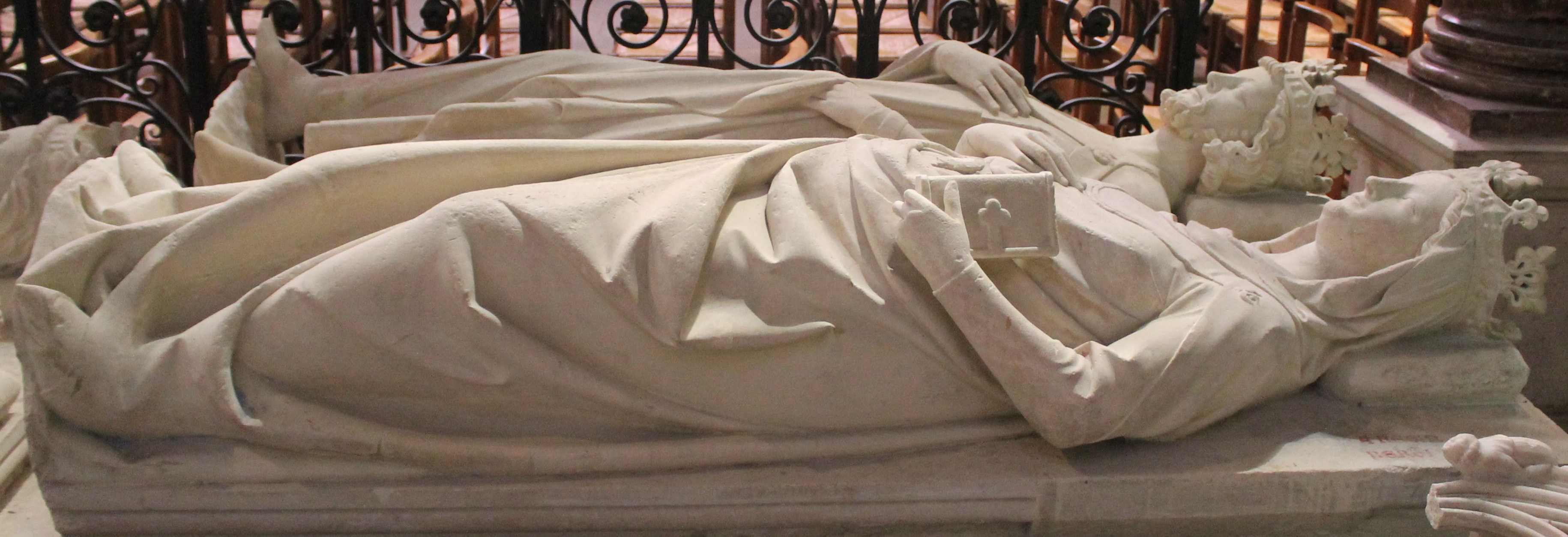 |
Effigies of king Robert II of France and
queen Constance on the ossuary in the crypt in the basilica
of Saint-Denis, Paris |
before the altar of the holy Trinity
in the basilica
of Saint-Denis, Paris, France
Adonis
archiepiscopi Viennensis chronicon continuatio altera in Monumenta
Germaniæ Historica SS 2 p326 (ed. G. H. Pertz, 1829)
Obiit
autem Miliduno castro, incarnationis dominicae anno 1032, et
deportatus Parisiis, iuxta patrem suum sepelitur ante altare sanctae
Trinitatis.
This roughly translates as:
He died,
moreover, in the castle of Melun, in the year of the incarnation of the
Lord 1032, and having been carried to Paris, he was buried next to his
father before the altar of the Holy Trinity.
Robert's tomb was desecrated during the French Revolution and his bones,
along with those of his ancestors and descendants, were thrown into a common
pit (a mass grave) outside the church. After the restoration of the monarchy
in the 19th century, these remains were gathered and placed in a massive
ossuary in the crypt of the Basilica, where they remain today.
- The Encyclopaedia Britannica 11th edition vol
23 p399 (ed. Hugh Chisholm, 1911); Medieval
Lands (ROBERT de France); wikipedia
(Robert II of France)
- Helgardi Flor. Epitome Vitæ Roberti Regis
in Recueil des historiens des Gaules et de la
France vol 10 p99 (1874); Genealogae Scriptoris Fusniacensis in Monumenta Germaniæ Historica SS 13 p252
(1881); The Encyclopaedia Britannica 11th edition vol
23 p399 (ed. Hugh Chisholm, 1911); The
Henry Project: The Ancestors of King Henry II of England (Robert II le
Pieux (the Pious)); Medieval
Lands (ROBERT de France); wikipedia
(Robert II of France)
- Helgardi Flor. Epitome Vitæ Roberti Regis
in Recueil des historiens des Gaules et de la
France vol 10 p99 (1874); The
Henry Project: The Ancestors of King Henry II of England (Robert II le
Pieux (the Pious)); Medieval
Lands (ROBERT de France); wikipedia
(Robert II of France)
- Ex Vita S. Bertulfi Abbatis Renticensis in
Recueil des historiens des Gaules et de la
France vol 10 p15 (1874); The Encyclopaedia Britannica 11th edition vol
23 p399 (ed. Hugh Chisholm, 1911); The
Henry Project: The Ancestors of King Henry II of England (Robert II le
Pieux (the Pious)); Medieval
Lands (ROBERT de France); wikipedia
(Robert II of France); Rozala parents from Ex Vita S. Bertulfi Abbatis Renticensis in
Recueil des historiens des Gaules et de la
France vol 10 p15 (1874), Medieval
Lands (ROZALA d'Ivrea) and wikipedia
(Robert II of France); Rozala 1st marriage, repudiation from Ex Vita S. Bertulfi Abbatis Renticensis in
Recueil des historiens des Gaules et de la
France vol 10 p15 (1874), The Encyclopaedia Britannica 11th edition vol
23 p399 (ed. Hugh Chisholm, 1911), Medieval
Lands (ROZALA d'Ivrea) and wikipedia
(Robert II of France); Rozala death from Medieval
Lands (ROZALA d'Ivrea)
- The Encyclopaedia Britannica 11th edition vol
23 p399 (ed. Hugh Chisholm, 1911); Medieval
Lands (ROBERT de France); wikipedia
(Robert II of France); Bertha father, 1st marriage, notes from The Encyclopaedia Britannica 11th edition vol
23 p399 (ed. Hugh Chisholm, 1911) and wikipedia
(Bertha of Burgundy)
- The ecclesiastical history of England and Normandy
by Ordericus Vitalis vol 2 p347 (trans. Thomas Forester,
1853); The Encyclopaedia Britannica 11th edition vol
23 p399 (ed. Hugh Chisholm, 1911); Medieval
Lands (ROBERT de France); wikipedia
(Robert II of France)
- Hugonis Floriacensis Modernorum Regum Francorum
Actus in Monumenta Germaniæ
Historica SS 9 pp388-9 (ed. G. H. Pertz, 1851); Excerptum Historicum in Recueil
des historiens des Gaules et de la France vol 11 p157
(1871); The ecclesiastical history of England and Normandy
by Ordericus Vitalis vol 2 p347 (trans. Thomas Forester,
1853); The Encyclopaedia Britannica 11th edition vol
23 p399 (ed. Hugh Chisholm, 1911); The
Henry Project: The Ancestors of King Henry II of England (Robert II le
Pieux (the Pious)); Medieval
Lands (ROBERT de France); wikipedia
(Robert II of France)
- The ecclesiastical history of England and Normandy
by Ordericus Vitalis vol 2 pp345-7 (trans. Thomas
Forester, 1853); The Encyclopaedia Britannica 11th edition vol
23 p399 (ed. Hugh Chisholm, 1911); The
Henry Project: The Ancestors of King Henry II of England (Robert II le
Pieux (the Pious)); Medieval
Lands (ROBERT de France); wikipedia
(Robert II of France)
- Helgardi Flor. Epitome Vitæ Roberti Regis
in Recueil des historiens des Gaules et de la
France vol 10 pp98-117 (1874); The ecclesiastical history of England and Normandy
by Ordericus Vitalis vol 2 pp345-7 (trans. Thomas
Forester, 1853); The Encyclopaedia Britannica 11th edition vol
23 p399 (ed. Hugh Chisholm, 1911); The
Henry Project: The Ancestors of King Henry II of England (Robert II le
Pieux (the Pious)); Medieval
Lands (ROBERT de France); wikipedia
(Robert II of France)
- Raoul Glaber: Les cinq livres de ses histoires
(900-1044) book 3 chapter 9 #36 p85 (ed. Maurice Prou,
1886); The ecclesiastical history of England and Normandy
by Ordericus Vitalis vol 1 p148 (trans. Thomas Forester,
1853); The ecclesiastical history of England and Normandy
by Ordericus Vitalis vol 2 p347 (trans. Thomas Forester,
1853); The Encyclopaedia Britannica 11th edition vol
23 p399 (ed. Hugh Chisholm, 1911); The
Henry Project: The Ancestors of King Henry II of England (Robert II le
Pieux (the Pious)); Medieval
Lands (ROBERT de France); wikipedia
(Robert II of France)
- Adonis archiepiscopi Viennensis chronicon
continuatio altera in Monumenta
Germaniæ Historica SS 2 p326 (ed. G. H. Pertz, 1829); Raoul Glaber: Les cinq livres de ses histoires
(900-1044) book 3 chapter 9 #36 p85 (ed. Maurice Prou,
1886); The
Revolutionary Exhumations at St-Denis, 1793 (Suzanne Glover
Lindsay); The
Henry Project: The Ancestors of King Henry II of England (Robert II le
Pieux (the Pious)); Medieval
Lands (ROBERT de France); wikipedia
(Robert II of France); find-a-grave.com
Return to Chris Gosnell's Home Page
If you have any comments, additions or modifications to the information on this page, please feel free to email me.
Created and maintained by: chris@ocotilloroad.com