Warenne Family
Ada de Warenne
William de
Warenne
Isabel
de Vermandois
Henry,
Earl of Huntingdon and Northumberland in 1139
Holinshed’s Chronicle of England, Scotland and Ireland
vol 5 p289 (ed. Raphaell Hollindshead, 1808)
Dauid had by
his wife Mauld inheritor of part of Northumberland, Cumberland, and
Huntington, a Sonne named Henrie, who maried the earle of Warrens
daughter, a ladie of high parentage, as descended of most noble bloud
both French and English. On whome he begat three sonnes, Malcolme,
William, and Dauid; also three daughters. Adhama, Margaret, and Mauld.
Raphael Holinshed tells of a sister of king William who was married to
Gilchrist, the earl of Angus and a military leader of Scotland, and who was
strangled by her husband, leading to Gilchrist's banishment. In addition, Robert de Pinkeney,
one of the Competitors
for the Crown of Scotland in 1291, claimed the throne by descent from
an illegitimate daughter of Earl Henry named Marjorie. The additional
daughter or daughters of Henry and Ada are not listed by later historians
such as Scottish kings; a revised chronology of Scottish
history, 1005-1625 p68 (Archibald Hamilton Dunbar, 1899).
James Balfour Paul mentions Marjorie in respect of Pinkeney's claim in Scots Peerage p5 but says that "her
position in uncertain".
Holinshed’s Chronicle of England, Scotland and Ireland
vol 5 p300 (ed. Raphaell Hollindshead, 1808)
in the
yeare of Grace 1178, … At the same time Gilcrist, hauing his wife in
suspicion of adulterie, droue hir out of doores, and afterwards
strangled hir in a village called Manis, not past a mile from Dundee.
The king (for that she was his sister) tooke such indignation therewith,
that he seized vpon all his lands and goods, purposing to haue put him
to death if he might haue got him into his hands: but when he saw he
could not be found, he proclamed him traitor, and raced his castell
(wherein he had dwelled) quite to the ground, in such wise that vnneth
remaineth anie token at this day where it stood.
Ada founded the nunnery of Haddington,
Scotland. These charters by Ada document her donation, and also name her
husband, Henry, and her son, William, king of Scots.
A history of Northumberland part 2 vol 3
pp17-8 (John Hodgson, 1820)
The
countess Ada, mother of the king of Scots, granted all Whitfield to the
church of Hexham, except the lands holden of her there by Robert, the
son of William and Johel, of Corbridge, and confirmed grants of the same
made by the prior and convent of “Coldeham,” and others, to Robert, her
chaplain, and to Matthew, the son of the said Robert. John, prior of
Hexham, also gave to the same Matthew, under the name of Matthew
Whitefelde, son of Robert, chaplain of the countess, half of Whitefelde,
all Parmontle, Elmlee, Softlaws, Dewsgrean, Townegreene, and Old-towne,
and all Huntersheels and Huntersheeles-park, lying between Harwoodbor̃
and Kingeswoodbor̃, as appears by the following charters, which are
preserved at Whitfield Hall, among the muniments of William Ord, esq.,
M.P.
[transcribed from the record type in the printed edition]
Ada
comitissa, mater regis Scotorum, omnibus sanctae ecclesiae filiis,
notum vobis fieri volo me dedisse Deo et ecclesiae Sancti Andreae
Hagustald et canonicis ibidem Deo servientibus in perpetuum totam
Witefeld cum bosco et plano cum prato et pastura et molino et cum
omnibus eidem villae de Witefeld adjacentibus, praeter illas quas
Robertus filius Willelmi et Joel de Corbrige de me tenent in eadem
Witefeld. Tenendum de me et heredibus meis feodo firma et perpetua
liberam et quietam ab omni servicio et consuetudine et ab omnibus
auxiliis et geld, easdem divisas per quas eam tenui de Henrico comite
sponso meo et postea de Willelmo rege Scotiae filio meo, praeter illas
divisas quas Robertus capellanus meus cum tenuit. Et sicut illam, quam
antea Robertus Capellanus per me de dominio guast Henrici comitis
sponsi mei coluit et inhabitavimus. Reddendo inde annuatim mihi vel
heredibus meis . . . libras pipis ad festum Sancti Michalis. Testibus:
Willelmo de Boleber, Henrico . . . , Regina de Reneber, Roberto
clerico de Heddon, Willelmo Giffard clerico, . . . . . . de Mortuo
mare, Gualramo filio Radle Taurii balor, Roberto de Belver.—(From
a Copy)
Ada comitissa mater regis
Scotorum omnibus hominibus et amicis suis et omnibus hominibus
Willelmi filii sui de Tindale salutem. Sciatis me dedisse Roberto
capellano meo Witefeild in feodo—unum sorum accipitrem annuatim
reddendo mihi seu cui praecipio. Testibus Hugone Giffard, Alexandro de
sancto Mayor, Mauricio, Willelmo Capon, Winemer. Apud Harigro.—(From
a Copy)
Ada comitissa mater
regis Scotorum omnibus sanctae ecclesiae filiis. Sciant praesentes et
posteri me concessisse et hac carta mea confirmasse Roberto capellano
meo et heredibus suis . . . . . . exceptis terris Joel et Roberti de
Disletona. Tenendum de Hagustald in feodo et hereditate cum bosco et
plano cum prato et pastura cum molino et cum omnibus eidem villae de
Witefeld adjacentibus libere et quiete et honorifice sicut carta
praedictorum . . . . . . . . Roberto et heredibus suis testatur et
confirmat. Testibus Alexandro de sancto Martino, Willelmo Giffard,
Waltero clerico.—(From a Copy)
Ada comitissa, mater regis Scotorum,
omnibus amicis et hominibus ac clericis et laicis, salutem. Sciant
praesentes et posteri me concessisse donum quod prior de Coldeham et
conventus ejusdem domus fecerunt Matheo filio Roberti capellani mei et
heredibus suis de firma mea de Whitfield. Quare volo et praecipio quod
praenominatus Matheus et heredes sui praedictam firmam teneant et
possideant bene et in pace, et cetera, sicut carta canonicorum
testatur et confirmat. Salvo eorum servicio. Insuper et concedo eidem
Matheo et heredibus suis edificare et hospitari eandem tam in bosco,
in plano, in pratis, et in pasturis, in scalingis, in ridinglis, in
omnibus locis ita plenarie sicut aliquo tempore . . . . . . guerram
melius edificata et hospicata fuerat. Testibus: Alexandro de sancto
Martino, Henrico de Graham, Walthevo clerico de Rok', Willelmo
Capellano, Galfrido Capellano, Willelmo clerico meo.—(From a
Copy.)
The charters translate as:
Ada,
countess and mother of the king of Scots, wishes all the sons of Holy
Church to know that I have given to God and to the church of Saint
Andrew of Haddington, and to the canons serving God there, forever, the
whole of Whitefield, with its wood and plain, meadow and pasture, mill,
and all other things adjoining to the township of Whitefield— except for
those lands which Robert son of William and Johel of Corbridge hold from
me in the same Whitefield.
They are to hold it from me and my heirs in perpetual fee-farm, freely
and quietly, released from all service and customary dues, and from all
aids and gelds, according to the same boundaries by which I held it from
Henry the earl, my late husband, and afterwards from William, king of
Scotland, my son; and according to the boundaries by which my chaplain
Robert held it. And likewise as that land which the said Robert the
Chaplain held from me of the demesne of the late Earl Henry, my husband,
and cultivated and inhabited. Rendering thence annually to me or my
heirs . . . pounds of pepper at the Feast of Saint Michael. Witnesses:
William of Bolebec, Henry . . . , Reginald of Renibour, Robert the clerk
of Heddon, William Giffard the clerk, . . . . . . of Mortuo mare, Walran
son of Radulf Taurius balor (Walran, son of Radulf the chief
officer/bull), Robert of Belvoir.—(From a Copy.)
Ada, Countess, mother of the king of Scots, to all her men and
friends, and to all the men of William, her son, of Tynedale, greeting.
Know ye that I have given to Robert, my chaplain, Whitfield in
fee—rendering to me annually or to whomsoever I command, one sore hawk
(accipitrem sorum). Witnesses: Hugh Giffard, Alexander of St. Martin,
Maurice, William Capon, Winemer. At Harigro. (From a Copy.)
Ada, Countess, mother of the king of Scots, to all the sons of
Holy Church. Let present and future generations know that I have granted
and by this my charter confirmed to Robert, my chaplain, and his heirs .
. . . . . excepting the lands of Joel and Robert of Dissington. To be
held of Hexham in fee and heredity, with wood and plain, with meadow and
pasture, with a mill and with all things adjacent to the said vill of
Whitfield, freely and quietly and honorably, just as the charter of the
aforesaid . . . . . . . . testifies and confirms to Robert and his
heirs. Witnesses: Alexander of St. Martin, William Giffard, Walter the
clerk. (From a Copy.)
Ada, Countess, mother of the king of Scots, to all friends and
men, both clergy and laymen, greeting. Let present and future
generations know that I have granted the gift which the Prior of
Coldingham and the convent of the same house made to Matthew, son of
Robert, my chaplain, and his heirs concerning my farm of Whitfield.
Wherefore I will and command that the aforesaid Matthew and his heirs
hold and possess the said farm well and in peace, etc., just as the
charter of the canons testifies and confirms. Saving their service.
Moreover, I grant to the same Matthew and his heirs to build and settle
the same place, both in wood, in plain, in meadows, and in pastures, in
shepherd huts (shielings), in clearings, in all places, as fully as at
any time . . . . . . it had been better built and settled in time of
war. Witnesses: Alexander of St. Martin, Henry of Graham, Waltheof the
clerk of Rock, William the Chaplain, Galfrid (Geoffrey) the Chaplain,
William my clerk. (From a Copy.)
Other charters by Ada are found in the cartulary of St Andrew, Edinburgh.
Liber Cartarum Prioratus Sancti Andree in Scotia
pp207-9 (1841)
[transcribed
from the record type in the printed edition]
1. Charter:
Grant of a Messuage in Haddington
Carta Comitissae Adae de tofto in Hadintuna
Ada Comitissa mater regis Scotorum, sanctae matris ecclesiae filiis,
salutem. Sciant praesentes et posteri me dedisse et hac mea carta
confirmasse conventui Canonicorum ecclesiae sancti Andreae Apostoli in
Scotia unum plenarium toftum in burgo meo de Hadintuna tenendum
perpetuo in elemosinam ita libere et quiete ab omni servicio et
consuetudine ut aliquam aliam elemosinam quiete et libere tenent pro
anima Henrici comitis sponsi mei et pro salute animae meae et pro
animabus praedecessorum meorum. Testibus: Hugone, Thoma archidiacono,
Alexandro de sancto Martino. Hela comitissa de Fife. Patricio
capellano. Willelmo clerico. Willelmo Giffar.
2. Carta Comitissae Adae de Terra in Caral
Ada comitissa mater Regis Scotorum. Omnibus sanctae matris ecclesiae
filiis, salutem. Noverint praesentes et futuri me dedisse et
concessisse et hac mea carta confirmasse Deo et canonicis de sancto
Andrea in Scotia illam terram in Charel quam Radulfus de aluerbaf
inhabitavit desuper uiam infra aliam uiam quae est juxta toftum
Radulfi de Dunfermeli et infra uestem fossam et riuum ultra illam fram
fubta uiam a Tofto Radulfi de morpath usque in mare per latitudinem
unius plenarii tofti ex transuerso. Volo igitur et praecipio ut
praedicti canonici praenominatam terram teneant et possideant in
perpetuum in elemosinam pro anima Henrici comitis sponsi mei et pro
salute animae meae et pro animabus praedecessorum et successorum
meorum. Ita libere et quiete et honorifice ut alia elemosina coeli et
liberi tenent in regno. Testibus: Alexandro de sancto Martino,
Willelmo Giffard, Willelmo Capon, Winemer, Ricardo de Rifing, Roberto
de neuham, Reginaldo filio sponsito, Reginaldo albo.
3. Carta Comitissae Adae de
tota Terra de Pethmulin
Ada Comitissa mater regis Scotorum. Omnibus sanctae matris ecclesiae
filiis. Praesentibus et posteris, salutem. Sciatis me dedisse et
concessisse et hac mea carta confirmasse Deo et ecclesiae sancti
Andreae et canonicis ibidem Deo servientibus et hospitati eorum totam
terram de Pethmulin quam malefus tenuit, sicut Hugo Giffard et ceteri
probi homines mei eandem terram perambulaverunt. Perpetuam elemosinam.
Concedo eis praeterea communem pasturam in Mohora. Quare volo et
praecipio quod praedicti canonici praenotatam terram teneant et
possideant quietam et liberam ab omni servicio saeculari, et sicut
aliqua elemosina melius, liberius, et quietius datur et tenetur in
toto regno regis filii mei. Testibus: Hugone Giffard, Alexandro de
sancto Martino, Radulfo de Ver, Willelmo de Mortemer, Willelmo de
Munfort, Thoma de Morham, Hugone de Baillon, Radulfo filio Fausarii,
Ricardo de Rising, Roberto de Newham, Mauricio.
4. Carta Comitissae Adae de una marca de Pethmulin
Ada comitissa mater regis Scotorum sanctae matris ecclesiae filiis,
salutem. Sciant praesentes et posteri me dedisse et concessisse et hac
nostra carta confirmasse Deo et sancto Andreae Apostolo et canonicis
apud Coldingham in feodo servientibus unam marcham argenti in
perpetuum in elemosinam pro anima comitis Henrici sponsi mei et pro
salute animae meae et pro animabus omnium antecessorum et successorum
meorum, hanc elemosinam dedi ad operationem novae ecclesiae. Et cum
effecta fuerit, dedi eandem elemosinam perpetuo ad luminare ejusdem
ecclesiae. Ne igitur haec elemosina in posterum decidat: Volo et
firmiter praecipio ut maleful de Pethmulin in Fyra de Karel illam
marcham argenti reddat praedictis canonicis annuatim de illa terra
quam de me tenet. Scilicet medietatem ad festum sancti Johannis
Baptistae et medietatem ad festum sancti Martini. Quicumque illam quam
alii maleful tenet post illum tenebit, debitum illud persolvat.
Testibus: Hugone Giffard, Alexandro de sancto Martino, Hugone de
Bailol, Willelmo capellano, Willelmo Giffard, Henrico de Grēd,
Steffano baliol.
The charters translate as:
1. Charter of
Countess Ada concerning a Messuage in Haddington
Ada, Countess, mother of the King of Scots, to the sons of Holy Mother
Church, greeting. Let present and future generations know that I have
given and by this my charter confirmed to the convent of Canons of the
Church of Saint Andrew the Apostle in Scotland, one full messuage (toft)
in my burgh of Haddington, to be held forever in alms so freely and
quietly from all service and custom as they hold any other alms quietly
and freely for the soul of Henry my husband the Earl, and for the
salvation of my soul, and for the souls of my predecessors. Witnesses:
Hugh, Thomas the Archdeacon, Alexander of St. Martin. Ela, Countess of
Fife. Patrick the Chaplain. William the Clerk. William Giffar.
2. Charter of Countess Ada concerning Land in Caral
Ada, Countess, mother of the King of Scots. To all sons of Holy Mother
Church, greeting. Let present and future generations know that I have
given and granted and by this my charter confirmed to God and the canons
of Saint Andrew in Scotland that land in Caral which Radulf de Alverbaf
inhabited, above the road, within the other road which is next to the
messuage (toft) of Radulf of Dunfermline, and within the western ditch
and the stream beyond that frame below the road from the Messuage of
Radulf of Morpeth all the way to the sea by the breadth of one full
messuage across. Therefore, I will and command that the aforesaid canons
hold and possess the aforementioned land forever in alms for the soul of
Henry my husband the Earl, and for the salvation of my soul, and for the
souls of my predecessors and successors. So freely and quietly and
honorably as they hold other free alms of heaven in the kingdom.
Witnesses: Alexander of St. Martin, William Giffard, William Capon,
Winemer, Richard de Rising, Robert of Newham, Reginald son of the
husband, Reginald White.
3. Charter of Countess Ada concerning the Entire Land of Pethmulin
Ada, Countess, mother of the King of Scots. To all sons of Holy Mother
Church. To present and future generations, greeting. Know ye that I have
given and granted and by this my charter confirmed to God and the Church
of Saint Andrew and the canons serving God there and their guest-house
(hospitality), the entire land of Pethmulin which Malefus held, just as
Hugh Giffard and the rest of my trustworthy men perambulated (walked the
boundaries of) the same land. [This is] perpetual alms. Furthermore, I
grant to them common pasture in Mohora. Wherefore I will and command
that the aforesaid canons hold and possess the aforementioned land quiet
and free from all secular service, and as any alms are best, most
freely, and most quietly given and held in the entire kingdom of the
king my son. Witnesses: Hugh Giffard, Alexander of St. Martin, Radulf de
Ver, William de Mortemer, William de Montfort, Thomas de Morham, Hugh de
Balliol, Radulf son of Fausarius (the Blacksmith), Richard de Rising,
Robert of Newham, Maurice.
4. Charter: Grant of a Mark of Silver from Pethmulin
Ada, Countess, mother of the King of Scots, to the sons of holy mother
church, greeting. Let present and future generations know that I have
given and granted and by this our charter confirmed to God and Saint
Andrew the Apostle and the canons serving in fee at Coldingham, one mark
of silver in perpetuity in alms for the soul of Earl Henry my husband,
and for the salvation of my soul and for the souls of all my ancestors
and successors. I gave this alms for the work of the new church. And
when it shall be completed, I gave the same alms perpetually for the
lights of the same church. Lest therefore this alms should fail in the
future: I will and firmly command that Maleful of Pethmulin in the Fyra
of Karel shall render that mark of silver annually to the aforesaid
canons from that land which he holds of me. Namely, one half at the
Feast of Saint John the Baptist and the other half at the Feast of Saint
Martin. Whosoever shall hold that land which the other Maleful holds
after him, shall discharge that debt. Witnesses: Hugh Giffard, Alexander
of St. Martin, Hugh de Balliol, William the Chaplain, William Giffard,
Henry de Grēd, Stephen Balliol.
Joannis de Fordun Scotichronicon; cum supplementis et
continuatione Walteri Boweri vol 1 p347 (1759)
Ada
etiam comitiſſa conjunx fratris ſui Henrici, poſt obitum mariti, ad
inſtigationem, ut dicitur, ejuſdem abbatis Walthevi, Ciſtertienſis
ordinis fundavit monaſterium monialium de Haddingtona.
This roughly translates as:
Countess Ada,
also consort of her brother Henry, after the death of her husband,
founded the monastery of nuns of Haddington, of the Cistercian order, at
the instigation, as is said, of the same abbot Walthew.
Chronica de Mailros p71 (ed. Joseph
Stevenson, 1835)
Anno M.c.xxxix. … Pax faƈta eſt inter duos
reges inſtantia regine, et Norhimbria data eſt Henrico filio regis
Dauid. Henricus comes duxit Ade commetiſſam filiam Willelmi comitis de
Warena, ſororem Willelmi junioris et Rodberti comitis de Liceſtria, et
Waleranni comitis de Mellent, cujus mater fuit ſoror Radulfi comitis
de Perona, regis Francorum conſanguinea.
This roughly translates as:
In the year
1139. … Peace was made between the two kings at the insistence of the
queen, and Northumbria was given to Henry, son of King David. Earl Henry
married Ada, the countess, daughter of William, Earl of Warenne, sister
of William the younger and Rodbert, Earl of Leicester, and Waleran, Earl
of Mellent, whose mother was the sister of Ralph, Earl of Peronne, a
blood relative of the King of the Franks.
John of Fordun’s Chronicle of the Scottish nation pp223-4
(ed. William F. Skene, 1872)
… KING
David’s son, Henry, Earl of Northumberland and Huntingdon, took Ada to
wife, the daughter of the elder, and sister of the younger, William,
Earl of Warenne, and sister of Robert, Earl of Leicester, and of
Waleran, Count of Melent (Melun). Her mother was the sister of Radulf,
Count of Peronne, and cousin to Louis, king of France. By her he had
three sons; namely, Malcolm, the future king of Scotland; David, who was
afterwards Earl of Huntingdon and Garviach; and William, who was also to
be afterwards king—and as many daughters. One, Ada, was given in
marriage to Florence, Count of Holland. The second, Margaret, wedded
Conan, Duke of Brittany and Earl of Richmond, and bore him a daughter,
named Constance, who was given in marriage to Geoffroy, brother of
Richard, king of England. Of her this Geoffroy begat a son, named
Arthur, who was afterwards drowned at sea, a daughter named Alice, who
conceived of Peter Mauclerk, and bore a son, named John, afterwards Duke
of Brittany, and another daughter, named Eleanor, who perished at sea,
with her brother Arthur. Earl Henry’s third daughter, Matilda, moreover,
departed this life in the same year as her father.
Annals of Scotland vol 1 p104 (David
Dalrymple, 1797)
1152.
The children of Prince Henry, by his wife Ada. were MALCOLM,
born in 1142; WILLIAM, born in 1143; David Earl of
Huntington, born in 1144‡; Ada or Elda, married in 1161, to Florence
Count of Holland; Margaret, married in 1160, to Conan IV. Duke of
Britany *; Matildis, who died unmarried.
‡ Andrew Winton, MS. Chr. Advocates Library,
affirms, that David Earl of Huntington was elder than his brother
William. The fame thing is mentioned by Bowmaker, the interpolator of
Fordun, L. v. c. 43. I can give no probable account of the origin of
this fiction
* She afterwards married Bohun Earl of Hereford. In the claim of
Robert de Pinkeny, [1291] ſhe is called Marjery, See Foedera,
T. ii. p. 576.
The Complete Peerage vol 6 p642 (George
Edward Cokayne, enlarged by Vicary Gibbs, 1926)
HUNTINGDON
EARLDOM.
IV. 1136.
4. HENRY OF SCOTLAND, yr. s., was b.
about 1114, and suc. as EARL OF HUNTINGDON
on his father’s resignation of the Earldom in 1136. … He m. Ada
(or Adeline), da. of William (DE WARENNE),
EARL OF SURREY, by Isabel, da. of Hugh, COUNT
OF VERMANDOIS.(i) He d. v.p.,
12 June 1152, and was bur. at Kelso. His widow d. in
1178,(l) having in that year founded the Nunnery of
Haddington.(m)
(i) Vita et Passio, p. 20. For the mother see
Will. of Jumieges, bk. 8, c. 40; Chron. de Mailros (Bannatyne
Club), p. 171.
(l) Chron. de Mailros, ut supra, p. 89.
(m) Fordun, p. 569. Of their 3 sons, the two elder,
Malcolm and William, became successively Kings of Scotland and Earls of
Huntingdon, and David, the youngest, became Earl of Huntingdon also.
They had 3 daughters: (1) Ada, m. Florence, Count of Holland, in
1162 [Holyrood Chron. (Wharton, vol. i, p. 162)]; (2) Margaret, m.,
in 1159, Conan IV, Duke of Brittany, and was mother of Constance of
Brittany (Chron. de Mailros, p. 77; Roger of Wendover,
vol. ii, p. 329); (3) Maud, d. unm., in 1152 (Fordun, p. 451)
The Complete Peerage vol 9 p706 (George
Edward Cokayne, enlarged by H. A. Doubleday, 1936)
NORTHUMBERLAND
EARLDOM.
I. 1139
1. HENRY (of Scotland), EARL OF HUNTINGDON,
only s. and h. ap. of David I, KING OF SCOTLAND,
by Maud, eld. da. and coheir of Waltheof, EARL OF NORTHUMBERLAND,
HUNTINGDON and NORTHAMPTON, by Judith his
wife, da. of Lambert, COUNT OF LENS, by
the Conqueror’s sister Adelaide, b. about 1114. He m.
Adag, da. of William (DE WARENNE),
EARL OF SURREY, by Isabel, da. of Hugh, COUNT
OF VERMANDOIS. He d. v.p., 12 ]une
1152. For further particulars see HUNTINGDON.
(g) Charters of Ada the Countess to Hexham, &c.,
are printed by Hodgson, Hist. of Northumberland, pt. ii, vol. 3,
p. 17; see also Reg. de Dryburgh, pp. 10, 69; Wardon
Cartulary (Beds Hist. Rec. Soc.), no. 340 b.
People of Medieval Scotland
(Ada de Warenne (d.1178), countess of Northumberland)
Ada was born around 1123, the daughter of William
(II) de Warenne, earl of Surrey (d.1138), and his wife, Isabel de
Vermandois (d.1147) widow of Robert de Beaumont, count of Meulan and earl
of Leicester (d.1118), and daughter of Hugues le Grand, count of
Vermandois, and granddaughter of Henri I of France. Ada had three
brothers, William (III) de Warenne (d.1148), Ralph and Reginald
(d.1178/79), and one sister, Gundreda, who married Roger, earl of Warwick
(d.1153). Her mother had produced eight children by her first marriage, so
Ada's had extensive family networks in England. She married Henry, prince
of Scotland, son of David I (d.1152) in April 1139, making her also
countess of Northumberland. She was mother to two kings of Scots, Malcolm
IV and William I, and also to David, earl of Huntingdon (d.1219). The
couple also had three daughters: Ada (d. 1205), who married Florence
(III), count of Holland; Margaret (d.1201), who married Conan (IV), duke
of Brittany (d.1171), and Humphrey (III) de Bohun of Trowbridge (d.1181);
and Matilda (Maud) (d.in infancy, 1152). Ada died in 1178. Her estates
included Tynedale at Whitfield (near Hexham), and Harringworth and
Kempston in the honour of Huntingdon. Her dower estates included the
burghs and shires of Haddington and Crail.
1178
Joannis de Fordun Scotichronicon; cum supplementis et
continuatione Walteri Boweri vol 1 p475 (1759)
MCLXXVIII
… Ada comitiſſa, mater regis Willelmi, quæ fundavit monaſterium
monialium de Haddinton, obierunt.
This roughly translates as:
1178 … Countess
Ada, mother of king William, who founded the monastery of nuns at
Haddinton, died.
Chronica de Mailros p89 (ed. Joseph
Stevenson, 1835)
Anno M.c.lxxviij. … Obiit Adac
comitiſſa, mater Malcolmi et Willelmi regum Scottorum, comitis Dauid.
c She was the daughter of the earl of Warren and
Surrey.
This roughly translates as:
In the year 1782 … Countess Ada, mother of Malcolm and William, kings of
Scots, and Earl David, died.
- Gesta Normannorum ducum (Guillaume de
Jumièges - Torigny) book VIII p332; Chronica de Mailros p71 (ed. Joseph
Stevenson, 1835); John of Fordun’s Chronicle of the Scottish nation
pp223-4 (ed. William F. Skene, 1872); The Complete Peerage vol 6 p642
(George Edward Cokayne, enlarged by Vicary Gibbs, 1926)
- A history of Northumberland part 2 vol 3
pp17-8 (John Hodgson, 1820); Holinshed’s Chronicle of England, Scotland and
Ireland vol 5 p289 (ed. Raphaell Hollindshead, 1808); John of Fordun’s Chronicle of the Scottish nation
p224 (ed. William F. Skene, 1872)
- Holinshed’s Chronicle of England, Scotland and
Ireland vol 5 p289 (ed. Raphaell Hollindshead, 1808); John of Fordun’s Chronicle of the Scottish nation
p224 (ed. William F. Skene, 1872); People
of Medieval Scotland (Ada de Warenne (d.1178), countess of
Northumberland)
- A history of Northumberland part 2 vol 3
pp17-8 (John Hodgson, 1820); Liber Cartarum Prioratus Sancti Andree in Scotia
pp207-9 (1841); Chronica de Mailros p71 (ed. Joseph
Stevenson, 1835); John of Fordun’s Chronicle of the Scottish nation
pp223-4 (ed. William F. Skene, 1872); Joannis de Fordun Scotichronicon; cum supplementis
et continuatione Walteri Boweri vol 1 p347 (1759); The Complete Peerage vol 6 p642
(George Edward Cokayne, enlarged by Vicary Gibbs, 1926); People
of Medieval Scotland (Ada de Warenne (d.1178), countess of
Northumberland); Medieval
Lands (ADA de Warenne); wikipedia
(Ada de Warenne)
- Joannis de Fordun Scotichronicon; cum supplementis
et continuatione Walteri Boweri vol 1 p475 (1759); Chronica de Mailros p89 (ed. Joseph
Stevenson, 1835); The Complete Peerage vol 6 p642
(George Edward Cokayne, enlarged by Vicary Gibbs, 1926)
Beatrice
Beatrice's mother was likely a
sister of Gunnor, the 2nd wife of Richard I of Normandy.
Beatrice's relationship to Gunnor is based primarily on a passage by Robert
de Torigny.
Gesta Normannorum ducum (Guillaume de
Jumièges - Torigny) book VIII p328 (ed. Jean Marx, 1914)
Interpolation
de Robert de Torigny
Et quoniam de sororibus Gunnoris comitissae fecimus mentionem, libet
etiam de illis, qui secundo gradu consanguinitatis affines eidem
fuere, prout ab antiquis acce- pimus aliqua dicere. Habuit ergo ex
fratre suo Herfasto eadem comitissa nepotem Osbernum de Crepon, patrem
videlices Willelmi, comitis Herefordi, viri per omnia laudabilis.
Neptes vero plures predicta Gunnor habuit, sed solummodo de quinque,
quibus maritis nupserint audivi. Una itaque earum matrimonio copulata
est patri (3) primi Willelmi de Warenna; ex qua natus est idem
Willelmus, postea comes Surreiae, et Rogerius de Mortuo Mari, frater
ipsius.
(3) Le père de Guillaume Ier de Varenne et de Roger
de Mortemer s’appelait, semble-t-il, Raoul de Varenne. Voir Cartulaire
de Saint-Wandrille, éd. Lot, p. 98, n . 1, et Le Prévost, éd.
d’Orderic, t. III, p. 316 note.
This roughly translates as:
Interpolation of Robert de Torigny
And since we have made mention of the sisters of Countess Gunnor, it is
pleasing also to say something of those who were related to her in the
second degree of kinship, according to what we have heard from those of
old. The same countess, therefore, had by her brother Herfast a nephew,
Osbern de Crepon, who was the father of William, Earl of Hereford, a man
praiseworthy in all respects. The aforesaid Gunnor had indeed several
nieces, but I have heard only of five, and which husbands they married.
One of these, therefore, was joined in marriage to the father (3) of the
first William de Warenne; from her was born that same William,
afterwards Earl of Surrey, and Roger de Mortimer, his brother.
(3) The father of William I de Warenne and Roger de Mortemer was
apparently named Ralph de Warenne. See the Cartulaire de
Saint-Wandrille, edited by Lot, p. 98, note 1, and Le Prévost,
edition of Orderic, vol. III, p. 316 note.
In this passage it is clearly stated that the mother of the first William de
Warenne was the niece of Gunnor, but the lack of details, for example, of
Beatrice's name, which sibling of Gunnor's she was the daughter of, and the
error stated that Willam de Warenne and Roger de Mortemer were brothers have
led to some suspicion of the statement. However L.C. Loyd accepts the
statement in ‘The Origin of the Family of Warenne’ (L. C. Loyd) in Yorkshire Archæological Journal vol 31 pp107-9
and both Charles Clay in Early Yorkshire Charters vol
8 pp1-2 (Charles Travis Clay, 1949) and Geoffrey White in The Complete Peerage vol 12 part 1 pp491-2
(George Edward Cokayne, enlarged by Geoffrey H. White, 1953) treat the link
to Gunnor having "strong reasons" and being "almost certain" respectively.
Rodolf de Warenne
In about 1053, Rodulf de Warenne I granted land in Vascœuil to the abbey of
St. Pierre de Préaux with the consent of his first wife, Beatrix, who was
likely a niece of duchess Gunnor and the mother of his sons, Rodulf and
William. By 1059, Rodulf had married his second wife, Emma.
Early Yorkshire Charters vol 8 pp1-2
(Charles Travis Clay, 1949)
THE EARLY GENERATIONS OF THE FAMILY OF WARENNE
… RODULF DE WARENNE I. …In the year
in which duke William married (1053), described as ‘quidam miles de
Warenna, Radulfus nomine,’ he gave to the abbey of St. Pierre de Préaux,
with the consent of his wife Beatrix, all that he had in Vascœuil, dept.
Eure, which appears to have been on the ducal demesne; among the
witnesses being his brother Godfrey.6 Before May 1055,
described as Rodulfus Warethnæ, he sold lands in the neighbourhood of
Rouen to the abbey of the Holy Trinity, among those who subscribed to
the instrument being his wife Beatrix;
… There are strong reasons for supposing that Rodulf’s first wife
Beatrix was a niece of duchess Gunnor, wife of duke Richard I4,
and that she was the mother of his two sons5:
(1) Rodulf de Warenne II. The details of a feodary of 1210-20
show that certain lands known to have been held by his father, both in
the pays de Caux and near Rouen, then formed part of the barony of
Esneval; and a comparison with the return of knights’ fees in Normandy
in 1172 shows that at that date they were already in the possession of
Robert d’Esneval. It is likely, therefore, that Rodulf II left issue,
and that before 1172 the Esneval family acquired in marriage with his
heiress the lands which he had inherited from his father.
(2) William de Warenne; see below.
(3) A daughter who married Erneis de Coulances and had two sons:
(i) Richard, lord of Coulances near Vire, a benefactor of the abbey of
St. Evroul; by his wife Adelaisa he had fifteen children, and died 15
Sept. 1125; and (ii) Roger, described by Orderic as son of Erneis de
Coulances and nephew of William earl of Surrey, and also named Roger de
Guarenna, who was a monk at St. Evroul in 1081 and passed, forty-six
years there.
6 Text pd. by T. Stapleton in his paper ‘Observations
in disproof of the pretended marriage of William de Warren …’ in Arch.
Journal, vol. iii (1846), p. 11.
4 This is based on the following passage, pd. in Complete
Peerage, loc. cit., p. 4, from William de Jumièges, bk. viii, c.
37, ed. Marx, p. 328: ‘Neptes vero plures predicta Gunnor habuit, sed
solummodo de quinque, quibus maritis nupserint, audivi. Una itaque earum
matrimonio copulata est patri primi Willelmi de Warenna; ex qua natus
est idem Willelmus, postea comes Surreiae, et Rogerius de Mortuo Mari,
frater ipsius …’ Although the reference to Roger de Mortemer is
certainly a mistake, there seems no reason to doubt the statement about
William de Warenne’s mother—a statement which is supported by the degree
of relationship between William de Warenne II and a daughter of king
Henry I examined in Appendix A below.
5 On this point see the note to charter no. 1.
Early
Yorkshire Charters vol 8 pp52-4 (Charles Travis Clay, 1949)
There
are also (a) a notification by the monks referring to an earlier
sale by Rodulf Warethnæ of 100 acres of wood in Blovilla [Blosseville,
nr. Rouen] and land there and in neighbouring places and to 100 acres of
the same wood sold by Roger son of the bishop1 ‘qui et
particeps et coheres est ejusdem alodii’; which sales were authorized
and confirmed by duke William and Malger, archbishop of Rouen; signum
Willelmi, comitis; signum archipræsulis Malgerii; signum ejusdem Rodulfi
de Guarethna; signum Beatricis, uxoris ejus; signum Rogerii, filii
episcopi. . . signum Willelmi, filii Rogeri, heredis scilicet ipsius …2
signum Hugonis, fratris ejus …3
The chief interest of these charters is due to the mention of
William, younger son of Rodulf de Warenne. He can be identified with
William de Warenne I, subsequently the first earl of Surrey2.
Some of the witness clauses and the clause in the record of sale by Hugh
de Flamanville suggest that he was Rodulf’s son by his second wife Emma.
But Beatrice, Rodulf’s first wife, was certainly living in 1053;3
and, as William fought at Hastings, he cannot have been the son of Emma.
On this point Mr. Loyd was of opinion that too much weight should not be
attached to a particular pronoun.4
1 Roger son of Hugh bishop of Coutances (Y.A.J.,
xxxi, pp. 99, 102-3).
2 A clause specifying a payment made to him for
consenting to his father’s sale.
3 Cartulaire, no. xxvii, p. 435; Arch.
Journal, iii, 8; notice in Y.A.J., xxxi, 99; abst. in Cal.
Docs. France, no. 71. The date is earlier than abp Malger’s
deposition in May 1055.
2 Full details of proof were given by Mr. L. C. Loyd,
who made an exhaustive examination of these charters and of related
evidence in his paper ‘The Origin of the Family of Warenne’ in Y.A.J.,
xxxi, pp. 97-113; see especially on this point pp. 106-10.
3 See p. 1 above.
4 Y.A.J., xxxi, 107
The Complete Peerage vol 12 part 1 pp491-2
(George Edward Cokayne, enlarged by Geoffrey H. White, 1953)
SURREY
RODULF DE WARENNE I
… held land at Vascoeuil (dept. Eure), which he gave about 1053 to the
abbey of St Pierre de Préaux,(c) and in the pays de Caux,
north of Rouen, where he sold 4 churches with tithes to the Holy Trinity
in 1059, and gave another church, also with tithes, in 1074.(d)
He m., 1stly, Beatrice,(e) whose mother was almost
certainly a sister of Gunnor, 2nd wife of Richard 1, Duke of Normandy.(f)
She was living about 1053.(g) Rodulf m., 2ndly, in or
before 1059,(h) Emma, whose parentage is unknown.
(c) Stapleton, Archaeological Journal, vol.
iii, p. 11. His 1st wife Beatrice consented. Loyd points out that
Vascoeuil had formed part of the ducal demesne (op. cit., p. 98);
and it seems likely that the land there was brought in by Beatrice.
(d) Cart. Ste Trinité, nos. xxix, xxxv; for
identification of the places concerned see Loyd, op. cit., p.
100. His 2nd wife, Emma, consented to these transactions. For other
benefactions by Rodulf see Cart. Ste Trinité.
(e) See note “c” above.
(f) Will. de Jumièges (ed. Marx, Soc. de l’Hist. de
Normandie, p. 328; cf. White, in Genealogist, N.S., vol.
xxxvii, pp. 61-63, and Loyd, in Y.A.J., vol. xxxi, pp. 107-09.
(g) See note “c” above.
(h) Cart. Ste Trinité, no. xxix,
- ‘The Origin of the
Family of Warenne’ (L. C. Loyd) in Yorkshire Archæological Journal vol 31 p
100; Early Yorkshire Charters
vol 8 pp1-2 (Charles Travis Clay, 1949); The Complete Peerage vol 12 part 1 p492
(George Edward Cokayne, enlarged by Geoffrey H. White, 1953)
- ‘The Origin of the
Family of Warenne’ (L. C. Loyd) in Yorkshire Archæological Journal vol 31 p
100; Early Yorkshire Charters
vol 8 pp1-2 (Charles Travis Clay, 1949); The Complete Peerage vol 12 part 1 p492
(George Edward Cokayne, enlarged by Geoffrey H. White, 1953)
- Early Yorkshire Charters
vol 8 pp52-4 (Charles Travis Clay, 1949); Early Yorkshire Charters
vol 8 p2 (Charles Travis Clay, 1949); Dictionary of national biography vol 59
p372 (ed. Sidney Lee, 1899); The Complete Peerage vol 12 part 1 pp491-2
(George Edward Cokayne, enlarged by Geoffrey H. White, 1953)
- ‘Observations in disproof
of the pretended marriage of William de Warren’ (Thomas Stapleton, 1834)
printed in Archaeological Journal vol 3 pp1-26;
‘The Origin of the Family of Warenne’ (L. C. Loyd, 1934) in Yorkshire Archæological Journal vol 31
pp98-103; Early Yorkshire Charters
vol 8 pp1-2 (Charles Travis Clay, 1949); The Complete Peerage vol 12 part 1 pp491-2
(George Edward Cokayne, enlarged by Geoffrey H. White, 1953)
Gundrada
William de Warenne
Gundrada was thought by 19th century historians to be the daughter of
Matilda, the wife of William the Conqueror, but ths is no longer accepted by
modern historians. She is now accepted to be the sister of Gerbold
the Fleming, the first Earl of Chester, and the two are possibly
children of an earlier Gerbold who was the advocate of the abbey
of St. Bertin, in the county of Flanders.
Extensive treatments of the possible ancestry of Gundrada can be found in
‘Observations in disproof of the pretended marriage of William de Warren’
(Thomas Stapleton, 1834) printed in Archaeological Journal vol 3 pp1-26,
‘Gundrada de Warrenne’ (E. Chester Waters, 1886) printed in Archaeological Journal vol 43 pp306-11,
‘The Parentage of Gundrada, wife of William of Warren’ (Edward A. Freeman,
1888) in The English Historical Review vol 3 pp680-701,
‘The Origin of the Family of Warenne’ (L. C. Loyd, 1934) in Yorkshire Archæological Journal vol 31 pp106-13
and Appendix A ‘Gundrada wife of William de Warenne the First’ in Early Yorkshire Charters vol 8 pp40-6
(Charles Travis Clay, 1949)
From analysis of her skeleton, Gundrada's height is estimated to have been
5ft 8in. Gundrada and William founded Lewes Priory, the first Cluniac
monastery in England. Gundrada died in child birth and was buried at Lewes
Priory.
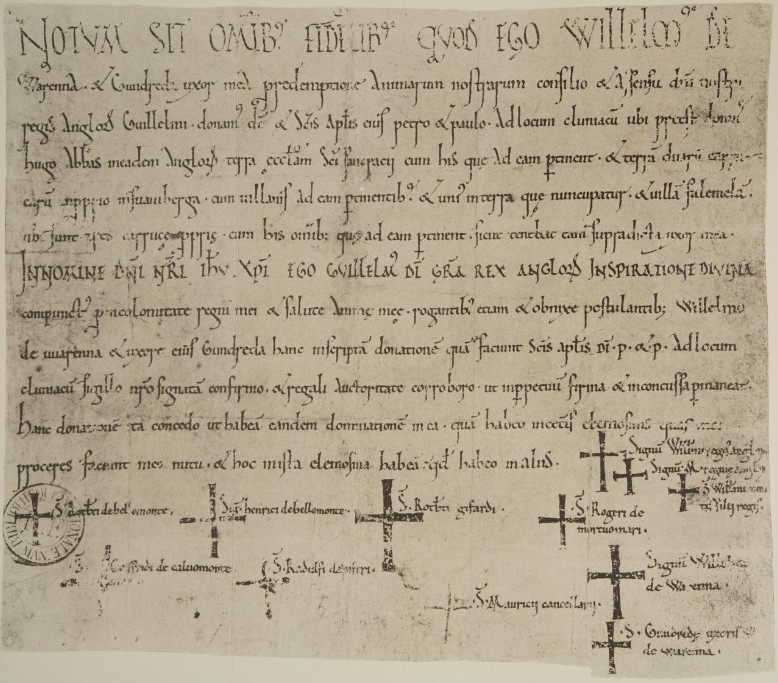 |
|
Charter of William de Warenne, 1st Earl,
to found Lewes priory. The charter is also signed by his wife,
Gundrada.
|
Early
Yorkshire Charters vol 8 pp54-5 (Charles Travis Clay, 1949)
2. Gift
by William de Warenne and Gundreda his wife, with the assent of king
William I, to the abbey of Cluny of the church of St. Pancras [at Lewes]
with its appurtenances, two ploughlands in demesne in Swanborough
[Sussex] with the villeins belonging thereto, and another with the vill
of Falmer [Sussex] where there were three ploughs in demesne, together
with its appurtenances as his wife was holding it; and confirmation by
king William I, saving his lordship therein. [c.
1078-1082] "> PLATE I
Original charter, Paris, Bibliothèque Nationale.7
Ecole des Chartes, lithograph facsimiles, no. 549. Pd. in Bernard and
Bruel, Recueil des Chartes de l’Abbaye de Cluny (Docs. Inédits),
iv, nos. 3558-9; and by Sir G. F. Duckett, Charters and Records of
the Abbey of Cluni, i, pp. 44-5, and in Y.A.J., ix, 433,
and xv, 432.8 Abst. in Davis, Regesta, no. 192.
Notum sit omnibus fidelibus
quod ego Willelmus de Warenna . et Gundreda uxor mea pro redemptione
animarum nostrarum consilio et assensu domini nostri regis Anglorum
Guillelmi . donamus Deo et sanctis apostolis eius Petro et Paulo . ad
locum Cluniacum ubi preest domnus Hugo abbas in eadem Anglorum terra
ecclesiam sancti Pancracii cum his que ad eam pertinent . et terram
duarum carrucarum in proprio in Suamberga . cum uillanis ad eam
pertinentibus . et unius in terra que nuncupatur . et uillam Falemelam
. ubi sunt tres carruce proprie . cum his omnibus que ad eam pertinent
. sicut tenebat eam supradicta uxor mea.
In nomine Domini nostri Ihesu Christi ego Guillelmus Dei
gratia rex Anglorum inspiratione diuina compunctus pro incolomitate
regni mei et salute anime mee . rogantibus etiam et obnixe
postulantibus Willelmo de Warenna et uxore eius Gundreda hanc
inscriptam donationem quam faciunt sanctis apostolis Dei . P[etro] et
P[aulo] ad locum Cluniacum sigillo nostro signatam confirmo . et
regali auctoritate corroboro . ut in perpetuum firma et inconcussa
permaneat. Hanc donationem ita concedo ut habeam eandem dominationem
in ea . quam habeo in ceteris elemosinis quas mei proceres faciunt meo
nutu . et hoc in ista elemosina habeam . quod habeo in alliis.
✠ signum Willelmi regis Anglorum ✠ signum M[athildis] regine
Anglorum ✠ s[ignum] Willelmi comitis filii regis . ✠ signum Willelmi
de Warenna . ✠ s[ignum] Gundrede uxoris W[illelmi] de Warenna . ✠
s[ignum] Rotberti de Bellomonte1 . ✠ sig[num] Henrici de
Bellomonte . ✠ s[ignum] Rotberti Gifardi . ✠ s[ignum] Rogeri de
Mortuomari . ✠ s[ignum] Goisfridi de Caluomonte . ✠ s[ignum] Radulfi
dapiferi . + s[ignum] Mauricii cancellarii.
This is the original foundation charter of Lewes priory. It was
sent to Cluny where it was preserved. No copy of it was entered in the
fifteenth-century chartulary of the priory. A note on the supposed first
charter of William de Warenne I is given in Appendix D below.
The latest date for the present charter is 1083, when queen
Maud died; but this can be put back to the previous year as it was
evidently issued before no. 3 below; and it was probably earlier than
Dec. 1081, as Robert de Beaumont had then become count of Meulan2.
The earliest date is c. 1078, when Maurice became chancellor.3
At the Domesday survey it was recorded that St. Pancras [Lewes priory]
held Falemere of William de Warenne.4
7 This original is one of the ‘chartes originales de
l’abbaye de Cluni, du xie siécle’ (Inventaire des
Manuscrits de la Bibliothèque Nationale— Fonds de Cluni—par
Léopold Delisle, Paris, 1884; §157, no. 121, p. 259).
8 There is an incorrect copy in Archaeologia,
xxxii, 124n in W. H. Blaauw’s article on the parentage of Gundreda.
1 The names of this witness and of the succeeding
ones are on the left, the names of the first witnesses being on the
right. It may be that the cross before the name of the last witness was
made by Maurice himself.
2 Complete Peerage, new ed., vii, 524.
3 Handbook of British Chronology, R. Hist.
Soc., p. 66. In the narrative account of the earls in the Lewes
Chartulary (f. 105v; S.R.S., ii, 15) the year 1088 is
given as the eleventh year of the foundation.
4 D.B., i. 26
The ecclesiastical history of England and Normandy by
Ordericus Vitalis vol 2 pp47-9 (trans. Thomas Forester,
1853)
The king had
already granted the city and county of Chester to Gherbod of Flanders,
who had been greatly harassed by the hostilities both of the English and
Welsh. Afterwards, being summoned by a message from his dependants in
Flanders, to whom he had entrusted his hereditary domains, he obtained
leave from the king to make a short visit to that country, but while
there his evil fortune led him into a snare, and, falling into the hands
of his enemies, and thrown into a dungeon, he had to endure the
sufferings of a long captivity, cut off from all the blessings of life.
… The earldom of Buckingham was given to Walter Giffard, and Surrey to
William de Warrenne, who married Gundred, Gherbod’s sister.
pp472-3
At that
time King William made William de Warrenne earl of Surrey; but not long
afterwards he was snatched away by death which spares no one. The
Cluniac monks whom he had established at Lewes,3 interred his
body in their chapter, and recorded his character and merits in verses
inscribed on his tomb on a white marble slab
… The earl was succeeded by his two sons, William and Reynold, with
their mother Gundrede,2 and they flourished for a long period
under William and Henry, kings of England, being distinguished for their
valour, worth, and power.
3 The priory of Lewes was founded by William de
Warrenne and Gundrede, his wife, about the year 1078, in the meadows
below the castle, which was the earl’s principal seat. The church, on
the site of which a small chapel stood before the conquest, was
dedicated to St. Pancras. Both the earl and countess were interred
there. Gundrede’s grave-stone, a slab of black marble, the greater part
of the inscription on which is legible, was carried off from the ruins
after the Reformation, but recovered some years since, and deposited in
the church at Southover adjoining the town of Lewes. Recently, in
cutting a line of railway through the ruins of the priory, the coffins
containing the remains both of William de Warrenne and Gundrede were
discovered. They have been removed to Southover church, and placed, with
other relics, in a small chapel or oratory erected on the south side of
the chancel for their reception. See a paper addressed by M. A. Lower to
the British Archæological Association) Nov. 19, 1845.
2 Gundrede did not survive her husband William de
Warrenne. She died in child-birth, at Castle Acre in Norfolk, the 27th
of May, 1085. The Conqueror’s charter of foundation of the priory of
Lewes discloses the curious fact, which no historian of the time has
mentioned, that Gundrede was a daughter of Queen Matilda. Her epitaph at
Lewes calls her stirps ducum, and in the charter of donation of
the priory of Walton in Norfolk to St. Pancras at Lewes by William the
Conqueror, the copy of which is not however very exact, that prince
calls her his daughter. But it has been well conjectured that she was,
in fact, as well as her brother Gerbode, the issue of Matilda by a
former marriage. She must, therefore, have been divorced when she
married William, and that might have been the reason for Pope Leo’s
offering so strenuous an opposition to that marriage.
Gerbode, who had the earldom of Chester conferred upon him by the
Conqueror (see before, p. 47), appears to have been in 1086 high-steward
of the abbey of St. Bertin, as well as another person of the same name
mentioned in charters of the years 1028 and 1056. This may have been
Queen Matilda's first husband.
Dictionary of national biography vol 23 pp338-9
(ed. Sidney Lee, 1899)
GUNDRADA
DE WARRENNE (d. 1085), wife of William
de Warenne, first earl of Surrey, was long supposed to have been a
daughter either of William the Conqueror and his queen Matilda of
Flanders, or of Matilda by an earlier marriage with Gerbod, advocate of
St Bertin. There is, however, no contemporary evidence for either of
these hypotheses, while there is a good deal that tells strongly though
indirectly, against both (Engl. Hist. Rev. No. xii. 680-701). All
that is really known about Gundrada’s parentage is that she was sister
to Gerbod the Fleming, earl of Chester 1070-71 (ORD. VIT.
ed Duchesne, 522 A, C; Liber de Hyda p. 296), and therefore
probably daughter of another Gerbod who was advocate of St. Bertin,
1026-67 (Archæological Journal, iii. 16, 17). The date of her
marriage with William de Warenne is not ascertained, but their second
son was old enough to command troops in 1090 (ORD. VIT.
690 A); and that they were married before 1077 is also shown by the
appointment in that year of the first prior of St. Pancras at Lewes (Ann.
Bermondsey, s.a. 1077), the earliest Cluniac house in England, of
which they were joint founders. It is said that they had started on a
pilgrimage to Rome, but owing to the war between the pope and the
emperor they were obliged to content themselves with visiting divers
monasteries in France and Burgundy; they made a long stay at Cluny, and
the outcome of their gratitude for the hospitality which they
experienced there was the foundation of Lewes priory (Monast. Angl.
v. 12; DUCKETT, Charters of Cluni, i. 47, 48).
The story comes from a fifteenth-century copy of a charter which
purports to have been granted by William de Warenne himself, but which
in its present form has almost certainly received interpolations; there
seems, however, no reason to doubt the genuineness of this part of it.
Gundrada had two sons, William, afterwards second earl of Warenne and
Surrey (ORD. VIT. 680 D), and Rainald (ib.
690 A and 815 A), and a daughter, Edith, wife, first of Gerald de
Gournay, and secondly of Drogo of Moncey (Cont. WILL. OF
JUMIÈGES, 1. viii. c. 8). Dugdale (Baronage, i.
74) gives her another daughter, married to Erneis de Colungis or
Coluncis, but the Roger, Erneis’s son, who was ‘nepos Guillelmi de
Garenna,’ was clearly something more than a boy when he entered the
monastery of St. Evroul before 1089 (ORD. VIT.
574 C, 600 B), and must therefore have been not Gundrada’s grandson, but
her husband’s nephew. She died in child-birth, 27 May 1085, at Castle
Acre, and was buried in the chapter-house at Lewes (DUGDALE,
Baronage, i. 74, from register of Lewes). Her tombstone was found
in Ifield Church (whither it had apparently been removed at the
dissolution) at the end of the last century, and placed in St. John’s
Church Southover (Lewes), where it now is; it is of black marble and
bears an inscription in Latin verse, beginning ‘Stirps Gundrada ducum’
(WATSON, Mem. of Earls of Warren and Surrey, i.
59-60). Her remains, enclosed in a chest with her name on the lid, were
discovered side by side with those of her husband on the site of Lewes
priory in October 1845. The inscriptions on the lid and the tombstone
seem to date from the early thirteenth century; the remains were
probably removed from their original place and re-interred at that time,
perhaps when the church was rebuilt, 1243-68 (Journ. Archæol. Assoc.
i. 347-350).
[To the references given above it need only be added that Mr.
Freeman has enumerated all the materials for the Gundrada controversy,
examined all that has been written about it, and summed up its results
in the English Historical Review, No. xii. pp. 680-701, October
1888.] K. N.
The Complete Peerage vol 12 part 1 p494
(George Edward Cokayne, enlarged by Geoffrey H. White, 1953)
WILLIAM
DE WARENNE I … m., 1stly, Gundred,
sister of Gerbod the Fleming, EARL OF CHESTER,(i)
possibly da. of Gerbod, hereditary advocate of the abbey of St. Bertin
at St. Omer.(j) She d. in child-birth, 27 May 1085,
at Castle Acre, Norfolk, and was bur. in the chapter-house at
Lewes.(k)
(h) E.Y.C., vol. viii, pp. 54-55.
(i) Orderic, vol. ii, p. 221; Chron. Mon. de Hida,
p. 296. Her christian name is proved by the original charter granted by
her husband and herself to Cluny (see preceding note).
(j) See the discussion by Clay, E.Y.C., vol.
viii, pp. 45-46: Gundred was formerly alleged to be a da. of the
Conqueror, or by a later theory, a da. of his wife by a former husband.
For a full account of these theories and their disproof see Idem,
Appendix A (pp. 40-46); H. Prentout, Études sur Quelques Points de
l’Histoire de Guillaume le Conquérant, pp. 29-56.
(k) E.Y.C., vol. viii, p. 5.
27 May 1085, in Castle Acre, Norfolk,
during childbirth
Chapter-house at Lewes
Priory, Sussex, England
In the course of the centuries which followed, Gundrada's tombstone
disappeared from the priory. In 1774 Edward Clarke discovered the stone in Isfield Church (seven
miles from Lewes), over the remains of Edward Shirley, Esq., who died in
1550. William Burrell had it moved on 2 October 1775 to St John's Church,
Southover, where it was placed on display. In 1845, while cutting a line of
railway through the ruins of the priory, cists containing the remains both
of William de Warrenne and Gundrede were discovered. They were removed to
Southover church, and placed, with Gundrada's tombstone, in a small chapel
erected on the eastern part of the south wall of the church, now known as
the Gundrada chapel.
The History and Antiquities of Lewes and Its Vicinity
vol 1 pp115-7 (Thomas Walker Horsfield, 1824)
About
seven years after the foundation of the Priory, Gundred, the wife of the
Earl of Warren, died in childbirth, the 27th of May, 1085, at Castle
Acre, in Norfolk, where the earl had not only erected a castle, but also
founded a Cluniac monastery, as a cell to the Priory of Lewes. She was
interred in the chapter house of the Priory of Lewes.
The sculptured slab of black marble, which once covered her
remains in the monastery, was discovered about the year 1775, by Dr.
Clarke, of Buxted, in the Shirley chancel of Isfield church. It formed
the table part of a mural monument of Edward Shirley, Esq., by whose
father, probably, it was preserved at the demolition of the Priory, and
conveyed by his directions to Isfield, of which manor he was lord. Dr.
Clarke communicated his discovery to William Burrell, Esq. LL.D. and
F.S.A., (afterwards Sir William Burrell,) who employed Mr. James
Lambert, jun. to copy the inscription. Dr. Burrell obtained permission
of Sir Robert Smyth, Bart. and John Ratcliffe, Esq. the representatives
of the Shirley family, to remove the stone from the chancel where it had
been so long preserved from the undistinguishing violence of fanaticism,
and the destructive, though well intended, measures of the reformers, of
the sixteenth and seventeenth centuries2. It was the
intention of Dr. Burrell, to replace the stone over the spot where the
body of Gundred had originally been deposited, but as the very scite of
the Chapter house of the once magnificent monastery, could not with
certainty be ascertained, the stone, together with a suitable shrine,
provided at Dr. Burrell’s expense, was placed in the vestry pew of
Southover church, that being the nearest ascertainable scite of its
original station. A marble tablet, placed against the wall of the south
aisle of the church, bearing the following inscription, directs the eye
of the stranger to the spot beneath it, where this interesting relic is
deposited:—
“Within this pew stands the tomb stone of Gundred, daughter of
William the Conqueror, and wife of William, the first Earl of Warren,
which having been deposited over her remains, in the Chapter house of
Lewes Priory, and lately discovered in Isfield church, was removed to
this place at the expence of William Burrell, Esq. A.D. 1775.”
The stone is of black marble: the lower end was probably broken
off to fit the place where it was found in Isfield church. This fracture
renders the inscription imperfect3. The stone is five feet
five inches long, two feet broad at the head, and twenty inches broad at
the feet. The annexed drawing (Pl. VII.)
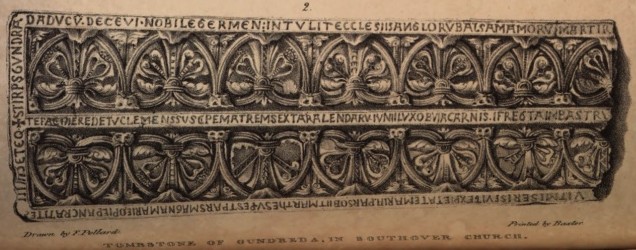 |
|
Illustration of Gundrada's tombstone
located in the Gundrada chapel of the Southover church in Lewes,
Kent.
|
will give the stranger a tolerably correct idea
of this piece of antiquity. It is sculptured in very high relief, and
displays in the workmanship the hand of a master. The form of the
letters, according to Gough, answers to those on the tombs of Bishop
Roger, at Salisbury, and William Deincourt, at Lincoln, between 1087 and
1100.
With the exception of the words in italics that have been
supplied, the following is what remains of the inscription. The points
are omitted, as there are evident mistakes in the pointing of the
original:—
“Stirps Gundrada ducum decus evi nobile germen
Intulit ecclesiis Anglorum balsama morum
Martir * * *
* *
Martha fuit miseris fuit ex
pietate Maria
Pars obiit Marthe superest pars magna
Marie
O pie Pancrati testis pietatis et
equi
Te facit heredem tu clemens suscipe
matrem
Sexta kalendarum Junii lux obvia carnis
Ifregit alabastrum1.”
2 The following Epitaph on Gundred, written by the
Lady of Sir William Burrell, previous to the removal of the tomb stone
from Isfield to Southover church, in 1775, is amongst the MSS. in the
possession of Sir C. M. Burrell, Bart.:—
What
though no effigy or sculptur’d bust
Adorns the place where lay Gundreda’s dust,
Yet true to honour shall immortal fame
Preserve to future age her pious name;
The acorn grew an oak; but envious time
Nipp’d the fair work of nature in its prime;
Quench’d the bright star that shone on Warren’s love,
And gave an angel to the realms above.
What though her tomb by Henry’s dire command
Became a victim to some ruffian hand,
Which in obedience to a monarch’s will
Destroy’d whole Abbies with an impious zeal;
A generous friend the sacred relique found,
And bore it from the desolated ground:
To Isfield’s aisle consigned the hallow’d prize,
Where now on Shirley’s monument it lies.
3 The reader will be pleased to notice, that
the preceding description of Gundred’s tomb stone, and the place where
it was deposited, &c. by Dr. Burrell, was written before the
alterations, (shall I call them improvements?) took place in
this department of Southover church. The marble tablet is now (Aug.
1823,) placed over the mantle piece of the vestry, into which this
corner of the church has been converted, so that it cannot be seen, but
by those who are permitted to enter that sacred apartment. The shrine
and tomb stone do not now stand under the inscription which was intended
to direct the eye of the stranger to it, but are placed in an obscure
corner, whence they serve for the two-fold purpose of a table and
writing-desk; and what must be peculiarly gratifying to the
antiquary, and will serve to perpetuate the correct taste of the
authors of these improvements is, that the black marble slab has
been painted, and the fractured end made perfect by cement. So
much for modern improvements!!!—“Difficile est satiram non scribere.”
1 The following lines may give a general idea of the
sense of the original:—
Gundred, illustrious branch of Ducal race,
Brought into England’s church balsamic grace:
Pious as Mary, and as Martha kind,
To generous deeds she gave her virtuous mind;
Though the cold tomb her Martha’s part receives,
Her Mary’s, better part! for ever lives.
O holy Pancras, keep with gracious care
A mother who has made thy sons her heir.
On the sixth calends of June’s fatal morn,
The marble frame, by inward struggles torn,
Freed the pure soul, which upwards bent its way
To realms of love and scenes of endless day.
On this inscription, Mr. Gough, in his Sepulchral Monuments,
makes the following judicious observations;—“The first line comprises
her illustrious descent, more comprehensively than Bishop Roger’s. The
second alludes to her merit in first introducing into England the
Cluniac order, a reform and perfecting of the Benedictine, and this is
the balsama morum. Then follows a beautiful allusion to the
character of the two sisters, Martha and Mary, in the Gospel, with the
happy application of the contrast between them. The poet concealing the
blameable part of Martha’s attachment to the world, ingeniously
represents her worldly mindedness as directed to, and governed by the
best views, those of providing for the necessaries of life and relieving
the distressed. Enough remains of the third line to shew that the
comparison begins here, that the first word is the name of Martha, and
that her example was followed by Gundreda in charitable distributions,
while in her devotion she copied the example of her other sister, who
sat at Jesus’ feet, attentive to his doctrine. The corporal part in
which this good lady resembled Martha, came to the end of all flesh: the
pars magna Mariæ, which I understand as synonimous with the
better part, that is, the soul, survives. The address to Saint
Pancratius is peculiarly happy. He was the patron of the new foundation,
and of the old church which preceded it. As the countess died in
child-bed, and the mother only is recommended to the regard of the
saint, it is probable the infant survived. The seventh line fixes her
death to the sixth calends of June, with Dugdale and Sandford, though an
ancient record seen by Le Neve makes it the eighth calends.
Notwithstanding the harshness of the construction, I cannot understand obvia
in the sense of hostilis. These two lines do not rhyme together.
The comparison with the two sisters holds very consistently with styling
this good princess’s devotions, the breaking the alabaster box of her
flesh and body, in allusion to the alabaster box of precious ointment,
with which Mary, the sister of Lazarus, anointed the feet of Jesus,
preparatory to his death; and with this the balsama morum
correspond. Ifregit, wants indeed the mark of the N over it, and
makes the verse hobble: but there is a similar omission over herede
in the second line, where it is indispensible, and instances of such
hobbling are not unfrequent.”
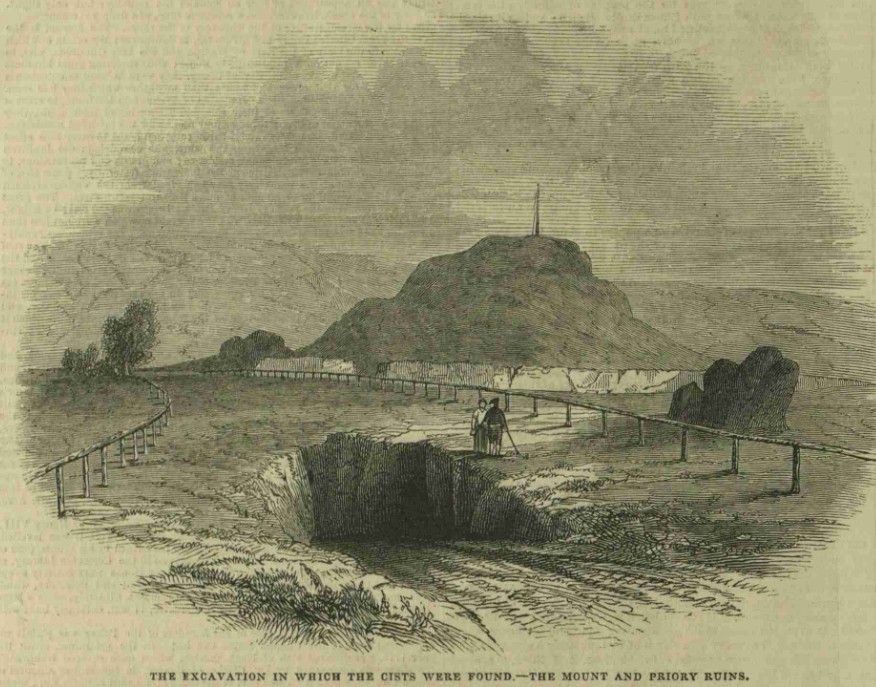 |
|
The excavation of a railway cutting at
Lewes Priory in 1845, during which cists containing the remains
of William de Warenne, 1st Earl of Surrey, and his wife,
Gundrada, were found.
|
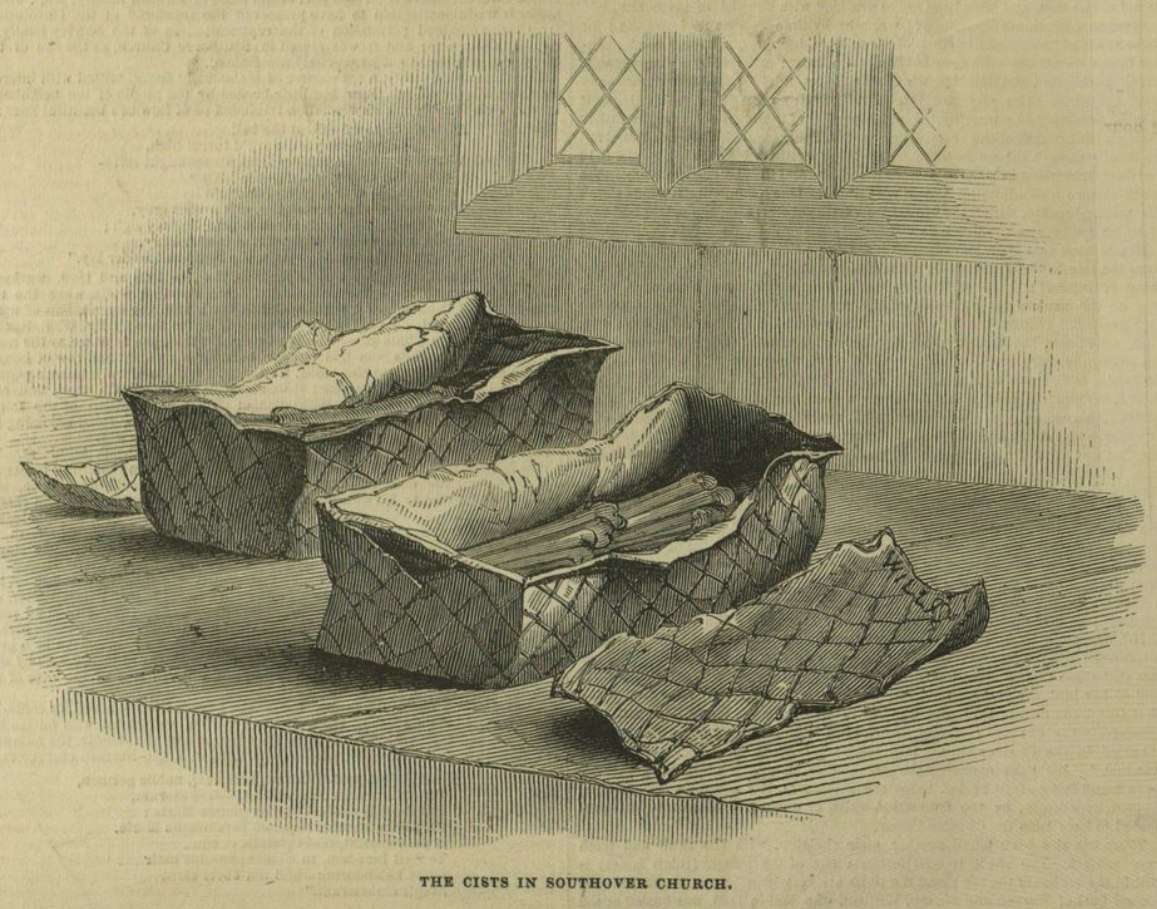 |
|
Cists containing the remains of William
de Warenne and Gundrada, drawn in 1845
|
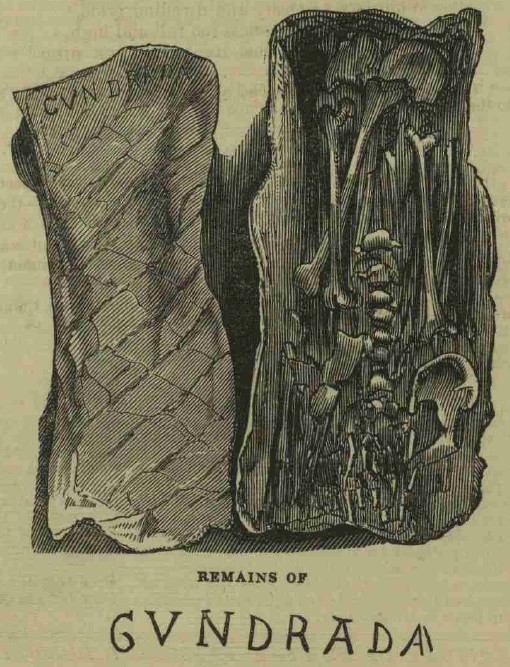 |
|
Remains of Gundrada, drawn in 1845, at
the time of the discovery of the cist containing his remains
|
Illustrated London News 8 November 1845 p295
ANTIQUARIAN DISCOVERIES
AT LEWES.
In our Journal of last week, we briefly noticed the discovery
amongst the ruins of the ancient Priory of Lewes, of the remains of
Gundrada, fifth daughter of William the Conqueror, and of William de
Warren, her husband, who, according to the best authorities, were
interred in the Chapter House of the above religious house. Thence, at
the Dissolution of the Priory, the tomb of the pious lady was removed to
the church of Isfield; but, it was brought back near its original
locality, in 1775, and placed in the neighbouring Church of Southover,
where it remains to this day. The entire discovery is of so interesting
a character, that we were induced to commission an artist of Brighton,
Mr. R. H. Hibbs, to proceed to Lewes, and sketch the remains and their
locality. We have ourselves since journeyed to the spot, and have been
much gratified with our visit of inspection.
Strange, indeed, are the changes wrought by time and man’s
ingenuity; for these relics of nearly eight centuries since have been
upturned in a work peculiar to our own times—the construction of a
railway; and this by a circumstance purely accidental, and but for which
the Relics might have rested for many more centuries. The projected line
of railway from Brighton to Hastings, it may be necessary to state, runs
through a portion of the town of Lewes, or rather through the grounds of
the ancient Priory of St. Pancras; and, although it will not materially
disturb the walls, there will yet be a cutting 40 feet wide by about 12
feet deep, traversing in a north-eastern direction from the western
boundary to the north-eastern wall adjoining the Mount Field. One of our
illustrations shows the precise locality, with “The Mount,” an
artificial elevation, the origin and uses of which are involved in much
doubt.
Nearly upon this spot, workmen had, for some time, been removing
the earth from the side banks of the western ruins of the Priory,
without discovering any thing of interest; but, on Monday week, they
commenced clearing a driftway on the bank of the west side of the
remains of the Priory chapel, on the high ground. During the day, the
workmen found a leaden coffin, 5 ft., 4 in. long, containing the remains
of a female skeleton, and portions of cere-cloth: the coffin was
surrounded by thin slabs of Caen stone, and the lead was much decayed.
Still, there was nothing to aid the identifying of these remains; and
their discovery was chiefly interesting as a good presage of what might
be expected. Accordingly, on Tuesday morning, the workmen exposed a
leaden Cist, or coffer, surrounded by a few square Caen stones. After
clearing away the soil, the Cist was carefully removed, and, on being
opened, was found to contain human bones, proved to be the remains of
Gundreda, daughter of William the Conqueror, the name “GVNDRADA,” as it
is spelt, being cut upon the lid. The size of the Cist is about 3 feet
in length, a foot in width, and 9 inches in depth: the lid, sides, and
ends, are in excellent preservation, but the bottom is much corroded.
The lead is ornamentally cast in beaded compartments of the lozenge
form, 5 inches by 3; and the lid fits on, or rather laps over the sides.
Soon after the finding of this Cist, and at a short distance from it,
the workmen found a second cist, precisely similar in form, character,
and material; being, however, slightly longer: the bottom is much
decayed, and on the lid is inscribed WILLMs, an old but usual way of
writing Gulielmus. This has been readily interpreted into the name of
William of Warren; by this means establishing the fact that these Cists
contain the remains of Gundreda, the founder of the Priory, and of her
lord, the first Earl of Warren and Surrey. Ancient records prove that
Gundreda died in 1085, and William of Warren in 1088, and that both were
interred in the Chapter House of Lewes Priory; the latter being, as it
is stated, “buried in the Chapter House, in a tomb adjoining that in
which his Countess was laid.” We have engraved the pair of Cist in an
adjoining column: they were found lying about 2½ feet below the surface
in two square compartments, formed, apparently, by the foundation-walls,
or under the floor of what is presumed to have been the Chapter House.
There has also been found another male skeleton, with the skull
and teeth very perfect. The skull is well formed; one of the femora
(thigh bones) is still in the socket of the hip; and the tibiæ are very
long. It is stated that the second Earl of Warren and Surrey, William,
who died in 1138, was buried at the feet of the first Earl; and it is
reasonably asked, in the Brighton Herald report, whether the above may
not be the remains of this Earl?
About a foot to eastward of the first-named remains were,
also, discovered those of some great ecclesiastical personage, probably,
one of the Priors. We find the following details in the Sussex
Express:—
“The skeleton was enveloped in a cowl of thin woollen cloth,
having underneath it a finer linen garment. The cowl covered the head;
the hands were resting across the breast, and the shoes were on. The
body had, evidently, been buried, without a wooden or leaden coffin,
upon a layer of fine sea beach, and inclosed within a stone Cist, which
was very perfect. Portions of hair, of dark red, were still to be seen.
To the south of this were two other skeletons, separated by a thin chalk
wall, of eight inches in thickness. The bodies were evidently simply
buried without coffins, and the earth thrown in upon them. These three
bodies lay parallel with each other, at the back of which were the
foundations of a wall, a foot thick, running in a slanting direction;
immediately behind which was exposed another stone Cist, with a
skeleton, and two others, side by side; and a foot southerly, yet
parallel, the skeleton of a female child, of about ten or twelve years
old, in a stone Cist, with a space carved out to receive the head. In
excavating these, the remains of two iron corner hinges were
discovered.”
On Thursday morning, another interesting relic was discovered
among the Priory ruins. This is a rudely-formed earthenware urn,
inclosed in a leaden vessel, the space between them being filled with
clay. The urn contained the lungs, stomach, and intestines of a human
being. It is recorded that the third Earl of Warren, grandson of the
first, went to the Holy Land in 1147, with the King of France, and was
slain in an attack made on the French army by the Turks: his remains
were brought home, and are presumed to have been, in part, the contents
of the urn.
There have, likewise, been found on the Priory site, several
fragments of ancient art, such as pieces of Roman tile, coins, tokens,
and other works in metal.
The annexed summary of the anatomical appearances of the remains
has been communicated to the Brighton Herald, by Mr. Pickford,
surgeon, of Brighton. Mr. Pickford, in company with Mr. Murrell, a
medical gentleman of Lewes, found the remains in the leaden coffins
described above. Of course, there was no order in their arrangement, as
the Cists were but three feet long, and so worn, that the bottom of the
one in which the Earl’s bones lay had fallen out, and that of the
Countess, was full of holes. To this is, doubtless, owing the fact, that
a great many of the Earl’s bones were missing, whilst those of the
Countess were nearly perfect, even to the bone of the tongue (os
hyoides), though her skull was much fractured. The bones
themselves were in a perfect state of preservation; they were strong,
heavy, and, where broken by the pick-axe, white. On measuring them, it
was found that both the Earl and Countess must have been persons of
large frame and tall stature. We give the admeasurements:—
Gundreda—Femur or thigh bone, 18¼ inches; tibia, or leg
bone, 15 inches; humerus, or upper arm bone, 12 inches; probable height,
about five feet eight inches.
William—Femur, 19¼ inches; tibia, 15¼ inches; humerus,
13½ inches; circumference of the shaft of the femur at its middle, 4¼
inches. Probable height, about six feet one or two inches.
These proportions, in the lady, equal those of a moderate-sized
man, and in the Earl exceed them. In a moderate-sized man, the femur, or
thigh bone, is 18 inches; the tibia, or leg bone, 15 inches; the
humerus, or upper arm bone, 12 inches; and the circumference of the
femur, or thigh bone, 3¼ inches.
There was, however, the thigh bone of another skeleton dug up on
this occasion which measured 20¾ inches, which would give a height of 6
feet 6¾ inches.
There was an appearance of hair on some of the remains; but only
slight. The body of the monk, however, had a complete crop, of a deep
red colour.
Thus far the circumstances of the discovery of the relics. The
ground is the site of the great Cluniac Priory of St. Pancras, in
Southover; the origin of which is traceable to the piety of the Earl of
Warren and his lady Gundreda, who, in the year 1076, set out on a
pilgrimage to Rome; and, receiving great kindness from the prior and
monks of St. Per, at Cluny, they were induced to entertain a greater
regard for that order and house than any other which they had seen.
Being already determined, by the persuasion of Archbishop Lanfranc, to
erect a religious house for the pardon of their sins and the saving of
their souls, they requested of the abbot at Cluny three or four monks
for the intended monastery. The abbot consented, and the grateful baron
returned home to carry into effect his holy project. In about six years,
the work was completed; the brethren then took possession of their
magnificent residence; and grants and benefactions, to an almost
incredible extent, enriched the increasing fraternity. Some idea of the
extensive scale of the monastery may be formed from the well-ascertained
fact, that its walls embraced an area of more than thirty-two acres. The
great church was rebuilt in the reign of Henry II. Its length was 150
feet; its height, 60 feet; it was supported by thirty-two pillars, eight
of which were not less than 42 feet high, 18 feet thick, and 45 feet in
circumference; the remaining twenty-four were 10 feet thick, 25 feet in
circumference, and 18 feet in height. The roof before the great altar
had an elevation of 93 feet. The Chapter House and the Church were by
far the most splendid parts of this stately pile: in the former were
interred the remains of the Founder of the Monastery and his Countess
(as we have explained), several of his successors in the barony, and
some distinguished nobles; the latter was richly adorned by the painter
and sculptor, and was distinguished by the magnificence of the funereal
monuments, with which it appears to have been crowded. We quote these
details from Mr. Baxter’s forth-coming “Guide to Lewes”.
William of Warren, the first Earl of Surrey, and husband of
Gundreda, had accompanied the Conqueror from Normandy, in his expedition
to England, and greatly aided by his conduct and bravery in obtaining
the battle of Hastings. He was more richly rewarded than any other
nobleman in the Conqueror’s suite: his possessions included the borough
and rape of Lewes: he rebuilt the Castle and founded the Monastery, as
we have described. This was the first convent of the Cluniac order
established in England; to which, therefore, all other Cluniac
Monasteries were subordinate, including the Priory of Castle Acre, in
Norfolk, another foundation of this Earl of Surrey. He is also supposed
to have built the Castle of Holmesdale, or Reigate, in Surrey; and
Dugdale states him to have died seised of two hundred Lordships, on June
24, 1088. He was buried, according to the Register of Lewes Priory, in
the Chapter House of that foundation, near his Countess Gundreda, who
died in childbirth, at Castle Acre, in 1085.
The Priory at Lewes proved a rich prize at the dissolution by
Henry VIII., when it was seized on by Thomas Cromwell. By his orders it
was levelled, and so completely was the work of its demolition performed
by his agents, (one of whom, Portmarus, describes it in a letter
preserved in the Cottonian Library, at the British Museum,) that the
Church and Chapter House were entirely swept away; and the ruins which
remain, are those of the Hall and Refectory, which were converted into a
malt-house. Near these remains, till lately, stood a large elliptical
oven, measuring in its longest diameter, 17 feet, curiously built with
tiles.
Thus, although the burial-place of the founders of the Priory was
plainly recorded, all trace of the Chapter House was lost. In the
meantime, about the year 1775, a sculptured slab of black marble, which
once covered Gundreda's remains, was discovered by Dr. Clarke, of
Buxted, in the Shirley Chancel of Isfield Church, where it formed part
of the tomb of Edward Shirley, Esq., whose father is traditionally said
to have preserved the memorial at the Dissolution. Dr. Clarke obtained
permission of the representatives of the Shirley family to remove the
stone; and it was placed in Southover Church, as the site of the Chapter
House could not be precisely ascertained.
The ruins, until lately, were a scene of melancholy decay,
visited with interest by many a lover of antiquities, but little heeded
by the people of the neighbourhood. How forcibly has its desolation
reminded us of Bowles’s beautiful lines:—
All is silent now!—silent the bell
That, heard from yonder ivy’d turret
high,
Warn’d the cowl’d brother from his midnight cell—
Silent the vesper chaunt—the Litany
Responsive to the organ—scatter’d lie
The wrecks of the proud pile, mid arches grey,
Whilst hollow winds through mantling ivy
sigh;
And e’en the mouldering shrine is sent away,
Where, in his warrior weeds, the Norman founder lay.”
We should add, from the Sussex Express, that, in 1828 and
1829, workmen were employed to level the ground about the standing
walls, when the turf was taken off from a great portion of the land, and
the foundations of many walls were exposed. A plan of them was made at
the time by Mr. W. E. Baxter, the publisher, in whose possession it now
is. In 1836, the frontage to the north of the Priory grounds was laid
out for building a crescent and row of houses. To the south-west of the
ruins stood, till lately, a portion of the immense pigeon-house
belonging to the fraternity; it was built in the form of a cross, and
contained recesses for more than 3,000 pair of doves. A mansion of the
Dorset family, which was destroyed by fire about 150 years ago, stood
adjoining the churchyard, and has given the name of Lord’s place to the
site.
On our late visit, the spot was crowded with wonder-struck
inquirers. We there learned that, on the discovery of the relics, they
were carefully preserved by Mr. Acton, the chief officer of the Lewes
and Hastings Railway Police, who had them removed to his own house, and
the greater part of them from thence to the Church of St. John the
Baptist, at Southover. The urn, with its leaden case, and a few small
relics, were left at Mr. Acton’s: the case, in form, resembles a kitchen
boiler, and has a projection from the lower part resembling a tap.
The Cists, and their contents, may be inspected at Southover
Church on any day, except Sunday, from ten till one, and from two till
four. Every visitor, not being an inhabitant of Southover, is expected
to contribute to the fund for reimbursing the expenses incident to the
discovery and preservation of these highly-interesting relics. We
learned from the Clerk, that they are inspected by a great number of
visitors, daily, except on Sundays. The Cists are placed side by side,
inclosed with railing, beneath a window on the north side of the nave of
the church, as shown in our illustration.
Nearly in the centre of the west end of the nave is the memorial,
or coffin-lid, of Gundreda. It is a slab of black Norman marble,
sculptured with foliage in a fine early style, and bearing around its
edge, and up the middle, the following inscription, with slight
conjectural supplements, in Anglo-Norman characters:—
“Stirps Gundreda Ducum, decus evi, nobile germen,
Intulit Ecclesiis Anglorum balsama morum,
Martha fuit miseris, fuit ex pietate Maria;
Pars obiit Marthe, superest pars magna Marie.
O pie Pancrati, testis pietatis et equi,
Te fecit heredem, tu clemens suscipe matr
Sexta kalendarum Junii lux obvia carni
Ifregit alabastrum.”
TRANSLATION.
“Gundred, of Ducal race, the ornament of her age, a noble
bud,
Brought into the Churches of England the balsam of
morals;
She was a Martha to the wretched; she was, for piety,
a Mary:
The part of Martha has died, the mighty part of Mary
survives.
O holy Pancras! witness of her piety and
righteousness,
She made thee her heir; do thou, benign, receive a
mother.
The hostile dawn of the sixth calend of June
Broke the alabaster of flesh.”
The slab is raised on a neatly-designed altar-tomb, which bears
an inscription stating the removal thither, in 1775, by William Burrell,
Esq. We believe it to be the intention of a Committee hereafter to
deposit the remains in the above or some other fitting receptacle in the
church: a fund is being raised for this purpose, subject to the control
of the Committee, consisting of the Rev. John Scoble, Rector; the
Churchwardens; the Earl of Chichester; the Rev. W. H. Cooper; J. Hoper,
Esq.; W. H. Blaauw, Esq.; and Mr. Figg, to whom the public are mainly
indebted for the suggestion which preserved the Relics.
We need scarcely observe that the Cists in which the bones were
found deposited, are not the coffins in which the bodies were originally
buried: this is evident, from their length. It is, therefore, inferred
by some, that, on the re-building of the church in the reign of Henry
II, the bodies of the founders of the Priory were disinterred, and the
bones deposited in these leaden coffers, and thus re-buried. We are,
however, rather inclined to refer this re-interment to the date of the
Dissolution, or soon after, especially as the spot is too elevated to
form any portion of the site of the Priory. Probably, this was the work
of some devotee, who thus sought to protect the bones of the pious
founders from being scattered to the winds. If such, however, be the
case, the spot where the Cists were found, cannot be considered as part
of the Chapter House site. By their recent discovery, the remains of
Gundreda will once more rest beneath the original slab or lid of her
coffin, or the greater portion of it. The lid of the Earl’s coffin was,
probably, similar; but, of this, no trace has been found.
The following observations on the discovery, communicated to the
Sussex Express, by Mr. Blaauw, one of the Committee, are entitled
to special attention:—
“It is obvious, from the length of these receptacles, that the
bones of the Earl and Countess have been transferred to them from some
previous tombs; and, it is not difficult to suppose that the Chapter
House, not being built at the time of their deaths, the founders were
buried elsewhere until its completion; and that the bodies were then
found so decayed, that their bones only remained for removal to a more
distinguished situation, and were, on that occasion, placed in these
very leaden chests. A rebuilding of the Priory Church was begun on the
anniversary of William the founder’s death, in 1243, and from the
antique form of the letters G and M, the inscriptions cannot be fixed at
a later period. The characters, indeed, more resemble the form used in
the 12th century. Of the genuine antiquity of these relics there cannot
be the slightest doubt.”
…
The Relics have been preserved by these means. The land on which
the Priory stood, and through which the railway passes, belongs to a
lady named Jackson, and who stipulated with the contractor for the
railway works, Mr. Wythes, through her solicitor, Mr. Hoper, of Lewes,
that all relics which might be discovered should be reserved for her.
Accordingly, they have been saved from falling into the hands of persons
who might have been unable to appreciate their real interest, but who
might have caused them to minister to their cupidity.
On returning to the site of the discoveries, our mind’s eye
carried us through a vista of eight centuries, as we gazed by turns on
the crumbling and ivy-clad ruins, and the railway works hard by. Then,
too, we felt the true spirit of Mr. Blaauw’s concluding
reflexions:—“Many a hymn and mass have been chaunted on behalf of the
souls of the pious founders of the Priory on the spot where noisy
steam-engines will soon rush across; and, though we by no means wish the
masses back, yet it almost requires the iron conscience of a railway to
be proof against the curses denounced in his charter by William de
Warenne on any who should disturb his foundation. ‘May those who oppose
or destroy these things meet with God’s sword of anger, fury, vengeance,
and eternal malediction; but may God welcome in peace with grace, mercy,
and eternal salvation those who preserve and defend them.’”
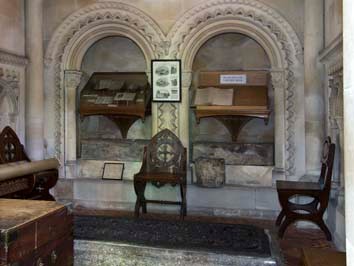 |
|
The remains of William and Gundrada are
now located in the Gundrada chapel of the Southover church in
Lewes, Kent. Gundrada's original tombstone of black Tournai marble
is in the foreground.
|
Notes on the churches in the counties of Kent, Sussex,
and Surrey, mentioned in Domesday book p290 (Arthur Hussey,
1852)
A small adjunct
to the eastern part of the south wall of the church has been erected to
contain the above-mentioned remains. The interior is richly adorned with
(beside other ornamental work) carving in various patterns copied from
fragments discovered in and near the site of the priory; which fragments
deserve notice and preservation, the character of the mouldings being
good, and not common.
- ‘Observations in
disproof of the pretended marriage of William de Warren’ (Thomas
Stapleton, 1834) printed in Archaeological Journal vol 3 pp1-26;
‘Gundrada de Warrenne’ (E. Chester Waters, 1886) printed in Archaeological Journal vol 43 pp306-11;
‘The Parentage of Gundrada, wife of William of Warren’ (Edward A.
Freeman, 1888) in The English Historical Review vol 3
pp680-701; ‘The Origin of the Family of Warenne’ (L. C. Loyd,
1934) in Yorkshire Archæological Journal vol 31
pp106-13; Appendix A ‘Gundrada wife of William de Warenne the
First’ in Early Yorkshire Charters vol 8 pp40-6
(Charles Travis Clay, 1949)
- Early Yorkshire Charters vol 8 pp54-5
(Charles Travis Clay, 1949); Dictionary of national biography vol 23
pp338-9 (ed. Sidney Lee, 1899); Dictionary of national biography vol 59
p373 (ed. Sidney Lee, 1899); The Complete Peerage vol 12 part 1 p494
(George Edward Cokayne, enlarged by Geoffrey H. White, 1953)
- Dictionary of national biography vol 23
pp338-9 (ed. Sidney Lee, 1899); Dictionary of national biography vol 59
pp374-5 (ed. Sidney Lee, 1899); The Complete Peerage vol 12 part 1 p495n
(George Edward Cokayne, enlarged by Geoffrey H. White, 1953)
- The ecclesiastical history of England and Normandy
by Ordericus Vitalis vol 2 pp47-9 (trans. Thomas
Forester, 1853); ‘Observations in disproof of the pretended marriage of
William de Warren’ (Thomas Stapleton, 1834) printed in Archaeological Journal vol 3 pp1-26;
‘The Origin of the Family of Warenne’ (L. C. Loyd, 1934) in Yorkshire Archæological Journal vol 31
pp106-13; Early Yorkshire Charters vol 8; Illustrated London News 8 November 1845
p295; Dictionary of national biography vol 23
pp338-9 (ed. Sidney Lee, 1899); The Complete Peerage vol 12 part 1 p494
(George Edward Cokayne, enlarged by Geoffrey H. White, 1953); Medieval
Lands (GUNDRED); wikipedia
(Gundred, Countess of Surrey)
- The ecclesiastical history of England and Normandy
by Ordericus Vitalis vol 2 p473n (trans. Thomas
Forester, 1853); Dictionary of national biography vol 23
p338 (ed. Sidney Lee, 1899); The Complete Peerage vol 12 part 1 p494
(George Edward Cokayne, enlarged by Geoffrey H. White, 1953)
- The ecclesiastical history of England and Normandy
by Ordericus Vitalis vol 2 pp472n-3n (trans. Thomas
Forester, 1853); Sepulchral monuments in Great Britain vol
1 part 1 pp8-10 (Richard Gough, 1786); The History and Antiquities of Lewes and Its
Vicinity vol 1 pp115-7 (Thomas Walker Horsfield, 1824);
Illustrated London News 8 November 1845
p295; Dictionary of national biography vol 23
pp338-9 (ed. Sidney Lee, 1899); The Complete Peerage vol 12 part 1 p494
(George Edward Cokayne, enlarged by Geoffrey H. White, 1953); Notes on the churches in the counties of Kent,
Sussex, and Surrey, mentioned in Domesday book p290
(Arthur Hussey, 1852)
Rodolf de Warenne
Beatrice
Emma
Emma is named as the wife of Rodolf in a number of charters by Rodulf, some
of them printed and abstracted in Early Yorkshire Charters vol
8 pp52-4 (Charles Travis Clay, 1949)
Knight
The Warenne family derived its name from the hamlet of Varenne on the river
Varenne in the Seine-Inférieure department of Normandy, a name that first
appears in a charter of Duke Robert I dating to approximately 1030–1035.
Rodulf de Warenne I was a knight of unknown parentage who had a brother
named Godfrey and held substantial territories on both banks of the Seine
and outside the walls of Rouen. In about 1053, he granted land in Vascœuil
to the abbey of St. Pierre de Préaux with the consent of his first wife,
Beatrix, who was likely a niece of duchess Gunnor and the mother of his
sons, Rodulf and William. By 1059, Rodulf had married his second wife, Emma,
and records indicate that both were still living in 1074 while overseeing
various churches and tithes in the pays de Caux.
Rodolf is first mentioned in a charter of duke Robert of Normandy dated to
between 1030 and 1035, showing that he held land near Rouen.
Monasticon Anglicanum vol 6 part 2 p1101
(William Dugdale, 1846)
Abbatia Sanctimonialium de S. Amando Rothomagi.
… in perpetuam concedimus: qui locus circa ecclesiam extenditur usque
ad vicum per quem ad portam Roddebecce itur; et indè usque ad terram
Willielmi de Tornebu. Iterum ab istâ, usque ad terram Radulfi de
Warennâ; indè verò usque ad murum civitatis; cujus rei signum est
altera pars nostræ elemosinæ, quæ huic conjuncta in alterâ parte muri
sita est.
This roughly translates as:
The Abbey of Nuns of St. Amand of Rouen.
… we grant in perpetuity: which site extends around the church as
far as the street through which one goes to the Robec Gate; and from
there as far as the land of William de Tournebu. Again from that [land],
as far as the land of Ralph de Warenne; from there, indeed, as far as
the city wall; the sign of which matter is the other part of our alms,
which, joined to this, is situated on the other side of the wall.
Two important studies of the Warenne family are an 1846 paper ‘Observations
in disproof of the pretended marriage of William de Warren’ by Thomas
Stapleton printed in Archaeological Journal vol 3 pp1-26, and a
1934 study by L. C. Loyd, correcting some of Stapleton's conclusions, in
‘The Origin of the Family of Warenne’ in Yorkshire Archæological Journal vol 31 pp97-113.
Early Yorkshire Charters vol 8 pp1-2
(Charles Travis Clay, 1949)
THE EARLY GENERATIONS OF THE FAMILY OF WARENNE
The family derived its name from the hamlet of Varenne,1
about two miles south of Arques and about thirteen miles north of
Bellencombre, on the river Varenne, in the department of
Seine-Inférieure in Normandy.2 The earliest occurrence of the
name is in a charter of Robert I, duke of Normandy, confirming the
foundation of the abbey of St. Amand at Rouen, which can be dated c.
1030-1035.3
… RODULF DE WARENNE I. The charter
of duke Robert, c. 1030-1035, mentioned above, shows that he was
holding land in the neighbourhood of the abbey of the Holy Trinity at
Rouen, which lay outside the then existing city wall to the east. In the
year in which duke William married (1053), described as ‘quidam miles de
Warenna, Radulfus nomine,’ he gave to the abbey of St. Pierre de Préaux,
with the consent of his wife Beatrix, all that he had in Vascœuil, dept.
Eure, which appears to have been on the ducal demesne; among the
witnesses being his brother Godfrey.6 Before May 1055,
described as Rodulfus Warethnæ, he sold lands in the neighbourhood of
Rouen to the abbey of the Holy Trinity, among those who subscribed to
the instrument being his wife Beatrix1; and in 1059,
described as Rodulfus de Warenna, with his [second] wife Emma, he sold
to the same house four churches in the pays de Caux.2 It was
probably in or about the following year that he consented to a sale of
tithe and land to the same house by his tenant Hugh de Flamanville,
among the subscriptions to his consent being his wife Emma and his sons
Rodulf and William. In 1074, with the same subscriptions, he made a gift
to the same house of another church and tithe in the pays de Caux.3
There are strong reasons for supposing that Rodulf’s first wife
Beatrix was a niece of duchess Gunnor, wife of duke Richard I4,
and that she was the mother of his two sons5:
(1) Rodulf de Warenne II. The details of a feodary of 1210-20
show that certain lands known to have been held by his father, both in
the pays de Caux and near Rouen, then formed part of the barony of
Esneval; and a comparison with the return of knights’ fees in Normandy
in 1172 shows that at that date they were already in the possession of
Robert d’Esneval. It is likely, therefore, that Rodulf II left issue,
and that before 1172 the Esneval family acquired in marriage with his
heiress the lands which he had inherited from his father.
(2) William de Warenne; see below.
(3) A daughter who married Erneis de Coulances and had two sons:
(i) Richard, lord of Coulances near Vire, a benefactor of the abbey of
St. Evroul; by his wife Adelaisa he had fifteen children, and died 15
Sept. 1125; and (ii) Roger, described by Orderic as son of Erneis de
Coulances and nephew of William earl of Surrey, and also named Roger de
Guarenna, who was a monk at St. Evroul in 1081 and passed, forty-six
years there.6
1
The usual Latin form is either Warenna or Warennia; see Chapter V.
2 Most of the details given here and in the account
of Rodulf de Warenne I and his son Rodulf II are taken from Mr. L. C.
Loyd’s paper, ‘The Origin of the Family of Warenne’ in Y.A.J.,
xxxi, pp. 97-113, or (for Roger de Warenne) from his ‘Note on the
Relationship between the Families of Mortimer and Warenne’, forming
Appendix A to The Complete Peerage, new ed., vol. ix, where full
documentary references and reasons for the various conclusions and
suggestions are given. In those papers certain theories which have been
advanced in the past are proved to be fallacious.
3 Text in Mon. Ang., vi, 1101.
6 Text pd. by T. Stapleton in his paper ‘Observations
in disproof of the pretended marriage of William de Warren …’ in Arch.
Journal, vol. iii (1846), p. 11.
1 Note to charter no. 1 in Chapter II below; Roger
son of the bishop, i.e. Roger son of Hugh bishop of Coutances,
was described as his particeps et coheres; but their
relationship, which was not that of brothers, has not been determined
(see ibid.).
2 Ibid.
3 Charter: no. 1.
4 This is based on the following passage, pd. in Complete
Peerage, loc. cit., p. 4, from William de Jumièges, bk. viii, c.
37, ed. Marx, p. 328: ‘Neptes vero plures predicta Gunnor habuit, sed
solummodo de quinque, quibus maritis nupserint, audivi. Una itaque earum
matrimonio copulata est patri primi Willelmi de Warenna; ex qua natus
est idem Willelmus, postea comes Surreiae, et Rogerius de Mortuo Mari,
frater ipsius …’ Although the reference to Roger de Mortemer is
certainly a mistake, there seems no reason to doubt the statement about
William de Warenne’s mother—a statement which is supported by the degree
of relationship between William de Warenne II and a daughter of king
Henry I examined in Appendix A below.
5 On this point see the note to charter no. 1.
6 Orderic, ed. Le Prévost, ii, 396; iii, pp.
12, 16-18.
Early
Yorkshire Charters vol 8 pp52-4 (Charles Travis Clay, 1949)
1. Gift
by Rodulf de Warenne and Emma his wife to the abbey of Holy Trinity,
Rouen, whither they came with their sons Rodulf and William in 1074
about sixteen years after their sale to the abbey of the churches and
tithes of Motteville-l’Esneval, Flamanville-l’Esneval, Emanville and:
Anglesqueville-sur-Saane in the pays de Caux, of all the tithe of
Auzouville-l’Esneval, with the church, which they had purchased from
William son of Roger son of Hugh the bishop [of Coutances]. At
Rouen. 1074.
Pd. in Cartulaire de l’Abbaye de la Sainte-Trinité du Mont de
Rouen (ed. A. Deville in Documents Inédits, 1841), no.
xxxv, p. 440; also by T. Stapleton1 in Arch. Journal,
iii, 12, and by L. C. Loyd2 in Yorks. Arch. Journal,
xxxi, 101, both from the same.
Omnibus sanctæ ecclesiæ filiis
notum sit, quod Rodulfus de Warenna ejusque conjux, vocabulo Emma, cum
filiis suis, Rodulfo scilicet atque Willelmo, post annos fere xvj quam
quattuor villarum Caletensis pagi, Maltevillæ videlicet, Flamenvillæ,
Amundi Villæ et Anglicevillæ, ecclesias et earum decimas nobis
vendiderant, convenientes in hoc monasterio anno dominicæ
incarnationis MLXXIIIJ, omnem totius Osulfi Villæ
ejusdem Caletensis pagi, cum ecclesia, decimam, quam a Guillelmo,
filio Rogerii, filii Hugonis episcopi XXX libris
denariorum emerant, pro redemptione animarum suarum, in perpetuam
hereditatem nobis dederunt, et donationem super altare Sanctæ
Trinitatis posuerunt, coram testibus.
Signum ipsius Rodulfi. Signum Emmæ, uxoris ejus. Signum
Rodulfi, filii eorum. Signum Willelmi, fratris ejus. Signum Hugonis de
Flamenvilla. Signum Rainaldi; signum Guillelmi, filiorum ejus. Signum
Gisleberti, clerici. Signum Leudonis. Ex nostra parte testes:
Ricardus, senescal; Bernardus, cocus; Ricardus de Appivilla;
Guillelmus, sartor; Rainaldus Anglicus; Walterius, cocus; Albericus de
Blovilla; Osbernus Bruncosted.
In the same chartulary there is the charter dated 1059 by which
Rodulfus de Warenna, ‘vir illustris,’ with Emma his wife, sold to abbot
Rainer and his monks the four churches named, each with ‘sex jugeres
terræ, quos acres dicimus,’ with the authority and a confirmation clause
of William ‘consul Normanniæ’; signum ejusdem Willelmi, comitis; signum
Rodulfi de Warenna; signum Emmæ, uxoris ejus; signum Hugonis de
Flamenvilla, and five witnesses (three being the same as in the above
charter) on the abbey’s behalf.3
There are also (a) a notification by the monks referring
to an earlier sale by Rodulf Warethnæ of 100 acres of wood in Blovilla
[Blosseville, nr. Rouen] and land there and in neighbouring places and
to 100 acres of the same wood sold by Roger son of the bishop1
‘qui et particeps et coheres est ejusdem alodii’; which sales were
authorized and confirmed by duke William and Malger, archbishop of
Rouen; signum Willelmi, comitis; signum archipræsulis Malgerii; signum
ejusdem Rodulfi de Guarethna; signum Beatricis, uxoris ejus; signum
Rogerii, filii episcopi. . . signum Willelmi, filii Rogeri, heredis
scilicet ipsius …2 signum Hugonis, fratris ejus …3
(b) sale by Rodulf de Warenna with the consent of Emma his
wife to abbot Rainer and the monks of all his portion of the wood in
Blosseville and Scurra [Lescure, nr. Rouen], with the approval of duke
William; signum ejusdem Willelmi, comitis; signum ipsius Rodulfi; signum
Emmæ, uxoris ejus; signum Hugonis de Flamenvilla; signum Leudonis; and
four witnesses on the abbey’s behalf.4
(c) gift and sale by Rodulf de Warethna with the
concurrence of Emma his wife of certain tithes in Emanville, Flamanville
and Motteville; signum ipsius Rodulfi; signum Emmæ, uxoris ejus; signum,
Hugonis de Flamenvilla; signum Willelmi, filii Anscheri; and six
witnesses on the abbey’s behalf.5
(d) sale by Rodulf de Warenna of the multure of all his
men in Blosseville and neighbouring places, similar to the sale made by
Roger son of Hugh the bishop.6
(e) record of the sale by Hugh de Flamenvilla to the abbey
of tithe in Emanville which he held of his lord Rodulf de Warethna, with
the latter’s consent, and interests in Motteville and Flamanville; with
a clause stating that subsequently the said Rodulf, Emma his wife, and
their sons Rodulf and William, together with the said Hugh, came to the
abbey and confirmed the sale; signum Rodulfi de Warethna; signum Vidonis
de Briothna;7 signum Willelmi, filii Walonis; signum Emmæ,
uxoris Rodulfi de Warethna; signum Rodulfi, filii eorum; signum
Willelmi, fratris ejus; signum ipsius Hugonis de Flamenvilla; signum
Rotberti, filii ejus; signum Gisleberti, filii ejusdem; signum Rodulfi
de Wesneval; and four witnesses on the abbey’s behalf.8
(f) confirmation by Rodulf de Warenna of the gift of tithe
made by his tenant Osmund de Bodes, at the time of the invasion of
England.9
(g) confirmations by Rodulf de Warethna or Warenna, dated.
1060 and 1062, of a gift and sale by two other tenants in Flamanville
and Emanville.1
The chief interest of these charters is due to the mention of
William, younger son of Rodulf de Warenne. He can be identified with
William de Warenne I, subsequently the first earl of Surrey2.
Some of the witness clauses and the clause in the record of sale by Hugh
de Flamanville suggest that he was Rodulf’s son by his second wife Emma.
But Beatrice, Rodulf’s first wife, was certainly living in 1053;3
and, as William fought at Hastings, he cannot have been the son of Emma.
On this point Mr. Loyd was of opinion that too much weight should not be
attached to a particular pronoun.4
The charters show that Rodulf de Warenne and Roger son of Hugh
bishop of Coutances, were coheirs in lands in the neighbourhood of
Rouen. Stapleton supposed that they were brothers; but Mr. Loyd shows
that this view cannot be upheld, and that their relationship must have
been more remote.5 Mr. Loyd has further shown that
Stapleton’s identification of Roger son of the bishop with Roger de
Mortemer is impossible.6
1 Giving the year as MLXIIIJ in
error.
2 First four witnesses only.
3 Cartulaire, no. xxix, p. 436; Arch.
Journal, iii, 12; Y.A.J. xxxi, 100 (in part); abst. in Cal.
Docs. France, no. 72.
1 Roger son of Hugh bishop of Coutances (Y.A.J.,
xxxi, pp. 99, 102-3).
2 A clause specifying a payment made to him for
consenting to his father’s sale.
3 Cartulaire, no. xxvii, p. 435; Arch.
Journal, iii, 8; notice in Y.A.J., xxxi, 99; abst. in Cal.
Docs. France, no. 71. The date is earlier than abp Malger’s
deposition in May 1055.
4 Cartulaire, no. xxviii, p. 436; Arch.
Journal, iii, 9.
5 Cartulaire, no. xxx, p. 437.
6 Ibid., nos. xl, xli, pp. 442-3.
7 Guy son of Rainald count of Burgundy by Adelis a
daughter of Richard II, duke of Normandy; he was given Brionne by duke
William (Orderic, ed. Le Prévost, iii, 230); and is styled ‘Wido
comes’ in another of these charters (see below).
8 Cartulaire, no. xxxi, p. 437; Arch.
Journal, iii, 10; dated in Y.A.J., xxxi, 101 as c.
1060.
9 Cartulaire, no. lvii, p. 451; Arch.
Journal, iii, 13.
1 Cartulaire, nos. xxxii, xxxiv, p. 439; and
cf. no. xxxiii,, also confirmed by ‘Wido comes,’ the same man as
Guy de Brionne mentioned above.
2 Full details of proof were given by Mr. L. C. Loyd,
who made an exhaustive examination of these charters and of related
evidence in his paper ‘The Origin of the Family of Warenne’ in Y.A.J.,
xxxi, pp. 97-113; see especially on this point pp. 106-10.
3 See p. 1 above.
4 Y.A.J., xxxi, 107
5 Ibid., pp. 102-3.
6 Complete Peerage, new ed., ix, app. A, p.
7.
The charters abstracted above have been printed in an 1846 paper
‘Observations in disproof of the pretended marriage of William de Warren’ by
Thomas Stapleton printed in Archaeological Journal vol 3 pp11-2.
Dictionary of national biography vol 59 p372
(ed. Sidney Lee, 1899)
WARENNE
or WARREN, WILLIAM, first EARL OF SURREY
(d. 1088), appears to have been the son of Rodulf or Ralph,
called ‘filius episcopi,’ by his second wife, Emma, Rodulf himself being
the son of Hugh (d. 1020), bishop of Coutances, by a sister of
Gunnor, wife of Richard I (d. 996), duke of the Normans (C. WATERS,
Gundrada de Warenne, p. 11; Archæological Journal, iii.
7; Cont. of WILL. JUMIÈGES, viii. 37,
makes his mother a niece of Gunnor). His name was derived from his
fortress situated on the left bank of the Varenne, and called after that
river
The Complete Peerage vol 12 part 1 pp491-2
(George Edward Cokayne, enlarged by Geoffrey H. White, 1953)
SURREY(d)
RODULF(e) DE WARENNE
I derived his name from the hamlet of Varenne (dept. Seine-Inférieure)
on the little river Varenne in Normandy.(f) His parentage is
unknown.(g) He is said to have held land outside the Walls of
Rouen under Robert I, Duke of Normandy (d. 1035),(a)
and the Cartulary of the abbey of the Holy Trinity on the Mont de Rouen
proves that he held a considerable territory on both banks of the Seine
upstream from Rouen.(b) He also held land at Vascoeuil (dept.
Eure), which he gave about 1053 to the abbey of St Pierre de Préaux,(c)
and in the pays de Caux, north of Rouen, where he sold 4 churches with
tithes to the Holy Trinity in 1059, and gave another church, also with
tithes, in 1074.(d) He m., 1stly, Beatrice,(e)
whose mother was almost certainly a sister of Gunnor, 2nd wife of
Richard 1, Duke of Normandy.(f) She was living about 1053.(g)
Rodulf m., 2ndly, in or before 1059,(h) Emma, whose
parentage is unknown. He and his and wife were both living in 1074.(i)
(d)This account of the first 5 Warenne Earls of
Surrey is based on the exhaustive account by C. T. Clay, Early
Yorkshire Charters (hereinafter referred to as E.Y.C.),
vol. viii, pp. 1-26, 40-129. The account of the father and brother of
the 1st Earl is
derived largely from L. C. Loyd, “The Origin of the Family of Warenne,”
in the
Yorks. Arch. Journal (referred to as Y.A.J.), vol. xxxi,
pp. 97-113.
(e) His christian name is Latinised both as Rodulfus
and as Radulfus (Ralph). This confusion occurs in other families (e.g.
the founder of the Tancarvilles) and is probably due to two somewhat
similar names having become assimilated into one; e,g. Ranulf
(from Hrabenwulf) and Randolf (from Randwulf) (Ancestor, no. 12,
p. 53). Scribes were then likely to change Rodulfus to Radulfus when
copying early charters (Cf. White in Genealogist, N.S.,
vol. xxxvii, p. 62, note 51, and Loyd in Y.A.J., vol. xxxi, p.
98, note 1).
(f) Idem, p. 111.
(g) Stapleton argued that Rodulf was a son of Hugh,
Bishop of Coutances (Archaeological Journal, vol. iii, pp. 6-12);
but this theory was disproved by Loyd (Y.A.J., vol. xxxi, pp.
102-03). His father also may have been named Rodulf, for one of the
witnesses to a charter of Duke William for St. Wundrille, not later than
1045, is a Roger son “Radulfi de Warethna” F. Lot, Études critiques
sur l’Abbaya St. Wandrille, no. 19). Loyd observes that from the
probable date of the charter this Roger may just as well have belonged
to the previous generation as that of William de Warenne (ante,
vol. ix, Appendix A, p. 5); so Roger may have been either br. of Rodulf
or his son.
(a) An alleged charter of Robert I confirming the
foundation of the abbey of St. Amand in Rouen (Dugdale, Mon.,
vol. vi, p. 1101; M. J. Le Cacheux, Histoire de l’Abbaye de
Saint-Amand de Rouen, pp. 242-43), when specifying the boundaries
of the site granted, refers to the terram Radulfi de Warenna.
Miss Le Cacheux gives cogent reasons for holding that this charter is
copied from Robert I’s charter confirming the foundation of the Holy
Trinity by the same founders, these boundaries of St. Amand having been
inserted in the text (Idem, pp. 27-28). However, in view of
Rodulf’s other holdings in the neighbourhood of Rouen, it is quite
likely that he did hold the land in question, which was evidently to the
east of the city towards Mont Ste Catherine; cf. Loyd in Y.A.J.,
vol. xxxi, p. 98, where the charter is accepted as genuine.
(b) Before May 1055 Rodulf sold to the monks land at
Blosseville and Eauplet, on the right bank of the Seine, and Sotteville
on the left bank. Subsequently he sold them all his rights in
Blosseville, Mesnil-Esnard, Neuvillette, Lescure and Eauplet (Cartulaire
de la Ste-Trinité du Mont de Rouen, ed. A. Deville, nos. xxvii,
xli; for the identification of the places named see Loyd in Y.A.J.,
vol. xxxi, p. 99).
(c) Stapleton, Archaeological Journal, vol.
iii, p. 11. His 1st wife Beatrice consented. Loyd points out that
Vascoeuil had formed part of the ducal demesne (op. cit., p. 98);
and it seems likely that the land there was brought in by Beatrice.
(d) Cart. Ste Trinité, nos. xxix, xxxv; for
identification of the places concerned see Loyd, op. cit., p.
100. His 2nd wife, Emma, consented to these transactions. For other
benefactions by Rodulf see Cart. Ste Trinité.
(e) See note “c” above.
(f) Will. de Jumièges (ed. Marx, Soc. de l’Hist. de
Normandie, p. 328; cf. White, in Genealogist, N.S., vol.
xxxvii, pp. 61-63, and Loyd, in Y.A.J., vol. xxxi, pp. 107-09.
(g) See note “c” above.
(h) Cart. Ste Trinité, no. xxix,
(i) Idem, no. xxxv.
- ‘The Origin of
the Family of Warenne’ (L. C. Loyd) in Yorkshire Archæological Journal vol 31 p
100; Early Yorkshire Charters vol 8 pp1-2
(Charles Travis Clay, 1949); The Complete Peerage vol 12 part 1 p492
(George Edward Cokayne, enlarged by Geoffrey H. White, 1953)
- Early Yorkshire Charters vol 8 pp52-4
(Charles Travis Clay, 1949); Early Yorkshire Charters vol 8 p2
(Charles Travis Clay, 1949); Dictionary of national biography vol 59
p372 (ed. Sidney Lee, 1899); The Complete Peerage vol 12 part 1 pp491-2
(George Edward Cokayne, enlarged by Geoffrey H. White, 1953)
- Early Yorkshire Charters vol 8 pp52-3
(Charles Travis Clay, 1949); ‘The Origin of the Family of Warenne’ (L.
C. Loyd) in Yorkshire Archæological Journal vol 31 p
100; Early Yorkshire Charters vol 8 pp1-2
(Charles Travis Clay, 1949); Dictionary of national biography vol 59
p372 (ed. Sidney Lee, 1899); The Complete Peerage vol 12 part 1 p492
(George Edward Cokayne, enlarged by Geoffrey H. White, 1953)
- Early Yorkshire Charters vol 8 p1
(Charles Travis Clay, 1949)
- ‘Observations in disproof
of the pretended marriage of William de Warren’ (Thomas Stapleton, 1834)
printed in Archaeological Journal vol 3 pp1-26;
‘The Origin of the Family of Warenne’ (L. C. Loyd, 1934) in Yorkshire Archæological Journal vol 31
pp98-103; Early Yorkshire Charters vol 8 pp1-2
(Charles Travis Clay, 1949); Dictionary of national biography vol 59
p372 (ed. Sidney Lee, 1899); The Complete Peerage vol 12 part 1 pp491-2
(George Edward Cokayne, enlarged by Geoffrey H. White, 1953)
William de Warenne
Rodolf de Warenne
Beatrice
Gundrada
a sister of Richard
Goet, or Gouet, of Perche Gouet (Eure et Loire)
Earl of Surrey
William de Warenne was a Norman noble closely connected to the ruling family
of Normandy and a distant cousin of William the Conqueror. He took his name
from the river Varenne in Normandy and rose to prominence as a warrior,
fighting for Duke William at the Battle of Hastings in 1066. As a reward, he
received vast lands in England, holding estates in more than a dozen
counties, with major strongholds at Lewes in Sussex, Castle Acre in Norfolk,
and Conisbrough in Yorkshire. He played an important role in governing
England during the Conqueror’s absences and helped suppress major
rebellions. Around 1088, for his loyalty to King William II (Rufus), he was
created Earl of Surrey, though he and his heirs were often known simply as
Earls Warenne. From analysis of his skeleton, his height is estimated to
have been 6ft 1 or 2in. William and his wife Gundrada founded Lewes Priory,
the first Cluniac monastery in England, and he was a generous patron of
religious houses. He was mortally wounded during the siege of Pevensey in
1088 and died shortly afterward at Lewes, where he was buried.
Early
Yorkshire Charters vol 8 is focused on the Honour of Warenne.
The volume contains extensive information about the family, including a
pedigree and biographies of many of its members, including William,
the 1st Earl. William's charters, #2 through #5, along with a plate
reproducing the original charter #2, are printed from p54.
Charter #2, is shown below and in the image alongside.
|
|
Charter of William de Warenne, 1st Earl,
to found Lewes priory.
|
Early
Yorkshire Charters vol 8 pp54-5 (Charles Travis Clay, 1949)
2. Gift
by William de Warenne and Gundreda his wife, with the assent of king
William I, to the abbey of Cluny of the church of St. Pancras [at Lewes]
with its appurtenances, two ploughlands in demesne in Swanborough
[Sussex] with the villeins belonging thereto, and another with the vill
of Falmer [Sussex] where there were three ploughs in demesne, together
with its appurtenances as his wife was holding it; and confirmation by
king William I, saving his lordship therein. [c.
1078-1082] PLATE I
Original charter, Paris, Bibliothèque Nationale.7
Ecole des Chartes, lithograph facsimiles, no. 549. Pd. in Bernard and
Bruel, Recueil des Chartes de l’Abbaye de Cluny (Docs. Inédits),
iv, nos. 3558-9; and by Sir G. F. Duckett, Charters and Records of
the Abbey of Cluni, i, pp. 44-5, and in Y.A.J., ix, 433,
and xv, 432.8 Abst. in Davis, Regesta, no. 192.
Notum sit omnibus fidelibus
quod ego Willelmus de Warenna . et Gundreda uxor mea pro redemptione
animarum nostrarum consilio et assensu domini nostri regis Anglorum
Guillelmi . donamus Deo et sanctis apostolis eius Petro et Paulo . ad
locum Cluniacum ubi preest domnus Hugo abbas in eadem Anglorum terra
ecclesiam sancti Pancracii cum his que ad eam pertinent . et terram
duarum carrucarum in proprio in Suamberga . cum uillanis ad eam
pertinentibus . et unius in terra que nuncupatur . et uillam Falemelam
. ubi sunt tres carruce proprie . cum his omnibus que ad eam pertinent
. sicut tenebat eam supradicta uxor mea.
In nomine Domini nostri Ihesu Christi ego Guillelmus Dei
gratia rex Anglorum inspiratione diuina compunctus pro incolomitate
regni mei et salute anime mee . rogantibus etiam et obnixe
postulantibus Willelmo de Warenna et uxore eius Gundreda hanc
inscriptam donationem quam faciunt sanctis apostolis Dei . P[etro] et
P[aulo] ad locum Cluniacum sigillo nostro signatam confirmo . et
regali auctoritate corroboro . ut in perpetuum firma et inconcussa
permaneat. Hanc donationem ita concedo ut habeam eandem dominationem
in ea . quam habeo in ceteris elemosinis quas mei proceres faciunt meo
nutu . et hoc in ista elemosina habeam . quod habeo in alliis.
✠ signum Willelmi regis Anglorum ✠ signum M[athildis] regine
Anglorum ✠ s[ignum] Willelmi comitis filii regis . ✠ signum Willelmi
de Warenna . ✠ s[ignum] Gundrede uxoris W[illelmi] de Warenna . ✠
s[ignum] Rotberti de Bellomonte1 . ✠ sig[num] Henrici de
Bellomonte . ✠ s[ignum] Rotberti Gifardi . ✠ s[ignum] Rogeri de
Mortuomari . ✠ s[ignum] Goisfridi de Caluomonte . ✠ s[ignum] Radulfi
dapiferi . + s[ignum] Mauricii cancellarii.
This is the original foundation charter of Lewes priory. It was
sent to Cluny where it was preserved. No copy of it was entered in the
fifteenth-century chartulary of the priory. A note on the supposed first
charter of William de Warenne I is given in Appendix D below.
The latest date for the present charter is 1083, when queen
Maud died; but this can be put back to the previous year as it was
evidently issued before no. 3 below; and it was probably earlier than
Dec. 1081, as Robert de Beaumont had then become count of Meulan2.
The earliest date is c. 1078, when Maurice became chancellor.3
At the Domesday survey it was recorded that St. Pancras [Lewes priory]
held Falemere of William de Warenne.4
7 This original is one of the ‘chartes originales de
l’abbaye de Cluni, du xie siécle’ (Inventaire des
Manuscrits de la Bibliothèque Nationale— Fonds de Cluni—par
Léopold Delisle, Paris, 1884; §157, no. 121, p. 259).
8 There is an incorrect copy in Archaeologia,
xxxii, 124n in W. H. Blaauw’s article on the parentage of Gundreda.
1 The names of this witness and of the succeeding
ones are on the left, the names of the first witnesses being on the
right. It may be that the cross before the name of the last witness was
made by Maurice himself.
2 Complete Peerage, new ed., vii, 524.
3 Handbook of British Chronology, R. Hist.
Soc., p. 66. In the narrative account of the earls in the Lewes
Chartulary (f. 105v; S.R.S., ii, 15) the year 1088 is
given as the eleventh year of the foundation.
4 D.B., i. 26
The ecclesiastical history of England and Normandy by
Ordericus Vitalis vol 2 p408 (trans. Thomas Forester, 1853)
Discourse of
King William the Conqueror on his death-bed, in which he recapitulates
the principal events of his life—His disposition of his treasure and
states.
… Notwithstanding, for this breach of his duty to me, I banished Robert
from Normandy, but, being soon afterwards reconciled with him, restored
him all his domains, except the castle of Mortemer, in which he had
sheltered my enemy; which I think he justly forfeited, and I granted it
to his cousin William de Warrene, one of my loyal young vassals.
Dictionary of national biography vol 59 pp372-4
(ed. Sidney Lee, 1899)
WARENNE
or WARREN, WILLIAM, first EARL OF SURREY
(d. 1088), appears to have been the son of Rodulf or Ralph,
called ‘filius episcopi,’ by his second wife, Emma, Rodulf himself being
the son of Hugh (d. 1020), bishop of Coutances, by a sister of
Gunnor, wife of Richard I (d. 996), duke of the Normans (C. WATERS,
Gundrada de Warenne, p. 11; Archæological Journal, iii.
7; Cont. of WILL. JUMIÈGES, viii. 37,
makes his mother a niece of Gunnor). His name was derived from his
fortress situated on the left bank of the Varenne, and called after that
river, though later called Bellencombre (Seine-Inférieure), where there
are some ruins of a castle of the eleventh century. He was a knight at
the battle of Mortemer in 1054; and when, after the battle, Roger de
Mortemer, his kinsman (he is incorrectly called his brother, ib.;
Stapleton says that he was uncle), offended Duke William, the duke gave
the castle of Mortemer to William Warenne (ORDERIC, p.
658).
He was one of the lords consulted by the duke with reference to
his complaints against Harold (d. 1066) [q. v.], and was present
at the battle of Hastings (WILL. OF POITIERS,
p. 135). When the Conqueror returned to Normandy in March 1067 he
appointed William, with other lords, to assist the two viceroys in
England. Grants of land were given him by the king; in Sussex he held
Lewes, where he erected a castle, and about a sixth part of the county.
He is said to have built another castle at Reigate in Surrey, and a
third at Castle Acre in Norfolk. In 1069 he received Conisborough in the
West Riding, with its appendages, and he became wealthy, for in 1086 he
held lands in twelve counties (ELLIS, Introduction to
Domesday, i. 213; WATSON). He fought against the
rebels in the Isle of Ely in 1071, and is represented as having a
special grudge against Hereward, who is said to have slain his brother
Frederic (Liber de Hyda, p. 295; Gesta Herewardi, pp. 46,
54, 61; Liber Eliensis, c. 105; Frederic occurs as a landholder
in Cambridgeshire and Norfolk, see Domesday, ff. 196, ii, 465b,
170b, 172b, but was dead in 1086). During the absence of
the king in 1075 Warenne was joint chief justiciar with Richard de Clare
(d. 1090?) [q. v.], and took a leading part in suppressing the
rebellion of the Earls of Hereford and Norfolk. In 1077 he and his wife
Gundrada [q.v.] founded the priory of St. Pancras at Lewes, the first
house of the Cluniac order that was founded in England; and in that year
Lanzo was sent over by the mother-house of Cluni as the first prior (for
the first and genuine charter of foundation see SIR G. DUCKETT,
Charters and Records of Cluni, i. 44-5). In a spurious charter of
foundation recited in 1417 (ib. pp. 47-53; Monasticon, v.
12), which should not entirely be disregarded, William is made to say
that he and his wife had been advised by Lanfranc [q. v.] to found a
religious house, and that they determined on their foundation in
consequence of a visit that they made to Cluni when they were intending
to go on a pilgrimage to Rome, but were prevented by the war between the
pope and the emperor, and when they were admitted into the brotherhood
of the house. William made large grants to his priory (Manuscript
Register of Lewes); it received a charter from the Conqueror, and
held a high place among the ‘daughters of Cluni’ (DUCKETT,
u.s.) In January 1085 William and other lords were engaged in the siege
of Ste.-Susanne in Maine, which was held against the Normans by the
viscount Hubert de Beaumont; they had no success, and were most of them
wounded (ORDERIC, p. 649).
William of Warenne remained faithful to William Rufus in the
rebellion of 1088, and the position of his castle at Lewes rendered his
loyalty especially useful to the king (ib. p. 667; FREEMAN,
William Rufus, i. 59). Probably in that year Rufus gave him the
earldom of Surrey; Orderic (p. 680) represents the grants as made at an
assembly that the king held at Winchester in 1090, probably at Easter
(see FREEMAN, u.s.), and adds that the earl died shortly
afterwards. He also (p. 522) speaks of a grant of ‘Surrey’ as made to
him by the Conqueror, and William’s name occurs in the testes of
two charters of the Conqueror to Battle Abbey as ‘comes de Warr’ (see Monasticon,
iii. 244-5); but these testes are certainly spurious, indeed the
charters themselves are not above suspicion. Nor does Orderic’s notice
of the grant of ‘Surrey’ necessarily imply a grant of the earldom; taken
with his account of the grant by Rufus, it seems rather to exclude such
a grant. Freeman indeed considers that William must have received a
grant of the earldom from the Conqueror, and accordingly gives him the
title of earl before 1087 (see Norman Conquest, iv. 471n.,
584, 659); but considering the number of times that his name occurs in
genuine records of the Conqueror’s time without the title of earl, as
specially in ‘Domesday,’ there is no valid reason for Freeman’s
supposition. (The question is well discussed by Mr. Round in the Complete
Peerage, vii. 322, art. ‘Surrey.’ The assertion of some
genealogists that William held a Norman earldom of Warenne is contrary
to an invariable Norman usage. On the custom of describing English earls
by their christian names followed by their title, and in some cases with
a distinctive suffix, as ‘Willelmus comes Warenna,’ where Warenne is
used as a surname to distinguish Earl William from other earls of the
same name, see ROUND, Geoffrey de Mandeville, p.
145.)
It is said that the earl was wounded in the leg by an arrow at
the siege of Pevensey, and was carried to Lewes, where he died, after
leaving his estates in England to his elder, and in Flanders to his
younger, son (Liber de Hyda, p. 299; the authority, though late,
may be accepted, see William Rufus, i. 76n.; the estates
in Flanders must have come to the earl by his marriage). The earl’s
death may then be dated 24 June 1088, for Pevensey was surrendered
probably in May in that year (the day is given in the Manuscript
Register of Lewes Priory, f. 105, and the date is also noted in Annales
de Lewes ap. Sussex Archæological Collections, ii. 24;
Dugdale, followed by Doyle, gives 24 June 1089). He was buried in the
chapter-house of Lewes, with an epitaph given by Orderic (p. 680). He is
described as remarkably valiant (BENOIT DE STE.
MORE, i. 189).
He married (1) Gundrada [q.v.], sister of Gerbod, a Fleming, earl
of Chester, and by her had two sons, William de Warenne (d. 1138)
[q. v.] and Rainald or Reginald, who fought on the side of Duke Robert
in 1090, was taken prisoner at Dive in 1106, and pardoned by Henry I (ORDERIC,
pp. 690, 819, 821), and a daughter Edith [see under GUNDRADA],
whose daughter Gundred married Nigel de Albini, and was mother of Roger
de Mowbray I (d. 1188?) [q. v.] After the death of Gundrada in
1085, William married (2) a sister of Richard Goet, or Gouet, of Perche
Gouet (Eure et Loire) (C. WATERS, u.s., p. 20; Bermondsey
Annals, iii. 420).
Besides the priory of Lewes, he founded the priory of Castle Acre
as a dependency of Lewes (Monasticon, v. 49), and is said to have
been a benefactor of St. Mary’s at York (ib. iii. 546, 550). He
is accused of having unjustly held lands belonging to the abbey of Ely,
and it is related that on the night of his death the abbot heard his
soul crying for mercy, and that shortly afterwards his widow sent a
hundred shillings to the church, which the monks refused to receive as
the money of one who was damned (Liber Eliensis, c. 119). The
story is no doubt connected with a long dispute between his descendants
and the monastery. His remains were discovered at Lewes in 1845, and
were reinterred at Southover in that borough (Sussex Archæological
Collections, ii. 11, xl. 170; Archæologia, xxxi. 439).
[Authorities cited in the text; Watson’s Earls of Warren and
Surrey; Stapleton’s Norm. Excheq. and ap. Archæol. Journal, iii. 1;
Registrum de Lewes, Cotton. MS. Vespasian, F. xv.; Addit, MS. (Eyton’s
MSS.) 31939.] W. H.
The Encyclopaedia Britannica 11th edition vol
28 p324 (ed. Hugh Chisholm, 1911)
WARENNE,
EARLS. The Warennes derived their surname from the river of
Guarenne or Varenne and the little town of the same name near Arques in
Normandy. William de Warenne, who crossed with William I. in 1066, was a
distant cousin of the Conqueror, his grandmother having been the sister
of Gunnora, wife of Richard I. of Normandy: De Warenne received as his
share of English spoil some 300 manors in Yorkshire, Norfolk, Surrey and
Sussex, including Lewes Castle. He was wounded at the siege of Pevensey
and died in 1089, a year after he had received the title of earl of
Surrey. Both he and his successors were more commonly styled Earl
Warenne than earl of Surrey. His wife Gundrada, described on her
monument as stirps ducum, appears to have been a sister of
Gharbod, earl of Chester.
The Complete Peerage vol 12 part 1 pp493-5
(George Edward Cokayne, enlarged by Geoffrey H. White, 1953)
SURREY
EARLDOM.
I. 1088.
1. WILLIAM DE WARENNE
I was yr. s. of Rodulf I by 1st wife.(e) At some time in or
after 1054. Duke William gave him the castle of Mortemer, which had been
forfeited by his kinsman, Roger de Mortimer, after the Battle of
Mortemer in Feb. of that year.(f) Probably at the same time
he acquired lands at Bellencombre, the castle of which became the caput
of the Warenne barony in Normandy.(g) In 1066 he was one of
the Norman barons summoned by the Duke to a Council on hearing that
Harold had been crowned King after the death of the Confessor.(h)
He took part in the invasion of England and was present at the Battle of
Hastings.(i) He was rewarded with lands in 13 counties,(i)
including most of the rape of Lewes in Sussex, the manor of
Conisborough, co. York,(k) and Castle Acre and a number of
holdings in Norfolk.(l) In 1067 he was one of the Norman
nobles whom the Conqueror left in England to support his vice-gerents,
William FitzOsbern and the Bishop of Bayeux.(a) In 1075 he
was one of the two chief justiciars who were in charge of England when
the Earls of Hereford and Norfolk rebelled and who summoned them to the
King’s court, and on their refusal crushed the rebellion.(b)
About 1083-85 he was fighting for the King in Maine.(c) In the
spring of 1088 he supported William II against the rebels led by the
Bishop of Bayeux and the Count of Mortain,(d) and to secure
his loyalty he was cr., shortly after Easter (16 Apr.) 1088,
EARL OF SURREY,(e) his immediate successors being styled
more usually EARLS DE WARENNE.(f)
He was mortally wounded at the siege of Pevensey before the end of May.(g)
He founded Lewes priory as a cell of Cluny abbey, about I078-82.(h)
He m., 1stly, Gundred, sister of Gerbod the Fleming, EARL
OF CHESTER,(i) possibly da. of
Gerbod, hereditary advocate of the abbey of St. Bertin at St. Omer.(j)
She d. in child-birth, 27 May 1085, at Castle Acre, Norfolk, and
was bur. in the chapter-house at Lewes.(k) He m.,
2ndly, . . ., sister of Richard GUET (living 1098).(l)
He d. 24 June 1088,(a) apparently from the effect of
his wound at Pevensey, at Lewes, and was bur. there beside his
wife.(b)
(e) For evidence that this William was identical with
William 5. of Rodulf I see Idem [Loyd in Y.A.J.,
vol. xxxi], pp. 106-10.
(f) Orderic (ed. Le Prévost), vol. iii, p. 237. On the
relationship between Roger and William, which cannot be ascertained with
certainty, see ante, vol. ix, Appendix A.
(g) For details of these lands see Loyd in Y.A.J.,
vol. xxxi, pp. 110-11.
(h) Orderic, vol. ii, p. 121.
(i) He is one of the twelve nobles named by William of
Poitiers (Duchesne, Hist. Norm. Scriptores, pp. 202, 204.;
Giles, Scriptores Rer. Gest. Will. Conq., pp. 134., 135, 138);
who is copied by Orderic, vol. ii, pp. 148, 151. For the men known to
have fought on the Norman side see Appendix L in this volume.
(j) Bedford, Bucks, Cambridge, Huntingdon, Lincoln,
Oxford, York, Berks, Essex, Hants, Norfolk, Suffolk and Sussex.
(k) For details see Clay in E.Y.C., vol. viii,
pp. 137-38.
(l) For Lewes, Castle Acre &c. see Farrer, Honors
and Knights’ Fees, vol. iii, pp. 296 seqq. Some of the
Norfolk holdings had previously been held by his wife’s brother
Frederick, on whom see Loyd, in Y.A.J., vol. xxxi, pp. 112-13.
(a) Orderic, vol. ii, p. 167.
(b) Idem, pp. 262-63. William was one of those
who occupied Norwich castle after its surrender.
(c) He was one of the leaders of an unsuccessful
attack on the castle of Ste Suzanne in Jan., year uncertain (Orderic,
vol. iii, p. 199).
(d) Idem, p. 273.
(e) Idem, p. 317; Chron. Mon. de Hida
(Rolls Ser.), p. 298 (where his county is not mentioned). The creation
has been ascribed to the Conqueror, but certainly in error; see the
discussion by Clay, in E.Y.C., vol. viii, pp. 4-5. This was the
only earldom created before the reign of Stephen of which the holder did
not take his title from the county in which lay his chief territorial
strength (Round, Geoffrey de Mandeville, p. 272). However, it is
likely that with the Earldom he was given lands at Reigate in Surrey (V.C.H.,
Surrey, vol. i, p. 340).
(f) That is, the Earls derived their usual style from
their family name, other instances being the Earls of Buckingham
(Giffard), Derby (Ferrers) and Hertford (Clare); cf. Round, Geoffrey
de Mandeville, pp. 320-21. See E.Y.C., vol. viii, pp.
238-41, for the styles by which the Earls were described.
(g) Chron. Mon. de Hida, p. 299.
(h) E.Y.C., vol. viii, pp. 54-55.
(i) Orderic, vol. ii, p. 221; Chron. Mon. de Hida,
p. 296. Her christian name is proved by the original charter granted by
her husband and herself to Cluny (see preceding note).
(j) See the discussion by Clay, E.Y.C., vol.
viii, pp. 45-46: Gundred was formerly alleged to be a da. of the
Conqueror, or by a later theory, a da. of his wife by a former husband.
For a full account of these theories and their disproof see Idem,
Appendix A (pp. 40-46); H. Prentout, Études sur Quelques Points de
l’Histoire de Guillaume le Conquérant, pp. 29-56.
(k) E.Y.C., vol. viii, p. 5.
(1) When he gave the manor of Cowick Bury, Essex, to
Bermondsey abbey (Ann. Mon., Rolls Ser., vol. iii, p. 429). In
1086 he held lands in Essex of William de Warenne (Farrer, op. cit,
vol. iii, p. 409). He may have been s. of William Guiet, who witnessed a
charter for St. Wandrille in company with Roger, s. of Ralph de Warenne,
not later than 1045 (see p. 491, note “g” above).
(a) See E.Y.C., vol. viii, p. 4, for a
discussion of the evidence.
(b) Chron. Mon. de Hida, p. 299. He had, by
his 1st wife, 2 sons, William, 2nd Earl, and Rainald, who suc.
him in Flanders; and a da. Edith, who m., 1stly, Gerard de
Gournay, lord of Gournay-en-Bray, 2ndly, Drew de Monchy; for details see
E.Y.C.,vol. viii, pp. 5-7.
24 June 1088, at Lewes, Sussex,
England
Chapter-house at Lewes
Priory, Sussex, England
In 1845, while cutting a line of railway through the ruins of the priory,
cists containing the remains both of William de Warrenne and Gundrede were
discovered. They were removed to Southover church, and placed, with other
relics, in a small chapel erected on the eastern part of the south wall of
the church, now known as the Gundrada chapel.
The ecclesiastical history of England and Normandy by
Ordericus Vitalis vol 2 pp472-3 (trans. Thomas Forester,
1853)
At that
time King William made William de Warrenne earl of Surrey;1
but not long afterwards he was snatched away by death which spares no
one.2 The Cluniac monks whom he had established at Lewes,3
interred his body in their chapter, and recorded his character and
merits in verses inscribed on his tomb on a white marble slab:—
Who seeks EARL WARRENNE’S tomb, may
look around,
And mark the buildings on this holy ground;
For here, with pious zeal, his wealth he spent
In rearing this his noblest monument.
Here the poor brethren whom his bounty fed
With dirge and requiem laid his honoured head;
ST. PANCRAS here his mouldering
ashes guards,
May the good Saint secure him rich rewards,
And grant him with the blest above to reign,
Who to St. Pancras raised this stately fane.
The earl was succeeded by his two sons, William and Reynold, with
their mother Gundrede,2 and they flourished for a long period
under William and Henry, kings of England, being distinguished for their
valour, worth, and power.
1 Our author states here, correctly, that William de
Warrenne was made earl of Surrey by William Rufus; but in his fourth
book (see before, p. 49) he has committed the error of attributing that
appointment to William the Conqueror.
2 William de Warrenne died June 24, 1089. He was son
of Ralph (or Walter) de Warrenne, who has been already mentioned (see
note, p. 408). He had, also, it has been supposed, a brother also named
Ralph, mentioned in the Chartulary of the Trinité-du-Mont, who came over
to England, according to Domesday-book, and was engaged in the rebellion
of Ralph de Gauder, if the passage referred to does not apply to the
latter from a confusion of the names. This illustrious family was
originally of Bellencombre near St. Saens.
3 The priory of Lewes was founded by William de
Warrenne and Gundrede, his wife, about the year 1078, in the meadows
below the castle, which was the earl’s principal seat. The church, on
the site of which a small chapel stood before the conquest, was
dedicated to St. Pancras. Both the earl and countess were interred
there. Gundrede’s grave-stone, a slab of black marble, the greater part
of the inscription on which is legible, was carried off from the ruins
after the Reformation, but recovered some years since, and deposited in
the church at Southover adjoining the town of Lewes. Recently, in
cutting a line of railway through the ruins of the priory, the coffins
containing the remains both of William de Warrenne and Gundrede were
discovered. They have been removed to Southover church, and placed, with
other relics, in a small chapel or oratory erected on the south side of
the chancel for their reception. See a paper addressed by M. A. Lower to
the British Archæological Association) Nov. 19, 1845.
2 Gundrede did not survive her husband William de
Warrenne. She died in child-birth, at Castle Acre in Norfolk, the 27th
of May, 1085. The Conqueror’s charter of foundation of the priory of
Lewes discloses the curious fact, which no historian of the time has
mentioned, that Gundrede was a daughter of Queen Matilda. Her epitaph at
Lewes calls her stirps ducum, and in the charter of donation of
the priory of Walton in Norfolk to St. Pancras at Lewes by William the
Conqueror, the copy of which is not however very exact, that prince
calls her his daughter. But it has been well conjectured that she was,
in fact, as well as her brother Gerbode, the issue of Matilda by a
former marriage. She must, therefore, have been divorced when she
married William, and that might have been the reason for Pope Leo’s
offering so strenuous an opposition to that marriage.
Gerbode, who had the earldom of Chester conferred upon him by the
Conqueror (see before, p. 47), appears to have been in 1086 high-steward
of the abbey of St. Bertin, as well as another person of the same name
mentioned in charters of the years 1028 and 1056. This may have been
Queen Matilda's first husband.
|
|
The excavation of a railway cutting at
Lewes Priory in 1845, during which cists containing the remains
of William de Warenne, 1st Earl of Surrey, and his wife,
Gundrada, were found.
|
|
|
Cists containing the remains of William
de Warenne and Gundrada, drawn in 1845
|
 |
|
Remains of William de Warenne, drawn in
1845, at the time of the discovery of the cist containing his
remains
|
Illustrated London News 8 November 1845 p295
ANTIQUARIAN DISCOVERIES
AT LEWES.
In our Journal of last week, we briefly noticed the discovery
amongst the ruins of the ancient Priory of Lewes, of the remains of
Gundrada, fifth daughter of William the Conqueror, and of William de
Warren, her husband, who, according to the best authorities, were
interred in the Chapter House of the above religious house. Thence, at
the Dissolution of the Priory, the tomb of the pious lady was removed to
the church of Isfield; but, it was brought back near its original
locality, in 1775, and placed in the neighbouring Church of Southover,
where it remains to this day. The entire discovery is of so interesting
a character, that we were induced to commission an artist of Brighton,
Mr. R. H. Hibbs, to proceed to Lewes, and sketch the remains and their
locality. We have ourselves since journeyed to the spot, and have been
much gratified with our visit of inspection.
Strange, indeed, are the changes wrought by time and man’s
ingenuity; for these relics of nearly eight centuries since have been
upturned in a work peculiar to our own times—the construction of a
railway; and this by a circumstance purely accidental, and but for which
the Relics might have rested for many more centuries. The projected line
of railway from Brighton to Hastings, it may be necessary to state, runs
through a portion of the town of Lewes, or rather through the grounds of
the ancient Priory of St. Pancras; and, although it will not materially
disturb the walls, there will yet be a cutting 40 feet wide by about 12
feet deep, traversing in a north-eastern direction from the western
boundary to the north-eastern wall adjoining the Mount Field. One of our
illustrations shows the precise locality, with “The Mount,” an
artificial elevation, the origin and uses of which are involved in much
doubt.
Nearly upon this spot, workmen had, for some time, been removing
the earth from the side banks of the western ruins of the Priory,
without discovering any thing of interest; but, on Monday week, they
commenced clearing a driftway on the bank of the west side of the
remains of the Priory chapel, on the high ground. During the day, the
workmen found a leaden coffin, 5 ft., 4 in. long, containing the remains
of a female skeleton, and portions of cere-cloth: the coffin was
surrounded by thin slabs of Caen stone, and the lead was much decayed.
Still, there was nothing to aid the identifying of these remains; and
their discovery was chiefly interesting as a good presage of what might
be expected. Accordingly, on Tuesday morning, the workmen exposed a
leaden Cist, or coffer, surrounded by a few square Caen stones. After
clearing away the soil, the Cist was carefully removed, and, on being
opened, was found to contain human bones, proved to be the remains of
Gundreda, daughter of William the Conqueror, the name “GVNDRADA,” as it
is spelt, being cut upon the lid. The size of the Cist is about 3 feet
in length, a foot in width, and 9 inches in depth: the lid, sides, and
ends, are in excellent preservation, but the bottom is much corroded.
The lead is ornamentally cast in beaded compartments of the lozenge
form, 5 inches by 3; and the lid fits on, or rather laps over the sides.
Soon after the finding of this Cist, and at a short distance from it,
the workmen found a second cist, precisely similar in form, character,
and material; being, however, slightly longer: the bottom is much
decayed, and on the lid is inscribed WILLMs, an old but usual way of
writing Gulielmus. This has been readily interpreted into the name of
William of Warren; by this means establishing the fact that these Cists
contain the remains of Gundreda, the founder of the Priory, and of her
lord, the first Earl of Warren and Surrey. Ancient records prove that
Gundreda died in 1085, and William of Warren in 1088, and that both were
interred in the Chapter House of Lewes Priory; the latter being, as it
is stated, “buried in the Chapter House, in a tomb adjoining that in
which his Countess was laid.” We have engraved the pair of Cist in an
adjoining column: they were found lying about 2½ feet below the surface
in two square compartments, formed, apparently, by the foundation-walls,
or under the floor of what is presumed to have been the Chapter House.
There has also been found another male skeleton, with the skull
and teeth very perfect. The skull is well formed; one of the femora
(thigh bones) is still in the socket of the hip; and the tibiæ are very
long. It is stated that the second Earl of Warren and Surrey, William,
who died in 1138, was buried at the feet of the first Earl; and it is
reasonably asked, in the Brighton Herald report, whether the above may
not be the remains of this Earl?
About a foot to eastward of the first-named remains were,
also, discovered those of some great ecclesiastical personage, probably,
one of the Priors. We find the following details in the Sussex
Express:—
“The skeleton was enveloped in a cowl of thin woollen cloth,
having underneath it a finer linen garment. The cowl covered the head;
the hands were resting across the breast, and the shoes were on. The
body had, evidently, been buried, without a wooden or leaden coffin,
upon a layer of fine sea beach, and inclosed within a stone Cist, which
was very perfect. Portions of hair, of dark red, were still to be seen.
To the south of this were two other skeletons, separated by a thin chalk
wall, of eight inches in thickness. The bodies were evidently simply
buried without coffins, and the earth thrown in upon them. These three
bodies lay parallel with each other, at the back of which were the
foundations of a wall, a foot thick, running in a slanting direction;
immediately behind which was exposed another stone Cist, with a
skeleton, and two others, side by side; and a foot southerly, yet
parallel, the skeleton of a female child, of about ten or twelve years
old, in a stone Cist, with a space carved out to receive the head. In
excavating these, the remains of two iron corner hinges were
discovered.”
On Thursday morning, another interesting relic was discovered
among the Priory ruins. This is a rudely-formed earthenware urn,
inclosed in a leaden vessel, the space between them being filled with
clay. The urn contained the lungs, stomach, and intestines of a human
being. It is recorded that the third Earl of Warren, grandson of the
first, went to the Holy Land in 1147, with the King of France, and was
slain in an attack made on the French army by the Turks: his remains
were brought home, and are presumed to have been, in part, the contents
of the urn.
There have, likewise, been found on the Priory site, several
fragments of ancient art, such as pieces of Roman tile, coins, tokens,
and other works in metal.
The annexed summary of the anatomical appearances of the remains
has been communicated to the Brighton Herald, by Mr. Pickford,
surgeon, of Brighton. Mr. Pickford, in company with Mr. Murrell, a
medical gentleman of Lewes, found the remains in the leaden coffins
described above. Of course, there was no order in their arrangement, as
the Cists were but three feet long, and so worn, that the bottom of the
one in which the Earl’s bones lay had fallen out, and that of the
Countess, was full of holes. To this is, doubtless, owing the fact, that
a great many of the Earl’s bones were missing, whilst those of the
Countess were nearly perfect, even to the bone of the tongue (os
hyoides), though her skull was much fractured. The bones
themselves were in a perfect state of preservation; they were strong,
heavy, and, where broken by the pick-axe, white. On measuring them, it
was found that both the Earl and Countess must have been persons of
large frame and tall stature. We give the admeasurements:—
Gundreda—Femur or thigh bone, 18¼ inches; tibia, or leg
bone, 15 inches; humerus, or upper arm bone, 12 inches; probable height,
about five feet eight inches.
William—Femur, 19¼ inches; tibia, 15¼ inches; humerus,
13½ inches; circumference of the shaft of the femur at its middle, 4¼
inches. Probable height, about six feet one or two inches.
These proportions, in the lady, equal those of a moderate-sized
man, and in the Earl exceed them. In a moderate-sized man, the femur, or
thigh bone, is 18 inches; the tibia, or leg bone, 15 inches; the
humerus, or upper arm bone, 12 inches; and the circumference of the
femur, or thigh bone, 3¼ inches.
There was, however, the thigh bone of another skeleton dug up on
this occasion which measured 20¾ inches, which would give a height of 6
feet 6¾ inches.
There was an appearance of hair on some of the remains; but only
slight. The body of the monk, however, had a complete crop, of a deep
red colour.
Thus far the circumstances of the discovery of the relics. The
ground is the site of the great Cluniac Priory of St. Pancras, in
Southover; the origin of which is traceable to the piety of the Earl of
Warren and his lady Gundreda, who, in the year 1076, set out on a
pilgrimage to Rome; and, receiving great kindness from the prior and
monks of St. Per, at Cluny, they were induced to entertain a greater
regard for that order and house than any other which they had seen.
Being already determined, by the persuasion of Archbishop Lanfranc, to
erect a religious house for the pardon of their sins and the saving of
their souls, they requested of the abbot at Cluny three or four monks
for the intended monastery. The abbot consented, and the grateful baron
returned home to carry into effect his holy project. In about six years,
the work was completed; the brethren then took possession of their
magnificent residence; and grants and benefactions, to an almost
incredible extent, enriched the increasing fraternity. Some idea of the
extensive scale of the monastery may be formed from the well-ascertained
fact, that its walls embraced an area of more than thirty-two acres. The
great church was rebuilt in the reign of Henry II. Its length was 150
feet; its height, 60 feet; it was supported by thirty-two pillars, eight
of which were not less than 42 feet high, 18 feet thick, and 45 feet in
circumference; the remaining twenty-four were 10 feet thick, 25 feet in
circumference, and 18 feet in height. The roof before the great altar
had an elevation of 93 feet. The Chapter House and the Church were by
far the most splendid parts of this stately pile: in the former were
interred the remains of the Founder of the Monastery and his Countess
(as we have explained), several of his successors in the barony, and
some distinguished nobles; the latter was richly adorned by the painter
and sculptor, and was distinguished by the magnificence of the funereal
monuments, with which it appears to have been crowded. We quote these
details from Mr. Baxter’s forth-coming “Guide to Lewes”.
William of Warren, the first Earl of Surrey, and husband of
Gundreda, had accompanied the Conqueror from Normandy, in his expedition
to England, and greatly aided by his conduct and bravery in obtaining
the battle of Hastings. He was more richly rewarded than any other
nobleman in the Conqueror’s suite: his possessions included the borough
and rape of Lewes: he rebuilt the Castle and founded the Monastery, as
we have described. This was the first convent of the Cluniac order
established in England; to which, therefore, all other Cluniac
Monasteries were subordinate, including the Priory of Castle Acre, in
Norfolk, another foundation of this Earl of Surrey. He is also supposed
to have built the Castle of Holmesdale, or Reigate, in Surrey; and
Dugdale states him to have died seised of two hundred Lordships, on June
24, 1088. He was buried, according to the Register of Lewes Priory, in
the Chapter House of that foundation, near his Countess Gundreda, who
died in childbirth, at Castle Acre, in 1085.
The Priory at Lewes proved a rich prize at the dissolution by
Henry VIII., when it was seized on by Thomas Cromwell. By his orders it
was levelled, and so completely was the work of its demolition performed
by his agents, (one of whom, Portmarus, describes it in a letter
preserved in the Cottonian Library, at the British Museum,) that the
Church and Chapter House were entirely swept away; and the ruins which
remain, are those of the Hall and Refectory, which were converted into a
malt-house. Near these remains, till lately, stood a large elliptical
oven, measuring in its longest diameter, 17 feet, curiously built with
tiles.
Thus, although the burial-place of the founders of the Priory was
plainly recorded, all trace of the Chapter House was lost. In the
meantime, about the year 1775, a sculptured slab of black marble, which
once covered Gundreda's remains, was discovered by Dr. Clarke, of
Buxted, in the Shirley Chancel of Isfield Church, where it formed part
of the tomb of Edward Shirley, Esq., whose father is traditionally said
to have preserved the memorial at the Dissolution. Dr. Clarke obtained
permission of the representatives of the Shirley family to remove the
stone; and it was placed in Southover Church, as the site of the Chapter
House could not be precisely ascertained.
The ruins, until lately, were a scene of melancholy decay,
visited with interest by many a lover of antiquities, but little heeded
by the people of the neighbourhood. How forcibly has its desolation
reminded us of Bowles’s beautiful lines:—
All is silent now!—silent the bell
That, heard from yonder ivy’d turret
high,
Warn’d the cowl’d brother from his midnight cell—
Silent the vesper chaunt—the Litany
Responsive to the organ—scatter’d lie
The wrecks of the proud pile, mid arches grey,
Whilst hollow winds through mantling ivy
sigh;
And e’en the mouldering shrine is sent away,
Where, in his warrior weeds, the Norman founder lay.”
We should add, from the Sussex Express, that, in 1828 and
1829, workmen were employed to level the ground about the standing
walls, when the turf was taken off from a great portion of the land, and
the foundations of many walls were exposed. A plan of them was made at
the time by Mr. W. E. Baxter, the publisher, in whose possession it now
is. In 1836, the frontage to the north of the Priory grounds was laid
out for building a crescent and row of houses. To the south-west of the
ruins stood, till lately, a portion of the immense pigeon-house
belonging to the fraternity; it was built in the form of a cross, and
contained recesses for more than 3,000 pair of doves. A mansion of the
Dorset family, which was destroyed by fire about 150 years ago, stood
adjoining the churchyard, and has given the name of Lord’s place to the
site.
On our late visit, the spot was crowded with wonder-struck
inquirers. We there learned that, on the discovery of the relics, they
were carefully preserved by Mr. Acton, the chief officer of the Lewes
and Hastings Railway Police, who had them removed to his own house, and
the greater part of them from thence to the Church of St. John the
Baptist, at Southover. The urn, with its leaden case, and a few small
relics, were left at Mr. Acton’s: the case, in form, resembles a kitchen
boiler, and has a projection from the lower part resembling a tap.
The Cists, and their contents, may be inspected at Southover
Church on any day, except Sunday, from ten till one, and from two till
four. Every visitor, not being an inhabitant of Southover, is expected
to contribute to the fund for reimbursing the expenses incident to the
discovery and preservation of these highly-interesting relics. We
learned from the Clerk, that they are inspected by a great number of
visitors, daily, except on Sundays. The Cists are placed side by side,
inclosed with railing, beneath a window on the north side of the nave of
the church, as shown in our illustration.
Nearly in the centre of the west end of the nave is the memorial,
or coffin-lid, of Gundreda. It is a slab of black Norman marble,
sculptured with foliage in a fine early style, and bearing around its
edge, and up the middle, the following inscription, with slight
conjectural supplements, in Anglo-Norman characters:—
“Stirps Gundreda Ducum, decus evi, nobile germen,
Intulit Ecclesiis Anglorum balsama morum,
Martha fuit miseris, fuit ex pietate Maria;
Pars obiit Marthe, superest pars magna Marie.
O pie Pancrati, testis pietatis et equi,
Te fecit heredem, tu clemens suscipe matr
Sexta kalendarum Junii lux obvia carni
Ifregit alabastrum.”
TRANSLATION.
“Gundred, of Ducal race, the ornament of her age, a noble
bud,
Brought into the Churches of England the balsam of
morals;
She was a Martha to the wretched; she was, for piety,
a Mary:
The part of Martha has died, the mighty part of Mary
survives.
O holy Pancras! witness of her piety and
righteousness,
She made thee her heir; do thou, benign, receive a
mother.
The hostile dawn of the sixth calend of June
Broke the alabaster of flesh.”
The slab is raised on a neatly-designed altar-tomb, which bears
an inscription stating the removal thither, in 1775, by William Burrell,
Esq. We believe it to be the intention of a Committee hereafter to
deposit the remains in the above or some other fitting receptacle in the
church: a fund is being raised for this purpose, subject to the control
of the Committee, consisting of the Rev. John Scoble, Rector; the
Churchwardens; the Earl of Chichester; the Rev. W. H. Cooper; J. Hoper,
Esq.; W. H. Blaauw, Esq.; and Mr. Figg, to whom the public are mainly
indebted for the suggestion which preserved the Relics.
We need scarcely observe that the Cists in which the bones were
found deposited, are not the coffins in which the bodies were originally
buried: this is evident, from their length. It is, therefore, inferred
by some, that, on the re-building of the church in the reign of Henry
II, the bodies of the founders of the Priory were disinterred, and the
bones deposited in these leaden coffers, and thus re-buried. We are,
however, rather inclined to refer this re-interment to the date of the
Dissolution, or soon after, especially as the spot is too elevated to
form any portion of the site of the Priory. Probably, this was the work
of some devotee, who thus sought to protect the bones of the pious
founders from being scattered to the winds. If such, however, be the
case, the spot where the Cists were found, cannot be considered as part
of the Chapter House site. By their recent discovery, the remains of
Gundreda will once more rest beneath the original slab or lid of her
coffin, or the greater portion of it. The lid of the Earl’s coffin was,
probably, similar; but, of this, no trace has been found.
The following observations on the discovery, communicated to the
Sussex Express, by Mr. Blaauw, one of the Committee, are entitled
to special attention:—
“It is obvious, from the length of these receptacles, that the
bones of the Earl and Countess have been transferred to them from some
previous tombs; and, it is not difficult to suppose that the Chapter
House, not being built at the time of their deaths, the founders were
buried elsewhere until its completion; and that the bodies were then
found so decayed, that their bones only remained for removal to a more
distinguished situation, and were, on that occasion, placed in these
very leaden chests. A rebuilding of the Priory Church was begun on the
anniversary of William the founder’s death, in 1243, and from the
antique form of the letters G and M, the inscriptions cannot be fixed at
a later period. The characters, indeed, more resemble the form used in
the 12th century. Of the genuine antiquity of these relics there cannot
be the slightest doubt.”
…
The Relics have been preserved by these means. The land on which
the Priory stood, and through which the railway passes, belongs to a
lady named Jackson, and who stipulated with the contractor for the
railway works, Mr. Wythes, through her solicitor, Mr. Hoper, of Lewes,
that all relics which might be discovered should be reserved for her.
Accordingly, they have been saved from falling into the hands of persons
who might have been unable to appreciate their real interest, but who
might have caused them to minister to their cupidity.
On returning to the site of the discoveries, our mind’s eye
carried us through a vista of eight centuries, as we gazed by turns on
the crumbling and ivy-clad ruins, and the railway works hard by. Then,
too, we felt the true spirit of Mr. Blaauw’s concluding
reflexions:—“Many a hymn and mass have been chaunted on behalf of the
souls of the pious founders of the Priory on the spot where noisy
steam-engines will soon rush across; and, though we by no means wish the
masses back, yet it almost requires the iron conscience of a railway to
be proof against the curses denounced in his charter by William de
Warenne on any who should disturb his foundation. ‘May those who oppose
or destroy these things meet with God’s sword of anger, fury, vengeance,
and eternal malediction; but may God welcome in peace with grace, mercy,
and eternal salvation those who preserve and defend them.’”
|
|
The remains of William and Gundrada are
now located in the Gundrada chapel of the Southover church in
Lewes, Kent
|
Notes on the churches in the counties of Kent, Sussex,
and Surrey, mentioned in Domesday book p290 (Arthur Hussey,
1852)
A small adjunct
to the eastern part of the south wall of the church has been erected to
contain the above-mentioned remains. The interior is richly adorned with
(beside other ornamental work) carving in various patterns copied from
fragments discovered in and near the site of the priory; which fragments
deserve notice and preservation, the character of the mouldings being
good, and not common.
- Dictionary of national biography vol 59
p374 (ed. Sidney Lee, 1899); The Complete Peerage vol 12 part 1 p493
(George Edward Cokayne, enlarged by Geoffrey H. White, 1953); Medieval
Lands (WILLIAM [I] de Warenne)
- Early Yorkshire Charters vol 8 pp54-5
(Charles Travis Clay, 1949); Dictionary of national biography vol 59
p373 (ed. Sidney Lee, 1899); The Complete Peerage vol 12 part 1 p494
(George Edward Cokayne, enlarged by Geoffrey H. White, 1953)
- Dictionary of national biography vol 59
pp374-5 (ed. Sidney Lee, 1899); The Complete Peerage vol 12 part 1 p495n
(George Edward Cokayne, enlarged by Geoffrey H. White, 1953)
- Dictionary of national biography vol 59
p373 (ed. Sidney Lee, 1899) citing Bermondsey Annals, iii.
420; The Complete Peerage vol 12 part 1 p494
(George Edward Cokayne, enlarged by Geoffrey H. White, 1953)
- Dictionary of national biography vol 59
p374 (ed. Sidney Lee, 1899); The Complete Peerage vol 12 part 1 pp493-5
(George Edward Cokayne, enlarged by Geoffrey H. White, 1953); Medieval
Lands (WILLIAM [I] de Warenne)
- ‘Observations in disproof
of the pretended marriage of William de Warren’ (Thomas Stapleton, 1834)
printed in Archaeological Journal vol 3 pp1-26;
‘The Origin of the Family of Warenne’ (L. C. Loyd, 1934) in Yorkshire Archæological Journal vol 31
pp106-13; Early Yorkshire Charters vol 8; Illustrated London News 8 November 1845
p295; The ecclesiastical history of England and Normandy
by Ordericus Vitalis vol 2 p408 (trans. Thomas Forester,
1853); Dictionary of national biography vol 59
pp372-4 (ed. Sidney Lee, 1899); The Encyclopaedia Britannica 11th edition vol
28 p324 (ed. Hugh Chisholm, 1911); The Complete Peerage vol 12 part 1 pp493-5
(George Edward Cokayne, enlarged by Geoffrey H. White, 1953); Medieval
Lands (WILLIAM [I] de Warenne); wikipedia
(William de Warenne, 1st Earl of Surrey)
- Dictionary of national biography vol 59
p373 (ed. Sidney Lee, 1899), citing the manuscript register of
Lewes priory; The Complete Peerage vol 12 part 1 p495
(George Edward Cokayne, enlarged by Geoffrey H. White, 1953)
- The ecclesiastical history of England and Normandy
by Ordericus Vitalis vol 2 pp472-3 (trans. Thomas
Forester, 1853); Illustrated London News 8 November 1845
p295; Dictionary of national biography vol 59
pp373-4 (ed. Sidney Lee, 1899); The Complete Peerage vol 12 part 1 p495
(George Edward Cokayne, enlarged by Geoffrey H. White, 1953); Notes on the churches in the counties of Kent,
Sussex, and Surrey, mentioned in Domesday book p290
(Arthur Hussey, 1852)
William de Warenne
William de
Warenne
Gundrada
Isabel
de Vermandois
2nd Earl of Surrey
William succeeded his father as earl of Surrey in 1088.
Early
Yorkshire Charters vol 8 is focused on the Honour of Warenne.
The volume contains extensive information about the family, including a
pedigree and biographies of many of its members, including William,
the 2nd Earl. William's charters, #6 through #29, along with some
plates reproducing the original charters, are printed from p62.
An example, #12, is shown below and in the image alongside.
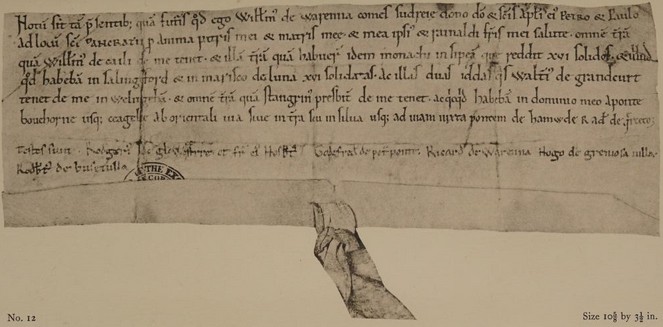 |
|
Charter of William de Warenne, 2nd Earl,
gifting land to Lewes priory
|
Early
Yorkshire Charters vol 8 p70 (Charles Travis Clay, 1949)
12.
Gift by William de Warenne [second] earl of Surrey to Lewes priory, for
the souls of his parents and the health of himself and Rainald his
brother, of all the land held of him by William de Cailli, and of land
in Shippy [in Tilney All Saints, Norfolk], ‘Salingeford’ [Norfolk] and
the marsh of Lynn, of 2 hides held of him by Walter de Grandcourt in
Willingham [co. Cambridge], and land of his demesne near Chailey
[Sussex]. [1088-1118] PLATE III
Original charter, P.R.O. Anc. Deed A. 10988; pd. in Cat. Anc. Deeds, v, 75. Lewes Chartulary, f. 18
(without witnesses); translation in S.R.S., i, 29.
Notum sit tam presentibus quam
futuris quod ego Willelmus de Warenna comes Sudreie dono Deo et
sanctis apostolis eius Petro et Paulo ad locum sancti Pancratii pro
anima patris mei et matris mee et mea ipsius et Rainaldi fratris mei
salute . omnem terram quam Willelmus de Caili de me tenet . et illam
terram quam habuer[unt] idem monachi in Sipea[m] que reddit xvi
solidos . et illud quod habebam in Salingeford et in marisco de Luna
xvi solidatas . ac illas duas iddas quas Walterius de Grandcurt tenet
de me in Welingeha[m] . et omnem terram quam Stangrinus presbiter de
me tenet . ac quicquid habebam in dominio meo a ponte Bouehorne usque
Ceagelie ab orientali uia siue in terra seu in silua usque ad uiam
iuxta pontem de Hamwde Rad[ulfi] de Querceto; Testes sunt Rodgerius de
Glowecestrre et frater eius Hosbertus Godefred[us] de Petraponte .
Ricard[us] de Warenna Hogo de Greniosa uilla . Rodbertus de Buseuilla.
Tag for seal.
Endorsed: VI. C.iij. Also in different medieval hands: (i) de
Willelmo de Caili et Staingrio presbitero et multis alus; (ii)
Welingeby et Salyngeford; (iii) W. com’ Warenn.’
Dictionary of national biography vol 59 pp374-5
(ed. Sidney Lee, 1899)
WARENNE
or WARREN, WILLIAM DE, second EARL OF
SURREY (d. 1138), elder son of William de Warenne
(d. 1088) [q. v.], by his wife Gundrada [q. v.], succeeded his
father as earl of Surrey in 1088, and is frequently described as
‘Willelmus comes de Warenna’ (see ROUND, Geoffrey de
Mandeville, p. 321). In January 1091 he helped Hugh (d.
1094) [q. v.] of Grantmesnil to defend Courcy against Robert de Bellême
[q. v.] and Duke Robert (ORDERIC, p. 692). About 1093-4
he sought to marry Matilda (1080-1118) [q. v.], or Edith, daughter of
Malcolm III [q. v.], king of Scots, who married Henry I. This marriage
may have been at the bottom of the earl’s hatred of Henry; he mocked at
the king’s love of hunting and called him ‘Harts-foot’ [see HENRY
I], and in 1101 shared in inciting Duke Robert to invade England (ORDERIC,
p. 785). He joined Robert on his landing. He was disinherited, and
accompanied the duke back to Normandy (ib. p. 788). The duke’s
visit to England in 1103 is said to have been made at the instigation of
the earl, who prayed Robert to intercede for him that he might be
restored to his earldom, saying that it brought him in a revenue of
1,000l. Henry restored him, and from that time he was the king’s
faithful adherent and trusted friend (ib. pp. 804-5). Henry
contemplated giving him one of his natural daughters in marriage, but
was dissuaded by Anselm [q. v.], who urged that the earl and the lady
were within the prohibited degrees, the earl being in the fourth and the
king’s daughter in the sixth generation (ANSELM, Epistolœ,
iv. 84; Anselm’s reckoning would match the descent assigned to William
de Warenne (d. 1088) [q. v.] as great-grandson of the father of
Gunnor).
At the battle of Tinchebray in 1106 the earl commanded the third
division of the king’s army, and when the castle of Elias de St. Saens
on the Varenne was taken in 1108 Henry gave it to him. He fought in the
battle of Brenneville, or Brémule, on 20 Aug. 1119, and is said to have
encouraged the king in his determination to take a personal share in the
combat (ORDERIC, pp. 853-4). He was with the king at his
death at the castle of Lions on 1 Dec. 1135, and was appointed governor
of Rouen and the district of Caux by the chief men of the duchy (ib.
p. 901). In 1136 he attended the court held by Stephen at Westminster,
and subsequently attested the king’s charter of liberties at Oxford (ROUND,
Geoffrey de Mandeville, pp. 262-3). He is said to have died in
that year (ROB. DE TORIGNI, a. 1136); but
as he was alive in 1137—for in that year his son, William de Warenne III
[q. v.], was styled ‘juvenis’ (ORDERIC, p. 910)—it is
safe to accept the authority of the manuscript register of Lewes priory
(f. 105), which dates his death 11 May 1138. He was buried with his
father in the chapter-house of Lewes.
He married the beautiful Elizabeth, or Isabel, daughter of Hugh
the Great, count of Vermandois, a son of Henry I of France, and widow of
Robert de Beaumont (d. 1118) [q. v.], count of Meulan, from whom
he carried her off while Robert was still living, though she was the
mother of eight children (HEN. HUNT. De
Contemptu Mundi, sect. 8). She died on 13 Feb. 1131, and was
buried at Lewes. By her he had three sons and two daughters, William de
Warenne (d. 1148) [q. v.], Reginald, and Ralph (for Ralph see Monasticon,
v. 15; the editors are mistaken in heading Charter No. xi., in which the
grantor speaks of Ralph ‘frater meus,’ as given by William de Warenne (d.
1138), as may be seen by the teste, one of the witnesses being
Ascelin, bishop of Rochester, who was not consecrated until 1142; the
charter was therefore given by William de Warenne (d. 1148), and
Ralph was his brother). Reginald was assured in the possession of the
castles of Bellencombre and Mortemer by the agreement made between
Stephen and Duke Henry (Henry II) in 1153, the rest of the Warenne
inheritance passing to Stephen’s son William (d. 1159) (Fœdera,
i. 18); Reginald was one of the persecutors of Archbishop Thomas in
1170, and became a wealthy baron by his marriage with Adeline or Alice,
daughter and sole heir of William de Wormegay in Norfolk (WATSON,
i. 67, following CAMDEN, Britannia, col. 393, ed.
Gibson, maintains that the lord of Wormegay was Reginald, son of William
de Warenne, d. 1088, because in Reginald’s charter to St. Mary
Overy, Southwark—Monasticon, vi. 171— he speaks of ‘Isabella
comitissa domina mea’ as a different person from his mother, but the
Isabella of the charter was doubtless the grantor’s niece, the daughter
of William de Warenne, d. 1148). By Adeline Reginald had a son
William, who founded the priory of Wormegay (ib. vi. 591), and
left as his sole heir his daughter Beatrice, who married (1) Dodo, lord
Bardolf, and (2) Hubert de Burgh [q. v.], earl of Kent. Earl William’s
two daughters were Gundrada, who married (1) Roger de Beaumont, earl of
Warwick, and in 1153 expelled Stephen’s garrison from the castle of
Warwick and surrendered it to Henry; and (2) William, called Lancaster,
baron of Kendal, and, it is said, a third husband: and Ada or Adeline,
who in 1139 married Henry of Scotland [q.v.], son of David I. He made
many grants to the priory of Lewes, and was regarded as its second
founder (Manuscript Register of Lewes; SIR G. DUCKETT,
Charters and Records of Cluni), completed the foundation of the
priory of Castle Acre begun by his father, and made grants to the abbey
of Grestein in Normandy and to the ‘infirm brethren’ of Bellencombre (Monasticon,
vi.,1113).
[Authorities cited in text.] W. H.
The Encyclopaedia Britannica 11th edition vol
28 p324 (ed. Hugh Chisholm, 1911)
WARENNE,
EARLS. The Warennes derived their surname from the river of
Guarenne or Varenne and the little town of the same name near Arques in
Normandy. William de Warenne, who crossed with William I. in 1066, was a
distant cousin of the Conqueror … Both he and his successors were more
commonly styled Earl Warenne than earl of Surrey. His wife Gundrada,
described on her monument as stirps ducum, appears to have been
a sister of Gharbod, earl of Chester.
Their son William, 2nd earl (c. 1071-1138), was a suitor
for the hand of Matilda of Scotland, afterwards queen of Henry I. He was
temporarily deprived of his earldom in 1101 for his support of Robert,
duke of Normandy, but he commanded at the battle of Tenchebrai (1106),
and was governor of Rouen in 1135. He carried off Elizabeth of
Vermandois, granddaughter of Henry I. of France, and wife of Robert,
count of Meulan, and married her in 1118 after her husband’s death.
The Complete Peerage vol 12 part 1 pp495-6
(George Edward Cokayne, enlarged by Geoffrey H. White, 1953)
SURREY
EARLDOM.
II. 1088.
2. WILLIAM (DE WARENNE)
II, EARL OF SURREY, 1st s. and h. by 1st
wife, usually styled EARL DE WARENNE.(c)
In 1090 he fought in Normandy against Robert de Bellême (afterwards 3rd
Earl of Shrewsbury), who was supported by Duke Robert,(d)
Shortly after 1093 he sought unsuccessfully to marry Maud, da. of
Malcolm III, King of Scotland.(e) He was with Henry I at
Windsor on 3 Sep. 1101,(f) but later in that autumn he went
with Duke Robert to Normandy and supported him against the King, who
confiscated his inheritance in England; however, in 1103 the Duke induced
Henry to restore his English Earldom.(g) In 1106 he commanded
a division of the royal army at the battle of Tinchebrai.(h)
In 1109 he was at a Great Council at Nottingham;(i) and in
1110 he was a surety for the performance of the treaty with the Count of
Flanders.(j) In 1111 he was one of the nobles sitting in
judgement in Normandy.(k) He commanded a division of the
royal army at the battle of Brémule in 1119.(l) In 1131 he
attended the Council at Northampton.(m) He was present at the
death of Henry I on 1 Dec. 1135 at Lyons-la-Forét; after which the
councillors put him in charge of the district of Rouen and the pays de
Caux.(n) Later he went to England, and he was at Westminster
with Stephen at Easter 1136.(o) He was probably still living
in June 1137(p) He was a benefactor, or confirmed previous
benefactions, to the abbeys of St. Evroul and St. Amand (Rouen), and the
priories of Lewes, Castle Acre, Wymondham, Longueville and
Bellencombre.(a) Henry I had proposed to marry William to one
of his illegitimate daughters, but on Archbishop Anselm’s objection this
match was abandoned on the ground of affinity.(b) William
eventually m. Isabel (or Elizabeth), widow of Robert (DE
BEAUMONT), COUNT OF MEULAN
and 1st EARL OF LEICESTER (d. 5
June 1118),(c) da. of Hugh DE CRÉPI
(styled “the Great”), COUNT OF VERMANDOIS(d)
(yr. s. of HENRY I, KING OF FRANCE),
by Adelaide, da. and h. of Herbert, COUNT OF VERMANDOIS
and VALOIS. He d. probably 11 May 1138(e)
and was bur. at his father’s feet in the chapter-house at Lewes.(f)
Isabel surv. him and with the consent of her s. the 3rd Earl gave the
church of Dorking to Lewes priory.(g) She d. probably
before July 1147.(h)
(c) “Comes de Warenna” or “Comes Warenne.” In a few
charters he uses the style of Earl of Surrey. For details see E.Y.C.,
vol. viii, p. 8, notes 9-11.
(d) Orderic, vol. iii, p. 362.
(e) Ibid, p. 400. She became the 1st wife of
King Henry I.
(f) When he witnessed 3 royal charters (E.Y.C.,
vol. viii, p. 7).
(g) Orderic, vol. iv, pp. 104, 110, 116, 161-63.
(h) Idem, pp. 225, 229.
(i) Cal. Charter Rolls, vol. v, p. 454;
Farrer, Outline Itinerary of Henry I, nos. 230, 231
(j) At Dover (Foedera, vol. i, pt. 1, p. 6; Liber
Niger Scaccarii, ed. Hearne, vol. i, p. 23).
(k) Haskins, Norman Institutions, p. 92.
(l) He had encouraged Henry to fight when William [de
Tancarville] the Chamberlain urged him to retreat (Orderic, vol. iv, pp.
356-57). His alleged speech to the King before the battle is given in Chron.
Mon. de Hida, pp. 316-17.
(m) Round, Geoffrey de Mandaville, p. 265.
(n) Orderic, vol. v, pp. 50, 52.
(o) Round, Geoffrey de Mandeville, pp. 262-63;
on this Easter court cf. Idem, pp. 16-18
(p) When his s. and h. is styled “Guillelmum juvenem
de Guarenna” by Orderic, vol. v, p. 85, which probably implies that his
son was not yet Earl of Surrey; E.Y.C., vol. viii, p. 8.
(a) Idem, p. 9, and charters on pp. 62-81.
(b) Migne, Patrologia, vol. clix—Epist. S.
Anselmi, lib. iv, ep. 84; cf. ante, vol. xi, Appendix D,
pp. 119-20; E.Y.C., vol. viii, pp. 41-43.
(c) According to Henry of Huntingdon, De Contemptu
Mundi (Rolls Ser., p. 307), the death of Isabel’s 1st husband was
hastened by an (unnamed) Earl carrying her off, by force or fraud. The
truth of this story is open to question, cf. ante, vol. vii, p.
526, note “d.”
(d) Will. de Juinieges, ed. Marx (Soc. de l’Hist. de
Normandie), p. 332—additions by R. de Torigny; Orderic, vol. iii, p.
480; vol. iv, p. 169; cf. ante, vol. vii, p. 526, note “b.”
(e) See the discussion on this date in E.Y.C.,
vol. viii, p. 8, note (7).
(f) Idem, p. 8, citing the Lewes Chartulary.
(g) Idem, p. 9. He left 3 sons: William, 3rd
Earl, Ralph, and Rainald, ancestor of the Warennes of Wormegay (Idem,
pp. 26-35); and 2 daughters: (1) Gundred, who m., 1stly, Roger
(de Beaumont), 2nd Earl of Warwick; 2ndly, (as his 2nd wife), William de
Lancaster; (2) Ada, who m. Henry, Earl of Huntingdon, s. of
David I, King of Scotland, by whom she was mother of Malcolm IV and
William the Lion, Kings of Scotland.
(h) I.e. before her s. William, 3rd Earl, went
on crusade in June 1147; see E.Y.C., vol. viii, pp. 9, 91. On 17
Feb., according to the Obituary of St. Nicaise (Recueil der Chartes
de Saint-Nicoise de Meulan, ed. Houth, p. 192).
Chronica de Mailros p71 (ed. Joseph
Stevenson, 1835)
Anno M.c.xxxix. … Henricus comes duxit Ade
commetiſſam filiam Willelmi comitis de Warena, ſororem Willelmi
junioris et Rodberti comitis de Liceſtria, et Waleranni comitis de
Mellent, cujus mater fuit ſoror Radulfi comitis de Perona, regis
Francorum conſanguinea.
This roughly translates as:
In the year
1139. … Earl Henry married Ada, the countess, daughter of William, Earl
of Warenne, sister of William the younger and Rodbert, Earl of
Leicester, and Waleran, Earl of Mellent, whose mother was the sister of
Ralph, Earl of Peronne, a blood relative of the King of the Franks.
11 May 1138
Chapter-house at Lewes
Priory, Sussex, England
- Dictionary of national biography vol 59
p374 (ed. Sidney Lee, 1899); The Complete Peerage vol 12 part 1 p495
(George Edward Cokayne, enlarged by Geoffrey H. White, 1953)
- Dictionary of national biography vol 59
p374 (ed. Sidney Lee, 1899); The Complete Peerage vol 12 part 1 pp495-6
(George Edward Cokayne, enlarged by Geoffrey H. White, 1953)
- Chronica de Mailros p71 (ed. Joseph
Stevenson, 1835); Dictionary of national biography vol 59
pp374-5 (ed. Sidney Lee, 1899); The Complete Peerage vol 12 part 1 pp495-6
(George Edward Cokayne, enlarged by Geoffrey H. White, 1953); wikipedia
(William de Warenne, 2nd Earl of Surrey)
- Dictionary of national biography vol 59
p374 (ed. Sidney Lee, 1899); The Complete Peerage vol 12 part 1 pp495-6
(George Edward Cokayne, enlarged by Geoffrey H. White, 1953)
- Early Yorkshire Charters vol 8; Dictionary of national biography vol 59
pp374-5 (ed. Sidney Lee, 1899); The Encyclopaedia Britannica 11th edition vol
28 p324 (ed. Hugh Chisholm, 1911); The Complete Peerage vol 12 part 1 pp495-6
(George Edward Cokayne, enlarged by Geoffrey H. White, 1953); Chronica de Mailros p71 (ed. Joseph
Stevenson, 1835); Medieval
Lands (WILLIAM [II] de Warenne); wikipedia
(William de Warenne, 2nd Earl of Surrey)
- Dictionary of national biography vol 59
p374 (ed. Sidney Lee, 1899), citing the manuscript register of
Lewes priory; The Complete Peerage vol 12 part 1 pp495-6
(George Edward Cokayne, enlarged by Geoffrey H. White, 1953)
- Dictionary of national biography vol 59
p374 (ed. Sidney Lee, 1899); The Complete Peerage vol 12 part 1 pp495-6
(George Edward Cokayne, enlarged by Geoffrey H. White, 1953)
Return to Chris Gosnell's Home Page
If you have any comments, additions or modifications to the information on this page, please feel free to email me.
Created and maintained by: chris@ocotilloroad.com