Arles
Boso
 |
|
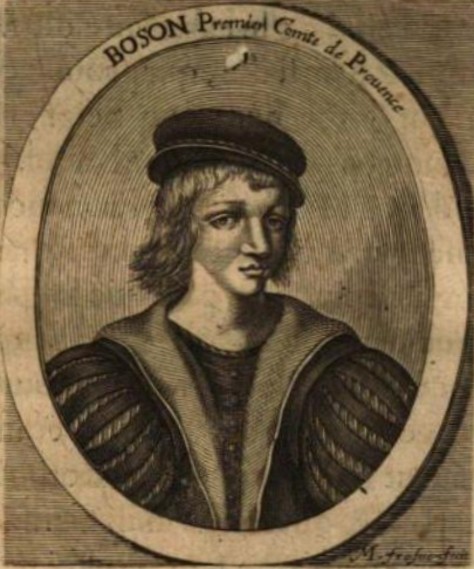
A 17th century depiction of Boso, count of
Arles
|
Roubard
Constance
Bozo and Constance are documented as married in a document dated May 961.
Count of Arles
Documents describing Boso as a count are dated between 949 and 965.
Boso (sometimes referred to as Boso II to distinguish him from the
earlier King Boso) was the architect of the house of Provence. While his
son, William le Libérateur, achieved international fame, it was Boso
who successfully navigated the collapse of the Carolingian authority to
establish his family as the hereditary rulers of the region.
Boso emerged during a period of extreme instability. The old Kingdom
of Provence was fragmenting, and power was being seized by local lords.
Boso’s primary achievement was the consolidation of the county of Arles and
by the mid-10th century, he had positioned himself as the most powerful
figure in the lower Rhône valley. Although he operated under the nominal
sovereignty of King Conrad the Peaceful, Boso functioned as a de facto
sovereign. He was the one who presided over the plaids (judicial
assemblies) in Arles and dictated the election of local bishops, such as
Pons of Orange in 964. Boso understood that land was power. He was a
frequent participant in "exchanges" with the Church, notably with the
archbishops of Arles and Marseille. These weren't always purely pious acts;
they were often strategic realignments of territory to secure the frontiers
of his county. He was a patron of the earliest developments at Montmajour,
helping to transform the "island of Saint Peter" from a swampy retreat into
a dynastic sanctuary that would eventually house the remains of his
descendants. Boso left a stabilized Provence to his sons. He transitioned
the family from being "officials" appointed by a King to being hereditary
lords who owned the land they ruled. His ability to maintain the
"magnificence of the church of Arles" while expanding his secular grip
provided the platform from which his son William would later launch the
campaign to liberate Provence from the Saracens.
Boso appears in a charter, dated to 965, which describes him as a count, and
names his two sons, Roubard and William, as well as his deceased father,
Roubaud.
Cartulaire de l'Abbaye de Saint-Victor de Marseilles
vol 1 pp40-41 (M. Guérard, 1857)
[Mart. 965.] … Honoratus, Massiliensis aecclesię ęquissimus presul, in
Arelale civitate, publice, in conspectu Bosoni comitis2,
filii Rothboldi quondam, atque in presentia omnium virorum
Arelatensium, judicumque ac principum … Placuit itaque, rogante domno
Honorato, jam predicto presule, et comiti excellentissimi , hanc
notitiam diffinitionis conscribi facere, consentiente ejus filio,
Rotbboldo, et fratre ejus, Wilelmo1 comite, omnibusque
consiliantibus Arelatensium principibus
2 Boso II, comes Provinciæ, circ. 948 - 968.
1 Guillelmus I, secundus Bosonis filius, qui patri
in comitatu Provinciæ, a. circ. 968, successit.
This roughly translates as:
[March 965.] … Honoratus, the most just prelate of the church of
Marseille, in the city of Arles, publicly, in the sight of count Boso,
son of the late Rotbold, and in the presence of all the men of Arles,
and of the judges and princes … It pleased [them] therefore, at the
request of the lord Honoratus, the aforementioned prelate, and of the
most excellent count, to have this notice of definition drawn up, with
the consent of his son, Rotbold, and of his brother, count William, and
all the counseling princes of the people of Arles.
2
Boso II, count of Provence, circa 948 - 968.
1 William I, the second son of Boso, who succeeded
his father in the county of Provence, circa 968.
Manteyer has published a number of charters, dated between 949 and 965,
describing Boso as a count.
La Provence du premier au douzième siècle
pp200-3 (Georges de Manteyer, 1908)
Le premier soin du nouveau roi de Provence fut d’y renouveler
le personnel comtal et vicomtal. L’acte du 7 octobre 949 prouve qu’il
avait déjá institué un nouveau comte d’Arles en remplacement de
Berthe.
… Les actes émanés du nouveau comte d’Arles, du 7 octobre 949 au mois
de mars 9651, sont datés d’Arles: là était sa résidence
ordinaire, pendant que son vicomte résidait à Marseille. Ces actes, où
paraît le comte d’Arles, sont relatifs à des localités sises aux
comtés d’Arles, de Marseille, d’Aix, de Fréjus, d’Antibes, d’Avignon,
d’Orange, de Vaison, de Saint-Paul-Trois-Châteaux et de Gap. Cela ne
veut pas dire que tous ces comtés fissent partie du groupe de cités
dépendant de lui en raison de ses fonctions: dans quelquesunes d’entre
elles, il ne possédait évidemment que des biens particuliers. Il
parait bien certain, toutefois, que les cités de Marseille, d’Aix et
de Fréjus rentraient dans le groupe en question. Le nouveau comte
d’Arles institué par Conrad porte le même nom que ses deux derniers
prédécesseurs: c’est encore un Boson. Il est impossible de le
confondre avec eux; car son père, dont on n’a que le nom, s’appelait
lui-même Roubaud; sa mère est inconnue. Sa femme s’appelle Constance;
il en eut deux fils, Roubaud et Guillaume. Le dernier acte où figure
le comte Boson est daté d’Arles au mois de mars 965: c’est un plaid
comtal dont la rédaction offre beaucoup d’intérêt. Le jugement,
prononcé par le comte, obtient l’assentiment de son fils Roubaud et de
son frère le comte Guillaume. Il résulte de la tout d’abord que
Roubaud est l’aîné des deux fils du comte et on pourrait déjà s’en
douter en constatant que, selon l’habituelle transmission du nom de
l’aïeul au petit-fils, c’est lui qui porte le nom de son grand-père
paternel; puisque son père le consulte seul, le cadet n’était
probablement pas encore majeur. Il résulte aussi de ce texte formel
que le comte d’Arles avait un frère, également comte, nommé Guillaume:
non seulement le comte d’Arles en parle dans le dispositif pour noter
son consentement, mais ce frère appose sa souscription après le juge
arlésien, en indiquant de nouveau sa qualité de comte. Cette part
approbative prise à un plaid arlésien prouve que Guillaume est
lui-même comte en Provence: l’autorité des deux frères s’exerce par
indivis.
1. Arles, 7 octobre [949]. Échange entre l’archevêquc Manasses
et Teucinde: « in comitatu Arelatensi, insolam sancti Petri que
nominatur a Montemajori… quod pertinet ad prepositum… Facta
commutatione… in Arelate civitate publice, nonis octobris, anno XII
regnante Conrado rege Alamannorum vel Provincie. Israel Aquensis
archiepiscospus, Manasses archiepiscopus firmavit, Contarus
Forojuliensis firmavit, Honoratus episcopus firmavit… Lambertus
presens fuit. Boso comes firmavit… Hodilus… scripsit » (Chantelou, Hist.
de Montmajour, éd. du Roure, pp. 25-27).
Arles, 14 août [952]. Échange entre Teucinde et l’archevêque: «
incomitatu Arelatense, in villa… Barcianicus… Facta… in Arelate
civitate… XVIIII kal. septembris anno XV regnante Gonrato rege. Boso
comes firmavit. Lanbertus judices fîrmavit. Hodilus… scripsit… »
(Albanès, Gall. noviss., Arles, no 255).
15 septembre 958. « Chuonradus… rex… Boso cornes intimavit…
abbatiam Sancti Amantii… Data VII. X. Kalendas octobris anno ab
incarnatione Domini Jesu Christi DCCCCLVIII, anno XXI regnante
Chuonrado rege » (Rec. des Ch, de Cluny, no 1052).
Arles, mai [961]. « ego Gencius… pro seniore meo Bosone et uxor
sua quondam… in pago Aquense superiore, ad castrum… Ansoyse… Facta… in
Arelate civitate… in mense maii, anno XXIV regnante Conrado rege
Alamannorum vel Provinciarum… Boso comes et uxor sua Constantia
firmaverunt. Illorum filii similiter Willelmus comes. Rotbaldus
comes… » (Montmajour, pp. 37-38). Les souscriptions des
fils sont postérieures.
Arles, 9[6]4. Election de Pons, évêque d’Orange, en
remplacement d’Ebræus: « deficiente metropolitano Arelatensi,
consensu augustalium principum et regis nostri Conradi necnon et
Bosonis comitis et episcoporum comprovincialium… ecclesiæ Arelatensis
ngressi magnificentiam… imperialem adierunt præsentiam…; commotus
igitur Cæsar Conradus rex, immo suadente Bosone comite, obsecrantibus
etiam prælibatis principibus, annuit illis imperiali licentia
providere quem vellent… » (Gall. Christ., t. 1, instr. eccl.
Arausicanæ, no 1, p. 131). La date, corrompue, est
DCCCCXIV: il faut la restituer. L’acte est postérieur à 948, en raison
de la présence de Conrad: il est antérieur au 1er mars 982,
date à laquelle Pons est déjà évèque d’Orange (Gall. Christ.,
t. 1, instr. eccl. Carpent., no 11, p. 148. Dans cet
intervalle, le siège d’Arles n’a été vacant qu’une fois, entre
Manassès et Itier: de là, la restitution de DCCCLXIV.
Vienne, 8 décembre 966/4. « Chuonradus… rex… hoc quod Boso
Arelatensis comes nobis reddidit ut de terra sancti Remigii de
Francia… insula maris… Lirinis… in comitatu Vuapinco… in comilatu
Aquense… sancte Marie Antibolensis » (Ibid., pp. 44-45).
Arles, mars 965. Plaid « in conspectu Bosoni comitis filii
Rothboldi quondam… in pago Massiliense… consentiente ejus filio
Rothboldo et fratre ejus Wilelmo comite… anno igitur incarnationis
dominicę DCCCCLXV, inditione VlI mense martio, regnante Rodulfo (sic)
rege Alamannorum seu Provenciarum… Ego… comes Boso… scribi et manu mea
roborare curavi. Lambertus judex firmavit. Comes Wilelmus firmavit…» (Saint-Victor,
no 29. Cet acte n’est pas le seul de Conrad passé à Arles
où le nom du roi ait été remplacé parcelui de son fils Rodolphe (cf. Gall.
Christ. noviss., Arles, no 281, acte du 31 décembre
l’an XLII).
Dans l’expression ejus filio, le mot ejus se
rapporte au comte Roubaud: dans fratre ejus qui suit, le mot ejus
répété à dessein par le scribe se rapporte encore au comte Roubaud. A
moins d’en méconnaître le sens naturel, on ne peut expliquer autrement
ce texte très clair.
This roughly translates as:
The
first concern of the new king of Provence was to replace the comital and
viscountal officials. The act of October 7, 949 proves that he had
already appointed a new count of Arles to replace Bertha.
… The acts issued by the new count of Arles, from October 7, 949 to
March 965, are dated from Arles: this was his usual residence, while his
viscount resided in Marseille. These acts, in which the count of Arles
appears, relate to localities situated in the counties of Arles,
Marseille, Aix, Fréjus, Antibes, Avignon, Orange, Vaison,
Saint-Paul-Trois-Châteaux and Gap. This does not mean that all these
counties were part of the group of cities dependent on him because of
his functions: in some of them, he evidently only possessed private
property. It seems quite certain, however, that the cities of Marseille,
Aix and Fréjus belonged to the group in question. The new count of Arles
appointed by Conrad bears the same name as his two immediate
predecessors: he is also a Boso. It is impossible to confuse him with
them; for his father, of whom only the name is known, was himself called
Roubaud; his mother is unknown. His wife was named Constance; he had two
sons, Roubaud and William. The last act in which count Boso appears is
dated from Arles in March 965: it is a comital court record whose
wording is of great interest. The judgment, pronounced by the count,
receives the assent of his son Roubaud and his brother count William. It
follows, first of all, that Roubaud is the elder of the count's two
sons, a fact that could already be inferred from the observation that,
according to the usual custom of transmitting the grandfather's name to
the grandson, he bears the name of his paternal grandfather; since his
father consults him alone, the younger son was probably not yet of age.
This formal text also reveals that the count of Arles had a brother,
also a count, named William: not only does the count of Arles mention
him in the document to record his consent, but this brother affixes his
signature after the judge from Arles, again indicating his title of
count. This act of approval in a legal proceeding in Arles proves that
William himself was a count in Provence: the authority of the two
brothers was exercised jointly.
1. Arles, 7 October [949]. Exchange between the archbishop
Manasses and Teucinde: "in the county of Arles, the island of saint
Peter which is named Montmajour… which belongs to the Provost… The
exchange having been made… publicly in the city of Arles, on the nones
of October, in the 12th year of the reign of Conrad, king of the
Alemanni or of Provence. Israel, Archbishop of Aix; Manasses,
Archbishop, confirmed it; Contarus of Fréjus confirmed it; Honoratus,
Bishop, confirmed it… Lambert was present. Count Boso confirmed it…
Odilus… wrote it" (Chantelou, Hist. de Montmajour, ed. du Roure,
pp. 25-27).
Arles, 14 August [952]. Exchange between Teucinde and the
archbishop: "in the county of Arles, in the village of… Barcianicus…
Done… in the city of Arles… the 19th day before the kalends of September
in the 15th year of the reign of king Conrad. Count Boso confirmed it.
Lambert, judge, confirmed it. Odilus… wrote it…" (Albanès, Gall.
noviss., Arles, no. 255).
15 September 958. "Conrad… king… count Boso gave notice… the
abbey of Saint-Amant… Given the 7th day before the kalends of October in
the year of the incarnation of the Lord Jesus Christ 958, in the 21st
year of the reign of king Conrad" (Rec. des Ch. de Cluny, no.
1052).
Arles, May [961]. "I, Gencius… for my senior [lord] Boso and his
late wife… in the upper region of Aix, at the castle of… Ansouis… Done…
in the city of Arles… in the month of May, in the 24th year of the reign
of Conrad, king of the Alemanni or of the Provinces… Count Boso and his
wife Constance confirmed it. Their sons likewise, count William and
count Roubaud, confirmed it…" (Montmajour, pp. 37-38). The
subscriptions of the sons are subsequent [added later].
Arles, 9[6]4. Election of Pons, bishop of Orange, replacing Ebræus:
"The metropolitan of Arles being absent, with the consent of the august
princes and of our king Conrad, as well as of count Boso and the bishops
of the province… they entered into the magnificence of the church of
Arles… they approached the imperial presence…; therefore moved, Caesar
king Conrad, rather at the persuasion of count Boso, and at the entreaty
of the aforementioned princes, granted them the imperial license to
provide whomever they wished…" (Gall. Christ., t. 1, instr. eccl.
Arausicanæ, no. 1, p. 131). The date, corrupted, is 914: it must be
restored. The act is later than 948, due to the presence of Conrad: it
is earlier than March 1, 982, the date by which Pons is already bishop
of Orange (Gall. Christ., t. 1, instr. eccl. Carpent., no. 11, p.
148). In this interval, the see of Arles was vacant only once, between
Manasses and Itier: hence, the restoration of 964.
Vienne, 8 December 966/4. "Conrad… king… that which Boso, count
of Arles, returned to us as of the land of saint Remigius of Francia…
island of the sea… Lérins… in the county of Gap… in the county of Aix…
saint Mary of Antibes" (Ibid., pp. 44-45).
Arles, March 965. Plaid [judicial assembly] "in the presence of
count Boso, son of the late Rotbold… in the region of Marseille… with
the consent of his son Roubaud and his brother, count William… therefore
in the year of the incarnation of the Lord 965, indiction VII, in the
month of March, in the reign of Rudolf (sic), king of the
Alemanni or of the Provinces… I… count Boso… took care to have this
written and to strengthen it with my hand. Lambert, judge, confirmed it.
Count William confirmed it…" (Saint-Victor, no. 29. This act is
not the only one of Conrad passed at Arles where the name of the king
was replaced by that of his son Rudolf (cf. Gall. Christ. noviss.,
Arles, no. 281, act of 31 December in the year 42).
In the expression ejus filio [his son], the word ejus
[his] refers to count Roubaud: in fratre ejus [his brother]
which follows, the word ejus repeated intentionally by the
scribe still refers to count Roubaud. Unless one disregards the natural
meaning, one cannot otherwise explain this very clear text.
The last record of Boso is in a
charter dated May 965
- Cartulaire de l'Abbaye de Saint-Victor de
Marseilles vol 1 pp40-41 (M. Guérard, 1857); La Provence du premier au douzième siècle
p202 (Georges de Manteyer, 1908); The
Henry Project: The Ancestors of King Henry II of England (Boso); Medieval
Lands (BOSON)
- Histoire de l'abbaye de Montmajour p28
(Claude Chantelou, 1876); La Provence du premier au douzième siècle
p201n (Georges de Manteyer, 1908); The
Henry Project: The Ancestors of King Henry II of England (Boso); Medieval
Lands (BOSON)
- Cartulaire de l'Abbaye de Saint-Victor de
Marseilles vol 1 pp40-41 (M. Guérard, 1857); Histoire de l'abbaye de Montmajour p28
(Claude Chantelou, 1876); The
Henry Project: The Ancestors of King Henry II of England (Boso); Medieval
Lands (BOSON)
- Cartulaire de l'Abbaye de Saint-Victor de
Marseilles vol 1 pp40-41 (M. Guérard, 1857); La Provence du premier au douzième siècle
pp200-3 (Georges de Manteyer, 1908); The
Henry Project: The Ancestors of King Henry II of England (Boso); Medieval
Lands (BOSON)
- Cartulaire de l'Abbaye de Saint-Victor de
Marseilles vol 1 pp40-41 (M. Guérard, 1857); Histoire des comtes de Provence pp29-32
(Antoine de Ruffi, 1655); La Provence du premier au douzième siècle
pp200-3 (Georges de Manteyer, 1908); The
Henry Project: The Ancestors of King Henry II of England (Boso); Medieval
Lands (BOSON); wikipedia
(Boso II of Arles)
- La Provence du premier au douzième siècle
p202 (Georges de Manteyer, 1908); The
Henry Project: The Ancestors of King Henry II of England (Boso)
Constance
Boso
Bozo and Constance are documented as married in a document dated May 961.
Constance is named as Boso's wife in a charter dated May 961, online in
manuscript at Histoire de l'abbaye de Montmajour p28
(Claude Chantelou, 1876) and summarised by Georges de Manteyer:
La Provence du premier au douzième siècle
p201n (Georges de Manteyer, 1908)
Arles, mai [961]. « ego Gencius… pro seniore meo Bosone et uxor
sua quondam… in pago Aquense superiore, ad castrum… Ansoyse… Facta… in
Arelate civitate… in mense maii, anno XXIV regnante Conrado rege
Alamannorum vel Provinciarum… Boso comes et uxor sua Constantia
firmaverunt. Illorum filii similiter Willelmus comes. Rotbaldus
comes… » (Montmajour, pp. 37-38). Les souscriptions des
fils sont postérieures.
This roughly translates as:
Arles,
May [961]. "I, Gencius… for my senior [lord] Boso and his late wife… in
the upper region of Aix, at the castle of… Ansouis… Done… in the city of
Arles… in the month of May, in the 24th year of the reign of Conrad,
king of the Alemanni or of the Provinces… Count Boso and his wife
Constance confirmed it. Their sons likewise, count William and count
Roubaud, confirmed it…" (Montmajour, pp. 37-38). The
subscriptions of the sons are subsequent [added later].
Constance of Arles
William I "le
Libératuer"
Hugonis
Floriacensis Modernorum Regum Francorum Actus in Monumenta
Germaniæ Historica SS 9 p385 (ed. G. H. Pertz, 1851)
Duxit
autem uxorem Constantiam, filiam Guillelmi comitis Arelatensis, natam
de Blanca, sorore Gaufridi comitis Andegavensis; ex qua genuit 4
filios, Hugonem qui cognominatus est Magnus, Henricum, Robertum,
Odonem.
This roughly translates as:
Moreover, he
[Robert] took as his wife Constance, the daughter of William, count of
Arles, born of Blanche, the sister of Geoffrey, count of Anjou; from her
he fathered four sons: Hugh, who was surnamed the Great; Henry; Robert;
and Odo.
Adelaide
"Blanche" of Anjou
Adonis
archiepiscopi Viennensis chronicon continuatio altera in Monumenta
Germaniæ Historica SS 2 p326 (ed. G. H. Pertz, 1829)
Regnans
cum patre Rotbertus 10 annis; post mortem eius 34 annis vixit,
regnavit et senuit. De coniuncta vero sibi uxore Constantia, filia
Adelaidis, cui prenomen erat Candida, inclitos et precipuos habens
filios, unum ex eis ad regnum elegit Hugonem.
This roughly translates as:
Robert,
reigning with his father for 10 years; after his [father's] death, he
lived, reigned, and grew old for 34 years. From the wife joined to him,
Constance, daughter of Adelaide, whose first name was Candida, having
renowned and distinguished sons, he chose one of them, Hugh, for the
kingship
Robert
II of France, about 1002
Around 1001, Robert finally succumbed to the Church’s demands, "repudiated"
Bertha and married Constance. However, Robert was still attached to Bertha
and he took her to Rome in 1010 to seek recognition of his marriage to her,
but was unsuccessful, and the king was forced to return to Constance.
The conflict between Queen Constance of Arles and her son, Henry I, was a
bitter struggle for the future of the French throne, rooted in Constance's
fierce desire to control the royal succession. The tension began years
before Robert the Pious died. Robert and Constance had several sons,
including Hugh Magnus (the eldest), Henry, and Robert. Constance favored the
younger son, Robert, whom she found more malleable or perhaps more like her
own hot-tempered southern kin. King Robert II insisted on the traditional
succession. After the death of the eldest son, Hugh, in 1025, the King
designated Henry as his heir and had him crowned co-king in 1027. Constance
was enraged by Henry's coronation, refusing to acknowledge him as king, and
in the letter transcribed below, Fulbert, a high-ranking bishop, explicitly
states that he is too afraid of the queen to travel to the coronation - that
she "is believed enough when she promises evil things, with many and
memorable deeds of hers providing proof".
When King Robert died in July 1031, Constance moved immediately to
block Henry’s path to sole power. She didn't just argue; she went to war.
Constance used her influence to seize several key royal castles, including
Senlis, Meun, and Sens. Henry, caught off guard and lacking immediate
support from the Frankish lords, was forced to flee for his life. He sought
refuge with Robert the Magnificent, the Duke of Normandy (father of William
the Conqueror). With Norman troops and the support of a few loyal counts,
 |
|
A 14th century depiction of the surrender
of Constance to her son, king Henry I
Illumination from Grandes Chroniques
de France held at the Bibliothèque nationale de France
(Français 2813, folio 177 recto) posted on wikipedia
|
Henry fought his way back into the heart of France, methodically besieging
the fortresses his mother had seized, ending when Constance submitted to
Henry in 1032. A settlement followed in which Henry I was recognized as the
undisputed king of France and Robert (the younger brother) was given the
duchy of Burgundy as a consolation prize. This created the first "Capetian
House of Burgundy," a powerful branch of the family that would rule that
region for over three centuries. Constance retired to Melun, where she died
just months later.
In one of his charters, dated 1027 or 1028, Robert notes how much he enjoyed
the "pleasant conversation" of Constance.
Roberti regis diplomata in Recueil
des historiens des Gaules et de la France vol 10 p621 (1874)
Innotescat
ergo universitati sanctæ matris Ecclesiæ fidelium, tam præsentium quàm
etiam futurorum, me et conjugem meam Constantiam, jocunda
conversatione mihi admodum dilectam, et in administratione renim ad se
pertineutium satis utilem et strenuam, prædium nostræ regali sedi
Vermeriæ contiguum, quod de auro [à patris suis domo] ex patris sui
dono asportato prædicta conjux mea emerat, S. Mariæ
Compendiensis Ecclesiæ, cujus cultum singulariter per ceteros
Sanctorum amplectebatur, et SS. Martyribus Cornelio et Cypriano in
eadem Ecclesia requiescentibus humiliter dedisse, et devotè jure
prætorio et forensi tradidisse pro nostra incolumitate et salute
animarum nostrarum, et filii nostri Hugonis jam regni solio, antequam
decederet, sublimati, et proh dolor! nostris diebus inibi sepnlti.
This roughly translates as:
Let it be known
therefore to the whole of the faithful of holy mother Church, as well
those present as also those to come, that I and my spouse Constance,
greatly beloved by me for her pleasant conversation, and sufficiently
useful and vigorous in the administration of things pertaining to her,
have humbly given a property adjacent to our royal seat of Verberie,
which my aforesaid spouse had bought with gold carried away from her
father’s house as a gift from her father, to the church of St. Mary of
Compiègne (whose worship she embraced singularly above the rest of the
saints) and to the holy martyrs Cornelius and Cyprian resting in the
same church; and [we have] devotedly handed it over by praetorian and
forensic law for our safety and the salvation of our souls, and for our
son Hugh, already raised to the throne of the kingdom before he
departed, and, oh, the grief! buried there in our own days.
After the death of Hugh, the eldest son, Constance opposed the coronation of
their second son, Henry, favouring their third son, Robert, leading to a
civil war following Henry's coronation.
Glabri Rodulphi Historiarum liber III in Recueil des historiens des Gaules et de la France
vol 10 pp39-40 (1874)
Constituerat
autem secundum Burgundiæ Ducem, Henricum nomine, post Hugonem natum,
ipsumque decrevit pro fratre in regnum sublimare. Sed rursùm mater
muliebri animositate agitata, tam à patre quàm à ceteris, qui parti
illius favebant, dissentit, dicens tertium ad regni moderamen
præstantiorem fore filium, qui et Roberti patris nomine censebatur.
This roughly translates as:
Moreover, he [Robert] had appointed Henry the second duke of Burgundy,
after Hugh was born, and he decreed to raise him into the kingdom in
place of his brother. But again the mother, driven by womanly animosity,
disagreed both with the father and with the others who were favoring
that party, saying that the third son, who was called by the name of his
father Robert, would be more outstanding for the government of the
kingdom.
Fulbert describes his fear of the wrath of queen Constance for even
attending Henry's coronation.
Fulberti Carnotensis Epistolæ in Recueil
des historiens des Gaules et de la France vol 10 p481 (1874)
LXXVIII.
Ad Goffridum Episcopum Cabilonensem.
Ob infirmam valetududinem non interest Henrici Regis
benedictioni.
VENERABILI Patri et Coëpiscopo suo G. Fulbertus.
Ad benedictionem Henrici regiæ prolis voto quidem rapior, sed adversa
me corporis valetudo retardat. Tentarem tamen utcunque moderatis
equitationibus eò pervenire, si non absterreret sævitia [Constantiæ]
matris ejus, cui satis creditur, cùm mala promittit: fidem facientibus
multis et memorabilibus gestis ejus. Qua difficultate prohibitus, rogo
vestram charitatem, dilectissime, ut vice mea suadeatis domno
Archiepiscopo Remensi, ceterisque Primoribus, ne qua occasione
differant benedictionem juvenis supradicti. Spero enim illum Deo et
bonis omnibus placiturum. Valete..
This roughly translates as:
78.
To Geoffrey bishop of Chalon.
Because of weak health he is not present at the benediction
of king Henry.
To the VENERABLE Father and his fellow-bishop
G[eoffrey], Fulbert [sends greetings]. Indeed I am carried away by
the desire for the benediction of Henry, the royal offspring, but the
adverse health of my body holds me back. Nevertheless, I would attempt
to arrive there somehow by moderate rides, if the cruelty of his mother
[Constance] did not terrify me, who is believed enough when she promises
evil things, with many and memorable deeds of hers providing proof.
Prevented by this difficulty, I ask your charity, most beloved, that in
my place you persuade the lord archbishop of Reims and the rest of the
Princes, that they not delay the benediction of the aforementioned youth
for any reason. For I hope that he will be pleasing to God and to all
good men. Farewell.
Hugonis
Floriacensis Modernorum Regum Francorum Actus in Monumenta
Germaniæ Historica SS 9 pp387-8 (ed. G. H. Pertz, 1851)
10. Henricus igitur patri suo succesdens in rego anno incarnacionis
dominicae 1032, regnauit annis 27. Huius mater Constantia magnam regni
porcionem post funus mariti in suum conabatur retinere dominium, urbem
scilicet Silvanectensem et Senonensem et castellum Bistisiacum et
Donnum Martinum et Puteolum et Milidunum et Pisciacum et Codiciacum.
Multos etiam Franciae et Burgundiae proceres sibi conciliaverat et a
filii fidelitate seiunxerat. Quod Henricus non tulit, sed adorsus
Pisciacum, mox illud suum retorsit ad dominium. Demum vero Puteolum
obsedit et cepit. Quod cernens Constantia, ab eo dextram expeciit.
Post haec autem aggressus est rex Odonem comitem, et abstulit illi
Gorniacum castrum. Senonicae quoque urbis partem, quam illi regina
Constantia dederat, ad suum postmodum retorsit dominium.
This roughly translates as:
10.
Henry, therefore, succeeding his father in the kingdom in the year of
the Incarnation of the Lord 1032, reigned for 27 years. After the death
of her husband, his mother Constance endeavored to retain a great
portion of the kingdom under her own lordship: namely, the cities of
Senlis (Silvanectensem) and Sens (Senonensem), and the
castles of Béthisy, Dammartin, Puteolum, Melun, Pisciacum, and Coucy.
She had even won over many nobles of France and Burgundy to her side and
separated them from loyalty to her son. Henry did not endure this, but
having attacked Pisciacum, he soon twisted it back into his own
lordship. At last, he besieged and captured Puteolum. Seeing this,
Constance sought a truce (dextram) from him. After these things,
the king attacked count Odo and took from him the castle of Gournay.
That part of the city of Sens, which queen Constance had given to [Odo],
he later twisted back into his own lordship.
Helgardi Flor. Epitome Vitæ Roberti Regis in Recueil des historiens des Gaules et de la France
vol 10 p110 (1874)
Tabulam
ad altare S. Pétri , in cujus honore exstat locus, auro bono totara
cooperait, de qua Constantia nobilis Regina ejus conjux gloriosa, post
mortem viri sui sanctissimi Deo, et sancto attribuit Aniano, summam
scilicet librarum [DCC] septem ipsius metalli in
meliorandis à se Monasterii [sartis tectis] facti tectis: quibus ab
imis ad superiora apertis, cœlum meliùs cerneretur quàm terra. Extitit
in ea quantitas auri [MCC] quindecim librarum probati.
Quod reliquum fuit, in quibus debuit, distribuit, quia erat ei
sollicitudo Ecclesiarum Dei, juxta utile Senioris sui velle.
This roughly translates as:
A panel at the
altar of St. Peter, in whose honor the place stands, he [Robert] covered
entirely with good gold; from which the noble Queen Constance, his
glorious spouse, after the death of her most holy husband, assigned to
God and to saint Anianus a sum, namely of seven [DCC] hundred pounds of
that same metal, for improving by her own hand the [repaired roofs] of
the monastery’s roofs; which, being open from the bottom to the top, the
sky could be seen better than the earth. There was in that [panel] a
quantity of gold of fifteen [MCC] hundred pounds of tested [gold]. What
was left over, she distributed to those whom she ought, because she had
a care for the churches of God, according to the beneficial will of her
lord.
The ecclesiastical history of England and Normandy by
Ordericus Vitalis vol 4 p135 (trans. Thomas Forester, 1853)
Robert was a
son of Robert king of France by his queen Constance, so that he derived
his nobility from the blood of kings and emperors; and he much
distinguished himself in different countries, by his noble deeds and
great merits. He it was who was sought by his powerful mother to be
raised to the throne of France, in preference to his elder brother
Henry; an object which she used all possible means to effect. In the
end, justice having placed the sceptre in the hand of Henry, the right
heir, Robert held for a long period the duchy of Burgundy, and had three
sons, Henry, Robert, and Simon.
The Encyclopaedia Britannica 11th edition vol
23 p399 (ed. Hugh Chisholm, 1911)
ROBERT
II. (c. 970-1031), king of France … For five years the king
braved all anathemas, but about 1002 he gave up Bertha and married
Constance, daughter of a certain Count William, an intriguing and
ambitious woman, who made life miserable for her husband, while the
court was disturbed by quarrels between the partisans of the two queens.
Still attached to Bertha, Robert took this lady with him to Rome in
1010, but the pope refused to recognize their marriage, and the king was
forced to return to Constance. By this wife Robert had four sons, and in
1017, the eldest of these, Hugh, (1007-1025), was crowned as his
father’s colleague and successor. After Hugh’s death the king procured
the coronation of his second son, Henry, duke of Burgundy, afterwards
king of France, a proceeding which displeased Constance, who wished her
third son, Robert (d. 1075), afterwards duke of Burgundy, to receive the
crown.
The Encyclopaedia Britannica 11th edition vol
13 pp290-1 (ed. Hugh Chisholm, 1911)
HENRY
I. (1008-1060), king of France, son of King Robert and his queen,
Constance of Aquitaine, and grandson of Hugh Capet, came to the throne
upon the death of his father in 1031, although in 1027 he had been
anointed king at Reims and associated in the government with his father.
His mother, who favoured her younger son Robert, and had retired from
court upon Henry’s coronation, formed a powerful league against him, and
he was forced to take refuge with Robert II., duke of Normandy. In the
civil war which resulted, Henry was able to break up the league of his
opponents in 1032. Constance died in 1034, and the rebel brother Robert
was given the duchy of Burgundy, thus founding that great collateral
line which was to rival the kings of France for three centuries.
22 July 1034, in Melun,
France
Raoul
Glaber: Les cinq livres de ses histoires (900-1044) book 3
chapter 9 #36 p85 (ed. Maurice Prou, 1886)
36. Anno quoque sequenti, mense Julio2, Rotbertus rex apud
castrum Meledunense diem clausit extremum; delatumque est corpus ejus
ad ęcclesiam Sancti Dionisii martyris ac in eadem sepultum. Tunc
rursus oritur inter matrem et filios rediviva discordiae crudelitas,
ac preteritarum irarum frena laxant inveterata odia. Diu multumque
vastando res proprias debacatum est donec Fulco Andegavorum comes
cognatus3 scilicet ipsorum, matrem redarguens cur bestialem
vesaniam erga filios exerceret, utrumque parentem in pacem reduceret.
Sequenti vero anno, eodem mense, atque in eodem castro quo rex
obierat, et ipsa obiit, indeque portata est ad Sancti Dionisii
basilicam ac juxta regem sepulta.
2. Le 20 juillet 1031.
3 Au dessus de cognatus, une main postérieure a ajouté
dans le ms. lat. 10912 avunculus. Cette addition a été
empruntée aux Gesta consul. Andegav., éd Marchegay p. 112.
This roughly translates as:
36. Also
in the following year, in the month of July2, king Robert
closed his final day [passed away] at the castle of Melun; and his body
was carried to the church of Saint Denis the Martyr and buried in that
same place. Then, once again, a renewed cruelty of discord arose between
the mother and the sons, and long-standing hatreds loosened the reins of
past angers. For a long time, there was an outburst of violence
involving the wasting of their own property, until their kinsman, Fulk,
Count of the Angevins3, reproving the mother for why she was
exercising such beastly madness toward her sons, brought both parent and
children back into peace. In the following year, however, in the same
month and in the same castle where the king had died, she also died;
from there she was carried to the basilica of Saint Denis and buried
next to the king.
2. 20 July 1031
3. Above cognatus, a later hand added avunculus in
manuscript lat. 10912. This addition was borrowed from the Gesta
consul Andegav., edited by Marchegay, p. 112.
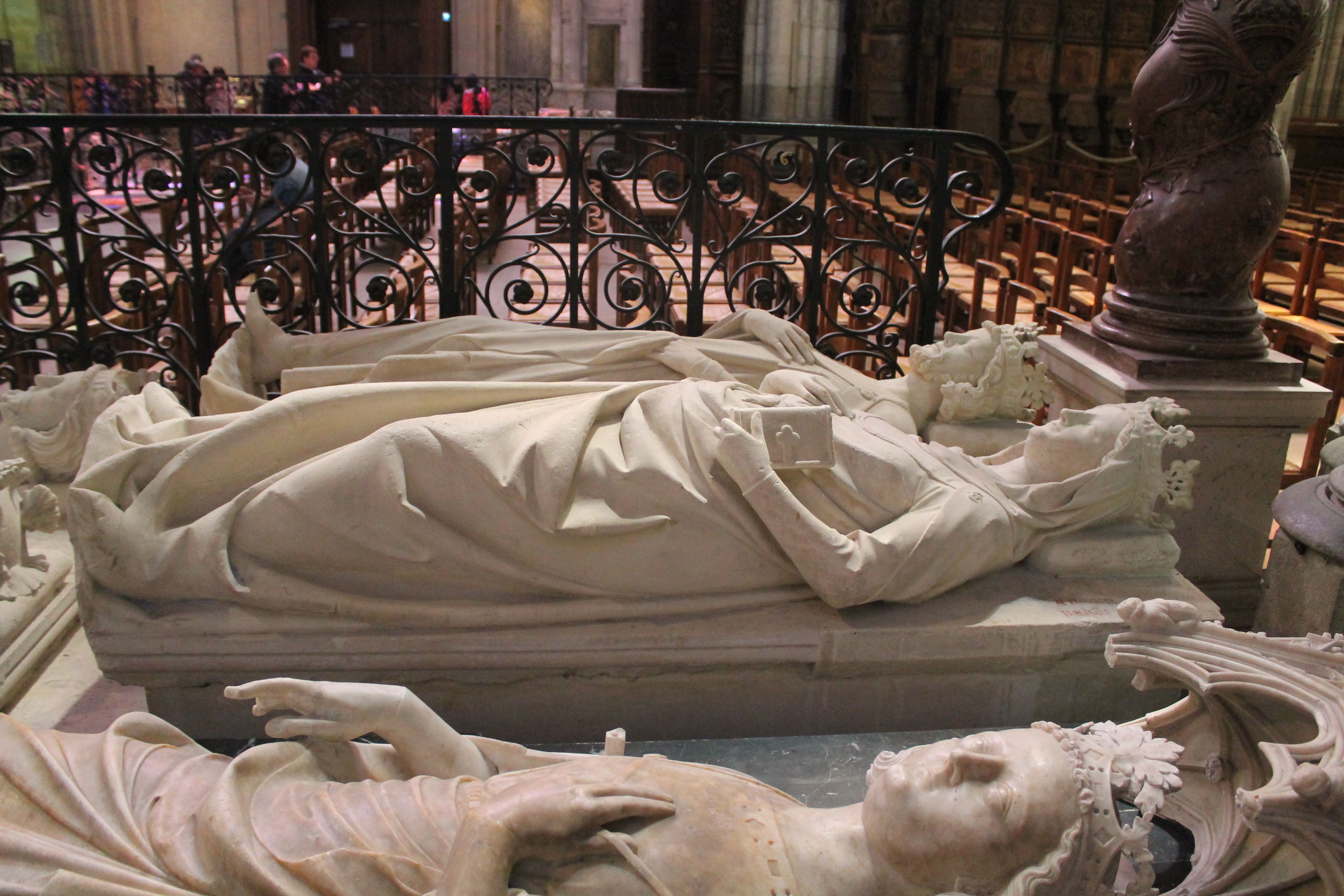
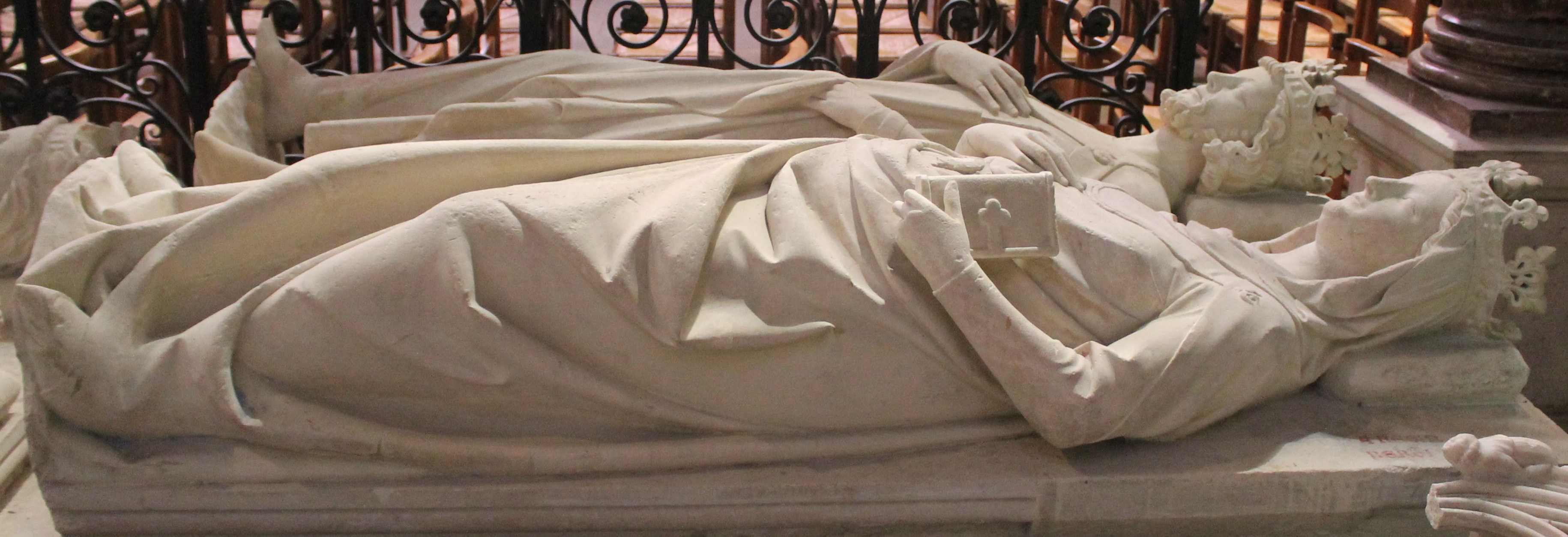 |
Effigies of king Robert II of France and
queen Constance on the ossuary in the crypt in the basilica
of Saint-Denis, Paris |
25 July 1034, next to her husband
before the altar of the holy Trinity in the basilica
of Saint-Denis, Paris, France
Adonis
archiepiscopi Viennensis chronicon continuatio altera in Monumenta
Germaniæ Historica SS 2 p326 (ed. G. H. Pertz, 1829)
Obiit
autem Miliduno castro, incarnationis dominicae anno 1032, et
deportatus Parisiis, iuxta patrem suum sepelitur ante altare sanctae
Trinitatis. Inclita vero Regina Constantia post mortem sui senioris
piissimi Rotberti anno tertion moritur, & 8. Kal. Aug. iuxta ipsum
sepelitur.
This roughly translates as:
He died,
moreover, in the castle of Melun, in the year of the incarnation of the
Lord 1032, and having been carried to Paris, he was buried next to his
father before the altar of the Holy Trinity. The illustrious Queen
Constance, indeed, died in the third year after the death of her most
pious lord Robert, and was buried next to him on the 8th of the Kalends
of August [July 25].
Constance's tomb was desecrated during the French Revolution and her bones
were thrown into a common pit (a mass grave) outside the church. After the
restoration of the monarchy in the 19th century, these remains were gathered
and placed in a massive ossuary in the crypt of the Basilica, where they
remain today.
- Hugonis Floriacensis Modernorum Regum Francorum
Actus in Monumenta Germaniæ
Historica SS 9 p385 (ed. G. H. Pertz, 1851); The
Henry Project: The Ancestors of King Henry II of England (Constance of
Arles); Medieval
Lands (CONSTANCE)
- Adonis archiepiscopi Viennensis chronicon
continuatio altera in Monumenta
Germaniæ Historica SS 2 p326 (ed. G. H. Pertz, 1829); Hugonis Floriacensis Modernorum Regum Francorum
Actus in Monumenta Germaniæ
Historica SS 9 p385 (ed. G. H. Pertz, 1851); The
Henry Project: The Ancestors of King Henry II of England (Constance of
Arles); Medieval
Lands (CONSTANCE)
- Adonis archiepiscopi Viennensis chronicon
continuatio altera in Monumenta
Germaniæ Historica SS 2 p326 (ed. G. H. Pertz, 1829); Hugonis Floriacensis Modernorum Regum Francorum
Actus in Monumenta Germaniæ
Historica SS 9 p385 (ed. G. H. Pertz, 1851); The ecclesiastical history of England and Normandy
by Ordericus Vitalis vol 2 p347 (trans. Thomas Forester,
1853); The Encyclopaedia Britannica 11th edition vol
23 p399 (ed. Hugh Chisholm, 1911); Medieval
Lands (ROBERT de France); wikipedia
(Robert II of France)
- Hugonis Floriacensis Modernorum Regum Francorum
Actus in Monumenta Germaniæ
Historica SS 9 pp388-9 (ed. G. H. Pertz, 1851); Excerptum Historicum in Recueil
des historiens des Gaules et de la France vol 11 p157
(1871); The ecclesiastical history of England and Normandy
by Ordericus Vitalis vol 2 p347 (trans. Thomas Forester,
1853); The Encyclopaedia Britannica 11th edition vol
23 p399 (ed. Hugh Chisholm, 1911); The
Henry Project: The Ancestors of King Henry II of England (Robert II le
Pieux (the Pious)); Medieval
Lands (ROBERT de France); wikipedia
(Robert II of France)
- Roberti regis diplomata in Recueil
des historiens des Gaules et de la France vol 10 p621
(1874); Hugonis Floriacensis Modernorum Regum Francorum
Actus in Monumenta Germaniæ
Historica SS 9 pp387-8 (ed. G. H. Pertz, 1851); Helgardi Flor. Epitome Vitæ Roberti Regis
in Recueil des historiens des Gaules et de la
France vol 10 p110 (1874); The ecclesiastical history of England and Normandy
by Ordericus Vitalis vol 4 p135 (trans. Thomas Forester,
1853); Glabri Rodulphi Historiarum liber III in Recueil des historiens des Gaules et de la France
vol 10 pp39-40 (1874); The Encyclopaedia Britannica 11th edition vol
23 p399 (ed. Hugh Chisholm, 1911); The
Henry Project: The Ancestors of King Henry II of England (Constance of
Arles); Medieval
Lands (CONSTANCE); wikipedia
(Constance of Arles)
- Adonis archiepiscopi Viennensis chronicon
continuatio altera in Monumenta
Germaniæ Historica SS 2 p326 (ed. G. H. Pertz, 1829);
exact date ("XI kal. augusti.") from Recueil des historiens de la France: Obituaires de
la province de Sens vol 1 p267 (1902); Raoul Glaber: Les cinq livres de ses histoires
(900-1044) book 3 chapter 9 #36 p85 (ed. Maurice Prou,
1886); The Encyclopaedia Britannica 11th edition vol
13 pp290-1 (ed. Hugh Chisholm, 1911); The
Henry Project: The Ancestors of King Henry II of England (Constance of
Arles); Medieval
Lands (CONSTANCE); wikipedia
(Constance of Arles)
- Adonis archiepiscopi Viennensis chronicon
continuatio altera in Monumenta
Germaniæ Historica SS 2 p326 (ed. G. H. Pertz, 1829); Raoul Glaber: Les cinq livres de ses histoires
(900-1044) book 3 chapter 9 #36 p85 (ed. Maurice Prou,
1886); The
Revolutionary Exhumations at St-Denis, 1793 (Suzanne Glover
Lindsay); The
Henry Project: The Ancestors of King Henry II of England (Constance of
Arles); find-a-grave.com
Roubard
Roubaud appears in a charter, dated to 965, which named him as the father of
Boso, and records that he is deceased (quondam).
Cartulaire de l'Abbaye de Saint-Victor de Marseilles
vol 1 p40 (M. Guérard, 1857)
[Mart. 965.] … Honoratus, Massiliensis aecclesię ęquissimus presul, in
Arelale civitate, publice, in conspectu Bosoni comitis2,
filii Rothboldi quondam, atque in presentia omnium virorum
Arelatensium, judicumque ac principum
2 Boso II, comes Provinciæ, circ. 948 - 968.
This roughly translates as:
[March 965.] … Honoratus, the most just prelate of the church of
Marseille, in the city of Arles, publicly, in the sight of count Boso,
son of the late Rotbold, and in the presence of all the men of Arles,
and of the judges and princes
2
Boso II, count of Provence, circa 948 - 968.
The only record of Roubard, dated May
965, describes him as deceased, though he may have died well before this
date.
William I "le Libératuer"
 |
|
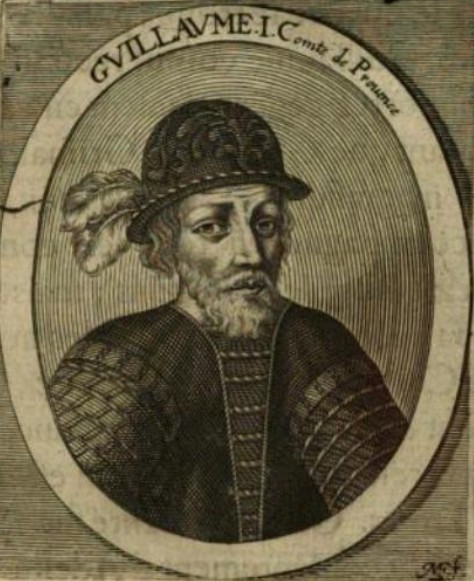
A 17th century depiction of William, count
of Arles
|
Boso
Constance
Arsinde
Arsinde is named as William's wife in charters dated between April 972 and
June 981.
Adelaide
"Blanche" of Anjou
Count of Arles and granted the
title of marquis of Provence in 979. In 993 he renounced these offices and
became a monk.
William I, known as William the Liberator (le Libérateur), was
the foundational figure of medieval Provence. His reign transitioned the
region from a chaotic frontier harassed by invaders into a structured,
sovereign territory that would eventually seat his daughter, Constance, on
the throne of France. The defining achievement of William’s life was the Battle of Tourtour
in 973. For decades, Saracen pirates based at Fraxinetum (modern-day La
Garde-Freinet) had terrorized the Mediterranean coast, notably capturing and
ransoming Maiolus,
abbot of Cluny. William galvanized the local nobility, crushed the Saracen
forces, and permanently expelled them from their strongholds. This victory
earned him the title pater
patriæ (father of the country) and allowed him to distribute the
conquered lands among his vassals, effectively creating the feudal map of
Provence.
William was a master of the "long game" in Mediterranean politics. He
held the title of count, but after his military successes and the expansion
of his influence, he began using the higher titles of marquis and duke. His
marriages were strategic - Arsinde, his first wife, likely of Languedocian
nobility, helped him consolidate power locally in the 970s. His second
marriage to Adelaide (Blanche) of Anjou, the "divorced queen of Aquitaine"
was a massive social climb. It linked the house of Provence to the powerful
counts of Anjou and the crumbling Carolingian crown, providing the prestige
necessary to eventually marry their daughter, Constance, to the Capetian
king Robert the Pious.
In 993, feeling his death approaching, William performed a dramatic
"Great Renunciation." He traveled to Avignon. There, in the presence of his
old friend and now saint Maiolus, he abdicated his titles. William traveled
the short distance from Avignon to the villa at Sarrians, which he had
already designated as a gift to the monastery of Cluny, where he performed
the ritual of laying down his "secular insignia" (his belt and mantle) and
formally received the habit of St Benedict. William remained there as a monk
until his death, probably in late 993 and was buried at Sarrians.
In a charter dated April 972 (this is the date agreed by modern historians,
depsite it being dated by Guérard to April 970), William is described as the
count of Provence, and names his wife, Arsinna. This has a "double-layer" of
donation - William grants the land to his follower Hugh Blavia, who then
immediately gifts that same land to the Abbey of Saint-Victor in Marseille.
This allowed Hugh to secure his own spiritual salvation while count William
fulfilled his duty to patronize the Church.
Cartulaire de l'Abbaye de Saint-Victor de Marseilles
vol 1 pp590-1 (M. Guérard, 1857)
598.
Carta de Ugone Blavia.
[April. 970.] Dilecto atque amabile nobis, Ugone Blavia. Ego, in Dei
nomine, Wilelmus3, comes Provincię, et conjux mea Arsinna4,
cessores atque donatores, una pro bono amore et benevolencię vestrę,
quę circa vos habemus, et quod semper bene humiliter nobis servistis,
propterea, cedimus vel donamus vobis aliquid de proprietate mea,
Wilelmo abvenit, in comitatu Forojuliense, in loco denominato
Ravanerias, et ultra rivulo Martino, et desta ultra usque in Lamaura,
unam medietatem tibi donamus, de fundum possessionis, de vestitum et
de hermo, et in antea de quantum vestitum erit unam medietatem habeas;
illa quę ego debeo habere; et Bonaldus debet ipsa terra vestire et
edificare. Et, in comitatu Sisterico, in villa Marzosco, donamus vobis
quantum nobis pax obvenit; et, in villa Fonte Jana, donamus vobis
quantum nobis pax obvenit; eo actenus tenore ipsas duas villas
Marzosco et villa Fonte Jana, quandiu Gualterius vixerit, teneat et
possideat usum et fructum; post obitum vero, ipse Ugo recipiat vel
heres sui, de fundum possessionis; hoc sunt vineis, terris cultis et
incultis, casariciis, ortis, oglatis, pratis, pascuis, silvis,
garricis, pomiferis vel impomiferis, aquis aquarum vel decursibus
earum; et faciatis de predicta donatione quicquid facere aut vindicare
volueritis, habendi, vendendi, dandi vel comutandi, veslrisque
heredibus derelinquendi, in Dei nomine, habeatis integram licenciam et
potestatem. Sane si quis, nos aut heredes nostri vel ullus homo,
contra donationem istam ire, agere vel inquietare voluerit, non valeat
vendicare quod repetit, sed componat in vinculo auri optimi libras II,
et in antea donatio ista fuma et stabilis permaneat omnique tempore,
cum stipulatione interposita pro omni firmitate subnexa.
Facta donatio ista in Arelate civitate, publice, in mense
aprelis, anno XXXIII regnante Conrado1
rege.
Signum domnus Wilelmus commes, et uxor sua Arsinna, qui hanc
cartula scribere et firmare rogaverunt, manus illorum firma. Signum
domnus Rotbaldus2 commes, voluit et eonsensit et firmavit.
Signum Dodonus firmavit. Signum Aicardus firmavit. Signum Amalricus
firmavit. Signum Poncius firmavit. Signum Raimbertus firmavit. Signum
Wilelmus firmavit. Signum Daidonatus firmavit.
Et ego Ugo, cognomento Blavia, hanc donationem, sicut senior
meus Guilelmus et domna mea Arsinna mihi donaverunt, ita et ego dono
domno meo sancto Victori martiri et ejus congregationi, in perpetuum
habendam.
3 Guillelmus I.
4 Arsinda, prima Guillelmi uxor.
1 Conradus Pacificus, rex Arelatensis.
2 Rotbaldus, frater Guillelmi I.
This roughly translates as:
598.
Charter of Hugh Blavia.
[April. 970.] To our beloved and amiable [friend], Hugh Blavia. I, in
the name of God, William, comes of Provence, and my spouse Arsinda,
[being] ceder-grantors and donors, together on account of the good love
and of our benevolence which we have toward you, and because you have
always served us well and humbly, for that reason, we cede or grant to
you something from my property, [which] came to William, in the comitatu
of Fréjus, in the place named Ravanerias, and beyond the Martin stream,
and from there beyond as far as Lamaura; we grant to you one half, from
the depth of the possession, of the cultivated and of the waste [land],
and henceforth of as much as shall be cultivated you shall have one
half; that [half] which I ought to have; and Bonaldus ought to cultivate
and build upon that land.
And, in the comitatu of Sisteron, in the village of Marzosco, we
grant to you as much as has come to us in peace; and, in the village of
Fonte Jana, we grant to you as much as has come to us in peace; with
this tenor hitherto: that as long as Gualterius shall live, he may hold
and possess the use and the fruit of these two villages, Marzosco and
the village of Fonte Jana; but after his death, Hugh himself or his
heirs may receive [them], from the depth of the possession; these are
vineyards, lands cultivated and uncultivated, farmhouses, gardens, olive
groves, meadows, pastures, forests, garigues, fruit-bearing or
non-fruit-bearing [trees], waters of waters or their watercourses; and
you may do with the aforesaid donation whatever you wish to do or to
claim, having, selling, giving or exchanging, and leaving it to your
heirs; in the name of God, you shall have full license and power.
Indeed if anyone, [whether] we or our heirs or any man, should
wish to go, act, or disturb against this donation, he shall not prevail
to claim what he seeks, but he shall pay 2 pounds of the best gold as a
fine, and henceforth this donation shall remain firm and stable for all
time, with the stipulation interposed for all subsequent firmness.
This donation was made in the city of Arles, publicly, in the
month of April, in the 33rd year of Conrad rege reigning.
Sign of the lord William commes, and his wife Arsinda, who asked
for this little charter to be written and confirmed, their hands [are]
firm. Sign of the lord Rotbold commes, [who] willed and consented and
confirmed. Sign of Dodonus confirmed. Sign of Aicardus confirmed. Sign
of Amalricus confirmed. Sign of Poncius confirmed. Sign of Raimbertus
confirmed. Sign of Wilelmus confirmed. Sign of Daidonatus confirmed.
And I, Hugh, surnamed Blavia, just as my lord William and my lady
Arsinda granted this donation to me, so also I grant [it] to my lord
saint Victor the martyr and to his congregation, to be held in
perpetuity.
3 William I.
4 Arsinda, William's first wife.
1 Conrad the Pacific, king of Arles.
2 Rothbald, brother of William I.
Histoire des comtes de Provence pp33-36
(Antoine de Ruffi, 1655)
Guillaume I. apres la mort de ſon pere Boſon luy ſucceda au
Comté de Prouence. Ce fut vn Prince pieux, genereux, & magnanime,
il viuoit ſous le Roy Conrad. Durant ſon regne les Sarrazins ſe
rendirent les maiſtres du Fort de Fraxinet, & de quelques villes
de Prouence, qu’ils ruinerent entierement. Celle de Frejus entre
autres fut tellement deſolée, qu’elle fut reduite en ſolitude; car les
habitans furent la pluſpart taillez en pieces, & ce peu qui échapa
de la furie de ces Barbares s’enfuit en des lieux éloignez. Mais
Guillaume en cette conjonƈture fit reluire ſa generoſité & ſa
valeur: car il chaſſa les Sarrazins de Prouence, & reprit meſme le
Fort de Fraxinet, apres vne memorable défaite. Ce qui eſt rapporté par
S. Odile Abbé de Cluni, en la vie de S. Mayeul, où il donne à
Guillaume cet éloge de Tresilluſtre, & Tres Chreſtien Prince,
& encore par Raoul Glaber, & par quelques Chartes.
Comme la Prouence ſe trouua paiſible par la fuite des
Sarrazins, Guillaume voulut reconnoiſtre ceux qui s’estoient portez
genereuſement en cette entrepriſe. Et d’autant que Giballin de
Grimaldis, homme vaillant & magnifique, l’auoit non ſeulement
touſiours accompagné en tous les combats qu’il auoit donnez contre les
Sarrazins; mais qu’il auoit meſme par ſa propre vertu deliuré des
mains de ces Barbares la Coſte de mer de S. Tropez; Guillaume luy fit
preſent de cette Coſte de mer auec toute ſon eſtendue, à la reſerue
des droiƈts qui eſtoient deus à l’Eglise de Frejus. Cette liberalité
fut faiƈte en la ville d’Arles, du consentement d’Adelle femme du
Prince, & de ſon fils Guillaume, & en preſence d’Anno
Archeueſque d’Arles, & de pluſieurs autres personnes de qualité.
Peu apres Rioulphe Eueſque de Frejus s’adreſſa au Comte
Guillaume, qui ſe trouua en la ville de Manosſque & luy representa
le deplorable eſtat dans lequel ſon Eglise eſtoit reduite; qu’il ne
luy reſtoit rien que le nom d’Eueſque; que dans ſon dioceſe toutes
choſes eſtoient dans vneſi grande confuſion depuis la venue des
Sarrazins, qu’il ne ſçauoit-pas où eſtoient ſituées les terres qui
appartenoient à ſon Egliſe; qu’il n’y auoit plus perſonne en vie qui
en pûſt donner quelque cónoiſſance, d’autant que tout auoit eſté, ou
perdu par la longueur du temps, ou conſumé par le feu. Si bien qu’il
le ſupplioit de faire reſtituer à son Egliſe tout le bien, &
toutes les terres qui en auoient eſté vſurpées Guillaume ne voulut
rien or donner alors ſur cette affaire, croyant qu’il y deuoit penser
meurement. Quelque temps apres ſe trouuant en la ville d’Arles de
l’auis de ſon Conſeil il fit donation, conjointement auec sa femme
Adelle, à l’Eueſque, & à ſes ſucceſſeurs, de la moitié de la ville
de Frejus, & du port de la meſme ville, enſemble de toute la
dixmе.
La pieté de ce Prince ne parut pas ſeulement en cette occaſion,
mais en beaucoup d’autres. Il donna au Monaſtere de Montmajour vn
fief, que la Charte appelle Sarrianis, & vne portion du
lieu de Pertuis qu’il auoit eu en don d’vn Eueſque nómé Inguilran,
& de ſon frere Nouilong. Il confirma vne donation qu’vne pieuſe
Dame, appellée Teucinda, auoit faite de l’isle de Montmajour, & de
ſes dependances au meſme Monaſtere. Il rendit à celuy de Cluni le lieu
de Valenſole, que l’Abbé Mayeul & les Religieux luy auoient
autrefois donné pour en ioüir durant ſa vie. Et en vne aſſemblée qui
fut faite en la ville d’Arles, composée d’vn grand nombre de
Cheualiers, que la Charte appelle Vaſſos Dominicos tàm Romanos
quàm Salicos, pour monſtrer que les vns eſtoient du Païs
couſtumier, les autres du Droiƈt eſcrit, Honoré Eueſque de Marſeille
entra dans cette celebre aſſemblée, & demanda auec grande inſtance
la reſtitution de quelques biens fituez au Comté d’Aix, que quelques
particuliers, qui eſtoient alors dans l’assemblée, auoient vſurpez au
Monaſtere S. Viƈtor. Guillaume trouuant la requeſte de l’Eueſque,
iuste, fit reſtituer ces biens à ce Monaſtere.
Guillaume eut pour femme Blanche fille de Geofroy Griſegorelle
Comte d’Anjou, ſelon le dire de quelques Autheurs. Mais les Chartes
nous apprennent qu’elle s’appelloit Adelle, de laquelle il eut
Guillaume II. du nom, & Conſtance mariée à Robert Roy de France.
I’ay veu toutefois deux titres, dans leſquels la femme de ce Prince
eſt nommée Arſindis. Ce qui m’oblige de croire qu’il fut marié deux
fois, & que cette Dame fut ſa premiere femme, de laquelle il n’eut
aucune lignée. La mort de Guillaume eſt diuerſement rapportée par les
Hiſtoriens: car les vns eſcriuent qu’il fut tué en vne bataille donnée
entre Lambert Comte de Louuain & Geofroy d’Ardenne. Les autres,
qu’il mourut auec l’habit de Moine, que luy donna Mayeul Abbé de
Cluni. Ce qui ſemble en quelque façon confirmé par vne Charte, qui
dit, que ce Prince auoit prié l’Abbé & les Religieux de luy
permettre d’eſtre enſeueli dans leur Monaſtere. Tant y a qu’il y a
apparence que ſa mort n’arriua qu’enuiron l’an 992. ou apres, ſelon la
datte de ſon teſtament, qui eſt de la meſme année, & qu’on void
encore en eſtat dans les Archiues de Sainƈt Ceſaire d’Arles. Il porta
la qualité & le titre de Prince, de Duc, de Marquis, de Comte de
Prouence, & de Pere de la Patrie.
This roughly translates as:
William I, after the death of his father Boso, succeeded him in the
County of Provence. He was a pious, generous, and magnanimous Prince; he
lived under king Conrad. During his reign, the Saracens made themselves
masters of the Fort of Fraxinet, and of several towns of Provence, which
they entirely ruined. That of Fréjus among others was so desolated that
it was reduced to a solitude; for the inhabitants were for the most part
cut to pieces, and the few who escaped the fury of these Barbarians fled
to distant places. But William in this juncture made his generosity and
his valor shine: for he drove the Saracens from Provence, and even
retook the Fort of Fraxinet after a memorable defeat. This is reported
by Saint Odilo, Abbot of Cluny, in the Life of Saint Maiolus, where he
gives to William this eulogy of "Most Illustrious and Most Christian
Prince," and also by Raoul Glaber, and by several Charters.
As Provence found itself peaceful by the flight of the Saracens,
William wished to recognize those who had behaved generously in this
undertaking. And insofar as Giballin de Grimaldis, a valiant and
magnificent man, had not only always accompanied him in all the combats
he had given against the Saracens, but had even by his own virtue
delivered from the hands of these Barbarians the seacoast of
Saint-Tropez; William made him a present of this seacoast with all its
extent, reserving the rights that were due to the Church of Fréjus. This
liberality was made in the city of Arles, with the consent of Adelaide,
wife of the Prince, and of his son William, and in the presence of Anno,
Archbishop of Arles, and of several other persons of quality.
Shortly thereafter, Rioulfe, Bishop of Fréjus, addressed himself
to Count William, who was in the town of Manosque, and represented to
him the deplorable state to which his Church was reduced; that there
remained to him nothing but the name of Bishop; that in his diocese all
things were in such great confusion since the coming of the Saracens
that he did not know where the lands belonging to his Church were
situated; that there was no longer anyone alive who could give any
knowledge of them, insofar as everything had been either lost by the
length of time or consumed by fire. So much so that he supplicated him
to have restored to his Church all the goods and all the lands that had
been usurped from it. William wished to order nothing then on this
matter, believing that he ought to think upon it maturely. Some time
later, being in the city of Arles, by the advice of his Council, he made
a donation, jointly with his wife Adelaide, to the Bishop, and to his
successors, of half of the city of Fréjus and of the port of the same
city, together with all the tithe.
The piety of this Prince appeared not only on this occasion, but
in many others. He gave to the Monastery of Montmajour a fief, which the
Charter calls Sarrians, and a portion of the place of Pertuis
which he had had as a gift from a Bishop named Ingelram, and from his
brother Nouilong. He confirmed a donation that a pious Dame, called
Teucinda, had made of the island of Montmajour and of its dependencies
to the same Monastery. He returned to that of Cluny the place of
Valensole, which the Abbé Maiolus and the Religious had formerly given
him to enjoy during his life. And in an assembly that was held in the
city of Arles, composed of a great number of Knights, whom the Charter
calls Vaſſos Dominicos tàm Romanos quàm Salicos to show that
some were of the customary Land [North], others of written Law [South],
Honoratus, Bishop of Marseille, entered into this celebrated assembly
and requested with great instance the restitution of some goods situated
in the County of Aix, which some private individuals, who were then in
the assembly, had usurped from the Monastery of Saint-Victor. William,
finding the request of the Bishop just, had these goods restored to that
Monastery.
William had for his wife Blanche, daughter of Geoffrey
Greymantle, Count of Anjou, according to the saying of some Authors. But
the Charters teach us that she was called Adelaide, by whom he had
William II of the name, and Constance, married to Robert, King of
France. I have seen, however, two titles in which the wife of this
Prince is named Arsindis. This obliges me to believe that he was married
twice, and that this Dame was his first wife, by whom he had no lineage.
The death of William is variously reported by Historians: for some write
that he was killed in a battle given between Lambert, Count of Louvain,
and Geoffrey of Ardenne. Others, that he died with the habit of a Monk,
which Maiolus, Abbot of Cluny, gave him. This seems in some way
confirmed by a Charter, which says that this Prince had prayed the Abbot
and the Religious to permit him to be buried in their Monastery. At any
rate, it appears that his death occurred only around the year 992 or
after, according to the date of his testament, which is of the same
year, and which is still seen in good condition in the Archives of
Saint-Césaire of Arles. He bore the quality and the title of Prince, of
Duke, of Marquis, of Count of Provence, and of Father de la Fatherland.
William's place in history was established by his military victory over the
Saracens in response to
their capture and ransoming Maiolus,
abbot of Cluny in 983.
La Provence du premier au douzième siècle
pp247-9 (Georges de Manteyer, 1908)
Cette capture d’un compatriote puissant et respecté, alors
intermédiaire entre le pape et l’empereur, produisit en Provence
l’élan nécessaire à l’effort qui s’mposait. La victoire du marquis,
qui anéantit les Sarrasins à leur retour par les Alpes, doit donc bien
être fixée au mois de septembre 983. En effet, munis de leur butin,
ceux-ci ne durent pas tarder à rentrer vers la fin d’août pour le
mettre à l’abri. La Vie de Mayeul par Cyr n’indique pas le nom du
vainqueur: celle qui fut faite par Odilon nomme Guillaume. Le marquis
rendit à l’abbé ses livres, mais il ne lui rendit pas son argent: il
se payait de sa peine. On ne peut dire où se produisit la rencontre.
… Tout porte à croire que la prise du Freinet, par Roubaud et Ardoin,
est un fait contemporain de la victoire remportée par Guillaume sur
les Sarrasins qui revenaient de Valais avec leur butin. En effet, la
mention de Roubaud au lieu de Guillaume est significative: étant donné
l’effacement habituel de ce comte devant son frère, c’est celui-ci qui
serait nommé comme chef d’expédition s’il avait été présent. Pendant
que les Sarrasins, forts d’un millier d’hommes, étaient séparés en
deux groupes, l’un qui revenait de Valais, l’autre qui gardait le
Freinet, les marquis de Provence et de Turin s’entendirent pour une
action commune. Les Provençaux, guidés par le traître Aymon,
combinèrent leur expédition dans le plus grand secret. Tandis que le
marquis de Provence Guillaume dressait, dans un défilé des Alpes,
l’embuscade où devait tomber le premier groupe, son frère Roubaud,
avec le marquis de Turin, se rendait maître du repaire.
… Ainsi disparut ce fléau des pillards mahométans que la Provence
avait laissé d’abord s’établir chez elle avec indifférence et même,
qui pis est, avec indulgeace, absorbée qu’elle était par ses
dissensions intestines. … Le comte Guillaume surgit: il se met au
premier rang avant Roubaud, unit sous son autorité dès 971 tous les
comtés de Provence, se fait décerner le titre régulier de manjuis en
979 à l’occasion d’un mouvement de la France en Guyenne. La Provence a
désormais un chef effectif, bien à elle.
This roughly translates as:
This
capture of a powerful and respected compatriot [Maiolus], then an
intermediary between the pope and the emperor, produced in Provence the
momentum necessary for the effort that was required. The victory of the
marquis, which annihilated the Saracens upon their return through the
Alps, can therefore be fixed to the month of September 983. Indeed,
provided with their booty, they must not have delayed in returning
toward the end of August to put it in safety. The Life of Maiolus by Cyr
[Syrus] does not indicate the name of the victor; the one that was made
by Odilo names William. The marquis returned his books to the abbé, but
he did not return his money: he was paying himself for his trouble. One
cannot say where the encounter took place.
… Everything leads one to believe that the taking of Fraxinet, by
Roubaud and Ardoin, is a contemporary fact of the victory won by William
over the Saracens who were returning from Valais with their booty.
Indeed, the mention of Roubaud instead of William is significant: given
the usual secondary role of this comte before his brother, it is the
latter who would be named as the leader of the expedition if he had been
present. While the Saracens, a thousand men strong, were separated into
two groups, one returning from Valais, the other guarding Le Freinet,
the marquis of Provence and of Turin agreed upon a common action. The
Provençals, guided by the traitor Aymon, coordinated their expedition in
the greatest secrecy. While the marquis of Provence, William, set up an
ambush in an Alpine pass where the first group was to fall, his brother
Roubaud, with the Marquis of Turin, seized the stronghold.
… Thus disappeared this scourge of Mohammedan pillagers that Provence
had first allowed to establish themselves in her midst with indifference
and even, what is worse, with indulgence, absorbed as she was by her
internal dissensions. … Count William emerged: he placed himself at the
forefront, ahead of Roubaud, united all the counties of Provence under
his authority as early as 971, and was granted the official title of
marquis in 979 during a French military campaign in Aquitaine. Provence
now had an effective leader of its own.
Manteyer has summarised the documentation regarding William's first and
second wives.
La Provence du premier au douzième siècle
pp254-8 (Georges de Manteyer, 1908)
§ 5. — Les deux femmes du marquis Guillaume.
Le marquis Guillaume se maria deux fois. Arsinde fut sa
première femme: l’acte, passé à Arles en avril 972, où Guillaume prend
le titre de comte de Provence, est rédigé au nom des deux époux1.
De même, l’acte de donation de Pertuis passé en juin 9812.
Le second acte, où paraît le titre de marquis, passé à Arles le 17
avril 981, est la donation, consentie à Hugues Blavie, d’une condamine
aux Lônes dans le canton Roubian. Cet acte est rédigé au nom seul de
Guillaume, mais il est souscrit également par sa femme Arsinde3.
Conformément à une règle, qui est constante à cette épocque, le titre
militaire de marquis ne peut être porté par une femme; Arsinde prend
donc simplement sa qualité de comtesse.
Arsinde, si l’on juge par son nom, devait être originaire de
Languedoc4. L’acte du 29 août 9935 prouve que le
frère de Roubaud, Guillaume, se remaria avec Alix et qu’il en eut un
fils nommé Guillaume comme lui. Cet acte est en effet rédigé en
commun, au nom de Guillaume, de sa femme Alix, de son fils Guillaume
et de son frère Roubaud1. Dès 986, Alix était la femme du
marquis2: elle était sœur de Drogon, évêque du Puy, et, par
conséquent, fille du comte d'Anjou Foulques et de Gerberge, comme le
prouve un acte de septembre 9943, Il s’agit donc bien
d’Alix, veuve du comte de Gévaudan Etienne I; elle avait eu de de ce
premier mariage Pons, Bertrand, Guillaume et Ermengarde. En 979, elle
s’était remariée avec Louis V. Pendant près de deux ans elle avait été
reine de Guyenne; mais, divorcée en 981 et délaissée à Brioude, elle
s’était réfugiée en Provence et s’y était unie à Guillaume, comme le
raconte Richer1. Guillaume venait précisément d’être revêtu
du titre de marquis, en raison de la venue de Louis V en Guyenne:
c’est peut-être la raison pour laquelle la reine divorcée et désireuse
de vengeance vint se donner à lui plutôt qu’à un autre. Malgré l’issue
malheureuse de son bref mariage avec Louis V, Alix, après tout, avait
été reine. Pour un marquis, la mariée était encore belle: cette union
dut être pour lui à peu près ce qu’avait été vers 913 pour le duc de
Provence Hugues son mariage avec la veuve du roi de Jurane. Les deux
actes de 986 et de 993 ne sont pas les seuls où Alix paraisse à côté
du marquis: il y en a quatre autres et ce sont ceux de juin [989], du
6 mars 990, de 992 et du 28 août [993 ?]2. L'acte du mois
d’août 1001 prouve qu’Alix eut de Guillaume non seulement un fils,
mais une fille nommée Constance1; cette fille portait ainsi
le nom de sa grand’ mere paternelle. A peine les Carolingiens
disparus, la femme répudiée de Louis V prit sa revanche: elle maria sa
fille avec le roi rance Robert II. Cet événement se produisit entre le
mois d’août 1001 et le 25 août 1003: Constance reçut en dot de l’or
qu’elle ne gaspilla pas2. A sa suite, les modes de Provence
envahirent la France. Elle devait mourir à Melun en juillet 1032.
Les derniers actes que l’on ait du marquis sont de 992 en
faveur de Saint-Césaire d’Arles, du 29 août 993 en faveur de Psalmody
et du 28 août vers 990 en faveur de Cluny. Étant donné que le frère,
la femme et le fils de Guillaume souscrivent celui-ci comme celui du
29 août, étant donné qu’il s’agit également d’une libéralité en faveur
d’une abbaye, on est porté à croire que cet acte fut passé le 28 août
993, la veille de celui relatif à Psalmody. Ce sont là, en somme, les
dernières dispositions prises par le marquis à la veille de sa mort.
On sait que, quand Guillaume sentit approcher son heure dernière, il
demanda l’assistance spirituelle de saint Mayeul et celui-ci, malgré
son grand âge, vint, pour le voir, planter sa tente dans l’ile sise
sous Avignon. Il est bien évident que le marquis se devait de
témoigner sa reconnaissance à l’abbé: cette donation du 28 août en est
un souvenir. Par conséquent les actes du 28 et du 29 août 993 ont dû
être passés à Avignon et Guillaume a dû mourir dans cette cité peu
apres. Il donna de plus, à Clunv, Sarrians pour y élever une église à
la sainte Croix, en souvenir de sa victoire, et il déclara sa volonté
d’y être inhumé1. Sa mort survint avant le mois de
septembre 994 et ces derniers faits confirment bien l’opinion que le
marquis occupait spécialement la région d’Avignon.
1. Arles, avril [972]. « ego in Doi nomine Wilelmus comes
Provincie et conjux mea Arsinna » [Saint-Victor, 598).
2. juin [981]: « Willelmus comes et conjux mea Arsindis »
(Chantelou pp. 56-57).
3. Arles, 17 avril [981]: « ego in Dei nomen Vuilelmus,
marchius Arelaleuse Provinlię… Signuui Vuilelmus… Signum Arsinda
comitissa firmavit… » (Saint-Victor, no 1042).
4. [Vers 959]. « Arsindis comitissa cum filiis suis Odo et
Raimundo… in comitatu Narbonense… prædictus Raymundus comes… »
(Vaissète, Hist. de Languedoc, t. V, 2e éd., col. 232-233,
no 106-XCI). Cf. no 79, 89.
5. [Avignon ?] 29 août [993|: « ego Guillelmus comes et uxor
mea Adalaiz et germanus meus Rodbaldus et filius meus Guillelmus… hunc
testamentun nostrum… fieri eligimus… donamus ad… Psalmodium… in pago
Nemausensi, ubi Rodanus vel Vitusalus Visterque [iter] faciunt…
ecclesiam… Sancti Cosmæ et Sancti Damiani et alia ecclesia… Sanctæ
Mariæ… in territorio civitatis Magalonensis, in suburbio castri
Substantionensis in terminiuim de villa Caldisianicas, cum cellulis…
Facta donatione ista IIII calendas septembris anno septimo quod
usurpavit Ugo ad Carolum Glium Ludovici regem… » (Gard, II. 106, Cart.
Psalmody, fo 15).
1. M. Blancard a parlé des actes, tirés des archives de
Psalmody, qui concernent Guillaume et sa femme Alix. Ces actes lui
paraissent décisifs et à bon droit; mais le fait qu’ils prouvent
péremptoirement est exactement le contraire de ce que M. Blancard
croyait pouvoir avancer. La cause de cette erreur regrettable de M.
Blancard est bien simple: il parle de ces actes, non d’après leur
texte, mais d’après l’analyse qu’en faisait Mabillon. Celui-ci se
trompait en disant: « Ad hæc eidem Warnerio Guillelmus comes et uxor
ejus Adelais ac cognatus ejus Rotbaldus comes ac Guillelmus frater
ejus dimiserunt ecclesiam de Bergen… » (Annales Ordinis S.
Benedicti… t. IV, Lucæ MDCCXXXIX, pp. 162-163). L’erreur
consistait à à dire que, d’après ces actes, Guillaume mari d’Alix
était différent du frère de Roubaud, Guillaume. Mabillon aurait dû
imprimer: « ac cognatus ejus Rotbaldus comes ac Guillelmus filius
ejus. » M. Blancard répète l’erreur échappée par inadvertance à
Mabillon et il ne l’aurait certainement pas répétée s’il avait pris la
peine de lire les textes de Psalmody avant d’en parler (L. Blancard, De
l’existence simultanée de Guillaume mari d’Arsinde et Guillaume mari
d’Adélaïde, comtes de Provence au Xe siècle, p. 9).
Nice, 30 décembre [1000-1032]: « ego Odila… per remedium
animarum Willelmo magnifico comite… in comitatu Nicensis, in
territorio, prope civitate, Cimela… » (Cte E. Cais de
Pierlas et Gust. Saige, Chartrier de Saint-Pons, Monaco, 1903,
p. 5, no III).
2. Avignon, 986: « ego Vuillelmus comes, inclitus marchio et
uxor mea Adalaix comitissa… » (Ruffi, Dissert, hist., 1712, p.
16).
3. Le Puy, septembre [994]: « ego Drogo gratia Dei episcopus
Aniciensis, filius Fulcoiiis comitis et Gerbergæ dedi et concessi
Willelmo comit Provinciæ filio Willelmi quondam comitis et Adalasiæ
sororis mese castrum do Chalanconio cum omnibus pertinentiis suis quod
heredes Alberti mihi nuper vendiderunt. ✝Signum Drogonis episcopi.
Actum apud Podium mense septembris anno VIII regnantibus Hugone et
Roberto regibus » (Bibl. nat. Dom Housseau, I, no 256; tiré
des Arch. de Barcelone parmi les titres des comtés d’Aragon et de
Provence). La communication de ce texte est due à l’obligeance de M.
Guy de Puybaudet, ancien membre de l’École de Rome.
1. « Regina, sese viduatam dolens et verita maioris incommodi
iniuriam, Willelmum Arelatensem adiit eique nupsit. Et sic ex divortio
adulterium publicum operatum est » (Richeri Histor., lib. III,
§ 95).
2. Arles, juin [989]: « …inter domno Vuilelmo comité et uxor
sua Adalax apud heum hominem nomine Aicardo… de villa… Segalarias… in
comitatu Aqueuse… de castrum quod edificari potuerit… donamus tibi
unam medietatem… Signum domnus Vuilelmus et uxor sua Adalax… Signum
Teutbaldus, vicarius. » (Bouches-du-Rhône, H. Saint-Victor, I,
no 17; Mém. de l’Ac. de Marseille, 1887, pp.
252-253). M. Blancard a identifié Seglarias avec
Saint-Zacharie.
Arles, 6 mars [990]. « Signum Willelmi comitis et uxoris sue
Adalays… Rotbaldus comes voluit et concessit » (Chantelou, pp. 66-68).
— 28 août [993?]: « Rodbaldus comes f. Adalaix comitissa f. Wilelmus
comes f. et filius ejus Wilelmus f. » (Cluny, no
1837). — Arles, 992: « domnus princeps et marchio istius Provinciæ
bonæ indolis Vuillelmus conjuge sua nomine Adalaix et filio suo nomine
Vuillelmo veniens… Factum hoc testamentum in ipso monasterio per
preceptum domini Vuillelmi principis consentiente conjuge ejus simul
cum filio in præsenti adslante domno Annone archiepiscopo qui
voluerunt et firmarunt simul cum canonicis. Domnus Rotbaldus comes
voluit atque firmavit. Stephanus episcopus firmavit… Pontius episcopus
firmavit. Alius Pontius archiepiscopus firmavit. Udolricus episcopus
firmavit Vuillelmus vicecomes firmavit. » (Bibl. nat. de Madrid, ms.
Ee. 45, ff. 24 vo-25 ro; Bouche, Hist. de
Provence, t. II, p. 47).
1. Août [1001]: « ego in Dei nomen Adalax comitissa et filius
suus Villelmus comes et filia sua Constantia… Signum Adalax comitisse
et filii sui Villelmi comitis et filiæ sue Constantie… » (Chantelou,
pp. 70-71).
2. 1029: « ego Robertus gratia Dei Francorum rex et Constantia
divino nutu regina. Me et conjugem meam Constanciam jocunda
conversatione mihi admodum dilectam et in administratione rerum ad se
pertinentium satis utilem et strenuam predium… quod de auro a patris
sui domo asportato… emerat… » (Bibl. nat., ms. lat. 17048, p. 424).
1. [1031-1048]: « …in villa Sarrianis quam Wilelmus quondain
dux Provintiæ et pater patriæ… monasterio Cluniensi et loco in quo se
sepeliri rogavit… moriens donando… æcclesiam construere studuit et eam
consecrare et dedicare rogavit a… Regimbaldo Arelatensium
archyepiscopo ad honorem Dei et memoriam dominicę et victoriosissimę
crucis ac Domini genitricis et… Petri et Pauli et… Marcelli… et…
Saturnini… » (Cluny, no 2886).
This roughly translates as:
§ 5. — The two wives of the marquis William
The marquis William married twice. Arsinde was his first wife:
the act, passed at Arles in April 972, where William takes the title of
comte of Provence, is drawn up in the names of both spouses1.
Likewise, the act of donation of Pertuis passed in June 9812.
The second act, in which the title of marquis appears, passed at Arles
on April 17, 981, is the donation, granted to Hugh Blavia, of a
condamine at Les Lônes in the canton of Roubian. This act is drawn up in
the sole name of William, but it is also subscribed by his wife Arsinde3.
In accordance with a rule which was constant at that epoch, the military
title of marquis cannot be carried by a woman; Arsinde therefore simply
takes her status as comtesse.
Arsinde, judging by her name, must have been originally from
Languedoc4. The act of August 29, 9935, proves
that the brother of Roubaud, William, remarried with Alix [Adelaide] and
that he had by her a son named William like himself. This act is indeed
drawn up jointly, in the name of William, of his wife Alix, of his son
William, and of his brother Roubaud1. As early as 986, Alix
was the wife of the marquis2: she was the sister of Drogon,
bishop of Le Puy, and, consequently, the daughter of Fulk, the count of
Anjou, and Gerberga, as is proven by an act of September 9943.
It is therefore indeed Alix, the widow of the count of Gévaudan, Stephen
I; she had had from this first marriage Pons, Bertrand, William, and
Ermengarde. In 979, she had remarried with Louis V. For nearly two years
she had been queen of Aquitaine; but, divorced in 981 and abandoned at
Brioude, she took refuge in Provence and united herself there to
William, as Richer1 recounts. William had precisely just been
invested with the title of marquis, by reason of the arrival of Louis V
in Aquitaine: this is perhaps the reason why the divorced queen,
desirous of vengeance, came to give herself to him rather than to
another. Despite the unhappy outcome of her brief marriage with Louis V,
Alix, after all, had been a queen. For a marquis, the bride was still
beautiful: this union must have been for him approximately what the
marriage with the widow of the king of Jurane had been around 913 for
the duc of Provence, Hugh. The two acts of 986 and 993 are not the only
ones where Alix appears alongside the marquis: there are four others,
and they are those of June [989], 6 March 990, 992, and 28 August [993?]2.
The act of the month of August 1001 proves that Alix had by William not
only a son, but a daughter named Constance1; this daughter
thus bore the name of her paternal grandmother. Scarcely had the
Carolingians disappeared when the repudiated wife of Louis V took her
revenge: she married her daughter to the Frankish king Robert II. This
event occurred between the month of August 1001 and 25 August 1003:
Constance received as a dowry gold which she did not waste2.
In her wake, the fashions of Provence invaded France. She was to die at
Melun in July 1032.
The last acts that we have from the marquis are from 992 in favor
of Saint-Césaire of Arles, of 29 August 993, in favor of Psalmody, and
of 28 August circa 990 in favor of Cluny. Given that the brother, the
wife, and the son of William subscribe to the latter as well as to that
of 29 August, and given that it also concerns a liberality in favor of
an abbey, one is inclined to believe that this act was passed on 28
August 993, the day before the one relating to Psalmody. These are, in
short, the last dispositions taken by the marquis on the eve of his
death. It is known that, when William felt his final hour approaching,
he requested the spiritual assistance of Saint Maiolus, and the latter,
despite his great age, came to see him, pitching his tent on the island
situated below Avignon. It is quite evident that the marquis owed it to
himself to testify his gratitude to the abbé: this donation of 28 August
is a souvenir of it. Consequently, the acts of 28 and 29 August 993,
must have been passed at Avignon, and William must have died in that
city shortly thereafter. Furthermore, he gave to Cluny [the villa of]
Sarrians to raise a church there to the Holy Cross, in memory of his
victory, and he declared his will to be buried there1. His
death occurred before the month of September 994, and these final facts
confirm well the opinion that the marquis specifically occupied the
region of Avignon.
1. Arles, April [972]. “I am William, count of Provence in the
name of God, and my wife Arsinna” [Saint-Victor, 598].
2. June [981]: “William, count of Provence and my wife Arsinda”
(Chantelou pp. 56-57).
3. Arles, 17 April [981]: “I am William, marchioness of the
Province of Arles… I have signed William… countess Arsinda has confirmed
her sign…” (Saint-Victor, no. 1042).
4. [About 959]. “Countess Arsinda with her sons Odo and Raymond…
in the county of Narbon… the aforementioned count Raymond…” (Vaissète, Hist.
de Languedoc, t. V, 2nd ed., col. 232-233, no. 106-XCI). Cf. no
79, 89.
5. [Avignon ?] 29 August [993|: “I, William, count, and my wife
Adalaiz, and my brother Rodbaldus, and my son William… we choose to make
this our testament… we donate to… Psalmodium… in the village of Nemaus,
where Rodanus or Vitusalus Visterque [is] making… the church… of Saints
Cosmas and Damian and another church… Saint Mary… in the territory of
the city of Magalon, in the suburb of the castle of Substantion on the
border of the villa of Caldisian, with cells… This donation was made on
the fourth day of September in the seventh year that Ugo usurped Charles
I, king of Louis…” (Gard, II. 106, Cart. Psalmody, fo 15).
1. Mr. Blancard spoke about the acts, taken from the Psalmody
archives, which concern Guillaume and his wife Alix. These acts seem
decisive to him and rightly so; but the fact that they prove
peremptorily is exactly the opposite of what Mr. Blancard thought he
could put forward. The cause of this regrettable error by Mr. Blancard
is very simple: he speaks of these acts, not according to their text,
but according to Mabillon's analysis of them. He was wrong when he said:
« Ad hæc eidem Warnerio Guillelmus comes et uxor ejus Adelais ac
cognatus ejus Rotbaldus comes ac Guillelmus frater ejus dimiserunt
ecclesiam de Bergen… » (Annales Ordinis S. Benedicti… t. IV, Lucæ
MDCCXXXIX, pp. 162-163). The error consisted in saying that, according
to these acts, Guillaume husband of Alix was different from Roubaud's
brother, Guillaume. Mabillon should have printed: « ac cognatus
ejus Rotbaldus comes ac Guillelmus filius ejus. » Mr. Blancard repeats
the error that Mabillon inadvertently escaped and he would certainly not
have repeated it if he had taken the trouble to read the texts of
Psalmody before talking about it (L. Blancard, De l’existence
simultanée de Guillaume mari d’Arsinde et Guillaume mari d’Adélaïde,
comtes de Provence au Xe siècle, p. 9).
Nice, 30 décembre [1000-1032]: “I Odila… for the sake of
the souls of count William the magnificent… in the county of Nice, in
the territory, near the city, Cimela…” (Cte E. Cais de Pierlas et Gust.
Saige, Chartrier de Saint-Pons, Monaco, 1903, p. 5, no III).
2. Avignon, 986: “I, count William, illustrious marchioness, and
my wife, countess Adalaix…” (Ruffi, Dissert, hist., 1712, p.
16).
3. Le Puy, September [994]: “I, Drogo, by the grace of God,
bishop of Anicia, son of count Fulco and Gerberga, have given and
granted to William, count of Provence, son of William, formerly count
and sister of Adalasia, my castle of Chalanconio with all its belongings
which the heirs of Albert have recently sold to me. ✝Sign of Drogo,
bishop of Chalanconio. Acted at the Podium in September of the year
VIII, during the reigns of Hugh and Robert” (Bibl. nat. Dom Housseau, I,
no. 256; taken from the Arch. of Barcelona among the titles of the
counties of Aragon and Provence). The communication of this text is due
to the kindness of M. Guy de Puybaudet, former member of the School of
Rome.
1. “The queen, mourning her widowhood and aware of the greater
inconvenience and injury, went to William of Arles and married him. And
thus out of the divorce public adultery was committed” (Richeri Histor.,
book III, § 95).
2. Arles, June [989]: “…between the lord William the count and
his wife Adalax with a certain man named Aicardo… of the villa…
Segalarias… in the county of Aqueuse… of a castle that could be built…
we give you one half… Signed lord William and his wife Adalax… Signed
Teutbaldus, vicar.” (Bouches-du-Rhône, H. Saint-Victor, I, no
17; Mém. de l’Ac. de Marseille, 1887, pp. 252-253). M. Blancard
has identified Seglarias with Saint-Zacharias.
Arles, 6 March [990]. “Signed William the count and his wife
Adalays… Rotbald the count wished and granted” (Chantelou, pp. 66-68). —
28 August [993?]: “Rodbald the count f. Adalaix the countess f. Wilelmus
the count f. and his son Wilelmus the count f.” (Cluny, no 1837).
— Arles, 992: “The lord prince and marquis of Provence, count William
the Good, with his wife named Adalaix and his son named William… This
testament was made in the monastery by the command of the lord William
the prince, with his wife and son in the presence of the lord Ann,
archbishop, who wished and signed it together with the canons. Lord
Rotbald the count wished and signed it. Bishop Stephen signed it… Bishop
Pontius signed it. Another archbishop Pontius signed it. Bishop Udolric
signed it. Vice-count William signed it.” (Bibl. nat. de Madrid, ms. Ee.
45, ff. 24 vo-25 ro; Bouche, Hist. de Provence, t. II, p. 47).
1. August [1001]: “In the name of God I Adalax the countess and
her son William the count and her daughter Constantia… Signed Adalax the
countess and her son William the count and her daughter Constantia
…” (Chantelou, pp. 70-71).
2. 1029: “I Robert by the grace of God king of the Franks and Constantia
by divine will queen. I and my wife Constance, who is very dear to me
for her pleasant conversation and in the administration of things
pertaining to themselves, have acquired a very useful and vigorous
estate… which they bought from gold taken from her father’s house…”
(Bibl. nat., ms. lat. 17048, p. 424).
1. [1031-1048]: “…in the villa of Sarrian which William,
sometimes duke of Provence and father of the country… asked to be buried
in the monastery of Cluny and the place where he died… he studied to
build a church and he asked Regimbald, archbishop of Arles, to
consecrate and dedicate it to the honor of God and the memory of the
most victorious and dominical cross and of the mother of the Lord and of
Peter and Paul and… Marcellus… and… Saturninus… ” (Cluny, no
2886).
In 993, feeling his death approaching, William performed a dramatic "Great
Renunciation." He traveled to Avignon. There, in the presence of his old
friend and now saint Maiolus, he abdicated his titles. William traveled the
short distance from Avignon to the villa at Sarrians, which he had already
designated as a gift to the monastery of Cluny, where he performed the
ritual of laying down his "secular insignia" (his belt and mantle) and
formally received the habit of St Benedict. William remained there as a monk
until his death.
Ex Vita S. Maioli Abbatis Cluniaacensiss in Recueil des historiens des Gaules et de la France
vol 10 p362 (1874)
CUM
Willelmus (a) Provincialium Princeps prægravari se ultima
sentiret sorte, Maïoli se meritis salvari posse ab animæ credidit
morte: qui sibi ad [Avignon] Avennorum accersitus opidum, ut
multitudinis vitaret conventum, in insula quæ Rhodanum sub præfato
castro scindit fluvium, sibi ponere jussit tentorium… In ipsius
præscripti Rhodani ripa ab antiquis B. Martini constructa fuerat
Ecclesia.
(a)
Willelmus iste Dux Provinciæ in Charta Leodegarii Cluniac. Monachi pater
patriæ appellatur. De codem Odile sub finem libelii de Maïoli
Gestis sic habet: Quantùm illum Willelmus Rector Provinciæ coluit,
vita illius et finis ostendit. Per ejus quippè meritum et fidele
obsequium, B. Benedicti percipere meruit habitum; in extremis
scilicet pro more illoram termporum.
This roughly translates as:
WHEN
William (a) the Prince of Provence felt himself weighed down by
his final lot, Maioli believed that he could be saved from death by the
merits of his soul: who, having been summoned to [Avignon], a town of
Avens, in order to avoid the assembly of the multitude, ordered himself
to pitch a tent on an island which divides the Rhone under the aforesaid
castle… On the bank of the same prescribed Rhone the ancients had built
a church of St. Martin.
(a) This William, Duke of Provence, is called the father
of the country in the Charter of Leodegar, the Monk of Cluny. The
Codex Odile, at the end of the book on Maioli’s Deeds, has it thus: How
much William, the Rector of the Province, worshipped him, his life and
his end show. Through his merit and faithful service, he deserved to
receive the habit of St. Benedict; in the extremes, that is to
say, according to the custom of those times.
993 or 994, probably in Avignon,
Provence
Cluny monastery in Sarrians,
Provence
Recueil des chartes de l'abbaye de Cluny vol 4
pp63-4 (Auguste Bernard & Alexandre Bruel, 1876)
Ea
auctoritate ammonitus, quidam Dei famulus, nomine Leodegarius,
Cluniensis monasterii frater et monachus, in villa quę vocatur
Sarrianis, quam Wilelmus, quondam dux Provintiæ et pater patrię2,
sanctorum apostolorum Petri et Pauli et monasterio Cluniensi et loco
in quo se sepeliri rogavit, et beato Maiolo adhuc in carne vivente et
vivens delegavit et moriens donando attribuit, æcclesiam construere
studuit
2 Ce nom indique qu’il s’agit ici du comte de
Provence (surnommé Père de ia Patrie), Guillaume I (968-998).
L’original porte: dux et Provintiæ pater patrię.
This roughly translates as:
Admonished by
that authority, a certain servant of God, Leodegarius by name, a brother
and monk of the monastery of Cluny, strove to build a church in the
village which is called Sarrians; which [village] William, formerly dux
of Provence and father of the fatherland, had assigned while living and
granted while dying to the holy apostles Peter and Paul and to the
monastery of Cluny and to the place in which he asked himself to be
buried and to the blessed Maiolus while still living in the flesh and
[which he] assigned by giving at his death
2 This name indicates that this refers to the Count
of Provence (nicknamed Father of the Fatherland), William I (968-998).
The original text reads: dux et Provintiæ pater patrię.
- William signed a charter
as the son of Boso and Constantia transcribed in La Provence du premier au douzième siècle
p201n (Georges de Manteyer, 1908); The
Henry Project: The Ancestors of King Henry II of England (Guillaume I
(or II) "le Libérateur"); Medieval
Lands (GUILLAUME)
- William signed a charter
as the son of Boso and Constantia transcribed in La Provence du premier au douzième siècle
p201n (Georges de Manteyer, 1908); The
Henry Project: The Ancestors of King Henry II of England (Guillaume I
(or II) "le Libérateur"); Medieval
Lands (GUILLAUME)
- 972 charter from
Cartulaire de l'Abbaye de Saint-Victor de
Marseilles vol 1 pp590-1 (1857); 981 charter from Cartulaire de l'Abbaye de Saint-Victor de
Marseilles vol 2 pp509-10 (1857); La Provence du premier au douzième siècle
pp254-8 (Georges de Manteyer, 1908); The
Henry Project: The Ancestors of King Henry II of England (Guillaume I
(or II) "le Libérateur"); Medieval
Lands (GUILLAUME)
- La Provence du premier au douzième siècle
pp254-8 (Georges de Manteyer, 1908); The
Henry Project: The Ancestors of King Henry II of England (Guillaume I
(or II) "le Libérateur"); Medieval
Lands (GUILLAUME)
- The
Henry Project: The Ancestors of King Henry II of England (Guillaume I
(or II) "le Libérateur"); Medieval
Lands (GUILLAUME); wikipedia
(William I of Provence)
- Cartulaire de l'Abbaye de Saint-Victor de
Marseilles vol 1 pp590-1 (1857); La Provence du premier au douzième siècle
pp247-9 (Georges de Manteyer, 1908); The
Henry Project: The Ancestors of King Henry II of England (Guillaume I
(or II) "le Libérateur"); Medieval
Lands (GUILLAUME); wikipedia
(William I of Provence)
- Cartulaire de l'Abbaye de Saint-Victor de
Marseilles vol 1 pp590-1 (1857); Ex Vita S. Maioli Abbatis Cluniaacensiss in
Recueil des historiens des Gaules et de la
France vol 10 p362 (1874); Histoire des comtes de Provence pp33-36
(Antoine de Ruffi, 1655); La Provence du premier au douzième siècle
pp254-8 (Georges de Manteyer, 1908); The
Henry Project: The Ancestors of King Henry II of England (Guillaume I
(or II) "le Libérateur"); Medieval
Lands (GUILLAUME); wikipedia
(William I of Provence)
- Histoire des comtes de Provence p36
(Antoine de Ruffi, 1655); La Provence du premier au douzième siècle
pp257-8 (Georges de Manteyer, 1908); The
Henry Project: The Ancestors of King Henry II of England (Guillaume I
(or II) "le Libérateur")
- Recueil des chartes de l'abbaye de Cluny
vol 4 pp63-4 ( Auguste Bernard & Alexandre Bruel, 1876); La Provence du premier au douzième siècle
pp257-8 (Georges de Manteyer, 1908); The
Henry Project: The Ancestors of King Henry II of England (Guillaume I
(or II) "le Libérateur")
Return to Chris Gosnell's Home Page
If you have any comments, additions or modifications to the information on this page, please feel free to email me.
Created and maintained by: chris@ocotilloroad.com