Valois
Adelais
Gauthier II "le
Blanc"
- Dreux ( ?
- 1035)
- Raoul I of Valois
- Fouques
- Guy d'Amiens ( ? - 1076)
- Adele (mother of Galeran, count of Meulan)
Adelais is "conjectured" to be the daughter of Herbert, count of Senlis (see
La France dans sa splendeur vol 2 pp28-29
(Pierre Louvet, 1674) and Histoire généalogique et chronologique de la Maison
Royale de France vol 2 p265 (Anselme de Sainte-Marie, 1726)).
This Herbert is presumably the son of Bernard, count of Senlis, son of Pepin
of Verrmandois, son of Bernard, king of Italy (see La France dans sa splendeur vol 2 pp26-27
(Pierre Louvet, 1674)). This supposed ancestry of Adelais is not well
documented in primary sources.
In this act by Gauthier II, dated circa 1006, he names his wife, Adelaide.
This charter is witnessed by two of their sons, Rodolfo and Drogon.
Cartulaire de l’abbaye de Saint-Père de Chartres
vol 1 pp170-171 (ed. Benjamin Guérard, 1840)
CAPITULUM XLIII.
De consuetudine data a VValterio comite2.
Circa
a. 1006.
« In nomine sanctæ et individuæ Trinitatis. Salubre atque utile
et proficuum animæ nostræ judicamus, ut ex his quæ in præsenti seculo
nobis a Deo collata sunt, Deo servientibus, pro salute animarum,
concedamus. Quicquid enim in hoc mundo cernimus, momentaneum et
transitorium et instabile omnino comprobamus. Iccirco ego VValterius1,
gratia Dei, comes, ob profectum et salutem animæ meæ et conjugis meæ
Adelidis filiorumque meorum, quicquid consuetudine temporali ad nos
pertinere videtur de navibus Sancti Petri Jociacensis, per Sequanam
transeuntibus prope nostrum castellum, quod vulgo dicitur Medanta, per
deprecationem Mainardi abbatis et ceterorum fratrum, eidem loco
concessimus; ea ratione ut neque ego, neque filii mei, vel aliquis
ministrorum nostrorum, per succedentia tempora, accipere aliquid
debeat. Quod si aliquis contra hoc nostræ largitionis donum insurgere
temptaverit, maledictionis et anathematis vinculo obligatus, perpetuæ
dampnationi subjaceat; et, quia cum benefactoribus partem habere
noluit, cum blasphematoribus et persecutoribus Domini, et Juda
traditore, Dathan quoque et Abiron, quos terra vivos absorbuit, in
æternum dispereat. Et ut hoc nostræ auctoritatis præceptum inconvulsum
permaneat, manu nostra illud subscriptione firmavimus, et manibus
filiorum et fidelium nostrorum roborandum tradidimus. S. VValterii
comitis. S. Rodulfi, filii ejus. S, Drogonis, filii ejus. S. VValterii
militis. S. Rorigonis. S. Hugonis. S. Sansonis. S. Uberti. S. Hugonis.
S. Addonis. S. Guadsonis. »
2 Hujus chartæ tempus conjicitur ex charta
Gemeticensi monasterio ab eodem Walterio, Velcassini comite, data, an
1006, de eodem vectigali a navigiis per Sequanam commeantibus
exigendo. Vide l’Art de vérifier les dates, t. II, 682.
1 Walterius II, Albus cognomine, Walterii I filius.
This roughly translates as:
CHAPTER XLIII.
On the custom given by count Walter2.
circa 1006.
« In the name of the holy and indivisible Trinity. We judge it
wholesome and useful and profitable for our souls to grant from those
things which have been bestowed upon us by God in this present world,
serving God, for the salvation of souls. For whatever we see in this
world, we prove to be momentary and transitory and altogether unstable.
I, count Walter1, by the grace of God, for the progress and
safety of my soul and that of my wife Adelaide and my children, hereby
grant whatever temporal custom seems to pertain to us concerning the
ships of Saint Peter Jociac, passing through the Seine near our castle,
which is commonly called Medanta, through the supplication of abbot
Maynard and the other brothers, in the same place; for the reason that
neither I, nor my children, nor any of our ministers, should receive
anything in succeeding times. But if anyone should attempt to rise up
against this gift of our bounty, let him be bound by the bond of curse
and anathema, and subject to perpetual damnation; and, because he would
not have a part with the benefactors, let him perish for ever with the
blasphemers and persecutors of the Lord, and with Judas the traitor,
Dathan also and Abiron, whom the earth swallowed up alive. And that this
precept of our authority may remain unshaken, we have confirmed it with
our own hand by subscription, and have delivered it to be strengthened
by the hands of our sons and faithful. Signed Walter the count. Signed
Rodulf, his son. Signed Drogon, his son. Signed Walter the soldier.
Signed Rorigon. Signed Hugh. Signed Sanson. Signed Uberto. Signed Hugh.
Signed Addon. Signed Guadson. »
2
The date of this charter is conjectured from a charter to the monastery
of Gemeits by the same Walter, count of Vexin, dated 1006, concerning
the same tax levied on ships passing through the Seine. See l'Art de
vérifier les dates, t. II, 682.
1 Walter II, surnamed White, son of Walter I.
Histoire de la maison de Chastillon sur Marne
pp656-657 (André Du Chesne, 1621)
GAVTIER
II. du nom ſurnommé le BLANC, fut Comte de Vexin, &
d’Amiens, & s’allia par mariage auec ADELAIS, que
ie conieƈture auoireſté fille de HERBERT Comte de
Senlis, iſſu d’vn puiſné des Comtes de Vermandois. Car vn ancien
Autheur eſcrit que ce GAVTIER fiſt baſtir le chaſteau
de CRESPY en Valois du temps du Roy Robert. Et depuis,
Roy Robert. Et depuis, ceux qu’on auoit appellez Comtes de Senlis ſe
qualifierent Comtes de Creſpy, ou de Valois. De Gautier &
d’Adelais, qui eſt Alix, vinrent trois fils & vne fille; ſçauoir
eſt DREVX Comte de Vexin & d’Amiens, mentionné
cy-apres, RAOVL Comte de Creſpy, duquel ſera auſſi
parlé apres ſon frere; FOVQVES Eueſque d’Amiens; &
N........mere de GVALERAN Comte de Meullent.
This roughly translates as:
Walter II,
surnamed "the White," was Count of Vexin and Amiens; he married Adelais,
whom I surmise to have been the daughter of Herbert, Count of Senlis
(himself descended from a younger son of the Counts of Vermandois), for
an ancient author records that this Walter built the castle of
Crépy-en-Valois during the reign of King Robert. Subsequently, those who
had been known as Counts of Senlis styled themselves Counts of Crépy or
of Valois. From the union of Walter and Adelais (also known as Alix)
came three sons and a daughter: namely, Dreux, Count of Vexin and Amiens
(mentioned hereafter); Raoul, Count of Crépy (who will also be discussed
after his brother); Foulques, Bishop of Amiens; and N........, mother of
Waleran, Count of Meulan.
La France dans sa splendeur vol 2 pp28-29
(Pierre Louvet, 1674)
Gautier
I. du nom, Comte de Vexin & d’Amiens, qui vinoit és années 965.
& 987. lequel épouſa Eve, fille & heritiere de Landry Comte de
Dreux, & en eut Gautier II. qui épouſa Adelais, fille de Herbert
Comte de Senlis. Ce fut ce Gautier qui fit bâtir le Château de Creſpy
en Valois, du témps du Roy Robert. Ils eurent trois fils & une
fille, Dreux Comte de Vexin & d’Amiens: Raoul Comte de Creſpy;
Fouques Evêque d’Amiens, & N. mere de Galeran, Comte de
Meulant.
This roughly translates as:
Gautier I, the
first of that name, Count of Vexin and Amiens, who flourished between
the years 965 and 987, married Eve, daughter and heiress of Landry,
Count of Dreux; by her, he had Gautier II, who married Adelais, daughter
of Herbert, Count of Senlis. It was this Gautier who commissioned the
construction of the Château de Crépy-en-Valois during the reign of King
Robert. They had three sons and one daughter: Dreux, Count of Vexin and
Amiens; Raoul, Count of Crépy; Fouques, Bishop of Amiens; and N., mother
of Galeran, Count of Meulan.
Anselme notes that Adelais is "conjectured" to be the daughter of Herbert de
Vermandois and heiress of the county of Crespy.
Histoire généalogique et chronologique de la Maison
Royale de France vol 2 p265 (Anselme de Sainte-Marie, 1726)
III.
GAUTIER II. du nom, ſurnommé le Blanc, comte de Vexin &
d’Amiens, fit bâtir le chateau de Creſpy en Valois, du tems du roi
Robert, & fonda en cette ville le monaſtere de S. Arnoul, l’an
1008.
Femme, ADELAIS, que l’on conjecture avoir été fille d’Herbert
de Vermandois, comte de Senlis: l’on présume qu’elle herita du comté
de Creſpy.
1. DREUX, comte de Vexin & d’Amiens, qui fuit.
2. RAOUL, comte de Creſpy, qui continua la lignée rapportée
ci-après.
3. FOUQUES d’Amiens, évêque d’Amiens en 997. …
4. GUY d’Amiens, a été inconnu à du
Chêne: mais la chronique de Corbie porte qu’il étoit frere de Fouques,
évêque d’Amiens, auquel il ſucceda étant chanoine de cette église. …
Il fut habile dans la poëſie Latine: Guillaume de Jumieges, &
Orderie Vital, ſont mention d’un poëme de la façon de Guy, évêque
d'Amiens, ſur la conquête d’Angleterre, par Guillaume, duc de
Normandie. Il mourut en 1076.
5. ADELE, femme de Robert,
comte de Meulan..
This roughly translates as:
III. GAUTIER
II. of that name, surnamed the White, count of Vexin and Amiens,
built the château de Créspy-en-Valois during the reign of king Robert,
and founded the monastery of Saint Arnoul in that city in the year 1008.
Wife: ADELAIS, who is conjectured to have been the daughter of Herbert
of Vermandois, count of Senlis; it is presumed that she inherited the
county of Créspy.
1. DREUX, count of Vexin and Amiens (see below).
2. RAOUL, count of Créspy, who continued the lineage
detailed hereafter.
3. FOUQUES of Amiens, bishop of Amiens
in 997...
4. GUY of Amiens, was unknown to Du
Chesne; however, the chronicle of Corbie records that he was the brother
of Fouques, bishop of Amiens, whom he succeeded while serving as a canon
of that church. … He was skilled in Latin poetry: William of Jumièges
and Orderic Vital make mention of a poem composed by Guy, bishop of
Amiens, concerning the conquest of England by William, Duke of Normandy.
He died in 1076.
5. ADELE, wife of Robert,
count of Meulan.
- Histoire de la maison de Chastillon sur Marne
pp656-657 (André Du Chesne, 1621); Cartulaire de l’abbaye de Saint-Père de Chartres
vol 1 p171 (ed. Benjamin Guérard, 1840); La France dans sa splendeur vol 2 p29
(Pierre Louvet, 1674); Medieval
Lands (GAUTHIER [II])
- Histoire de la maison de Chastillon sur Marne
p657 (André Du Chesne, 1621); La France dans sa splendeur vol 2 p29
(Pierre Louvet, 1674); Histoire généalogique et chronologique de la
Maison Royale de France vol 2 p265 (Anselme de
Sainte-Marie, 1726); Medieval
Lands (GAUTHIER [II]); wikipedia
(Walter II of the Vexin)
- Cartulaire de l’abbaye de Saint-Père de Chartres
vol 1 pp170-171 (ed. Benjamin Guérard, 1840); Histoire de la maison de Chastillon sur Marne
pp656-657 (André Du Chesne, 1621); La France dans sa splendeur vol 2 pp28-29
(Pierre Louvet, 1674); Histoire généalogique et chronologique de la
Maison Royale de France vol 2 p265 (Anselme de
Sainte-Marie, 1726); Medieval
Lands (ADELA)
Adele of Valois
Raoul II of
Valois
Aelis
de Bar-sur-Aube
Heribert
IV
Adele of Valois was the daughter of Raoul II, count of Crépy and Valois, and
his first wife, Alix, the countess of Bar-sur-Aube. She married Heribert IV,
count of Vermandois. When her brother, Simon of Crépy, abdicated his secular
titles to enter a monastery, Heribert claimed the county of Valois jure
uxoris (in right of his wife).
Adele ("Alida"), and her children Eudon and Alida are named in the will of
her husband, Heribert IV, dated 1059.
Histoire de l'Abbaye Notre-Dame de Vermand
pp10-13 (Georges Lecocq, 1875)
Domini
nostri anno millesimo-quinquagesima nono, Ego Herbertus Vermandensium
et Vadascorum comes, … et de consultu Alidæ conjugis meæ carissimæ,
testamentum meum condidi, … Ne vero quis hæredum huic meæ ultimæ
voluntati contradicere præsumat, coram me advocari jussi filium meum
Eudonem quem diù consilio et bene placito meo rebellem, Magnatum
interventu, paulo ante in gratiam receperam; qui tandem meæ voci
obediens adstantibus filiis suis, Eudone, Elebando et Sohiro, dixit et
promisit se cum suis nihil unquam contra has elemosynas tentaturum.
Idemque promisit Alida sponsa mea cujus nutui ac dispositioni omnia
cœtera bona mea anteà ex amore per codicillum reliqueram. Ad hæc etiam
annuit Alida filia mea dilectissima.
This roughly translates as:
In the year of the same Lord one thousand and
fifty-nine, I Herbert, Count of Vermandois and Vadas, … and with the
advice of my dearest wife Alida, I have made my will, … Lest any heir
presume to contradict this last will of mine, I have ordered my son Eudon
to be summoned before me, whom I had received into favor a little while
before, by divine counsel and with my good pleasure, a rebel, through the
intervention of Magnatus; who at length obeyed my voice, with his sons,
Eudon, Elebandus, and Sohirus, present, and promised that he and his
family would never attempt anything against these alms. My spouse Alida,
to whose will and disposition I had previously left all my other goods out
of love by codicil, promised the same. My most beloved daughter Alida also
agreed to this.
The Chronicle of Alberic de Trois-Fontaines names Adele's mother and father
Chronica
Albrici Monachi Trium Fontium in Monumenta
Germaniæ Historica SS 23 p793 (ed. G. H. Pertz, 1851)
Reliquerat
autem comes Rodulfus ex uxore sua, que dicta est Adala, filium bone
indolis nomine Symonem et filiam nomine Alaidem. Hic est Symon vir
sanctus, qui primo consul et regis Francorum primipilus, postea
monachus probatissimus effectus. Cum Mellentinus comes Robertus ducere
voluisset filiam Hugonis Crispeiensis comitis, natam de sorore huius
Symonis, Yvo in epistolis suis contra proponit, dicens etc.: Gauterus
Albus de Albemarla genuit matrem Waleranni comitis, qui genuit matrem
Roberti comitis Mellentini. Idem Gauterus Albus genuit Rodulfum,
patrem Rodulfi, qui genuit Veromandensem comitissam, scilicet Adalam,
ex qua nata est Alais, uxor comitis Hugonis, cuius filiam ducere vult
comes Robertus Mellentinus.
This roughly translates as:
Now count
Rudolf had left by his wife, who was called Adala, a good-natured son
named Simon and a daughter named Alaide. This is Simon, a holy man, who
was first consul and first-in-command of the French kings, and
afterwards became a most approved monk. When count Robert of Mellentin
wished to marry the daughter of count Hugh of Crispi, born of the sister
of this Simon, Yves in his letters proposes against it, saying etc.:
Gauther Albus de Albemarle begot the mother of count Waleran, who begot
the mother of count Robert of Mellentin. The same Gauther the White
begat Rudolph, the father of Rudolph, who begat a countess of Vermand,
namely Adala, from whom was born Alais, the wife of count Hugh, whose
daughter count Robert Mellentine wishes to marry.
Mémoires pour l’histoire du Vermandois vol 1
pp623-626 (Louis-Paul Colliette, 1771)
Le ſeizieme Comte-Abbé de Saint-Quentin fut Hébert IV, Ce Seigneur …
épousa Adéle, que d’autres nomment Hildébrante, fille de Raoul II [aliàs
Raoul III] comte de Crépy en Valois, & ſeigneur de pluſieurs
autres villes, châteaux & comtés. Comes Criſpeius,
Creſpienſis, Creſpeïcus, Vadenſis. … Cette alliance priſe dans
une famille extrêmement noble, puiſqu’elle ſortoit de Charlemagne par
les femmes, mit le comble à la grandeur de nos Comtes, & fit
tomber, dans leur maiſon, des biens immenſes & des dignités
conſidérables.
… On ne doit pas croire que l’épouſe d’Hébert IV, Adéle de
Crépy, ſortit du ſecond mariage de ſon pere Raoul III: les auteurs du
temps rapportent que c’eſt de ſon premier lit.
… Parmi les excellentes qualités qui brillerent en Hébert IV,
ſon inſigne piété envers les Saints le rendit infiniment illuſtre. La
collégiale des chanoines de la ville de Roye, au diocese d’Amiens, que
ce Comte a fondée & dotée, conjointement avec ſon épouſe,
célébrera à jamais la générosité de ce couple fidele.
This roughly translates as:
The
sixteenth Count-Abbot of Saint-Quentin was Herbert IV. This nobleman …
married Adela, whom others call Hildebranda, the daughter of Ralph II [alias
Ralph III], count of Crépy and Valois, and lord of several other towns,
castles, and counties. Count Crispeius, Crespensis, Crespeïcus,
Vadensis. … This alliance, contracted with an exceedingly noble
family, for it traced its lineage back to Charlemagne through the female
line, brought the grandeur of our Counts to its zenith, and brought into
their house immense estates and considerable dignities.
… One must not suppose that the wife of Herbert IV, Adèle de Crépy, was
born of her father Ralph III’s second marriage; contemporary authors
report that she was born of his first marriage.
… Among the excellent qualities that shone forth in Hébert IV, his
signal piety toward the Saints rendered him infinitely illustrious. The
collegiate church of canons in the town of Roye, situated in the diocese
of Amiens, which this Count founded and endowed jointly with his wife,
shall forever celebrate the generosity of this faithful couple.
p674
L’expulſion d’Eudes du Comté de Vermandois, ſit tomber ſur ſa ſœur
Adéle l’opulente ſucceſſion d’Hébert IV & d’Adéle de Crépy, leurs
parens communs. Cette tranſportation fut jugée & approuvée par les
principaux Seigneurs de leurs provinces; & le Roi Philippe Ier
en confirma, par son autorité ſuprême, le décret. Ce Prince
favoriſoit en cela même ſenſiblement ſon frere Hugues, auquel la
Comteſſe de Vermandois portoit ſes biens & ſes dignités, par une
ſuite de l’alliance qu’elle avoit contraƈtée avec lui.
This roughly translates as:
The
expulsion of Odo from the County of Vermandois caused the opulent
inheritance of Herbert IV and Adele of Crépy, their common kinsfolk, to
devolve upon his sister, Adele. This transfer was adjudicated and
approved by the principal lords of their provinces, and King Philip I,
by virtue of his supreme authority, confirmed the decree. In doing so,
the King significantly favored his own brother, Hugh, upon whom the
Countess of Vermandois bestowed her estates and dignities as a
consequence of the alliance she had contracted with him.
The Encyclopaedia Britannica 11th edition vol
27 p1024 (ed. Hugh Chisholm, 1911)
VERMANDOIS.
… Albert I., Herbert III., Albert II., Otto and Herbert IV., were
unimportant. In 1077 the last male of the first house of Vermandois,
Herbert IV., received the countship of Valois in right of his wife. He
died soon afterwards, leaving his inheritance to his daughter Adela,
whose first husband was Hugh the Great, the brother of king Philip I.
- Chronica Albrici Monachi Trium Fontium in Monumenta Germaniæ Historica SS 23 p793
(ed. G. H. Pertz, 1851); Histoire généalogique de la maison royale de
France vol 1 p51 (Anselme de Sainte-Marie, 1726); Mémoires pour l’histoire du Vermandois vol
1 p623 (Louis-Paul Colliette, 1771); Medieval
Lands (ADELAIS de Valois); wikipedia
(Adele of Valois)
- Chronica Albrici Monachi Trium Fontium in Monumenta Germaniæ Historica SS 23 p793
(ed. G. H. Pertz, 1851); Histoire généalogique de la maison royale de
France vol 1 p51 (Anselme de Sainte-Marie, 1726); Mémoires pour l’histoire du Vermandois vol
1 p624 (Louis-Paul Colliette, 1771); Medieval
Lands (ADELAIS de Valois); wikipedia
(Adele of Valois)
- Histoire de l'Abbaye Notre-Dame de Vermand
pp10-13 (Georges Lecocq, 1875); Mémoires pour l’histoire du Vermandois vol
1 p623 (Louis-Paul Colliette, 1771); Medieval
Lands (HERIBERT [VI]); wikipedia
(Herbert IV, Count of Vermandois)
- Histoire de l'Abbaye Notre-Dame de Vermand
pp10-13 (Georges Lecocq, 1875); De Genere Comitum Flandrensium, Notae Parisienses
in Monumenta Germaniae Historica SS 13
p257 (1881); Medieval
Lands (HERIBERT [VI]); wikipedia
(Herbert IV, Count of Vermandois)
- Histoire de l'Abbaye Notre-Dame de Vermand
pp10-13 (Georges Lecocq, 1875); Mémoires pour l’histoire du Vermandois vol
1 p623-626 p674
(Louis-Paul Colliette, 1771); The Encyclopaedia Britannica 11th edition vol
27 p1024 (ed. Hugh Chisholm, 1911); Medieval
Lands (ADELAIS de Valois); wikipedia
(Adele of Valois)
Edelgarde
Gualeran
This charter by Eldegarde dated c. 981 mentions her deceased husband
Gualeran ("VValerauni") and her son, count Gauthier ("VValterio")
Cartulaire de l’abbaye de Saint-Père de Chartres
vol 1 p87-88 (ed. Benjamin Guérard, 1840)
CAPITULUM V.
De Gunherii Villa data a comitissa Eldegarde.
«Laudanda2 et nimium prædicanda est ineffabilis
misericordia Conditoris nostri qui, redemptis precio sui sanguinis et
unda sacri baptismatis originali crimine mundatis, prævidens et
præsciens post ista omnia, nec unius diei spacium a qualicumque
peccato vivere immunem nec humanæ corruptionis labem posse quemquam
evadere, contulit multa animæ salutis remedia quibus non solum
viciorum curantur morbida, set etiam inmortalitatis adquiruntur
gaudia. Inter quæ elemosinarum plurimum valet largitas, cui non solum
plurimorum patrum astipulatur auctoritas, set etiam ipsius Domini voce
laudaturbeata dicentis: Dimittite et dimittemini, et quæcumque
feceritis uni ex minimis, michi exibebitis. Super his etiam
quidam sapiens dicit: Redemptio animæ viri, propriæ divitiæ ejus,
et illud: Date elemosinam, et omnia munda sunt vobis. Et multa
his similia inveniuntur in dando elemosinam adhortationum præcipua, in
quibus longum est ire per singula. Talibus instructa exortationibus
precedentium patrum non improbanda devotio utpote filii æcclesiæ
multis prediorum suorum reditibus eandem dotaverunt æcclesiam et multa
ei contulerunt variis necessitatibus profutura, quibus per
quadripertitum decoratur orbem et rerum opulentia dilatatur, gaudet et
exultat. Horum ego Eldegardis exempla secuta proposui in corde meo
qualiter de prædiorum meorum possessionibus hereditariam facerem
sanctam Dei ecclesiam. Verum, quia beato Petro apostolo specialiter
conlata est potestas solvendi atque ligandi, nullum melius censui
michi consulendum et pro peccatis meis aput eum quem tanto dilexit
amore misericorditer intercedendum. Ergo, tam pro meis criminibus
veniam impetrandis quam pro senioris mei VValerauni, ut utrisque
Dominus indulgere dignetur peccatorum remissionem, consentiente
VValterio comite filio meo, cedo ad locum Sancti Petri Carnotensis
alodum juris mei, quem senior meus supra nominatus, secundum legem
salicam et secundum consuetudinem qua viri proprias uxores dotant,
michi in propriam concessit, nomine Guntherii Villa, et de dominatione
mea in dominationem monachorum ibidem servientium perpetualiter
transfundo atque transcribo. Sunt autem mansi VIII,
habens unusquisque bonuarios XX. Si quis vero contra
hanc donationem (quod absit) venire aut eam infringere temptaverit,
aut aliquam inferre calumniam, Dei omnipotentis indignationem
inrecuperabiliter, nisi cito resipuerit, offendat; et æternaliter
infernalibus detrudatur cruciatibus, ubi vermis, qui nunquam moritur,
eorum conrodat carnes, et ignis, qui nunquam extinguitur, eorum semper
pascatur cruciatibus. Ut autem hæc donatio inviolabilem obtineat
firmitatem, domni Hugonis, Francorum ducis, et nobilium virorum sibi
adsidentium manibus corroborare congruum duxi, stipulatione subnixa.
Actum Pontis Isera castro, publice. S. Hugonis ducis. S. Walterii
comitis.»
2 Annum 981 huic chartæ assignant Annales
Benedictini t. IV p. 3.
This roughly translates as:
CHAPTER V.
Of the Village of Gunher given by countess Eldegarde.
«2The ineffable mercy of our Creator is to be praised
and greatly preached, who, having redeemed us with the price of his
blood and cleansed us from the original crime by the water of holy
baptism, foreseeing and foreknowing that after all this, no one can live
a single day free from any sin or escape the stain of human corruption,
has bestowed many remedies for the salvation of the soul, by which not
only are the diseases of vice cured, but also the joys of immortality
are acquired. Among which the generosity of alms is of the greatest
value, to which is pledged not only the authority of many fathers, but
also the blessed voice of the Lord himself, who says: Forgive and
you will be forgiven, and whatever you do to one of the least of
these, you will forgive me. On these also a wise man says: The
redemption of a man's soul is his own riches, and that: Give
alms, and all things are clean to you. And many similar things are
found in the giving of alms, the chief exhortations, in which it is long
to go through each one. Equipped with such exhortations of the preceding
fathers, the devotion is not to be disapproved, since the sons of the
church endowed the same church with many of the incomes of their estates
and contributed much to it that would benefit various needs, by which
the world is adorned through the fourfold division and the opulence of
things is expanded, rejoices and exults.Following the examples of these,
I, Eldegard, proposed in my heart how I would make the holy church of
God hereditary from the possessions of my estates. But since the power
of loosing and binding was specially conferred on the blessed apostle
Peter, I thought of no better one to consult and to mercifully intercede
for my sins with him whom he loved with such love. Therefore, both for
the sake of obtaining pardon for my crimes and for that of my husband
Waleraun, so that the Lord may deign to indulge the remission of sins in
both, with the consent of my son count Walter, I give to the place of
Saint Peter of Chartres a portion of my right, which my husband above
named, according to the Salic law and according to the custom by which
men endow their own wives, granted to me as my own, in the name of
Gunther Village, and I transfer and assign from my dominion to the
dominion of the monks serving there in perpetuity. Now there are 8
manors, each having 20 bonniers of land. But if anyone (which is far
from it) comes against this donation or attempts to infringe it, or to
bring any calumny, he will incur the wrath of almighty God
irretrievably, unless he quickly repents; and he will be eternally
thrust into hellish torments, where the worm that never dies will gnaw
at their flesh, and the fire that is never extinguished will always feed
on their torments. But so that this donation may obtain an inviolable
firmness, I have deemed it appropriate to confirm it by the hands of
lord Hugh, duke of the Franks, and the noble men who assist him,
supported by a stipulation. Act of Pont-Isera castle, publicly. Signed
duke Hugh. Signed count Walter.»
2 The Annales Benedictini assign the year 981
to this charter, t. IV p. 3.
The hagiography of Simon, written in the early 12th century, contains
information about his ancestors, one of whom is named as Heldegard, who is
then stated to be the daughter of Adela who was the daughter of Heribert
[II}, son of Heribert [I]. This ancestry of Eldegarde is suspect as the
Hildegarde. daughter of Adela, daughter of Heribert II (and the wife of
Arnulf, count of Flanders). is more commonly thought to have married Dirk
II, count of Holland. Even the name Adela as the wife of Heribert II
is questioned - she is more solidly represented just as the daughter of king
Robert I.
De S. Simone Comite et Monachio in Acta
Sanctorum Septembris vol 8 p718 (ed. G. H. Pertz, 1851)
Rodulfo,
S. Simonis genitori, Vilcassino, Crespeiensi et Barrensi ad Albam
comiti, pater fuit Rodulfus senior, avus Walterius eo nomine secundus,
proavus Walterius I, abavus Gualerannus; abavia Heldegardis, quæ per
matrem Adelam, avum Herbertum Viromandiæ, comitem, proavum alium
Herbertum, abavum Bernardum Italiæ regem, atavum Pippinum Gibbosum
italiæ quoque regem et Karoli Magni filium, tritavum habuit ipsum
Karolum magnum.
This roughly translates as:
To Rodolfo, the
parent of St. Simon, count of Vilcassino, Crespiensi and Barrensi ad
Alba, the father was Rodolfo the elder, grandfather Walter the second of
that name, great-grandfather Walter I, great-grandfather Gualerannus;
great-grandmother Heldegard, who through her mother Adela, grandfather
Herbert of Vermandois, count, great-grandfather another Herbert,
great-great-grandfather Bernard, king of Italy,
great-great-great-grandfather Pepin the Short, also king of Italy and
son of Charlemagne, had great-great-great-great-grandfather Charlemagne
himself.
Du Chesne states that he suspects Eledegarde was the ocuntess of Amiens.
Pierre Louvet copies this statiung it as a fact, and by Anselme de
Sainte-Marie, who states it to a conjecture.
Histoire de la maison de Chastillon sur Marne
p656 (André Du Chesne, 1621)
Le
premier donc qui ietta les fondements de ceſte puiſſante &
illuſtre Famille fut GVALERAN Comte de Vvexin le
François, ou pour parler plus ouuertement, Comte de Ponthoiſe, de
Chaumont, de Mante, & de Meullent. Il florit ſoubs les Roys Louys
d’Outremer & Lothaire ſon fils, & eſpouſa EDELGARDE
que ie ſoupçonne auoir eſté Comteſſe d’Amiens: dont naſquit GAVTIER
I.
This roughly translates as:
The first,
then, to lay the foundations of this powerful and illustrious family was
Waleran, Count of French Vexin or, to speak more plainly, Count of
Pontoise, Chaumont, Mantes, and Meulan. He flourished under King Louis
d’Outremer and his son Lothair, and married Edelgarde, whom I suspect to
have been Countess of Amiens, by whom he had a son, Walter I.
La France dans sa splendeur vol 2 p28
(Pierre Louvet, 1674)
LA
Maiſon des anciens Comtes de Valois a pris ſon origine des Côtes du
Vexin; le premier qui jetta les fondemens de cette puiſſante &
illuſtre Famille fut Gualeran, Cóte du Vexin François, ou pour parler
plus clairement, Comte de Pontoiſe, de Chaumont, de Mante & de
Meulant. Il vivoit ſous les Rois Loüis d’Outremer & Lothaire ſon
fils. Il épouſa Edelgarde, Comteſſe d'Amiens, dont leur nâquit Gautier
I. du nom, Comte de Vexin & d’Amiens
This roughly translates as:
The House of
the ancient Counts of Valois traces its origins to the Counts of Vexin;
the first to lay the foundations of this powerful and illustrious family
was Waleran, Count of French Vexin, or, to speak more clearly, Count of
Pontoise, Chaumont, Mantes, and Meulan. He lived during the reigns of
Kings Louis IV d’Outremer and his son, Lothair. He married Edelgarde,
Countess of Amiens, with whom he had Gautier I, the first of that name,
Count of Vexin and Amiens
Histoire généalogique et chronologique de la Maison
Royale de France vol 2 p265 (Anselme de Sainte-Marie, 1726)
I.
GUALERAN, comte de Vexin ou de Pontoiſe, Chaumont, Mante & Meulan,
que l’on appelle le Vexin - François, vivoit dans le x.
ſiécle, ſous les rois Louis d’Outremer & Lothaire ſon fils.
Femme, EDELGARDE, que l’on conjeƈture avoir été comteſſe
d'Amiens.
D'elle nâquit,
II. GAUTIER I.
This roughly translates as:
I. GUALERAN,
count of Vexin (or of Pontoise, Chaumont, Mantes, and Meulan, the region
known as the French Vexin), lived in the 10th century, under the
kings Louis d’Outremer and Lothair, his son.
Wife: EDELGARDE, who is conjectured to have been countess of
Amiens.
Born of this union,
II. GAUTIER I.
- A charter by
Eldegardis dated c. 981 mentions her deceased husband Gualeran "senioris
mei Valeranni" in Cartulaire de l’abbaye de Saint-Père de Chartres
vol 1 pp87-88 (ed. Benjamin Guérard, 1840); De S. Simone Comite et Monachio in Acta
Sanctorum Septembris vol 8 p718 (ed. G. H. Pertz, 1851);
Histoire de la maison de Chastillon sur Marne
p656 (André Du Chesne, 1621); La France dans sa splendeur vol 2 p28
(Pierre Louvet, 1674); Histoire généalogique et chronologique de la
Maison Royale de France vol 2 p265 (Anselme de
Sainte-Marie, 1726); Medieval
Lands (WALERAN)
- Cartulaire de l’abbaye de Saint-Père de Chartres
vol 1 p87-88 (ed. Benjamin Guérard, 1840); De S. Simone Comite et Monachio in Acta
Sanctorum Septembris vol 8 p718 (ed. G. H. Pertz, 1851);
Histoire de la maison de Chastillon sur Marne
p656 (André Du Chesne, 1621); La France dans sa splendeur vol 2 p28
(Pierre Louvet, 1674); Histoire généalogique et chronologique de la
Maison Royale de France vol 2 p265 (Anselme de
Sainte-Marie, 1726); Medieval
Lands (WALERAN)
Gualeran
Edelgarde
Count of Pontoise, Chaumont,
Mantes, and Meulan
Cartulaire de l’abbaye de Saint-Père de Chartres
vol 1 p55 (ed. Benjamin Guérard, 1840)
« Auxiliante Christo domino et salvatore nostro, VValterius3,
comes Dorcassini comitatus. …
3 Walterius I, comes Dorcassinus et Velcassinus,
comitis Walerani filius, S. Dionysii advocatus, cujus ante hanc
chartam nulla mentio est in historia, alia deinde largitus diversis
monasteriis, vivebat adhuc anno 987.
This roughly translates as:
« With
the help of Christ our Lord and savior, Walter3, count of
Dreux. …
3 Walter I, count of Dreux and
Vexin, son of Count Waleran, advocate of St. Denis, of whom there is no
mention in history before this charter, but who afterwards gave other
gifts to various monasteries, was still living in the year 987.
The hagiography of Simon, written in the early 12th century, contains
information about his ancestors, one of whom was Gualeran.
De S. Simone Comite et Monachio in Acta
Sanctorum Septembris vol 8 p718 (ed. G. H. Pertz, 1851)
Rodulfo,
S. Simonis genitori, Vilcassino, Crespeiensi et Barrensi ad Albam
comiti, pater fuit Rodulfus senior, avus Walterius eo nomine secundus,
proavus Walterius I, abavus Gualerannus; abavia Heldegardis, quæ per
matrem Adelam, avum Herbertum Viromandiæ, comitem, proavum alium
Herbertum, abavum Bernardum Italiæ regem, atavum Pippinum Gibbosum
italiæ quoque regem et Karoli Magni filium, tritavum habuit ipsum
Karolum magnum.
This roughly translates as:
To Rodolfo, the
parent of St. Simon, count of Vilcassino, Crespiensi and Barrensi ad
Alba, the father was Rodolfo the elder, grandfather Walter the second of
that name, great-grandfather Walter I, great-grandfather Gualerannus;
great-grandmother Heldegard, who through her mother Adela, grandfather
Herbert of Vermandois, count, great-grandfather another Herbert,
great-great-grandfather Bernard, king of Italy,
great-great-great-grandfather Pepin the Short, also king of Italy and
son of Charlemagne, had great-great-great-great-grandfather Charlemagne
himself.
Histoire de la maison de Chastillon sur Marne
p656 (André Du Chesne, 1621)
Le
premier donc qui ietta les fondements de ceſte puiſſante &
illuſtre Famille fut GVALERAN Comte de Vvexin le
François, ou pour parler plus ouuertement, Comte de Ponthoiſe, de
Chaumont, de Mante, & de Meullent. Il florit ſoubs les Roys Louys
d’Outremer & Lothaire ſon fils, & eſpouſa EDELGARDE
que ie ſoupçonne auoir eſté Comteſſe d’Amiens: dont naſquit GAVTIER
I.
This roughly translates as:
The first,
then, to lay the foundations of this powerful and illustrious family was
Waleran, Count of French Vexin or, to speak more plainly, Count of
Pontoise, Chaumont, Mantes, and Meulan. He flourished under King Louis
d’Outremer and his son Lothair, and married Edelgarde, whom I suspect to
have been Countess of Amiens, by whom he had a son, Walter I.
La France dans sa splendeur vol 2 p28
(Pierre Louvet, 1674)
LA
Maiſon des anciens Comtes de Valois a pris ſon origine des Côtes du
Vexin; le premier qui jetta les fondemens de cette puiſſante &
illuſtre Famille fut Gualeran, Cóte du Vexin François, ou pour parler
plus clairement, Comte de Pontoiſe, de Chaumont, de Mante & de
Meulant. Il vivoit ſous les Rois Loüis d’Outremer & Lothaire ſon
fils. Il épouſa Edelgarde, Comteſſe d'Amiens, dont leur nâquit Gautier
I. du nom, Comte de Vexin & d’Amiens
This roughly translates as:
The House of
the ancient Counts of Valois traces its origins to the Counts of Vexin;
the first to lay the foundations of this powerful and illustrious family
was Waleran, Count of French Vexin, or, to speak more clearly, Count of
Pontoise, Chaumont, Mantes, and Meulan. He lived during the reigns of
Kings Louis IV d’Outremer and his son, Lothair. He married Edelgarde,
Countess of Amiens, with whom he had Gautier I, the first of that name,
Count of Vexin and Amiens
Histoire généalogique et chronologique de la Maison
Royale de France vol 2 p265 (Anselme de Sainte-Marie, 1726)
I.
GUALERAN, comte de Vexin ou de Pontoiſe, Chaumont, Mante & Meulan,
que l’on appelle le Vexin - François, vivoit dans le x.
ſiécle, ſous les rois Louis d’Outremer & Lothaire ſon fils.
Femme, EDELGARDE, que l’on conjeƈture avoir été comteſſe
d'Amiens.
D'elle nâquit,
II. GAUTIER I.
This roughly translates as:
I. GUALERAN,
count of Vexin (or of Pontoise, Chaumont, Mantes, and Meulan, the region
known as the French Vexin), lived in the 10th century, under the
kings Louis d’Outremer and Lothair, his son.
Wife: EDELGARDE, who is conjectured to have been countess of
Amiens.
Born of this union,
II. GAUTIER I.
- A charter by
Eldegardis dated c. 981 mentions her deceased husband Gualeran "senioris
mei Valeranni" in Cartulaire de l’abbaye de Saint-Père de Chartres
vol 1 pp87-88 (ed. Benjamin Guérard, 1840); De S. Simone Comite et Monachio in Acta
Sanctorum Septembris vol 8 p718 (ed. G. H. Pertz, 1851);
Histoire de la maison de Chastillon sur Marne
p656 (André Du Chesne, 1621); La France dans sa splendeur vol 2 p28
(Pierre Louvet, 1674); Histoire généalogique et chronologique de la
Maison Royale de France vol 2 p265 (Anselme de
Sainte-Marie, 1726); Medieval
Lands (WALERAN)
- Histoire de la maison de Chastillon sur Marne
p656 (André Du Chesne, 1621); La France dans sa splendeur vol 2 p28
(Pierre Louvet, 1674); Histoire généalogique et chronologique de la
Maison Royale de France vol 2 p265 (Anselme de
Sainte-Marie, 1726)
- Cartulaire de l’abbaye de Saint-Père de Chartres
vol 1 p55 (ed. Benjamin Guérard, 1840); De S. Simone Comite et Monachio in Acta
Sanctorum Septembris vol 8 p718 (ed. G. H. Pertz, 1851);
Histoire de la maison de Chastillon sur Marne
p656 (André Du Chesne, 1621); La France dans sa splendeur vol 2 p28
(Pierre Louvet, 1674); Histoire généalogique et chronologique de la
Maison Royale de France vol 2 p265 (Anselme de
Sainte-Marie, 1726); Medieval
Lands (WALERAN)
Gauthier I
Gualeran
Edelgarde
Eve
Adela
This marriage had occurred by 987, when Adela is noted in a document as the
wife of Gauthier, although in another of Gauthier's charters dated to c.
986, he is still married to Eve.
Count of of Dreux, Vexin and
Amiens, and advocate of St. Denis
In this act by Gauthier I, dated 965, he names his "predecessor" count
Landry, who was his first wife's father.
Cartulaire de l’abbaye de Saint-Père de Chartres
vol 1 pp55-56 (ed. Benjamin Guérard, 1840)
CAPITULUM PRIMUM.
De ecclesia Sancti Georgii sancto Petro
data.
«Auxiliante Christo domino et salvatore nostro, VValterius3,
comes Dorcassini comitatus. Notum esse volumus omnibus sanctæ Dei
æcclesiæ fidelibus tam presentibus quamque futuris, quia adiit nostram
præsentiam nobilis vassallus Teodfredus, postulans ut assensum ei
præberemus super quandam æcclesiam beneficii ipsius, videlicet in
honore sancti Georgii consecratam, quam ipse tradere disponebat
monasterio Sancti Petri Carnotensis ubi præesse videtur Guibertus,
humilis abbas. Siquidem eandem æcclesiam expetierunt ab eo monachi
sancti Petri omnes in commune tradi sibi donatione perpetua, tali
ratione et convenientia quali inter eos deliberatum est. Considerans
igitur salubrem ejus petitionem, ejus voluntati libentissime annui,
maxime propter animæ meæ remedium parentumque meorum et prædecessoris
mei Landrici1 comitis; quod simili de causa confirmavit se
idem facere Teodfredus, pro obtentu veniæ suorum parentumque
peccatorum. Ad cavendam autem (quod minime credimus) subsequentium
inimicorum calumniam, causa recognitionis, singulis annis, missa
sancti Remigii quæ evenit kalendis octobris, trium solidorum pensionem
solvere eis statuimus. Quod si quis contra hanc donationis traditionem
venire temptaverit, aut aliquam calumniam ullo umquam tempore inferre
voluerit, æcclesiastica dampnetur auctoritate, et episcopali
percutiatur excommunicationis anathemate; nobis autem nostrisque
successoribus, socio fisco coactus, v libras auri cocti emendando
persolvat; monachis autem nullo umquam tempore usque in finem seculi
nichil aliud exinde requiratur, nisi quod supra scriptum est. Itaque
ut hæc notitiales litteræ stabilem et inconvulsam obtineant
firmitatem, tam manu nostra quam Richardi ducis in cujus comitatu esse
videtur, quam etiam nobilium laïcorum, subter roborare decrevimus.
Actum Ebroico comitatu, publice. Signum VValterii comitis, hujus
cartulæ auctoris. S. Teodfredi militis. S. Richardi ducis. — Anno ab
incarnatione Domini DCCCCo LXo Vo,
indictione VIIIa, regnante CLothario rege
anno XI. Scripta est hæc donatio a levita Germano.»
3 Walterius I, comes Dorcassinus et Velcassinus,
comitis Walerani filius, S. Dionysii advocatus, cujus ante hanc
chartam nulla mentio est in historia, alia deinde largitus diversis
monasteriis, vivebat adhuc anno 987.
1 Landricus ille, comes Dorcassinus pater erat Evæ,
Walterii I uxoris, ex qua Walterius comitatum Dorcassinum tenebat, cum
ex patre comes Velcassinus, ex matre autem Eldegarde Ambianensis jam
esset.
This roughly translates as:
CHAPTER ONE.
Of the Church of St. George given to St.
Peter.
«With the help of Christ our Lord and savior, Walter3,
count of Dreux. We wish it to be known to all the faithful of the holy
church of God, both present and future, that the noble vassal Theodfred
came to our presence, requesting that we give him our assent to a
certain church of his benefice, namely, consecrated in honor of saint
George, which he intended to give to the monastery of Saint Peter of
Chartres, where Guibert, the humble abbot, seems to preside. For the
monks of saint Peter all requested from him that the same church be
given to them in common by perpetual donation, in such a manner and in
such a manner as was agreed upon between them. Considering therefore his
request salutary, I most gladly accede to his will, especially for the
sake of the cure of my soul and that of my parents and of my predecessor
count Landric1; which Theodfred confirmed for a similar
reason that he would do the same, in order to obtain forgiveness for the
sins of his own and his parents. But to guard against (which we do not
believe at all) the calumny of subsequent enemies, for the sake of
recognition, we have decided to pay them a pension of three solidi every
year, on the feast of St. Remigius, which occurs on the kalends of
October. But if anyone should attempt to go against this tradition of
donation, or should at any time wish to bring about any calumny, let him
be condemned by ecclesiastical authority, and be struck with the
episcopal anathema of excommunication; but to us and our successors,
compelled by the treasury, he shall pay five pounds of baked gold in
compensation; but to the monks at no time at any time until the end of
the world shall anything else be required of them from there, except
what is written above. Therefore, so that these notional letters may
obtain a stable and unshaken firmness, we have decided to reinforce them
under our own hand, as well as that of duke Richard, in whose company he
seems to be, and also of noble laymen. Done in the county of Évreux,
publicly. Sign of count Walter, the author of this charter. Signed
Theodfred the knight. Signed duke Richard. — In the year of the
incarnation of the Lord 965, indiction VIII, in the eleventh year of the
reign of King Lotario. This donation was written by a German Levite.»
3 Walter I, count of Dreux and
Vexin, son of Count Waleran, advocate of St. Denis, of whom there is no
mention in history before this charter, but who afterwards gave other
gifts to various monasteries, was still living in the year 987.
1 That Landric, count of Dreux was the father of Eva,
wife of Walter I, by whom Walter held the county of Dreux, since he was
already count of Vexin by his father, and by his mother, Eldegarde of
Amiens.
pp72-73
CAPITULUM XIV.
De æcclesia Ermenteriarum et de ommi
terra quam emerant monachi Sancti Petri ab Archinulfo quodam milite.
«In nomine Domini et salvatoris nostri Jhesu Christi. Comes
VValterius, notum esse volumus omnibus tam præsentibus quam futuris,
quia adierunt presentiam nostram monachi Sancti Petri Carnotensis, ut
eis ex nostra parte concederetur, quatinus liceret eis comparare
ecclesiam ex beneficio Archinulfi fidelis nostri, de cujus est
beneficio nomine Ermenteriæ, simul cum omnibus in eadem villa et
ejusdem Archinulfi beneficio pertinentibus. Quod, eo consentiente
simul et precante, libenti animo annuimus. Terminatur autem ipsa terra
ex uno latere fluvio Arvæ, altero latere via publica, una fronte
fluviolo vulgari nomine Berlo vocitato, quarta fronte dividitur ipsa
terra ab illa quæ continetur ab Evroldo Villare. Infra has
terminationes, totum quod ibi continetur, concedimus, terras tam
cultas quam incultas, tam eam quæ videtur esse silva, pro precio quod
inter Archinulfum et monachos complacuit; ea ratione ut annis singulis
in festivitate sancti Martini, quæ est III idus
novembris, dent monachi Archinulfo, et post ejus obitum suis
heredibus, solidos duos pro caritate et custodia loci; et nulla omnino
alia res ab eis requiratur, atque æcclesiam omnemque terram quam
diximus jure perpetuo, sine ulla calomnia, possideant ac teneant
nunquamque ammittant; alteram autem æcclesiam, quæ in vicino est,
Roheria dicta, pro animæ meæ remedio et uxoris meæ Evæ voluntariæ,
ipsis concessimus. Etiamque Archinulfus, qui in eadem æcclesia partem
habebat, cum filio suo Roscelino, exemplum nostrum secutus, eodem
tenore similiter facit. Ut autem hee traditiones omni tempore firmæ et
stabiles permaneant, secundum petitionem monachorum, conscriptionis
cartam eis fecimus, et manu nostra ac fidelium nostrorum subterfirmare
curavimus. Si quis igitur has donationes irritas facere voluerit, aut
aliquo modo destruere, aut plus aliquid quam supra posuimus requirere,
aut aliqua prava consuetudine habitatores gravare, iram Dei
omnipotentis incurrat, et cum Dathan et Abiron atque Juda traditore et
ipso Antichristo et angelis ejus infernalem dampnationem in flammam
ignis æterni perpetualiter incurrat.
Actum Drocis, publice.
Walterius comes. Eva comitissa. Erchenulfus et Roscelinus,
filius ejus, qui venditores et datores fuerunt præfatarum rerum.
Albertus. Baldricus. Urso. Marcuardus. Salico. Hadebrandus. Gosfredus.
Nanterus. Anseius. Rainardus presbiter. Anfredus. Erenbertus. Haimo.
Gislebertus. Hubertus. Hugo. Emmo. Magenardus. Hilgaldus. Evrardus.
Alo. Hugo.»
This roughly translates as:
CHAPTER XIV.
Of the church of Ermenteria and of all
the land which the monks of Saint Peter had bought from Archinulf, a
certain soldier.
«In the name of our Lord and savior Jesus Christ. Count Walter,
we wish it to be known to all, both present and future, that the monks
of Saint Peter of Chartres have approached our presence, that it may be
granted to them on our part, that they may be permitted to purchase a
church by the benefice of our faithful Archinulf, from whose benefice
the name of Ermenteria is, together with all those in the same town and
belonging to the benefice of the same Archinulf. Which, with his consent
and prayer, we consented with a willing heart. Now the land itself is
bounded on one side by the river Arva, on the other side by a public
road, on one front by a small stream commonly called Berlo, on the
fourth front the land itself is divided from that which is held by
Evrold Villar. Below these boundaries, we grant all that is contained
therein, both cultivated and uncultivated lands, as well as that which
appears to be forest, for the price agreed upon between Archinulf and
the monks; on the condition that every year on the feast of Saint
Martin, which is the 3rd day of the Ides of November, the monks give
Archinulf, and after his death to his heirs, two solidi for charity and
custody of the place; and that no other thing at all be required of
them, and that they may possess and hold the church and all the land
which we have mentioned by right in perpetuity, without any calumny, and
never lose it; but we grant them another church, which is nearby, called
Roheria, for the remedy of my soul and with the voluntary consent of my
wife Eva. And Archinulf, who had a share in the same church, with his
son Roscelin, following our example, does likewise in the same manner.
But that these traditions may remain firm and stable at all times,
according to the request of the monks, we have made a charter of
conscription for them, and we have taken care to confirm it with our own
hand and that of our faithful. If anyone therefore wishes to make these
donations void, or in any way destroy them, or require anything more
than we have set above, or burden the inhabitants with any wicked
custom, let him incur the wrath of Almighty God, and with Dathan and
Abiron and Judas the traitor and the Antichrist himself and his angels,
let him incur the infernal damnation in the flame of eternal fire
perpetually.
Act of Droci, publicly.
Count Walter. Countess Eva. Erchenulf and Roscelin, his son, who
were the sellers and givers of the aforementioned things. Albert.
Baldric. Urso. Marquard. Salico. Hadebrand. Gosfred. Nanter. Anseius.
Rainard the presbyter. Anfred. Erenbert. Haimo. Gislebert. Hubert. Hugh.
Emmo. Magenard. Hilgald. Evrard. Alo. Hugh.
This act, dated 987, is witnessed by Gauthier I, and his sons "Waltero,
Rodulfo & Gozfrido".
Recueil des historiens des Gaules et de la France
vol 10 p553 (1760)
S.
(d) Walteri Comitis Ambianenſis ac filiorum ejus Walteri,
Gotfredi, Rodulfi.
(d) Hic est Walterus Comes, qui cum uxore ſua Adela
filiiſque suis Waltero, Rodulfo & Gozfrido, Corbeienſi Monaſterio
donavit villam Otmari curtis [Mericourt-l’abbé] in pago Ambian.
quam villam Ermenfridus Comes Ambian, ejuſque frater, nomine
Gozbertus, jam pridem S. Petro donare ſtatuerant: Aƈtum Ambianis
anno Dom Incarn. DCCCCLXXXVII regnante Odone [L. Hugone].
This roughly translates as:
S. (d)
Walter, Count of Amiens and his sons Walter, Gottfried, Rodolf.
(d) This is Count Walter who, with his wife Adela and his
sons Walter, Rodolf and Gosfrid, donated to the Monastery of Corbeil the
village of Otmar's Court [Méricourt - the abbot] in the village of
Amiens, which village Ermenfrid, Count of Amiens and his brother, named
Gosbert, had long ago pledged to donate to St. Peter: At Amiens in
the year of the Incarnation, 987, during the reign of Odo [L.
Hugone].
The hagiography of Simon, written in the early 12th century, contains
information about his ancestors, one of whom was Gauthier (written here as
Walterius I).
De S. Simone Comite et Monachio in Acta
Sanctorum Septembris vol 8 p718 (ed. G. H. Pertz, 1851)
Rodulfo,
S. Simonis genitori, Vilcassino, Crespeiensi et Barrensi ad Albam
comiti, pater fuit Rodulfus senior, avus Walterius eo nomine secundus,
proavus Walterius I, abavus Gualerannus; abavia Heldegardis, quæ per
matrem Adelam, avum Herbertum Viromandiæ, comitem, proavum alium
Herbertum, abavum Bernardum Italiæ regem, atavum Pippinum Gibbosum
italiæ quoque regem et Karoli Magni filium, tritavum habuit ipsum
Karolum magnum.
This roughly translates as:
To Rodolfo, the
parent of St. Simon, count of Vilcassino, Crespiensi and Barrensi ad
Alba, the father was Rodolfo the elder, grandfather Walter the second of
that name, great-grandfather Walter I, great-grandfather Gualerannus;
great-grandmother Heldegard, who through her mother Adela, grandfather
Herbert of Vermandois, count, great-grandfather another Herbert,
great-great-grandfather Bernard, king of Italy,
great-great-great-grandfather Pepin the Short, also king of Italy and
son of Charlemagne, had great-great-great-great-grandfather Charlemagne
himself.
Histoire de la maison de Chastillon sur Marne
p656 (André Du Chesne, 1621)
GAVTIER
I. du nom Comte de Vvexin & d’Amiens. Ceſtui-cy viuoit és années
neuf cents ſoixante-cinq, & neuf cents quatre-vingts ſept; &
priſt à femme EVE, qui ſemble auoir eſté fille &
heritiere de LANDRY Comte de Dreux. Car i’ay veu des
Chartes, par leſquelles Gautier ſon mary s’intitule Comte de Dreux,
& fait mention de Landry ſon predeceſſeur en icelle Comté. Tant y
a que de luy & d’Eue fortirent quatre fils; ſçauoir eſt GAVTIER,
qui cõtinua la ligneé; GEOFROY, parauenture Comte de
Dreux; RAOVL, & GVY Eueſque de
Soiſſons.
This roughly translates as:
Walter I, Count
of Vexin and Amiens. He was living between the years 965 and 987 and
married Eve, who appears to have been the daughter and heiress of
Landry, Count of Dreux; for I have seen charters in which Walter, her
husband, styles himself Count of Dreux and makes mention of Landry as
his predecessor in that county. In any event, four sons were born to him
and Eve: namely Walter, who continued the lineage; Geoffrey, possibly
Count of Dreux; Raoul; and Guy, Bishop of Soissons.
La France dans sa splendeur vol 2 pp28-29
(Pierre Louvet, 1674)
LA
Maiſon des anciens Comtes de Valois a pris ſon origine des Côtes du
Vexin; le premier qui jetta les fondemens de cette puiſſante &
illuſtre Famille fut Gualeran, Cóte du Vexin François, ou pour parler
plus clairement, Comte de Pontoiſe, de Chaumont, de Mante & de
Meulant. Il vivoit ſous les Rois Loüis d’Outremer & Lothaire ſon
fils. Il épouſa Edelgarde, Comteſſe d'Amiens, dont leur nâquit Gautier
I. du nom, Comte de Vexin & d’Amiens, qui vinoit és années 965.
& 987. lequel épouſa Eve, fille & heritiere de Landry Comte de
Dreux, & en eut Gautier II. qui épouſa Adelais, fille de Herbert
Comte de Senlis.
This roughly translates as:
The House of
the ancient Counts of Valois traces its origins to the Counts of Vexin;
the first to lay the foundations of this powerful and illustrious family
was Waleran, Count of French Vexin, or, to speak more clearly, Count of
Pontoise, Chaumont, Mantes, and Meulan. He lived during the reigns of
Kings Louis IV d’Outremer and his son, Lothair. He married Edelgarde,
Countess of Amiens, with whom he had Gautier I, the first of that name,
Count of Vexin and Amiens, who flourished between the years 965 and 987;
the latter married Eve, daughter and heiress of Landry, Count of Dreux
and by her had Gautier II, who married Adelais, daughter of Herbert,
Count of Senlis.
Histoire généalogique et chronologique de la Maison
Royale de France vol 2 p265 (Anselme de Sainte-Marie, 1726)
II.
GAUTIER I. du nom, comte de Vexin & d’Amiens, qui vivoit en 965.
& 987. & en 995. qu’il reſtitua à l’abbaïe de Saint Creſpin à
Soiſſons, certaines terres ſcites en Valois, preſents ſes fils Gautier
& Raoul.
Femme, EVE, qui ſemble avoir été fille & heritiere de Landry,
comte de Dreux; cette vrai-ſemblance eſt fondée ſur des chartes, où
Gautier ſon mari prend le titre de comte de Dreux, & fait mention
de Landry, ſon prédécesseur en ce comté.
1. GAUTIER II. du nom, comte de Vexin, qui fuit.
2. GODEFROY, qui peut avoir été comte de Dreux.
3. RAOUL, dont on ne trouve que le nom.
4. GUY, surnommé d’Amiens, évêque de
Soiſſons, qui en 972. fut donné en ôtage avec l’évêque de Beauvais, au
duc de Normandie, pour le roi Loüis V. il mourut en 995.
This roughly translates as:
II. GAUTIER I.
of that name, count of Vexin and Amiens, who was living in 965, 987, and
995, at which latter date he restored certain lands situated in Valois
to the abbey of Saint-Crépin in Soissons, in the presence of his sons, Gauthier
and Raoul.
Wife, EVE, who appears to have been the daughter and heiress of Landry,
count of Dreux; this likelihood is based upon charters in which Gautier,
her husband, assumes the title of count of Dreux and makes mention of Landry
as his predecessor in that county.
1. GAUTIER II. of that name, count of Vexin (see
below).
2. GODEFROY, who may have been count of Dreux.
3. RAOUL, of whom nothing is known save his name.
4. GUY, surnamed "of Amiens," bishop of
Soissons; in 972, he was given as a hostage, along with the Bishop of
Beauvais, to the duke of Normandy on behalf of King Louis V. He died in
995.
14 January, before 998 (and after
987, when he witnesses a document)
Cartulaire de Notre-Dame de Chartres vol 3 p21
(Eugène de Lépinois and Lucien Merlet, 1865)
NECROLOGIUM
INSIGNIS ECCLESIÆ BEATÆ MARIÆ CARNUTENSIS.
XIX KALENDAS
FEBRUARII (14 janvier).
l. — Obiit Walterius1, comes, et reliquit fratribus
Sancte-Marie alodos suos qui sunt in pago Dorcasino et Carnoto; ea
ratione ut memoria ejus celebretur in ecclesia Sancte-Marię
perpetualiter;
1 Peut-être cet obiit conceme-t-il un des trois
Gauthier, comtes de Vexin, dont le premier (965-985) avait épousé Eve,
fille de Landry, comte de Dreux.
This roughly translates as:
NECROLOGY OF THE DISTINGUISHED CHURCH OF BLESSED MARY OF
CHARTRES.
19th KALENDS OF FEBRUARY
(14 January).
1. — Walter1, count, died, and he left to the brothers
of Saint Mary his allodial lands which are in the region of Dreux and
Chartres; so that his memory may be celebrated in the church of
Saint-Marie perpetually;
1 Perhaps this death concerns one of the three
Gauthiers, counts of Vexin, the first of whom (965-985) had married Eve,
daughter of Landry, count of Dreux.
Recueil des historiens de la France: Obituaires de la
province de Sens vol 2 p180 (1906)
Abbaye
de Saint-Père-en-Vallée … [14 jan.] XIX kal. febr. Ob.
… Gualterius, comes Dorcassini castri, qui dedit Sancto Petro
ecclesiam Roherię(6).
(6) Donation de 989 (Cartul., 72-73).
This roughly translates as:
Abbey of Saint-Père-en-Vallée … [14 Jan.] 19th Kalends February. Died …
Walter, count of Derux castle, who gave to Saint Peter the church of
Roheria(6).
(6) Donation of 989 (Cartul., 72-73).
Recueil des historiens de la France: Obituaires de la
province de Sens vol 1 p248 (1902)
Abbaye
de Saint-Germain-des-Prés … [14] XVIIII kal. febr.
Dep. … Gaulterii comitis (7)
(7) Comte de Vexin, mort avant 998.
This roughly translates as:
Abbey of Saint-Germain-des-Prés … [14] 19th Kalends of February [14
January] Parting from … count Gauthier(7)
(7) Count of Vexin, died before 998.
- De S. Simone Comite et Monachio in Acta
Sanctorum Septembris vol 8 p718 (ed. G. H. Pertz, 1851);
Histoire de la maison de Chastillon sur Marne
p656 (André Du Chesne, 1621); La France dans sa splendeur vol 2 pp28-29
(Pierre Louvet, 1674); Histoire généalogique et chronologique de la
Maison Royale de France vol 2 p265 (Anselme de
Sainte-Marie, 1726); Medieval
Lands (GAUTHIER [I])
- Cartulaire de l’abbaye de Saint-Père de Chartres
vol 1 pp87-88 (ed. Benjamin Guérard, 1840); De S. Simone Comite et Monachio in Acta
Sanctorum Septembris vol 8 p718 (ed. G. H. Pertz, 1851);
Histoire de la maison de Chastillon sur Marne
p656 (André Du Chesne, 1621); La France dans sa splendeur vol 2 pp28-29
(Pierre Louvet, 1674); Histoire généalogique et chronologique de la
Maison Royale de France vol 2 p265 (Anselme de
Sainte-Marie, 1726); Medieval
Lands (GAUTHIER [I])
- In a charter
dated to circa 986 Gauthier names his wife Eve "uxoris meæ Evæ" in Cartulaire de l’abbaye de Saint-Père de Chartres
vol 1 p73 (ed. Benjamin Guérard, 1840); Histoire de la maison de Chastillon sur Marne
p656 (André Du Chesne, 1621); La France dans sa splendeur vol 2 p29
(Pierre Louvet, 1674); Medieval
Lands (GAUTHIER [I])
- Gauthier witnessed a
document dated 975 that was also witnessed by two of his sons "Walterii
et Radulfi filiorum ejus" in Mémoires de la Société archéologique et historique
de l'Orléanais vol 30 p124 (1906) as well as a document
dated 987 witnessed by "Walteri Comitis Ambianensis ac filiorum ejus
Walteri Gotfredi Rodulfi" in Recueil des historiens des Gaules et de la France
vol 10 p553 (1760); Histoire de la maison de Chastillon sur Marne
p656 (André Du Chesne, 1621); La France dans sa splendeur vol 2 p29
(Pierre Louvet, 1674); Histoire généalogique et chronologique de la
Maison Royale de France vol 2 p265 (Anselme de
Sainte-Marie, 1726); Medieval
Lands (GAUTHIER [I])
- Recueil des historiens des Gaules et de la France
vol 10 p553 (1760); Medieval
Lands (GAUTHIER [I])
- Gauthier witnessed a
document dated 975 as "Wauterii comitis" in Mémoires de la Société archéologique et historique
de l'Orléanais vol 30 p124 (1906); Cartulaire de l’abbaye de Saint-Père de Chartres
vol 1 pp55-56 (ed. Benjamin Guérard, 1840); Histoire de la maison de Chastillon sur Marne
p656 (André Du Chesne, 1621); Histoire généalogique et chronologique de la
Maison Royale de France vol 2 p265 (Anselme de
Sainte-Marie, 1726); Medieval
Lands (GAUTHIER [I]); wikipedia
(Walter I of the Vexin)
- Cartulaire de l’abbaye de Saint-Père de Chartres
vol 1 pp55-56 (ed. Benjamin Guérard, 1840); De S. Simone Comite et Monachio in Acta
Sanctorum Septembris vol 8 p718 (ed. G. H. Pertz, 1851);
Histoire de la maison de Chastillon sur Marne
p656 (André Du Chesne, 1621); La France dans sa splendeur vol 2 pp28-29
(Pierre Louvet, 1674); Medieval
Lands (GAUTHIER [I]); wikipedia
(Walter I of the Vexin)
- Cartulaire de Notre-Dame de Chartres vol 3
p21 (Eugène de Lépinois and Lucien Merlet, 1865); Recueil des historiens de la France: Obituaires de
la province de Sens vol 2 p180 (1906); Recueil des historiens de la France: Obituaires de
la province de Sens vol 1 p248 (1902); Recueil des historiens des Gaules et de la France
vol 10 p553 (1760); Medieval
Lands (GAUTHIER [I])
Gauthier II "le Blanc"
Gauthier I
Eve
Adelais
- Dreux ( ?
- 1035)
- Raoul I of Valois
- Fouques
- Guy d'Amiens ( ? - 1076)
- Adele (mother of Galeran, count of Meulan)
count of Valois, the Vexin,
Amiens, Dreux, and Meulan
In this act by Gauthier II, dated circa 1006, he names his wife, Adelaide.
This charter is witnessed by two of his sons, Rodolfo and Drogon.
Cartulaire de l’abbaye de Saint-Père de Chartres
vol 1 pp170-171 (ed. Benjamin Guérard, 1840)
CAPITULUM XLIII.
De consuetudine data a VValterio comite2.
Circa
a. 1006.
« In nomine sanctæ et individuæ Trinitatis. Salubre atque utile
et proficuum animæ nostræ judicamus, ut ex his quæ in præsenti seculo
nobis a Deo collata sunt, Deo servientibus, pro salute animarum,
concedamus. Quicquid enim in hoc mundo cernimus, momentaneum et
transitorium et instabile omnino comprobamus. Iccirco ego VValterius1,
gratia Dei, comes, ob profectum et salutem animæ meæ et conjugis meæ
Adelidis filiorumque meorum, quicquid consuetudine temporali ad nos
pertinere videtur de navibus Sancti Petri Jociacensis, per Sequanam
transeuntibus prope nostrum castellum, quod vulgo dicitur Medanta, per
deprecationem Mainardi abbatis et ceterorum fratrum, eidem loco
concessimus; ea ratione ut neque ego, neque filii mei, vel aliquis
ministrorum nostrorum, per succedentia tempora, accipere aliquid
debeat. Quod si aliquis contra hoc nostræ largitionis donum insurgere
temptaverit, maledictionis et anathematis vinculo obligatus, perpetuæ
dampnationi subjaceat; et, quia cum benefactoribus partem habere
noluit, cum blasphematoribus et persecutoribus Domini, et Juda
traditore, Dathan quoque et Abiron, quos terra vivos absorbuit, in
æternum dispereat. Et ut hoc nostræ auctoritatis præceptum inconvulsum
permaneat, manu nostra illud subscriptione firmavimus, et manibus
filiorum et fidelium nostrorum roborandum tradidimus. S. VValterii
comitis. S. Rodulfi, filii ejus. S, Drogonis, filii ejus. S. VValterii
militis. S. Rorigonis. S. Hugonis. S. Sansonis. S. Uberti. S. Hugonis.
S. Addonis. S. Guadsonis. »
2 Hujus chartæ tempus conjicitur ex charta
Gemeticensi monasterio ab eodem Walterio, Velcassini comite, data, an
1006, de eodem vectigali a navigiis per Sequanam commeantibus
exigendo. Vide l’Art de vérifier les dates, t. II, 682.
1 Walterius II, Albus cognomine, Walterii I filius.
This roughly translates as:
CHAPTER XLIII.
On the custom given by count Walter2.
circa 1006.
« In the name of the holy and indivisible Trinity. We judge it
wholesome and useful and profitable for our souls to grant from those
things which have been bestowed upon us by God in this present world,
serving God, for the salvation of souls. For whatever we see in this
world, we prove to be momentary and transitory and altogether unstable.
I, count Walter1, by the grace of God, for the progress and
safety of my soul and that of my wife Adelaide and my children, hereby
grant whatever temporal custom seems to pertain to us concerning the
ships of Saint Peter Jociac, passing through the Seine near our castle,
which is commonly called Medanta, through the supplication of abbot
Maynard and the other brothers, in the same place; for the reason that
neither I, nor my children, nor any of our ministers, should receive
anything in succeeding times. But if anyone should attempt to rise up
against this gift of our bounty, let him be bound by the bond of curse
and anathema, and subject to perpetual damnation; and, because he would
not have a part with the benefactors, let him perish for ever with the
blasphemers and persecutors of the Lord, and with Judas the traitor,
Dathan also and Abiron, whom the earth swallowed up alive. And that this
precept of our authority may remain unshaken, we have confirmed it with
our own hand by subscription, and have delivered it to be strengthened
by the hands of our sons and faithful. Signed Walter the count. Signed
Rodulf, his son. Signed Drogon, his son. Signed Walter the soldier.
Signed Rorigon. Signed Hugh. Signed Sanson. Signed Uberto. Signed Hugh.
Signed Addon. Signed Guadson. »
2
The date of this charter is conjectured from a charter to the monastery
of Gemeits by the same Walter, count of Vexin, dated 1006, concerning
the same tax levied on ships passing through the Seine. See l'Art de
vérifier les dates, t. II, 682.
1 Walter II, surnamed White, son of Walter I.
The hagiography of Simon, written in the early 12th century, contains
information about his ancestors, one of whom was Gauthier (written here as
Walterius).
De S. Simone Comite et Monachio in Acta
Sanctorum Septembris vol 8 p718 (ed. G. H. Pertz, 1851)
Rodulfo,
S. Simonis genitori, Vilcassino, Crespeiensi et Barrensi ad Albam
comiti, pater fuit Rodulfus senior, avus Walterius eo nomine secundus,
proavus Walterius I, abavus Gualerannus; abavia Heldegardis, quæ per
matrem Adelam, avum Herbertum Viromandiæ, comitem, proavum alium
Herbertum, abavum Bernardum Italiæ regem, atavum Pippinum Gibbosum
italiæ quoque regem et Karoli Magni filium, tritavum habuit ipsum
Karolum magnum.
This roughly translates as:
To Rodolfo, the
parent of St. Simon, count of Vilcassino, Crespiensi and Barrensi ad
Alba, the father was Rodolfo the elder, grandfather Walter the second of
that name, great-grandfather Walter I, great-grandfather Gualerannus;
great-grandmother Heldegard, who through her mother Adela, grandfather
Herbert of Vermandois, count, great-grandfather another Herbert,
great-great-grandfather Bernard, king of Italy,
great-great-great-grandfather Pepin the Short, also king of Italy and
son of Charlemagne, had great-great-great-great-grandfather Charlemagne
himself.
The Chronicle of Alberic de Trois-Fontaines (written between 1232 and 1251)
names Gauthier (Gauterus Albus de Albemarla" as the common ancestor of two
people whose marriage was being proposed,
Chronica
Albrici Monachi Trium Fontium in Monumenta
Germaniæ Historica SS 23 p793 (ed. G. H. Pertz, 1851)
Cum
Mellentinus comes Robertus ducere voluisset filiam Hugonis
Crispeiensis comitis, natam de sorore huius Symonis, Yvo in epistolis
suis contra proponit, dicens etc.: Gauterus Albus de Albemarla genuit
matrem Waleranni comitis, qui genuit matrem Roberti comitis
Mellentini. Idem Gauterus Albus genuit Rodulfum, patrem Rodulfi, qui
genuit Veromandensem comitissam, scilicet Adalam, ex qua nata est
Alais, uxor comitis Hugonis, cuius filiam ducere vult comes Robertus
Mellentinus.
This roughly translates as:
When count
Robert of Mellentin wished to marry the daughter of count Hugh of
Crispi, born of the sister of this Simon, Yves in his letters proposes
against it, saying etc.: Gauther Albus de Albemarle begot the mother of
count Waleran, who begot the mother of count Robert of Mellentin. The
same Gauther the White begat Rudolph, the father of Rudolph, who begat a
countess of Vermand, namely Adalam, from whom was born Alais, the wife
of count Hugh, whose daughter count Robert Mellentine wishes to marry.
Histoire de la maison de Chastillon sur Marne
pp656-657 (André Du Chesne, 1621)
GAVTIER
II. du nom ſurnommé le BLANC, fut Comte de Vexin, &
d’Amiens, & s’allia par mariage auec ADELAIS, que
ie conieƈture auoireſté fille de HERBERT Comte de
Senlis, iſſu d’vn puiſné des Comtes de Vermandois. Car vn ancien
Autheur eſcrit que ce GAVTIER fiſt baſtir le chaſteau
de CRESPY en Valois du temps du Roy Robert. Et depuis,
Roy Robert. Et depuis, ceux qu’on auoit appellez Comtes de Senlis ſe
qualifierent Comtes de Creſpy, ou de Valois. De Gautier &
d’Adelais, qui eſt Alix, vinrent trois fils & vne fille; ſçauoir
eſt DREVX Comte de Vexin & d’Amiens, mentionné
cy-apres, RAOVL Comte de Creſpy, duquel ſera auſſi
parlé apres ſon frere; FOVQVES Eueſque d’Amiens; &
N........mere de GVALERAN Comte de Meullent.
This roughly translates as:
Walter II,
surnamed "the White," was Count of Vexin and Amiens; he married Adelais,
whom I surmise to have been the daughter of Herbert, Count of Senlis
(himself descended from a younger son of the Counts of Vermandois), for
an ancient author records that this Walter built the castle of
Crépy-en-Valois during the reign of King Robert. Subsequently, those who
had been known as Counts of Senlis styled themselves Counts of Crépy or
of Valois. From the union of Walter and Adelais (also known as Alix)
came three sons and a daughter: namely, Dreux, Count of Vexin and Amiens
(mentioned hereafter); Raoul, Count of Crépy (who will also be discussed
after his brother); Foulques, Bishop of Amiens; and N........, mother of
Waleran, Count of Meulan.
Gautier commissioned the construction of the Château de Crépy-en-Valois.
La France dans sa splendeur vol 2 pp28-29
(Pierre Louvet, 1674)
Gautier
I. du nom, Comte de Vexin & d’Amiens, qui vinoit és années 965.
& 987. lequel épouſa Eve, fille & heritiere de Landry Comte de
Dreux, & en eut Gautier II. qui épouſa Adelais, fille de Herbert
Comte de Senlis. Ce fut ce Gautier qui fit bâtir le Château de Creſpy
en Valois, du témps du Roy Robert. Ils eurent trois fils & une
fille, Dreux Comte de Vexin & d’Amiens: Raoul Comte de Creſpy;
Fouques Evêque d’Amiens, & N. mere de Galeran, Comte de
Meulant.
This roughly translates as:
Gautier I, the
first of that name, Count of Vexin and Amiens, who flourished between
the years 965 and 987, married Eve, daughter and heiress of Landry,
Count of Dreux; by her, he had Gautier II, who married Adelais, daughter
of Herbert, Count of Senlis. It was this Gautier who commissioned the
construction of the Château de Crépy-en-Valois during the reign of King
Robert. They had three sons and one daughter: Dreux, Count of Vexin and
Amiens; Raoul, Count of Crépy; Fouques, Bishop of Amiens; and N., mother
of Galeran, Count of Meulan.
Histoire généalogique et chronologique de la Maison
Royale de France vol 2 p265 (Anselme de Sainte-Marie, 1726)
III.
GAUTIER II. du nom, ſurnommé le Blanc, comte de Vexin &
d’Amiens, fit bâtir le chateau de Creſpy en Valois, du tems du roi
Robert, & fonda en cette ville le monaſtere de S. Arnoul, l’an
1008.
Femme, ADELAIS, que l'’on conjecture avoir été fille d’Herbert
de Vermandois, comte de Senlis: l’on présume qu’elle herita du comté
de Creſpy.
1. DREUX, comte de Vexin & d’Amiens, qui fuit.
2. RAOUL, comte de Creſpy, qui continua la lignée rapportée
ci-après.
3. FOUQUES d’Amiens, évêque d’Amiens en 997. …
4. GUY d’Amiens, a été inconnu à du
Chêne: mais la chronique de Corbie porte qu’il étoit frere de Fouques,
évêque d’Amiens, auquel il ſucceda étant chanoine de cette église. …
Il fut habile dans la poëſie Latine: Guillaume de Jumieges, &
Orderie Vital, ſont mention d’un poëme de la façon de Guy, évêque
d'Amiens, ſur la conquête d’Angleterre, par Guillaume, duc de
Normandie. Il mourut en 1076.
5. ADELE, femme de Robert,
comte de Meulan..
This roughly translates as:
III. GAUTIER
II. of that name, surnamed the White, count of Vexin and Amiens,
built the château de Créspy-en-Valois during the reign of king Robert,
and founded the monastery of Saint Arnoul in that city in the year 1008.
Wife: ADELAIS, who is conjectured to have been the daughter of Herbert
of Vermandois, count of Senlis; it is presumed that she inherited the
county of Créspy.
1. DREUX, count of Vexin and Amiens (see below).
2. RAOUL, count of Créspy, who continued the lineage
detailed hereafter.
3. FOUQUES of Amiens, bishop of Amiens
in 997...
4. GUY of Amiens, was unknown to Du
Chesne; however, the chronicle of Corbie records that he was the brother
of Fouques, bishop of Amiens, whom he succeeded while serving as a canon
of that church. … He was skilled in Latin poetry: William of Jumièges
and Orderic Vital make mention of a poem composed by Guy, bishop of
Amiens, concerning the conquest of England by William, Duke of Normandy.
He died in 1076.
5. ADELE, wife of Robert,
count of Meulan.
Mémoires pour l’histoire du Vermandois vol 1
p624 (Louis-Paul Colliette, 1771)
Raoul
III deſcendoit de Raoul II, & celui-ci de Gautier II, comte de
Valois & du Vexin, d’Amiens, de Dreux & de Meulan, qui avoit
fait bâtir pluſieurs châteaux-forts, & avoit fondé en divers lieux
nombre d’égliſes, d’abbayes & de chapitres, tant ſéculiers que
réguliers.
This roughly translates as:
Raoul III was
descended from Raoul II, and the latter from Gautier II, count of
Valois, the Vexin, Amiens, Dreux, and Meulan, who had commissioned the
construction of several fortresses and founded, in various locations, a
number of churches, abbeys, and collegiate chapters, both secular and
regular.
- Gauthier and his brother
"Walterii et Radulfi filiorum ejus" witnessed a document dated 975 also
signed by their father, Gauthier "Wauterii comitis" in Mémoires de la Société archéologique et historique
de l'Orléanais vol 30 p124 (1906) as well as a document
dated 987 witnessed by "Walteri Comitis Ambianensis ac filiorum ejus
Walteri Gotfredi Rodulfi" in Recueil des historiens des Gaules et de la France
vol 10 p553 (1760); De S. Simone Comite et Monachio in Acta
Sanctorum Septembris vol 8 p718 (ed. G. H. Pertz, 1851);
Chronica Albrici Monachi Trium Fontium in Monumenta Germaniæ Historica SS 23 p793
(ed. G. H. Pertz, 1851); Histoire de la maison de Chastillon sur Marne
p656 (André Du Chesne, 1621); La France dans sa splendeur vol 2 pp28-29
(Pierre Louvet, 1674); Cartulaire de l’abbaye de Saint-Père de Chartres
vol 1 p171n (ed. Benjamin Guérard, 1840); Medieval
Lands (GAUTHIER [II]); wikipedia
(Walter II of the Vexin)
- La France dans sa splendeur vol 2 pp28-29
(Pierre Louvet, 1674)
- Cartulaire de l’abbaye de Saint-Père de Chartres
vol 1 p171 (ed. Benjamin Guérard, 1840); Histoire de la maison de Chastillon sur Marne
pp656-657 (André Du Chesne, 1621); La France dans sa splendeur vol 2 p29
(Pierre Louvet, 1674); Medieval
Lands (GAUTHIER [II])
- Histoire de la maison de Chastillon sur Marne
p657 (André Du Chesne, 1621); La France dans sa splendeur vol 2 p29
(Pierre Louvet, 1674); Histoire généalogique et chronologique de la
Maison Royale de France vol 2 p265 (Anselme de
Sainte-Marie, 1726); Medieval
Lands (GAUTHIER [II]); wikipedia
(Walter II of the Vexin)
- Mémoires pour l’histoire du Vermandois vol
1 p624 (Louis-Paul Colliette, 1771); Cartulaire de l’abbaye de Saint-Père de Chartres
vol 1 p171n (ed. Benjamin Guérard, 1840); Medieval
Lands (GAUTHIER [II]); wikipedia
(Walter II of the Vexin)
- Cartulaire de l’abbaye de Saint-Père de Chartres
vol 1 pp170-171 (ed. Benjamin Guérard, 1840); De S. Simone Comite et Monachio in Acta
Sanctorum Septembris vol 8 p718 (ed. G. H. Pertz, 1851);
Chronica Albrici Monachi Trium Fontium in Monumenta Germaniæ Historica SS 23 p793
(ed. G. H. Pertz, 1851); Histoire de la maison de Chastillon sur Marne
pp656-657 (André Du Chesne, 1621); La France dans sa splendeur vol 2 pp28-29
(Pierre Louvet, 1674); Histoire généalogique et chronologique de la
Maison Royale de France vol 2 p265 (Anselme de
Sainte-Marie, 1726); Mémoires pour l’histoire du Vermandois vol
1 p624 (Louis-Paul Colliette, 1771); Medieval
Lands (GAUTHIER [II]); wikipedia
(Walter II of the Vexin)
Raoul I of Valois
depending on how it is counted, Raoul is sometimes numbered as Raoul II
Gauthier II "le
Blanc"
Adelais
_____
de Breteuil
count of Valois
The hagiography of Raoul's grandson, Simon, written in the early 12th
century, contains information about Raoul and his family.
De S. Simone Comite et Monachio in Acta
Sanctorum Septembris vol 8 pp717-718 (ed. G. H. Pertz, 1851)
§
IV. S. Simonis parentes, frater et sorores; patris illustre genus,
potentia, majorum series, ditiones et dignitates.
… 33 Allata hactenus dubium non relinquunt, quin Simoni
pater fuerit Rodulfus (aliis Rodulphus et
Radulfus) comes Crispeiensis; mater Adela, frater
Walterus seu Walterius et sorores saltem duæ, de quarum
nominibu,s conjugiis ac progenie Chiffletium, quantum hic sufficiet,
disputantem postea audiemus. Ordo exigit, ut quæ de parentum stirpe
tradidit præmittamus. Caput secundum Observationum, ita orditur:
Rodulfo, S. Simonis genitori, Vilcassino, Crespeiensi et Barrensi ad
Albam comiti, pater fuit Rodulfus senior, avus Walterius eo nomine
secundus, proavus Walterius I, abavus Gualerannus; abavia Heldegardis,
quæ per matrem Adelam, avum Herbertum Viromandiæ, comitem, proavum
alium Herbertum, abavum Bernardum Italiæ regem, atavum Pippinum
Gibbosum italiæ quoque regem et Karoli Magni filium, tritavum habuit
ipsum Karolum magnum.
This roughly translates as:
§ IV. Saint
Simon's parents, brother and sisters; his father's illustrious family,
power, line of ancestors, domains and dignities.
… 33 The above-mentioned leave no doubt that Simon's
father was Rodolfo (alias Rodolpho and Ralph) count of Crispi; his
mother Adela, his brother Walter and at least two sisters, about whose
names, marriages and offspring we will hear Chiffletius discuss later,
as far as this will suffice. Order requires that we first state what
he has handed down about the lineage of his parents. The second
chapter of the Observations begins thus: To Rodolfo, the parent of
St. Simon, count of Vilcassino, Crespiensi and Barrensi ad Alba, the
father was Rodolfo the elder, grandfather Walter the second of that
name, great-grandfather Walter I, great-grandfather Gualerannus;
great-grandmother Heldegard, who through her mother Adela, grandfather
Herbert of Vermandois, count, great-grandfather another Herbert,
great-great-grandfather Bernard, king of Italy,
great-great-great-grandfather Pepin the Short, also king of Italy and
son of Charlemagne, had great-great-great-great-grandfather Charlemagne
himself.
The Chronicle of Alberic de Trois-Fontaines (written between 1232 and 1251)
names Raoul's father.
Chronica
Albrici Monachi Trium Fontium in Monumenta
Germaniæ Historica SS 23 p793 (ed. G. H. Pertz, 1851)
Cum
Mellentinus comes Robertus ducere voluisset filiam Hugonis
Crispeiensis comitis, natam de sorore huius Symonis, Yvo in epistolis
suis contra proponit, dicens etc.: Gauterus Albus de Albemarla genuit
matrem Waleranni comitis, qui genuit matrem Roberti comitis
Mellentini. Idem Gauterus Albus genuit Rodulfum, patrem Rodulfi, qui
genuit Veromandensem comitissam, scilicet Adalam, ex qua nata est
Alais, uxor comitis Hugonis, cuius filiam ducere vult comes Robertus
Mellentinus.
This roughly translates as:
When count
Robert of Mellentin wished to marry the daughter of count Hugh of
Crispi, born of the sister of this Simon, Yves in his letters proposes
against it, saying etc.: Gauther Albus de Albemarle begot the mother of
count Waleran, who begot the mother of count Robert of Mellentin. The
same Gauther the White begat Rudolph, the father of Rudolph, who begat a
countess of Vermand, namely Adalam, from whom was born Alais, the wife
of count Hugh, whose daughter count Robert Mellentine wishes to marry.
Du Chesne here states that Raoul and the daughter of Hilduin had, as a
daughter, Alix who became countess of Bar sur Aube, but it is now believed
that Alix was actually their daughter-in-law, the wife of their son, Raoul.
Histoire de la maison de Chastillon sur Marne
p657 (André Du Chesne, 1621)
RAOVL frere de Dreux Comte de Vvexin eut pour portion
hereditaire la Cõté de Creſpy, autrement dite de Valois, & eſpouſa
la fille de GELDVIN, ou HILDVIN Comte de
Bretueil & de Clairmont en Beauuoiſin: qui luy apporta en dot la
terre de NANTVEIL ſurnommée de là Nantueil le Hildouin,
ou Haudouin, en memoire du Comte Hilduin ſon pere. Le meſme RAOVL
fut auſſi Comte de Bar ſur Aube en Champagne, & procrea deux fils
& vne fille, aſſauoir RAOVL Comte de Creſpy, qui
ſuit: THIBAVT de CRESPY Seigneur de
Nantueil, dont la deſcente ſera repreſentée cy-apres: & ALIX
de CRESPY femme de Thibaut I. du nom Comte de
Champagne, lequel à cauſe d’elle obtint depuis la Comté de Bar ſur
Aube.
This roughly translates as:
Raoul,
brother of Dreux, Count of Vexin, received the County of Crépy, also
known as the County of Valois, as his hereditary share; he married the
daughter of Gelduin (or Hilduin), Count of Breteuil and
Clermont-en-Beauvaisis. She brought him the lands of Nantueil as her
dowry, a place subsequently named Nantueil-le-Hildouin (or Haudouin) in
memory of her father, Count Hilduin. This same Raoul was also Count of
Bar-sur-Aube in Champagne and fathered two sons and a daughter: namely
Raoul, Count of Crépy (who follows); Thibaut de Crépy, Lord of Nantueil
(whose lineage is set out hereafter); and Alix de Crépy, wife of Thibaut
I, Count of Champagne, who subsequently acquired the County of
Bar-sur-Aube through her.
La France dans sa splendeur vol 2 p30
(Pierre Louvet, 1674)
Raoul frere de Dreux, Comte de Vexin, eut pour ſa portion hereditaire,
la Comté de Creſpy, autrement dite de Valois. Il épouſa la fille de
Hilduin, Comte de Breteüil, & de Clemont en Beauvoiſis; & fut
auſſi Comte de Bar ſur Aube en Champagne. Il eut deux fils Raoul II.
Comte de Creſpy, & Thibaud, Seigneur de Nanteüil.
This roughly translates as:
Raoul,
brother of Dreux, Count of Vexin, received as his hereditary portion the
County of Crépy, otherwise known as Valois. He married the daughter of
Hilduin, Count of Breteuil and Clermont-en-Beauvaisis, and was also
Count of Bar-sur-Aube in Champagne. He had two sons: Raoul II, Count of
Crépy, and Thibaud, Lord of Nanteuil.
Mémoires pour l’histoire du Vermandois vol 1
p624 (Louis-Paul Colliette, 1771)
Raoul
III deſcendoit de Raoul II, & celui-ci de Gautier II, comte de
Valois & du Vexin, d’Amiens, de Dreux & de Meulan, qui avoit
fait bâtir pluſieurs châteaux-forts, & avoit fondé en divers lieux
nombre d’égliſes, d’abbayes & de chapitres, tant ſéculiers que
réguliers.
This roughly translates as:
Raoul III was
descended from Raoul II, and the latter from Gautier II, count of
Valois, the Vexin, Amiens, Dreux, and Meulan, who had commissioned the
construction of several fortresses and founded, in various locations, a
number of churches, abbeys, and collegiate chapters, both secular and
regular.
- Raoul signs one of his
father's charters as "Rodulfi filii ejus" in Cartulaire de l’abbaye de Saint-Père de Chartres
vol 1 p171 #XLIII (Benjamin Guérard, 1840); De S. Simone Comite et Monachio in Acta
Sanctorum Septembris vol 8 pp718-719 (ed. G. H. Pertz,
1851); Chronica Albrici Monachi Trium Fontium in Monumenta Germaniæ Historica SS 23 p793
(ed. G. H. Pertz, 1851); Histoire de la maison de Chastillon sur Marne
pp656-657 (André Du Chesne, 1621); La France dans sa splendeur vol 2 p29
(Pierre Louvet, 1674); Mémoires pour l’histoire du Vermandois vol
1 p624 (Louis-Paul Colliette, 1771); Medieval
Lands (RAOUL de Mantes); wikipedia
(Ralph III of Valois)
- Raoul signs one of his
father Walter's charters which names Walter's wife as Adelaide
("conjugis meæ Adelidis ") as "Rodulfi filii ejus" in Cartulaire de l’abbaye de Saint-Père de Chartres
vol 1 p171 #XLIII (Benjamin Guérard, 1840); Histoire de la maison de Chastillon sur Marne
pp656-657 (André Du Chesne, 1621); La France dans sa splendeur vol 2 p29
(Pierre Louvet, 1674); Medieval
Lands (RAOUL de Mantes); wikipedia
(Ralph III of Valois)
- Histoire de la maison de Chastillon sur Marne
pp656-657 (André Du Chesne, 1621); La France dans sa splendeur vol 2 p30
(Pierre Louvet, 1674); Mémoires de la Société de l'Histoire de Paris et
de l'Ile-de-France vol 10 pp198-200 (Société de
l'histoire de Paris et de l'Ile-de-France, 1883); Medieval
Lands (RAOUL de Mantes); wikipedia
(Ralph III of Valois)
- Histoire de la maison de Chastillon sur Marne
pp656-657 (André Du Chesne, 1621); La France dans sa splendeur vol 2 p30
(Pierre Louvet, 1674)
- La France dans sa splendeur vol 2 p30
(Pierre Louvet, 1674); wikipedia
(Ralph III of Valois)
- De S. Simone Comite et Monachio in Acta
Sanctorum Septembris vol 8 pp718-719 (ed. G. H. Pertz,
1851); Chronica Albrici Monachi Trium Fontium in Monumenta Germaniæ Historica SS 23 p793
(ed. G. H. Pertz, 1851); Histoire de la maison de Chastillon sur Marne
p657 (André Du Chesne, 1621); La France dans sa splendeur vol 2 p30
(Pierre Louvet, 1674); Mémoires pour l’histoire du Vermandois vol
1 p624 (Louis-Paul Colliette, 1771); Medieval
Lands (RAOUL de Mantes); wikipedia
(Ralph III of Valois)
Raoul II of Valois
depending on how it is counted, Raoul is sometimes numbered as Raoul III
Raoul I of Valois
_____
de Breteuil
Aelis
de Bar-sur-Aube
Histoire de Bar-sur-Aube page xiv-xvi
(Henri d’Arbois de Jubainville, 1859)
Nocher II eut deux filles, Adélaïde et Isabelle. Isabelle, la plus
jeune, fut dame de la Ferté, épousa Gautier de Clamecy et en eut un
fils nommé Raoul, qui était déjà un jeune homme quand il périt
étranglé. Adélaïde, fille aînée de Nocher II, reçut, pour sa part de
l’hérédité paternelle, le comté de Bar-surAube, et par suite de la
mort de sa sœur et de son neveu, la seigneurie de la Ferté lui échut.
Elle épousa d’abord Rainaud de Semur, qui mourut peu après sans
enfants. Veuve, elle habitait le château de Bar-sur-Aube, alors bâti
sur la montagne qui s’élève aujourd’hui au-dessus de la ville: c’était
vers l’année 1040 ou environ. Raoul III, comte de Valois, futur
héritier du Vexin et d’Amiens (2) vint à passer. Il se rendait en
pélerinage à Rome. Il demanda à qui appartenait le château de Bar. On
lui parla d’Adélaïde, de la jeunesse de cette femme et des domaines
qui lui appartenaient: il alla lui faire visite, elle lui plut, dit le
chroniqueur monastique. Une promesse mutuelle de mariage fut la
conséquence immédiate de cette entrevue. Mais le comte de Valois était
fort pressé de terminer son pélerinage, il remit la célébration de
cette union à son retour de Rome et partit. Les vassaux du comté de
Bar-sur-Aube eurent connaissance des projets de leur dame, et,
craignant la puissance et la tyrannie du maître qu’elle leur
destinait, ils décidèrent qu’Adélaïde épouserait, au lieu de Raoul,
Rainard autrement Renaud II, comte de Joigny et de Sens, de 1012 à
1055 (1), alors veuf de sa femme Juville (2). Adélaïde céda, et ce
mariage était accompli quand le comte de Valois revint de Rome. Ayant
appris cette injure, il fit des préparatifs de vengeance. Bientôt on
le vit arriver avec une troupe considérable de gens de guerre, il prit
le château de Joigny et le détruisit, fit sa fiancée prisonnière et la
conduisit à la Ferté, où il la laissa sous bonne garde, voulant avant
de l’épouser savoir si elle était grosse; puis il partit. Les vassaux
du comté de Bar-sur-Aube firent leur profit de cette nouvelle absence
et se hâtèrent de marier leur dame à Roger de Vignory (3). Quand Raoul
reçut cette nouvelle, il revint avec ses gens, ravagea complètement la
terre de Roger, mit le feu partout, porta partout le pillage et la
mort, jusqu’à ce qu’on lui rendît sa fiancée. Ce fut alors qu’il
l’épousa (1). Il fut à cause d’elle comte de Bar-sur-Aube; il signala
son administration par des donations aux abbayes de Saint-Claude et de
Montier-en-Der, notamment il déchargea cette dernière de tout droit de
péage pour ses charriots sur le territoire de Bar-sur-Aube; il fonda
dans l’église de Montier-en-Der une messe par semaine, et, en retour
de ses bienfaits, cette abbaye s’engagea à nourrir un pauvre (2).
Adélaïde était morte en 1053 (3). Elle avait eu de Raoul deux
fils, Gauthier et Simon, et deux filles. On doit penser qu’elle eut
pour successeur immédiat, à Bar-sur-Aube, son fils Gauthier. Ce
dernier est qualifié de comte dans un des cartulaires de Molesme (4).
(2) Il en hérita en 1063. Une charte de lui, comme comte
d’Amiens, se trouve dans le Rec. des Monuments de l’Histoire du
Tiers-État, I, 19-20.
(1) Art de vérifier les dates, II, 594.
(2) Voir une charte publiée dans MARTÈNE, Anecd.
I, 1417. Elle établit que Rainaud était marié à une nommée Juville, à
une date qui se place de 1023 à 1027.
(3) Il est question de ce Roger, en 1026, dans la Chronique
de Saint-Bénigne, et en 1038 dans Albéric, ap. D. BOUQUET,
XI, 15 C. 352 A. Voir aussi PÉRARD, p. 187.
(1) Ce récit est emprunté à la Notice des avoués du prieuré de la
Fertésur-Aube, publiée d’après un manuscrit de l’abbaye de
Saint-Claude dans BOLLAND, septembre, VIII, 720 C. D.
E. On peut consulter encore sur Adélaïde, comtesse de Soissons, l’Art
de vérifier les dates, II, 727; sur Renaud II, comte de Joigny,
le même ouvrage, même tome, p. 594. La tradition attribue à Raoul une
fille nommée Elisabeth, fondatrice de l’Abbaye de Ville-Chasson, au
diocèse de Sens, Ann. Bened., V, 467; Gallia Christ.,
XII, 188; TOUSSAINT DUPLESSIS, Hist.
de l’église de Meaux, I, 711. Peu nous importe ici que cette
tradition soit exacte ou non.
(2) 1er cart. de Montier-en-Der, fo 76 et
78, aux archives de la Haute-Marne, et BOLLAND,
septembre, VIII, 733.
(3) Cette date est celle d’une charte de son mari donnée à
Soissons, l’an de l’incarnation 1053. C’est une faute d’impression qui
a fait écrire 1043 dans l’Art de vérifier les dates, II, 701.
Voir BOLLAND, septembre, VIII, 721 E.
(4) VIIIo idus septembris obiit Walterius comes, 1er
Cart. de Molesme, p. 12, 13, aux archives de la Côte-d’Or, cf. BOLLAND,
septembre, VIII, 733 В.
This roughly translates as:
Nocher
II had two daughters, Adélaïde and Isabelle. Isabelle, the younger, was
lady of La Ferté; she married Gautier de Clamecy and bore him a son
named Raoul, who was already a young man when he met his death by
strangulation. Adélaïde, Nocher II’s eldest daughter, received the
county of Bar-sur-Aube as her share of the paternal inheritance;
following the deaths of her sister and nephew, the lordship of La Ferté
also fell to her.
She first married Rainaud de Semur, who died shortly thereafter
without issue. As a widow, she resided at the castle of Bar-sur-Aube,
then situated on the hill that rises above the town today, around the
year 1040. Raoul III, count of Valois and future heir to the Vexin and
Amiens (2), happened to pass by while on a pilgrimage to Rome. He
inquired as to the ownership of the castle of Bar. He was told about
Adélaïde, her youth, and the estates she held; he went to visit her and,
according to the monastic chronicler, was captivated by her. A mutual
promise of marriage was the immediate result of this meeting. However,
the count of Valois was in great haste to complete his pilgrimage; he
postponed the wedding until his return from Rome and departed. The
vassals of the county of Bar-sur-Aube learned of their lady’s plans and,
fearing the power and tyranny of the master she intended for them,
decided that Adélaïde should marry Rainard, also known as Renaud II,
count of Joigny and Sens from 1012 to 1055 (1), and then a widower
following the death of his wife Juville (2), rather than Raoul. Adélaïde
yielded, and the marriage had already taken place by the time the count
of Valois returned from Rome. Upon learning of this insult, he made
preparations for revenge. Soon he was seen arriving with a substantial
force of fighting men; he captured and destroyed the castle of Joigny,
took his fiancée prisoner, and brought her to La Ferté, where he left
her under close guard, wishing to know if she was pregnant before
marrying her, and then departed. The vassals of the county of
Bar-sur-Aube took advantage of this renewed absence and hastened to
marry their lady to Roger de Vignory (3). When Raoul received this
news, he returned with his men, completely ravaged Roger’s lands, set
fires everywhere, and spread pillage and death until his fiancée was
returned to him. It was then that he married her (1). Through her, he
became count of Bar-sur-Aube; he distinguished his administration by
making donations to the abbeys of Saint-Claude and Montier-en-Der,
notably exempting the latter from all tolls on its wagons within the
territory of Bar-sur-Aube, and by establishing a weekly mass at the
church of Montier-en-Der; in return for his benefactions, the abbey
pledged to provide food for a poor person (2).
Adelaide died in 1053 (3). She had borne Raoul two sons, Gauthier
and Simon, and two daughters. It is to be assumed that her immediate
successor at Bar-sur-Aube was her son Gauthier. The latter is styled
"count" in one of the cartularies of Molesme (4).
(2) He inherited it in 1063. A charter issued by him as count of
Amiens can be found in the Recueil des monuments de l'histoire du
Tiers-État, I, 19–20.
(1) L'Art de vérifier les dates, II, 594.
(2) See a charter published in MARTÈNE, Anecdota.
I, 1417. It establishes that Rainaud was married to a woman named
Juville, at some point between 1023 and 1027.
(3) This Roger is mentioned in 1026 in the Chronicle of
Saint-Bénigne, and in 1038 in the work of Albéric (see D.
BOUQUET, XI, 15 C. 352 A). See also PÉRARD,
p. 187.
(1) This account is drawn from the Notice des avoués du prieuré de
la Ferté-sur-Aube [Account of the advocates of the priory of La
Ferté-sur-Aube], published from a manuscript of the abbey of
Saint-Claude in BOLLAND, September, VIII, 720 C, D, E.
For further information on Adelaide, countess of Soissons, one may
consult L’Art de vérifier les dates, II, 727; and for Renaud II,
count of Joigny, the same work, same volume, p. 594. Tradition
attributes to Raoul a daughter named Elisabeth, founder of the Abbey of
Ville-Chasson in the diocese of Sens; see Ann. Bened., V, 467; Gallia
Christ., XII, 188; TOUSSAINT DUPLESSIS,
Hist. de l’église de Meaux, I, 711. Whether or not this tradition
is accurate is of little importance here.
(2) 1st cartulary of Montier-en-Der, fols. 76 and 78,
in the Haute-Marne archives, and BOLLAND, September,
VIII, 733.
(3) This date corresponds to a charter issued by her husband at Soissons
in the year of the Incarnation 1053. A misprint led to the date 1043
appearing in *L’Art de vérifier les dates*, II, 701. See Bolland,
September, VIII, 721 E.
(4) VIIIo idus septembris obiit
Walterius comes [Count Walter died on the eighth day before the Ides of
September], 1st Cartulary of Molesme, pp. 12–13, in the Côte-d’Or
archives; cf. BOLLAND, September, VIII, 733 B.
Eleanor (or Haquenez?), whom
he repudiated in 1060
Anne de Russie, reine de France pp55-58 (Le
Vicomte de Caiz de Saint Aymour, 1896)
Raoul
avait eu déjà deux femmes: Adèle ou Alix, fille de Nautcher, comte de
Bar-sur-Aube, qui lui avait laissé en mourant, en 1053, avec deux fils
et deux filles, cette seigneurie et celle de Vitry, et Aliénor (1) qui
vivait encore, mais qu’il soupçonnait d’adultère et qu’il songeait à
répudier.
Il mit son projet à exécution dès qu’il eut la certitude que la
reine partageait l’amour qu’il avait conçu pour elle: et pour que rien
ne manquât à ce petit roman d’histoire royale, un jour qu’Anne de
Russie se promenait dans la forêt de Senlis, sous les ombrages de
laquelle ils se rencontraient assez souvent, il l’enleva comme une
simple bergère et l’emmena à Crépy-en-Valois, sa capitale, où quelque
prêtre complaisant ou terrorisé les maria.
Ceci se passa très probablement dans la première moitié de
l’année 1063, car la dernière charte dans laquelle Anne est traitée de
« reine » est datée de cette année, la deuxième du règne de son fils.
On peut penser au scandale que fit cette escapade princière,
quel chagrin en eurent le jeune roi Philippe, et ses frères et quelle
indignation en conçut le Régent. Tout ce réunissait pour condamner
cette union: la mort très récente de Henri Ier; la jeunesse
des petits princes qui avaient encore besoin de leur mère; enfin la
situation respective d’Anne et de Raoul aussi bien que la manière dont
ils s’y étaient pris pour arriver à la satisfaction de leur passion
réciproque. Non seulement le comte de Valois était déjà marié, mais la
proche parenté de ce seigneur avec Henri, premier époux d’Anne de
Russie, aurait suffi, d’après les mœurs du temps, pour entacher de
nullité un mariage contracté entre eux. Mais rien ne prévalut contre
la fougue emportée de l’amant et contre la faiblesse déraisonnable de
l’amante.
Quoi qu il en soit, tout se serait peut-être arrangé, tant
était grande la puissance du comte de Valois et la crainte qu’il
inspirait, sans la protestation hardie de l’épouse qu’il avait
abandonnée.
Celle-ci, en effet, ne se résigna pas à son sort. Outrée de
fureur et ne respirant que la vengeance, elle partit pour Rome dès
qu’elle sut l’usage que son volage époux avait fait de sa liberté
reconquise par la répudiation violente dont elle avait été la victime,
et elle alla porter directement ses plaintes au Pape Alexandre II.
Celui-ci l’ayant accueillie avec bienveillance, elle revint de Rome
avec une lettre du Saint-Père pour Gervais, archevêque de Reims,
ordonnant à ce prélat de faire une enquête. Et l’archevêque ayant peu
après confirmé les faits allégués par l’épouse répudiée, Alexandre II
enjoignit à Raoul de renvoyer la reine et de reprendre Aliénor. Puis
sur son refus, il l’excommunia et déclara nul son mariage.
Bravant les censures ecclésiastiques, le comte de Valois
continua à vivre avec sa troisième femme. On s’habitua peu à peu à
cette union irrégulière.
(1) Gall. Christ. XII, 242. CARLIER,
dans son Histoire du Valois (Paris, 1704) in-4o. Tome I, p.
289, l’appelle Haquenez; mais on sait combien il faut se méfier de cet
historien fantaisiste.
This roughly translates as:
Raoul had
already had two wives: Adèle or Alix, daughter of Nautcher, count of
Bar-sur-Aube, who had left him, upon her death in 1053, along with two
sons and two daughters, this lordship and that of Vitry; and Eleanor
(1), who was still alive, but whom he suspected of adultery and whom he
was considering divorcing.
He put his plan into action as soon as he was certain that the
queen shared the love he had conceived for her. And so that nothing
would be lacking in this little tale of royal history, one day, while
Anne of Russia was strolling in the forest of Senlis, in whose shade
they often met, he abducted her like a simple shepherdess and took her
to Crépy-en-Valois, his capital, where some compliant or terrified
priest married them.
This most likely took place in the first half of 1063, for the
last charter in which Anne is addressed as "queen" is dated that year,
the second of her son's reign.
One can imagine the scandal caused by this princely escapade, the
grief felt by the young king Philip and his brothers, and the
indignation of the Regent. Everything conspired to condemn this union:
the very recent death of Henry I; the young princes, still dependent on
their mother, were young; and Anne and Raoul's respective situations, as
well as the manner in which they had sought to satisfy their mutual
passion, were all factors. Not only was the count of Valois already
married, but his close kinship with Henry, Anne of Russia's first
husband, would have been sufficient, according to the customs of the
time, to invalidate any marriage between them. But nothing prevailed
against the lover's impetuous passion and the beloved's unreasonable
weakness.
In any case, everything might have been resolved, so great was
the count of Valois's power and the fear he inspired, had it not been
for the bold protest of the wife he had abandoned.
She, indeed, refused to resign herself to her fate. Overcome with
fury and consumed by a thirst for revenge, she left for Rome as soon as
she learned of how her fickle husband had used his newfound freedom,
regained through the violent repudiation of which she had been the
victim. She went directly to Pope Alexander II to lodge her complaints.
He received her favorably, and she returned from Rome with a letter from
the Holy Father to Gervais, archbishop of Reims, ordering him to conduct
an investigation. The archbishop soon confirmed the facts alleged by the
repudiated wife, and Alexander II ordered Raoul to dismiss the queen and
take Eleanor back. Upon his refusal, he excommunicated him and declared
their marriage null and void.
Defying ecclesiastical censures, the count of Valois continued to
live with his third wife. People gradually became accustomed to this
irregular union.
(1) Gall. Christ. XII, 242. Carlier, in his Histoire du
Valois (Paris, 1704, 4to, Vol. I, p. 289), calls her Haquenez; but it is
well known how wary one must be of this fanciful historian.
Anne
of Kiev in 1062
Anne of Kiev, then the widow of king Henry and regent of France, was
Rodulfus's third wife, and the marriage led to his excommunication both on
grounds of bigamy due to his repudiation of his second wife not being fully
recognised, and because Raoul and Henry I were distantly related.
Hugonis
Floriacensis Modernorum Regum Francorum Actus in Monumenta
Germaniæ Historica SS 9 p389 (ed. G. H. Pertz, 1851)
11. Philippus igitur regnum assecutus est Francorum anno incarnationis
divinae 1059, regnavitque annis ferme 40. Cuius mater Anna, Henrici
relicta, nupsit Rodulfo comiti, viro nobili et generoso.
This roughly translates as:
11.
Philip therefore attained the kingdom of the Franks in the year of the
divine incarnation 1059, and he reigned for nearly 40 years. His mother
Anna, the relict of Henry, married count Ralph, a man noble and
generous.
count of Crépy and Valois
The hagiography of Raoul's son, Simon, contains information about Raoul and
his family. It then describes how Raoul married Aeliz who had three husbands
before him, the second and third ones after he was engaged to her.
De S. Simone Comite et Monachio in Acta
Sanctorum Septembris vol 8 pp717-718 (ed. G. H. Pertz, 1851)
§
IV. S. Simonis parentes, frater et sorores; patris illustre genus,
potentia, majorum series, ditiones et dignitates.
De parentibus Simonis ista notavit biographus:
Pater ejus Rodulfus, divitiis et viribus potentissimus, mater Adela
vocabatur. Guibertus abbas de Novigento, cujus verba superius
recensui, solum patrem memorat Radulphum comitem, addens
similiter nonnulla, quibus summam hujus potentiam et illustre genus
commendat, nominatim Rodulfi conjugium cum relicta Henrici regis
uxore, Philippi I regis matre. Albericus Trium Fontium monachus in
Chronico ad annum 1061 utrumque parentem nominat et sororem unam:
Reliquerat autem comes Rodulphus ex uxore sua, quæ dicta est Adela,
filium bonæ indolis, nomine Simonem, et filiam nomine Alaidam. Idem
ad annum 1066 patrem vocat comitem Rodulphum de Crespeio,
vitricum regis Philippi. Guillelmus Pictaviensis, auctor coævus in
Gestis Guillelmi ducis Normannorum et regis Anglorum agens de
comitiis Fiscannensibus, similiter regis vitricum dixit,
ejusque inter proceres Francos excellentiam non obscure insinuat:
Regis Francorum vitricus intererat huic curiæ Rodulphus præpotens
comes, multaque nobilitas Franciæ. Auctorem hunc hic pene ad
verbum descripsit Ordericus Vitalis in Historia ecclesiastica lib.
4, comitia ista referens ad annum 1067. Mitto alios, qui Rodulfum
Philippi regis consanguineum scripserunt, quoniam de iis infra
recurret sermo.
32 Plenius Simonis parentes atque horum prolem
edocemur ex Chartis, quas Chiffletius Observationibus suis, ut
dictorum suorum argumenta et testimonia, subjunxit. Eas inter ex
autographo S. Remigii Remensis producit Scriptum Rodulfi comitis
de rebus, quas dedit sancto Remigio pro anima Walteri filii sui, in
quo sic loquitur: Notum sit universis Catholicæ matris Ecclesiæ
filiis tam præsentis temporis quam futuri, quod ego Rodulfus comes de
Crispeio filium habui Walterum nomine, quem maximo semper amore dilexi
etc. Dein relata dicti filii cæde, et sepultura in S. Remigii
abbatia, bona ac privilegia recenset, quæ eidem abbatiæ attribuit
pro ipsius animæ salute additque: Hoc autem totum, sicut supra
dictum est, ita statuo et confirmo et laudare facio Symonem filium
meum, duos quoque gneros meos, quos de filiabus meis habeo; id est
Heribertum comitem, et juvenem nobilissimum Bartholomeum. Alteram
chartam profert Chiffletius ex tabulario Molismensi, in qua
Simon instituit anniversarium diem parentum suorum, Rodulfi
videlicet comitis et Walterii fratris sui et matris suæ Adelæ, nec non
et ipsius domni postquam obitus ejus evenerit. Uberiori usui nobis
erunt laudatæ chartæ, dum ad tempus, quo scriptæ sunt, pervenerimus.
33 Allata hactenus dubium non relinquunt, quin Simoni pater
fuerit Rodulfus (aliis Rodulphus et Radulfus) comes
Crispeiensis; mater Adela, frater Walterus seu
Walterius et sorores saltem duæ, de quarum nominibu,s conjugiis ac
progenie Chiffletium, quantum hic sufficiet, disputantem postea
audiemus. Ordo exigit, ut quæ de parentum stirpe tradidit
præmittamus. Caput secundum Observationum, ita orditur: Rodulfo,
S. Simonis genitori, Vilcassino, Crespeiensi et Barrensi ad Albam
comiti, pater fuit Rodulfus senior, avus Walterius eo nomine secundus,
proavus Walterius I, abavus Gualerannus; abavia Heldegardis, quæ per
matrem Adelam, avum Herbertum Viromandiæ, comitem, proavum alium
Herbertum, abavum Bernardum Italiæ regem, atavum Pippinum Gibbosum
italiæ quoque regem et Karoli Magni filium, tritavum habuit ipsum
Karolum magnum. Verum quo ordine quibusque causis tres illi comitatus
Rodulfo obvenerint, accurate persecutus est nominatissimus genealogus
dominus du Bouchet in Dissertatione hisiorica de comitibus
Vilcassinis, quam Gallice a se conscriptam, et ad me transmissam
Probationibus illigavi. Ex ea intelliges, fuisse Vilcassinos comites
regalis monasterii. Dionysiani advocatos et Oriflammæ vexilliferos:
atque in eo munere, sicut et in comitatus Vilcassini possessione,
ipsos reges Francorum habuisse successores.
This roughly translates as:
§ IV. Saint
Simon's parents, brother and sisters; his father's illustrious family,
power, line of ancestors, domains and dignities.
The biographer noted the following about Simon's parents: His
father Rodolfus, most powerful in wealth and strength, his mother was
called Adela. Guibert, abbot of Novigen, whose words I have reviewed
above, mentions only his father, count Rodolfus, adding some things in
the same way, to which he commends the great power and illustrious
family, namely Rodolfus' marriage with the surviving wife of King
Henry, the mother of king Philip I. Alberic the monk of Trifontium in
his Chronicle for the year 1061 names both parents and one sister:
But count Rodolfus had left by his wife, who was called Adela, a son of
good character, named Simon, and a daughter named Alaida. The same
for the year 1066 calls his father count Rodolfus of Crespeio,
stepfather of king Philip. William of Pictou, a contemporary author in
the Acts of William, duke of Normandy and king of England, dealing with
the elections of Fiskanne, similarly called the king's stepfather, and
does not obscurely suggest his excellence among the French nobles: The
stepfather of the French king was present at this court, the powerful
count Rudolf, and many nobles of France. Ordericus Vitalis described
this author almost verbatim in his Ecclesiastical History, Book 4,
referring those elections to the year 1067. I send others who wrote
that Rudolf was a blood relative of king Philip, since we will discuss
them below.
32 We learn more about Simon's parents and their offspring
from the Charters, which Chiffletius has added to his Observations as
arguments and testimonies for his words. Among them, from the
autograph of St. Remigius of Reims, he produces the Writing of
count Rudolf concerning the things which he gave to St. Remigius for the
soul of his son Walter, in which he speaks thus: Let it be known
to all the sons of the Catholic Mother Church, both of the present time
and of the future, that I, count Rudolf of Crispi, had a son named
Walter, whom I have always loved with the greatest love, etc. Then
he recounts the murder of the said son and his burial in the abbey of
St. Remigius, and lists the goods and privileges which he attributes
to the same abbey for the salvation of his soul, and adds: All
this, as has been said above, I establish and confirm and cause my son
Simon to praise, as well as my two sons-in-law, whom I have by my
daughters; that is, count Herbert, and the most noble young man
Bartholomew. Chiffletius brings forth another charter from the
Molise archives, in which Simon establishes the anniversary of his
parents, namely count Rodolfo and his brother Walter and his
mother Adela, and also of the lord himself after his death. The
praised charters will be of greater use to us, until we reach the time
when they were written.
33 The above-mentioned leave no doubt that Simon's father was
Rodolfo (alias Rodolpho and Ralph) count of Crispi; his mother Adela,
his brother Walter and at least two sisters, about whose names,
marriages and offspring we will hear Chiffletius discuss later, as far
as this will suffice. Order requires that we first state what he has
handed down about the lineage of his parents. The second chapter of
the Observations begins thus: To Rodolfo, the parent of St. Simon,
count of Vilcassino, Crespiensi and Barrensi ad Alba, the father was
Rodolfo the elder, grandfather Walter the second of that name,
great-grandfather Walter I, great-grandfather Gualerannus;
great-grandmother Heldegard, who through her mother Adela, grandfather
Herbert of Vermandois, count, great-grandfather another Herbert,
great-great-grandfather Bernard, king of Italy,
great-great-great-grandfather Pepin the Short, also king of Italy and
son of Charlemagne, had great-great-great-great-grandfather Charlemagne
himself. But in what order and for what reasons those three counties
came to Rodolfo, the most renowned genealogist Lord du Bouchet has
accurately traced in his historical Dissertation on the counts of
Vilcassino, which he wrote in French and transmitted to me, and I have
bound with Proofs. From it you will understand that the Vilcassinos were
counts of the royal monastery. Dionysianus advocates and
standard-bearers of the Oriflamme: and in that office, as also in the
possession of the county of Vilcassin, the kings of the Franks
themselves had successors.
pp720-721
(ed. G. H. Pertz, 1851)
§
V. Præclara stirps matris S. Simonis; nuptiæ ipsius cum Rodulfo
Crispeiensi comite; repudii a nonnullis asserti evidens refutatio.
Expositis xpositis titulis ac dignitatibus generis
paterni, ad qualemcumque maternæ stirpis notitiam genealogicam cum
Chiffletio procedimus. Verbis num. 33 recitatis mox addit
Chiffletius: Rodulpho (Simonis genitori) tres fuere ex ordine
uxores. Prima Adela, Nocheri Barrensis ad Albam comitis filia, Nocheri
comitis Suessionum neptis, Achardi proneptis, quem genere Normannum et
Firmitatis ad Albam conditorem facit Charta vetus ἀνεπίγραφα, quam ex contentis Dominorum
Firmitatis, sive Cellæ Firmitatis Advocatorum notitiam
inscribere licet. Ea Charta quatuor Adelæ seu sponsos, seu viros
commemorat; Rainaldum de Sinemuro; Rainardum comitem de Jooniaco;
Rotgerium de Wangionis ripa, et Rodulfum, quem Calvimontis Vallis
Cassini comitem appellat. Huic tantum postremo Adela liberos genuit,
Walterium et Simonem filios, totidemque filias, Adalam
Veromandensem comitissam, et Alaydem sive Adelaidem, Bartholomæo
Brecarum domino matrimonio junctam, de quibus cap, 4 et 5 pluribus.
44 Nihil præter ista de matris familia, ejusdemve quatuor
seu sponsis seu maritis, tradit Chiffletius; haud dubie, quia sicut
pauca, quæ dederat de paterna Simonis stirpe plenius
intellecta voluit ex Gallica Boucheti Dissertatione, ita quæ hic de
materna perstrinxit, distincte satis cognoscenda putavit tum ex
eodem Boucheto, tum ex ea, quam laudat, Charta, similiter ad
probationes suas destinata. Et sane utrobique prolixius de iis
agitur; at etiam hic repetitionis evitandæ causa, solam Chartam, quæ
latine exarata est, et, ni fallor, Boucheto præluxit transcribam.
Titulus is illi præfixus est: Genealogia materna S. Simonis
comitis, et adscripta hæc Chiffletii admonitio: Ex Charta de
Advocatis Cellæ Firmitatis ad Albam, seu Notitia ejus loci dominorum,
quam descripsimus ex veteri codice ms. S Eugendi Jurensis. Tum
sequitur ipsa Charta seu Notitia: Conditor Firmitatis vocatus
est Achardus, et uxor ejus Achardia: fueruntque Normanni. Ex his
Nocherius comes Suessionem egressus traditur: de quo alius Nocherius,
Wido quoque clericus frater ejus sunt orti. Hic secundus Nocherius
duas filias habuit, Comitissam scilicet (quæ et Adelhida) et Isabel.
Sed Isabel Galterius de Clamice uxorem duxit et medietatem totius
honoris possedit: habuitque ex ea filium, Rodulfum nomine, qui apud
Firmitatem jam juvenis strangulatus fuisse traditur.
45 Comitissa vero, quæ major natu erat, quatuor viros habuit;
Rainaldum de Sinemuro, qui mortuus nullos ex ea liberos tulit. Post
hæc Rodulfus, comes Calvimontis Vallis Cassini, dum Romam pergeret,
secus castellum Barri, quod tunc in monte situm erat, transitum
faciens, dum, cujus esset castrum illud, sciscitaretur, dictum est ei,
et hoc et alia quædam regionis ejusdem castella cujusdam puellæ esse,
quæ utroque parente jam dudum orbata, virum etiam in adolescentia
amisisset. Quod audiens comes, statim ad eam divertit: quæ cum ei
placuisset, fide data vel accepta, uxorem eam se ducere in reditu
promisit. Quod cum primoribus terræ illius displicuisset; timentes
videlicet potentiam et tyrannidem ipsius, consilio inito, Rainardo
comiti de Jooniaco tradere eam decreverunt: sicque factum est. Quod
cum Rodulphus comes Roma rediens, didicisset, armis ultum iri injuriam
parat.
46 Nam cum valida pugnatorum manu a Francia veniens, Jooniacum
castellum cepit et diruit; inventamque ibi puellam, sponsam videlicet
suam, secum reduxit. Et cum eam interim in castello Firmitatis
custodiendam dimisisset, volens scilicet cognoscere, utrum a Rainardo
comite imprægnata fuisset; iterum illi, qui prius, homines videlicet
sui, Rotgerio de Wangionis ripa puellam tradiderunt. Quod cum comiti
denuo nunciatum fuisset, reversus cum suis, terram illius omnino
depopulatus est, incendio cuncta tradens, rapinisque et cædibus
universa consumens, donec sua sibi puella redderetur. At tunc demum
celebratis nuptiis, eam sibi in matrimonio copulavit: et ex ea duos
filios Galterium et Symоnem, et unam filiam, id est, Aaliz
genuit, quam Bartolomeus, juvenis de Breias uxorem duxit, et ex ea
Hugonem Bardul genuit.
This roughly translates as:
§ V. The
illustrious lineage of the mother of St. Simon; her marriage to
Rudolf, Count of Crispien; a clear refutation of the divorce alleged
by some.
Having set out the titles and dignities of the paternal line, we
proceed with Chiffletius to some genealogical knowledge of the
maternal line. After reciting words no. 33, Chiffletius soon adds:
Rodolfo (Simon's father) had three wives in order. The first,
Adela, daughter of count Nocher of Barrens ad Alba, granddaughter of
count Nocher of Suessions, great-granddaughter of Achard, whom an old
anonymous Charter makes Norman by lineage and founder of Firmitatis ad
Alba, which it is possible to inscribe from the contents of the Lords
of Firmitatis, or the Cell of Firmitatis Advocates. That
Charter mentions four of Adela's husbands; Rainald of Sinemure; Rainard,
count of Jooniac; Rotger of Wangioni's bank, and Rodolfo, whom he calls
count of Calvimonte, the Valley of Cassini. To him only Adela finally
bore children, sons Walter and Simon, and as many daughters, Adalam,
countess of Vermond, and Alayde or Adelaide, married to Bartholomew,
lord of Brecar, of whom chapters 4 and 5 contain more.
44 Chiffletius gives nothing beyond this about his mother's
family, or her four spouses or husbands; no doubt, because just as he
wished the few things he had given about Simon's paternal
lineage to be more fully understood from Bouchet's French
Dissertation, so he thought that what he has here summarized about his
maternal lineage could be clearly understood both from Bouchet himself
and from that Charter which he praises, similarly intended for his
proofs. And indeed, in both places they are discussed at length; but
here also, for the sake of avoiding repetition, I will transcribe only
the Charter, which was written in Latin and, if I am not mistaken,
preceded Bouchet. The title is prefixed to it: The maternal
genealogy of the count St. Simon, and this admonition of Chiffletius
is attached: From the Charter of the Advocates of Firmitatis at
Alba, or the Notice of the lords of the place, which we have described
from the old codex of the manuscript of St. Eugenius of Jurensis. Then
follows the Charter or Notice itself: The founder of Firmitatis
was called Achardus, and his wife Achardia: and they were Normans. From
these, count Nocher is said to have left Soissons: from whom another
Nocher, and Wido, also a cleric, his brother, were born. This second
Nocher had two daughters, namely the Countess (who was Adelhida) and
Isabel. But Isabel married Galterius de Clamice and possessed half of
the whole honour: and by her he had a son, named Rodulf, who is said to
have been strangled at Firmitatis when he was still a young man.
45 The Countess, who was the eldest, had four husbands; Rainald
de Sinemuro, who died leaving no children by her. After this, while on
his way to Rome, Rodolphe, count of Calvimonte in the Cassini Valley,
was passing by the castle of Barri, which was then situated on a
mountain, and while he was inquiring as to whose castle it was, he was
told that this and some other castles of the same region belonged to a
certain girl who had long since been bereaved of both parents and had
also lost her husband in her youth. Hearing this, the count immediately
turned to her: when she pleased him, he promised, on promise or
acceptance, to take her as his wife on his return. This displeased the
chiefs of that land; fearing, in fact, his power and tyranny, they took
counsel and decided to hand her over to count Rainard of Ioniacus: and
so it was done. When count Rodolphe, returning to Rome, learned that the
injury would be avenged by arms.
46 For, coming from France with a strong band of fighters, he
captured and destroyed the castle of Ioniacus; and finding the girl
there, he brought her back with him. And when he had left her in the
meantime to be kept in the castle of Firmitatis, wanting to know whether
she had been impregnated by count Rainard; again those who had been
before, namely his men, handed the girl over to Roger of the Wangion
bank. When this had been reported to the count again, he returned with
his men and completely ravaged his land, burning everything and
consuming everything with plunder and murder, until his own girl was
returned to him. But then at last, having celebrated the wedding, he
took her to himself in marriage: and by her he had two sons, Galter and
Simon, and one daughter, that is, Aaliz, whom Bartholomew, the young man
of Breias, married, and by her he begot Hugh Bardul.
pp722-723
(ed. G. H. Pertz, 1851)
§
VI. Sancti educatio post obitum matris; Rodulfi patris eum secunda
conjuge divortium: tertiæ nuptiæ cum regina vidua, affine sua; ex
communicatio ejusdem, verisimiliter post aliquod tempus sublata.
… quando Rodulfus pater repudiata, ut supra vidimus, secunda
conjuge, Simonis noverca, tertiam duxit, de qua hæc collegit
Chiffletius in Observationibus Mss.: Fuit igitur tertia ejus
conjux Anna, Jaroslai Russorum regis filia, Henrici I Francorum regis
relicta: quam duxisse videtur anno 1061, expleto anno luctus reginæ
viduæ. Propter has autem nuptias sacris interdictus est Rodulfus. Sic
enim ait Clarius monachus in Chronico Senonensi S. Petri Vivi: “Mortuo
autem Hainrico rege apud Vitriacum castrum in Brieria et sepulto in
basilica sancti Dionysii, Rodulfus comes, consanguineus, ejusdem regis
duxit uxorem in conjugio contra jus et fas; unde fuit excommunicatus.
Balduinus vero comes Flandrensis regem parvulum Philippum aluit, et
Franciam gubernavit.” Duxerat videlicet Annam Rodulfus in gradu
affinitatis lege ecclesiastica tunc prohibito. Nam, ut notum est, ante
concilium Lateranense anno 1215 sub Innocentio III, vetita erant
matrimonia intra septem gradus sive consanguinitatis, sive
affinitatis: erat autem Rodulfus Henrici regis consanguineus in quinto
gradu; adeoque Annæ reginæ in eodem gradu affinis
This roughly translates as:
§ VI The
education of the saint after the death of his mother; the divorce of
his father Rodolfo from his second wife; his third marriage to the
widowed queen, his relative; from the same communication, probably
removed after some time.
… when [Simon's] father Rodolfo, having been divorced, as we have
seen above, from his second wife, Simon's stepmother, he married a
third, Simon's stepmother, of whom Chiffletius collected the following
in his Observations on Mss.: His third wife was therefore Anna,
daughter of Yaroslav, king of the Russians, left by Henry I, king of the
Franks: whom he seems to have married in 1061, after the year of
mourning for the widowed queen had expired. Because of this marriage,
Rodolphe was forbidden to perform sacred rites. For thus says the monk
Clarius in the Chronicle of Senon of St. Peter Vivi: “When King Henry
died at the castle of Vitria in Brier and was buried in the basilica of
St. Denis, Count Rodolphe, a blood relative of the same king, married
the wife of the same king in a marriage contrary to law and custom;
wherefore he was excommunicated. But Baldwin, Count of Flanders, raised
the young king Philip and governed France.” Rodolphe had married Anne in
a degree of affinity then forbidden by ecclesiastical law. For, as is
known, before the Lateran Council in 1215 under Innocent III, marriages
within seven degrees of consanguinity or affinity were forbidden: but
Rodolphe was a blood relative of King Henry in the fifth degree; and
therefore related to Queen Anne in the same degree
The Chronicle of Alberic de Trois-Fontaines names Raoul's father and
grandfather
Chronica
Albrici Monachi Trium Fontium in Monumenta
Germaniæ Historica SS 23 p793 (ed. G. H. Pertz, 1851)
Hic dicendum est, quod Hugo vir nobilis cognomento Bardol fuit domnus
Brecarum, id est de Brois, et erat ex una parte heres legitimus
comitis Veromandie Rodolfi. Quo Rodulfo mortuo dictus Hugo Bardol
Vitriacum invasit et Barrum super Albam et Firmi tatem: et hoc de
assensu regis Philippi, qui cetera que fuerunt comitis Rodulfi
invadebat. Reliquerat autem comes Rodulfus ex uxore sua, que dicta est
Adala, filium bone indolis nomine Symonem et filiam nomine Alaidem.
Hic est Symon vir sanctus, qui primo consul et regis Francorum
primipilus, postea monachus probatissimus effectus. Cum Mellentinus
comes Robertus ducere voluisset filiam Hugonis Crispeiensis comitis,
natam de sorore huius Symonis, Yvo in epistolis suis contra proponit,
dicens etc.: Gauterus Albus de Albemarla genuit matrem Waleranni
comitis, qui genuit matrem Roberti comitis Mellentini. Idem Gauterus
Albus genuit Rodulfum, patrem Rodulfi, qui genuit Veromandensem
comitissam, scilicet Adalam, ex qua nata est Alais, uxor comitis
Hugonis, cuius filiam ducere vult comes Robertus Mellentinus. Sed
sciendum, quod comitissa Alaydis, soror sancti Symonis, comiti
Campanie Theobaldo peperit duos filios, Philippum episcopum
Cathalaunensem et Hugonem Campanie comitem, et post mortem comitis
Theobaldi eadem Alaydis Hugoni, fratri regis Philippi, peperit liberos
utriusque sexus, et per illam Hugo Magnus Veromandie comitatum
optinuit.
This roughly translates as:
Here it
must be said that Hugh, a nobleman by the surname of Bardol, was lord of
Brecar, that is, of Brois, and was on one side the legitimate heir of
count Rudolf of Vermandy. When Rudolf died, the said Hugh Bardol invaded
Vitriacum and Barr on Alba and Firme: and this with the consent of king
Philip, who invaded the rest that belonged to count Rudolf. Now count
Rudolf had left by his wife, who was called Adala, a good-natured son
named Simon and a daughter named Alaide. This is Simon, a holy man, who
was first consul and first-in-command of the French kings, and
afterwards became a most approved monk. When count Robert of Mellentin
wished to marry the daughter of count Hugh of Crispi, born of the sister
of this Simon, Yves in his letters proposes against it, saying etc.:
Gauther Albus de Albemarle begot the mother of count Waleran, who begot
the mother of count Robert of Mellentin. The same Gauther the White
begat Rudolph, the father of Rudolph, who begat a countess of Vermand,
namely Adalam, from whom was born Alais, the wife of count Hugh, whose
daughter count Robert Mellentine wishes to marry. But it should be known
that countess Alaydis, sister of Saint Simon, bore two sons to count
Theobald of Champagne, Philip, bishop of Cathalau, and Hugh, count of
Champagne, and after the death of count Theobald, the same Alaydis bore
children of both sexes to Hugh, brother of king Philip, and through her
Hugh the Great obtained the county of Vermand.
William the Conqueror, in his supposed deathbed confession related by
Ordericus Vitalis, mentions Raoul (Ralph) in his recounting of the invasion
of Normandy by king Henry of France in 1057.
The ecclesiastical history of England and Normandy by
Ordericus Vitalis vol 2 pp407-408 (trans. Thomas Forester,
1853)
“On one
occasion, King Henry, was so enraged against me, that he invaded my
territories with a vast army in two divisions, in order to overwhelm
them by a double attack. He led one body of troops himself into the
diocese of Evreux, and ravaged the whole country on this side the Seine,
while he gave the command of the other division to his brother Eudes,
with Reynold de Clermont, and the two counts, Ralph de Montdidier,3
and Guy de Ponthieu, with orders to enter Normandy by the fords of the
Epte, and, carrying fire and sword through Brai and the Talois, with the
whole district of Rouen, to continue their devastations to the
sea-coast. Receiving intelligence of these movements, I lost no time in
preparing to meet them. Stationing myself with part of my troops along
the bank of the Seine against the king’s tents, I kept him in check, and
was ready to fall upon the enemy at whatever point he attempted to
ravage my territories. Meanwhile, I detached against Eudes and his
division Robert, Count d’Eu, with Roger de Mortemer,1 and
other distinguished knights; who, encountering the French near the
castle of Mortemer, the line of battle was formed by both armies, and a
desperate engagement ensued, in which the carnage was enormous, for the
combatants on both sides were full of ardour and resolved not to yield
but with their lives. On one side, the French made furious assaults,
inspired by the hope of gaining the spoils of the victory; on the other,
the Normans struck home, animated by their determination to repel the
enemy and defend their lives and possessions. This battle was fought
beyond the Seine in the winter season, before Lent, eight years after
that of Val-des-Dunes. Guy, count of Ponthieu, was taken prisoner and
Eudes, Reynold, and others were put to flight, owing their escape to the
speed with which they ran away. Count Ralph [de Valois] would also have
been taken, if Roger, my commander-in-chief, had not favoured his escape
on account of the fealty he had formerly sworn to him. In acting thus,
in the hour of the count’s utmost need, he paid him a noble and
legitimate service; receiving him in his castle, where he entertained
him three days, and afterwards conducting him in safety to his own
territories. Notwithstanding, for this breach of his duty to me, I
banished Robert from Normandy, but, being soon afterwards reconciled
with him, restored him all his domains, except the castle of Mortemer,
in which he had sheltered my enemy; which I think he justly forfeited,
and I granted it to his cousin William de Warrene,3 one of my
loyal young vassals.
3
Ralph III., called the Great, comte de Valois and Amiens in 1030, in
right of his father, Ralph II., re-united to it Pontoise, Mantes, and
great part of the Vexin, after the death of his cousin Walter in 1063.
See before, p. 79. He never bore the title of Comte de Montdidier given
him by our author, and only possessed that place by depriving his
cousin-german, Rothaïs daughter and heiress of Eudes, comte de
Montdidier of it. Having married twice, he divorced his second wife to
marry the queen, Anne of Russia, widow of Henry I. Faithful to his
habits of violence and usurpation, towards the close of his life (about
1071 or 1072) he seized the castle of Péronne, of which exploit he was
so proud that he afterwards used no other title but that of Ralph de
Péronne. He died at Montdidier, Sept. 8, 1074, under excommunication for
his divorce, and was buried in the priory of Notre-Dame in that town.
Simon de Crépi, his son and successor,
led a life as pure and holy as that of Ralph had been violent and
criminal. One of his first cares was to restore Montdidier to the right
heirs, and to disinter his father’s body, and have it conveyed to his
own patrimony at Creépi. This exhumation was made on March 22, 1076.
Simon, who was present, was so shocked at the appearance of his father’s
corpse, that it was a new motive for his quitting the world and devoting
himself to a monastic life, which he shortly afterwards did, although
his friends, to withdraw him from it, brought about his marriage with
Judith, daughter of Robert Comte d’Auvergne. The new married pair made
vows of chastity on the day of their union, and both embraced a
religious life. Simon was one of the nearest relatives and most devoted
friends of Queen Matilda.
1 Roger de Mortemer,
brother of William de Warrene, son of Walter (or Ralph), who married a
niece of the Duchess Gonnor.
3 Although Roger de
Mortemer, Roger’s son, fought bravely at the battle of Hastings, the
castle of his ancestors was not restored to him. In the treaty of 1153,
between King Stephen and Duke Henry, by which the domains of Earl
Warrene were ceded to William, the king’s son, the castles of
Bellencombre and Mortemer appear in the first line. A charter of
Reginald de Boulogne, in 1204, mentions the castle of Mortemer, quod
fuit comitis Garenniæ.
The ecclesiastical history of England and Normandy by
Ordericus Vitalis vol 1 p456 (trans. Thomas Forester, 1853)
On a
certain occasion [1066] there was a violent quarrel between Count Hugh,
so often named, and Ralph, count of Mantes, father-in-law of Philip,
king of France,1 and Hugh, boldly encountering the count of
Mantes with inferior forces, was compelled to retreat.
1 Ralph, count de Cressi and Valois, married, in
1062, Agnes, wife of Henry I., king of France, and died in 1074.
When William returned to Normandy in 1067, following his conquest of
England, Raoul was among those who celebrated his return.
The ecclesiastical history of England and Normandy by
Ordericus Vitalis vol 2 pp5-6 (trans. Thomas Forester, 1853)
King
William then set sail in the month of March, and crossed the sea in
safety to his native dominions. He took with him, in honourable
attendance, Stigand the archbishop, Edgar Etheling, cousin of King
Edward, and the three powerful earls, Edwin, Morcar, and Waltheof,1
with Ethelnoth, governor of Canterbury, and several others of high rank
and most graceful person. The king adopted a courteous policy in thus
preventing these great lords from plotting a change during his absence,
and the people would be less able to rebel when deprived of their
chiefs.
… The feast of
Easter1 was kept at the abbey of the Holy Trinity at Fécamp,
where a great number of bishops, abbots, and nobles assembled. Earl
Radulph, father-in-law of Philip king of France2 with many of
the French nobility, were also there beholding with curiosity the
long-haired natives of English-Britain, and admiring the garments of
gold tissue, enriched with bullion, worn by the king and his courtiers.
They also were greatly struck with the beauty of the gold and silver
plate, and the horns tipped with gold at both extremities.
1 Waltheof held the earldoms of Northampton and
Huntingdon.
1 Easter fell this year on the 8th of April.
2 Ralph the Great, count of Valois.
La France dans sa splendeur vol 2 p30
(Pierre Louvet, 1674)
Raoul II. eut deux fils & deux filles, le premier des fils nommé
Gauthier, fut tué auprés de Reims au voyage que le Roy Philippe I. fit
en Champagne pour aſſieger Vitry. Le ſecond fut Simon, Comte de
Meulant, qui s’alla rendre Religieux au Monaſtere de S. Claude,
quittant toutes ſes Seigneuries à ſes ſœurs, l’aînée deſquelles Alix
de Creſpy porta en mariage les Comtés de Valois & de Chaumont à
Herbert Comte de Vermandois, & leur fille Adelle ou Alix les porta
à Hugues de France, qui fit la ſeconde branche de Vermandois
This roughly translates as:
Raoul II
had two sons and two daughters. The elder of the sons, named Gauthier,
was killed near Reims during the expedition King Philip I undertook in
Champagne to lay siege to Vitry. The second was Simon, Count of Meulan,
who retired to become a monk at the Monastery of Saint-Claude, ceding
all his lordships to his sisters; the eldest of these, Alix de Crépy,
brought the Counties of Valois and Chaumont as her dowry to Herbert,
Count of Vermandois, and their daughter, Adèle (or Alix), brought them
to Hugh of France, who established the second branch of Vermandois.
Mémoires pour l’histoire du Vermandois vol 1
pp623-625 (Louis-Paul Colliette, 1771)
Hébert
IV … épousa Adéle, que d’autres nomment Hildébrante, fille de Raoul II
[aliàs Raoul III] comte de Crépy en Valois, & ſeigneur de
pluſieurs autres villes, châteaux & comtés. Comes Criſpeius,
Creſpienſis, Creſpeïcus, Vadenſis. … Cette alliance priſe dans
une famille extrêmement noble, puiſqu’elle ſortoit de Charlemagne par
les femmes, mit le comble à la grandeur de nos Comtes, & fit
tomber, dans leur maiſon, des biens immenſes & des dignités
conſidérables. Raoul III deſcendoit de Raoul II, & celui-ci de
Gautier II, comte de Valois & du Vexin, d’Amiens, de Dreux &
de Meulan, qui avoit fait bâtir pluſieurs châteaux-forts, & avoit
fondé en divers lieux nombre d’égliſes, d’abbayes & de chapitres,
tant ſéculiers que réguliers. Nous donnerons ci-après l’exaƈte
généalogie de ces Seigneurs.
Le beau-pere d’Hébert IV avoit épouſé, en premieres nôces,
Adéle de Bar-ſur-Aube, morte en 1053, qu’il abandonna pour prendre
Hahaïs, qu’on croit avoir été de la Maiſon de Champagne, & qu’il
répudia ſous prétexte d’adultere, pour s’attacher, en troiſiemes
nôces, en 1062, à Anne de Ruſſie ou de Moſcovie, la veuve d’Henri Ier,
que ce Prince avoit quittée de ſon vivant. Raoul III eut deux garçons,
Gautier & Simon, & deux filles Adéle & N..., de ſon
premier lit: de ſon ſecond il eut Gui & Yves, qui ne lui
ſuccéderent point: de ſon troiſieme, il n’eut point d’enfans.
… C’est à l’occaſion de l’expulſion de la ſeconde épouſe de
Raoul de Crépy III, & de ſes troiſiemes nôces avec Anne de Ruſſie,
que le Pape Alexandre II donna à l’Archevêque de Reims, Gervais, la
commiſſion d’inſtruire le procès de ce divorce, & d’en envoyer
enſuite le verbal en la Cour de Rome, pardevant laquelle l’épouſe
répudiée avoit été former elle-même ſa plainte. Mais le Comte, obſtiné
dans ſa paſſion, ne tint jamais compte des plus ſalutaires avis qu’on
lui donna, ni des plus foudroyantes cenſures dont on l’accabla.
This roughly translates as:
Herbert IV. …
married Adela, whom others call Hildebranda, the daughter of Ralph II [alias
Ralph III], count of Crépy and Valois, and lord of several other towns,
castles, and counties. Count Crispeius, Crespensis, Crespeïcus,
Vadensis. … This alliance, contracted with an exceedingly noble
family, for it traced its lineage back to Charlemagne through the female
line, brought the grandeur of our Counts to its zenith, and brought into
their house immense estates and considerable dignities. Raoul III was
descended from Raoul II, and the latter from Gautier II, count of
Valois, the Vexin, Amiens, Dreux, and Meulan, who had commissioned the
construction of several fortresses and founded, in various locations, a
number of churches, abbeys, and collegiate chapters, both secular and
regular. We shall provide the exact genealogy of these lords hereafter.
Hébert IV’s father-in-law had married, as his first wife, Adèle
de Bar-sur-Aube, who died in 1053, whom he abandoned to take Hahaïs,
believed to have belonged to the House of Champagne, and whom he
subsequently repudiated on grounds of adultery in order to wed, as his
third wife, in 1062, Anne of Russia (or Muscovy), the widow of Henry I,
a prince who had himself abandoned her during his lifetime. Raoul III
had two sons, Gautier and Simon, and two daughters, Adèle and N..., by
his first wife; by his second, he had Guy and Yves, neither of whom
succeeded him; and by his third, he had no children.
… It was on the occasion of the expulsion of Raoul de Crépy III’s
second wife, and his subsequent third marriage to Anne of Russia, that
Pope Alexander II commissioned Gervais, the Archbishop of Reims, to
conduct the proceedings regarding this divorce and to subsequently
forward the official record to the Court of Rome, before which the
repudiated wife had herself lodged her complaint. Yet the Count,
obstinate in his passion, paid no heed whatsoever to the most salutary
counsel offered to him, nor to the most thunderous censures heaped upon
him.
Anne de Russie, reine de France pp53-62 (Le
Vicomte de Caiz de Saint Aymour, 1896)
Cependant, l’accomplissement de ses de voirs de mère et l’exécution de
son pieux dessein, la fondation de l’abbaye de Saint-Vincent,
n’absorbait pas tellement la reine qu’elle ne pût prendre quelques
distractions purement mondaines. Parmi ces distractions, la promenade
et la chasse dans les belles forêts qui entouraient sa résidence,
tenaient la première place. Tous les seigneurs du voisinage venaient
aussi lui faire leur cour ainsi qu’au jeune roi: et plus d’un, parmi
eux, apportait ses hommages, non seulement à la reine, mais aussi à la
femme. Il ne faut pas oublier, en effet, qu’Anne de Russie n’avait, à
la mort de son époux, que trente-cinq ou trente-six ans, qu’elle était
renommée pour sa beauté, et que, chez beaucoup de femmes de son pays,
cet âge est celui du plus complet épanouissement de leurs charmes.
Parmi les seigneurs qui se trouvaient ainsi attirés le plus
assidûment à Senlis, était Raoul III, dit le Grand, comte de Crépy et
de Valois, du Vexin d’Amiens, de Bar-sur-Aube, de Vitry, de Péronne et
de Montdidier. Ce prince, descendant de Charlemagne, par Hildegarde,
dame de Crépy, était, nous dit l’historien du Valois, « l’un des plus
puissants seigneurs et des plus absolus qui aient existé en France… »;
il « ne reconnaissait de puissance au-dessus de la sienne que celle
qu’il pouvait faire servir à l’accomplissement de ses desseins », et «
il ne craignait ni les armes du roi, ni les censures de l’Eglise… »
Plus âgé que la reine de quelques années, Raoul avait eu déjà
deux femmes: Adèle ou Alix, fille de Nautcher, comte de Bar-sur-Aube,
qui lui avait laissé en mourant, en 1053, avec deux fils et deux
filles, cette seigneurie et celle de Vitry, et Aliénor (1) qui vivait
encore, mais qu’il soupçonnait d’adultère et qu’il songeait à
répudier.
Il mit son projet à exécution dès qu’il eut la certitude que la
reine partageait l’amour qu’il avait conçu pour elle: et pour que rien
ne manquât à ce petit roman d’histoire royale, un jour qu’Anne de
Russie se promenait dans la forêt de Senlis, sous les ombrages de
laquelle ils se rencontraient assez souvent, il l’enleva comme une
simple bergère et l’emmena à Crépy-en-Valois, sa capitale, où quelque
prêtre complaisant ou terrorisé les maria.
Ceci se passa très probablement dans la première moitié de
l’année 1063, car la dernière charte dans laquelle Anne est traitée de
« reine » est datée de cette année, la deuxième du règne de son fils.
On peut penser au scandale que fit cette escapade princière,
quel chagrin en eurent le jeune roi Philippe, et ses frères et quelle
indignation en conçut le Régent. Tout ce réunissait pour condamner
cette union: la mort très récente de Henri Ier; la jeunesse
des petits princes qui avaient encore besoin de leur mère; enfin la
situation respective d’Anne et de Raoul aussi bien que la manière dont
ils s’y étaient pris pour arriver à la satisfaction de leur passion
réciproque. Non seulement le comte de Valois était déjà marié, mais la
proche parenté de ce seigneur avec Henri, premier époux d’Anne de
Russie, aurait suffi, d’après les mœurs du temps, pour entacher de
nullité un mariage contracté entre eux. Mais rien ne prévalut contre
la fougue emportée de l’amant et contre la faiblesse déraisonnable de
l’amante.
Quoi qu il en soit, tout se serait peut-être arrangé, tant
était grande la puissance du comte de Valois et la crainte qu’il
inspirait, sans la protestation hardie de l’épouse qu’il avait
abandonnée.
Celle-ci, en effet, ne se résigna pas à son sort. Outrée de
fureur et ne respirant que la vengeance, elle partit pour Rome dès
qu’elle sut l’usage que son volage époux avait fait de sa liberté
reconquise par la répudiation violente dont elle avait été la victime,
et elle alla porter directement ses plaintes au Pape Alexandre II.
Celui-ci l’ayant accueillie avec bienveillance, elle revint de Rome
avec une lettre du Saint-Père pour Gervais, archevêque de Reims,
ordonnant à ce prélat de faire une enquête. Et l’archevêque ayant peu
après confirmé les faits allégués par l’épouse répudiée, Alexandre II
enjoignit à Raoul de renvoyer la reine et de reprendre Aliénor. Puis
sur son refus, il l’excommunia et déclara nul son mariage.
Bravant les censures ecclésiastiques, le comte de Valois
continua à vivre avec sa troisième femme. On s’habitua peu à peu à
cette union irrégulière. Le roi lui-même, sans doute par crainte de
s’aliéner son puissant beau-père, et peut-être aussi mû par un
sentiment de tendresse pour sa mère, qui, jusqu’à l’éclosion de cette
malheureuse passion n’avait jamais failli à aucun de ses devoirs, fit
probablement taire son juste ressentiment. Nous voyons, en effet, dès
l’année 1065, Raoul et ses deux fils accompagner Philippe Ier
à Corbie et signer avec lui un diplôme en faveur de l’abbaye de
Hasnon. Néanmoins, nous ne trouvons plus Anne nommée dans aucune
charte donnée par son fils depuis son union avec le comte de Valois,
sauf dans celle qu’il octroya à Senlis, en 1069, au monastère de Saint
Vincent. Mais cette exception se justifie suffisamment par le fait que
la mère du roi était la fondatrice de ce couvent et qu’il était, pour
ainsi dire, impossible de ne pas le rappeler dans une charte
concernant cette fondation et donnée dans la ville même où s’élevait
l’abbaye due à sa piété.
Cette réserve n’empêchait pas d’ailleurs les bonnes relations
de la mère et du fils, et Raoul de Crépy étant mort à Montdidier le 8
septembre 1074, sa veuve reparut immédiatement à la cour de Philippe Ier.
(1) Gall. Christ. XII, 242. CARLIER,
dans son Histoire du Valois (Paris, 1704) in-4o. Tome I, p.
289, l’appelle Haquenez; mais on sait combien il faut se méfier de cet
historien fantaisiste.
This roughly translates as:
However,
fulfilling her maternal duties and carrying out her pious project, the
founding of the abbey of Saint Vincent, did not so absorb the queen that
she could not indulge in some purely worldly pastimes. Among these,
walking and hunting in the beautiful forests surrounding her residence
held first place. All the local lords also came to pay their respects to
her and the young king; and more than one of them offered homage not
only to the queen, but also to the woman. It must not be forgotten, in
fact, that Anne of Russia was only thirty-five or thirty-six years old
at the death of her husband, that she was renowned for her beauty, and
that, for many women of her country, this age is that of the fullest
blossoming of their charms.
Among the lords who were thus most assiduously drawn to Senlis
was Raoul III, known as the Great, count of Crépy and Valois, of the
Vexin of Amiens, of Bar-sur-Aube, of Vitry, of Péronne and of
Montdidier. This prince, a descendant of Charlemagne through Hildegarde,
lady of Crépy, was, the historian of Valois tells us, "one of the most
powerful and absolute lords who ever existed in France..." He
"recognized no power above his own except that which he could use to
accomplish his designs," and "he feared neither the king's arms nor the
Church's censures..."
A few years older than the queen, Raoul had already had two
wives: Adèle or Alix, daughter of Nautcher, count of Bar-sur-Aube, who
had left him, upon her death in 1053, along with two sons and two
daughters, this lordship and that of Vitry; and Eleanor (1), who was
still alive, but whom he suspected of adultery and whom he was
considering divorcing.
He put his plan into action as soon as he was certain that the
queen shared the love he had conceived for her. And so that nothing
would be lacking in this little tale of royal history, one day, while
Anne of Russia was strolling in the forest of Senlis, in whose shade
they often met, he abducted her like a simple shepherdess and took her
to Crépy-en-Valois, his capital, where some compliant or terrified
priest married them.
This most likely took place in the first half of 1063, for the
last charter in which Anne is addressed as "queen" is dated that year,
the second of her son's reign.
One can imagine the scandal caused by this princely escapade, the
grief felt by the young king Philip and his brothers, and the
indignation of the Regent. Everything conspired to condemn this union:
the very recent death of Henry I; the young princes, still dependent on
their mother, were young; and Anne and Raoul's respective situations, as
well as the manner in which they had sought to satisfy their mutual
passion, were all factors. Not only was the count of Valois already
married, but his close kinship with Henry, Anne of Russia's first
husband, would have been sufficient, according to the customs of the
time, to invalidate any marriage between them. But nothing prevailed
against the lover's impetuous passion and the beloved's unreasonable
weakness.
In any case, everything might have been resolved, so great was
the count of Valois's power and the fear he inspired, had it not been
for the bold protest of the wife he had abandoned.
She, indeed, refused to resign herself to her fate. Overcome with
fury and consumed by a thirst for revenge, she left for Rome as soon as
she learned of how her fickle husband had used his newfound freedom,
regained through the violent repudiation of which she had been the
victim. She went directly to Pope Alexander II to lodge her complaints.
He received her favorably, and she returned from Rome with a letter from
the Holy Father to Gervais, archbishop of Reims, ordering him to conduct
an investigation. The archbishop soon confirmed the facts alleged by the
repudiated wife, and Alexander II ordered Raoul to dismiss the queen and
take Eleanor back. Upon his refusal, he excommunicated him and declared
their marriage null and void.
Defying ecclesiastical censures, the count of Valois continued to
live with his third wife. People gradually became accustomed to this
irregular union. The king himself, no doubt fearing to alienate his
powerful father-in-law, and perhaps also moved by a feeling of
tenderness for his mother, who, until the blossoming of this unfortunate
passion, had never failed in any of her duties, probably silenced his
justifiable resentment. Indeed, we see Raoul and his two sons
accompanying Philip I to Corbie as early as 1065 and signing a charter
with him in favor of the abbey of Hasnon. Nevertheless, we find Anne
mentioned in no charter issued by her son after her marriage to the
count of Valois, except in the one he granted to the monastery of Saint
Vincent at Senlis in 1069. But this exception is sufficiently justified
by the fact that the king's mother was the founder of this convent, and
it was practically impossible not to mention this in a charter
concerning its foundation, issued in the very town where the abbey,
established in gratitude for her piety, stood.
This reservation, however, did not prevent good relations between
mother and son, and Raoul de Crépy having died at Montdidier on
September 8, 1074, his widow immediately reappeared at the court of
Philip I.
(1) Gall. Christ. XII, 242. Carlier, in his Histoire du
Valois (Paris, 1704, 4to, Vol. I, p. 289), calls her Haquenez; but it is
well known how wary one must be of this fanciful historian.
22 February 1072, in Montdidier,
Somme, France
In a donation to the abbey of Molesme, Raoul's son Simon states the day (but
not the year) of his father's death as 8th Kalends March i.e. 22 February.
The editor footnoted the year as 1072. However, the translator's notes of
Ordericus Vitalis puts the date of Raoul's death as 8 September 1074,
placing the event at Montdidier (The ecclesiastical history of England and Normandy by
Ordericus Vitalis vol 1 p407 (trans. Thomas Forester, 1853)).
It is interesting that in Simon's charter, the death date of Raoul's son
Walter, given as 8th Ides September, immediately follows that of Raoul and
could be the source of confusion regrdig the day ("VIII. kalendas martii
obiit Radulfus comes. VIII. idus septembris obiit Walterius comes"). When
Simon moved the corpse of his father to a new burial place on 22 March 1075,
he stated that it "had been lying there for three years". The question of
these dates is discussed in detail by G. H. Pertz in De S. Simone Comite et Monachio in Acta
Sanctorum Septembris vol 8 pp726-728 (ed. G. H. Pertz, 1851),
who concludes that the 22 February 1072 date is correct.
Cartulaires de l'abbaye de Molesme
vol 2 p21 (ed. Jacques Laurent, 1911)
14.
DE GRANTIACO
Donation par Simon, comte de Bar-sur-Aube, de ce qu’il avait en
propre à Grancey[-sur-Ource], à charge de la célébration de
plusieurs anniversaires.
Château de La Ferté-sur-Aube, |1076-1077*|.
Notum fieri volumus omnibus tam futuris quam presentibus
quatinus domnus Symon comes** Barrensium dedit Beate Marie semper
virgini Dei genitrici et domno Roberto abbati, fratribusque in loco
Molismensi Deo servientibus, quicquid habebat in dominicatu apud
villam que dicitur Granciacus, Robertum scilicet et mulierem ejus
Wilesendem cum omnibus infantibus suis, silvam que dicitur Carmeacus,
et piscaturam cum gaurea: eo tenore ut quotannis anniversarius dies
parentum suorum, Radulfi videlicet comitis et Walterii fratris suis et
matris sue Adele, necnon et ipsius domni Symonis, postquam obitus ejus
evenerit, agatur a fratribus. Consuetudines autem quas rustici debent,
similiter dedit, quatinus in prefato loco Molismensi quemcumque ipse
comes mittere ad monachatum voluerit recipiatur et alatur.
Signum Symonis comitis. S. Anschulphi sexcalqui. S. Evrardi
vicecomitis. S. Widonis de Ulmiaco. S. Fulberti prepositi. S. Arnulfi
vicecomitis. S. Drogonis. S. Odoardi marescalci. S. Milonis Orphani.
S. Helie militis Thorotensis. Actum est hoc publice apud castrum quod
situm est apud Albam fluvium, quod Firmitas nuncupatur, regnante
Philippo rege. VIII. kalendas martii obiit Radulfus comes***. VIII.
idus septembris obiit Walterius comes****. III. idus septembris obiit
Adelina comitissa *****.
Mentions: Du Cange-Henschel, Glossarium, vo
«Gaurea»; Acta Sanctorum, Septembr. t. VIII, p. 733; H.
d’Arbois de Jubainville, Hist. de Bar-sur-Aube, p. XIX;
Blampignon, Bar-sur-Aube, p. 380, no 6.
* Simon embrassa l’état monastique après le 22 mars
1077 et au plus tard en 1078 (H. d’Arbois de Jubainville, Hist. de
Bar-sur-Aube, p. XIX).
** Simon, comte de Valois, Vexin, d’Amiens, Vitry et
Bar-sur-Aube, seigneur de La Ferté-sur-Aube, puis moine en l’abbaye de
Saint-Claude; inscrit au catalogue des saints. Cf. H. d’Arbois de
Jubainville, op. cit., p. XVIII..
*** Raoul III, comte de Valois, Vexin, d’Amiens et Vitry, mort
le 22 février 1072.
**** Gautier, frère aîné de Simon, fut avant lui comte de Bar
entre 1053 et 1065/69.
***** Adèle, comtesse de Bar-sur-Aube, ✞ 1053. Sur ces personnages,
voir H. d’Arbois de Jubainville, op. cit., pp. XVI-XVII.
This roughly translates as:
14.
OF GRANTIACO
Donation by Simon Count of Bar sur Aube of what he owned in
Grancey[-sur-Ource], charging the celebration of several anniversaries.
Château de La Ferté-sur-Aube, |1076-1077*|.
We
wish it to be made known to all, both future and present, that lord
Symon** count of Bar gave to Blessed Mary ever-virgin mother of God
and to lord Robert abbot, and to the brothers serving God in the place
of Molesme, whatever he had in the domain at the village which is
called Grancey, namely Robert and his woman Wilesendis with all their
infants, the forest which is called Carmeacus, and the fishery with
the gaurea: on the condition that every year the anniversary day of
his parents, namely count Radulf and Walter his brother and his mother
Adele, and also of lord Symon himself, after his death shall have
occurred, shall be observed by the brothers.
M oreover, the customs which the peasants owe, he similarly gave, on
the condition that in the aforesaid place of Molesme whomever the
count himself shall wish to send to the monastic life shall be
received and nourished.
Sign
of Symon count. Sign of Anschulph seneschal. Sign of Evrard viscount.
Sign of Wido of Ulmiacus. Sign of Fulbert provost. Sign of Arnulf
viscount. Sign of Drogo. Sign of Odoard marshal. Sign of Milo the
Orphan. Sign of Helias knight of Thorote.
This was done publicly at the castle which is situated at the river
Aube, which is called La Ferté, while Philip king was reigning. On the
8th kalends of March count Radulf*** died. On the 8th ides of
September count Walter**** died. On the 3rd ides of September countess
Adelina***** died.
References: Du Cange-Henschel, Glossarium, vo
«Gaurea»; Acta Sanctorum, Septembr. t. VIII, p. 733; H. d’Arbois
de Jubainville, Hist. de Bar-sur-Aube, p. XIX;
Blampignon, Bar-sur-Aube, p. 380, no 6.
* Simon entered the monastic
life after 22 March 1077, and no later than 1078 (H. d’Arbois de
Jubainville, Hist. de Bar-sur-Aube, p. XIX).
** Simon, count of Valois, Vexin,
Amiens, Vitry, and Bar-sur-Aube, and Lord of La Ferté-sur-Aube, later a
monk at the Abbey of Saint-Claude, is listed in the catalogue of saints.
Cf. H. d’Arbois de Jubainville, op. cit., p. XVIII)
*** Raoul III, count of Valois,
Vexin, Amiens, and Vitry, died on 22 February 1072.
**** Gautier, Simon’s elder brother, was
count of Bar before him, between 1053 and 1065/69.
***** Adèle, countess of Bar-sur-Aube, ✞1053.
For these figures, see H. d’Arbois de Jubainville, op. cit., pp.
XVI–XVII.
De S. Simone Comite et Monachio in Acta
Sanctorum Septembris vol 8 pp726-728 (ed. G. H. Pertz, 1851)
§
VIII. Mors Rodulfi: bellum Simonis cum Philippo rege, et juxta
aliquos cum Hugone Bardulfo, sororis filio.
Non convenit inter auctores de anno, quo, moriens Rodulfus,
possessiones suas sane amplas ac dignitatum titulos in Simonem,
filium tunc unicum transmiserit. Audiendi non sunt Labbeus in
Tabulis Genealogicis pag. 43 et Chesnius in Historia familiæ
Castellioneæ pag. 658, Rodulfi obitum consignantes anno 1066; eorum
quippe sententiam subvertunt inventa postmodum documenta. Restant
duæ sententiæ præcipuæ, Chiffletii nimirum ad annum 1072 et Boucheti
ad 1074 dictum obitum differentis. Suam paucis exponit Chiffletius
in Observationibus cap. 9 Primum, quod hodiedum facile admittitur,
contendit, non posse stalui ante annum 1072, tum ita pergit: Neque
vero Rodulfum ultra anni 1072 Februarium (tabulæ enim Molismenses
signant 8 Kalendas Martias) vitam produxisse, inde ostenditur,
quod, eo mortuo, Simon ejus filius trium fere annorum bello a Philippo
rege vexatus est, ex Vita S. Simonis auctore æquali, ac tandem pace
inter eos firmata, Simon Vitriacum resque alias suas de Philippi regis
manu recepit anno 1075, ad quem annum Vitriaci redditio in Alberici
Chronicis adnotata est.
78 Verum est, ad dictum annum adnotatur in Chronicis istis
Redditio Vitriaci, eidemque apud Albericum illigatur pax Simonem
inter et Philippum regem; si hoc recte; omnino sequitur, Rodulfum
non vixisse ultra annum 1072; quoniam, teste biographo, Simon
fere triennio labore militari implicitus fuerit. At prius
audiendus est Bouchetus, sententiam suam paucis similiter proponens
ac probans: Certum est, decessisse tantum (Rodulfum) 22
Februarii anni 1074, ut testantur duæ Chartæ Simonis comitis, filii
ejus et heredis; altera in gratiam Roberti abbatis Molismensis, ubi
mors ejus notatur 7 Kalendas Martii, … altera pro abbatia S. Arnulfi
Crispeiensis, data 11 Kalendas Aprilis seu 22 Martii anni 1072, quæ
habet, quod jam annis tribus decessisset Rodulfus, quando scilicet
ejus corpus ex Monte-Desiderii Crispeium transferri jussit Simon.
Chartæ hujus secundæ, quam cum priore post dabo integram, nemo
hactenus, quem novi, auctoritatem infringere conatus est, adeo
accurati agnoscuntur omnes ipsius characteres chronologici. Ex eadem
Charta etiam Marlotus Rodulfi mortem annecti anno 1074: Mabillonius
vero Observationibus præviis, commendata Charta auctoritate a
characteribus, anno 1077 apprime congruentibus, ulterius procedit
dicens: Immo ibi Simon patris sui corpus, nonnisi elapso post
ejus ebitum triennio, se transtulisse dicit, quod eidem anno 1077
convenit ; cum OMNES Radulfi mortem anno 1074
consignent. Qui sunt illi omnes, veteresne an recentiores? Si
veteres, operæ pretium fuerat unum alterumve nominare: si
recentiores, excipi saltem potuerant Chesnius et Labbeus, locis
supra citatis.
79 Verum, his missis, non possum non mirari, cur
Chiffletius, qui Boucheti Dissertationem Gallicam ms. habuit et suis
quidem Probationibus illigandum prelo destinavit una cum memorata
Charta, per Bouchetum ex Tabulario Crispeiensi descripta, cur,
inquam, Chiffletius in Observationibus nihil reposuerit ad Boucheti
sententiam, suæ tam oppositam, et, ut opinabatur idem Bouchetus,
certam. Citat Chartam Chiffletius cap. 9, ubi agit de Rodulfi
corporis translatione, et confectam fuisse opinatur paucis diebus,
antequam sæculo valediceret Simon, sed nullo verbo attingit
sententiam Bouchetianam. Quid causæ fuerit, nescio; at mihi
sententia ista non est tam certa, quam visa fuit Boucheto et aliis.
Rationem affero. Auctor vitæ Simonis plane indicat, quod
paternum corpus transferri curaverit inter fiagella positus,
bëllorum negotiis impeditus: Charta vero, in qua idem Simon translationem
memorat, atque ea de causa S. Arnulfi monasterio benefacit,
subscribitur a Philippo rege, quocum ipsi bellum fuit. Proindeque
pronum est cogitare, alio tempore, nempe durante bello, translatum
esse corpus, quod in Monte-Desiderii jam triennio jacuerat, alio,
composita scilicet pace cum Philippo, factam esse donationis
Chartam, cui durante bello non videtur subscripturus fuisse rex.
80 Explicationem istam non renuit Charta ipsa, quam
subnecto: In nomine sanctæ et individuæ Trinitatis, Patris, et
Filii et Spiritus sancti. Amen. Omnis, qui semetipsum intelligit,
hominem duabus naturis, anima videlicet rationali et corpore constare
cognoscit. Qua in re saluberrimum esse videtur, parti utrique digne,
quæ sua sunt, providere. Et quia justum est de resurrectione cogitare,
valde necessarium est pro peccatis offerre: unde beatus Augustinus,
animas, inquit, defunctorum posse relevari pietate suorum viventium.
Quapropter ego SIMON, Dei gratia comes, de salute animæ
meæ, immo et patris mei, venerabilis comitis Radulphi, præcavens in
futurum, præsentis vitæ dies nihil esse conspiciens, atque mentem pro
posse in consideratione æternitatis figens, supradictum Radulphum
patrem meum de Montedesiderio, jam per tres annos post sui
dissolutionem corporis ibi jacentem, apportari * feci et ecclesiæ
sancti Arnulphi, quæ ab eodem et ab antecessoribus suis in castello
Crespeiaci honorifico schemate fundata est, in qua etiam ex aqua et
Spiritu sancto renatus fuerat, reddidi: ibique more antiquorum, juxta
sepulchrum matris meæ, uxoris suæ, nec non et prædecessorum nostrorum
cum psalmis et orationibus in spelunca duplici collocare feci.
81 Et ut melius apud Deum eumdem archiepiscopum et martyrem,
videlicet beatum Arnulphum, habeamus pro animabus nostris
intercessorem, eidem ecclesiæ per annulum aureum totam terram de
Bonoculo, quam hactenus in dominio habebam cum servis et omnibus
appendiciis suis concedo. Tali vero tenore, quod in vita mea
medietatem habeam ejusdem terræ, ecclesia autem similiter: post mortem
vero meam tota pertineat ad ecclesiam. Dono etiam ecclesiæ eidem duo
candelabra valde pretiosa, quatenus per merita sancti martyris animam
patris mei lux æterna possideat. Hoc autem dono et voluntarie concedo,
et manu propria firmo, et, ut aliorum manibus hæc Chartula roboretur,
postulo. Si quis vero (quod futurum esse non credo) de heredibus meis
contra hanc donationem aliquid calumniaverit, ejus repetitio effectum
non habeat; sed cum Simone Mago et Juda Iscariote, Dathan quoque et
Abyron iram omnipotentis Dei incurrrat: qui vero bene administraverit,
particeps ejus eleemosynæ fiat.
82 Actum hoc est in Crespeiaco castello 11 Kalendas Aprilis,
anno Iucarnati Verbi 1077, Indictione 15, Epacta 23, concurrente
sexto, regni autem Philippi Francorum regis anno 18. Signum Philippi
regis Francorum. Sic habet apographum nostrum ms., cui convenit
editio Mabilloniana in Observationibus præviis ad vitam Simonis:
excipe tamen paucarum vocum diversitatem, in margine indicatam, et
numerum annorum regni Philippi regis, qui apud Mabillonium omissus
est. Sed animum nunc adverte, oro, ad utramque Chartæ partem:
videbis in priori, quanum. 80 inserta est, efferri omnia in
præterito tempore, seu narrari ea, quæ facta fuerunt; in altera,
quam numerus 81 complectitur, omnia. in præsenti, id est, indicari
ea, quæ modo fiunt. Videbis, inquam, integram Chartam aptari posse
explicationi ante datæ, et proinde, licet Charta conscripta sit anno
1077, non inde certo sequi, Rodulfum non obiisse ante annum 1074.
83 Dices; Simon tantum ferre triennio juxta
biographum labore militari impeditus fuit: juxta Chartam
corpus Rodulfi, quando translatum est, jam tres annos jacuerat
in Monte-Desiderii, vel fallitur ergo biographus, dum translationem
statuit durante bello, et hoc ad triennium dumtaxat extendit, vel
exaggerat Charta dum ad tres annos ab obitu differt translationem.
Respondeo, neutrum dici debere, nisi probetur, initium belli
desumendum esse ab ipso Rodulfi obitu, quod objecta difficultas
involvit; sed cujus oppositum colligimus ex biographo, dum ait:
Parente vero utroque orbatum (Simonem) rex Francorum Philippus,
malignitatis spiritu permotus, quæ jure successerat, hujus hæreditatem
surripere gestiens, utpote juvenem solum sine consilio, absque
parentum adjutorio, leviter expugnare existimans: PRIMUM
INSIDIUS MOLITUR APPETERE, dein in apperto bello commovet
tempestatem. Vides, inter obitum Rodulfi et belli initium fluxisse
aliquod tempus, quod Philippus insumpsit insidiis? Qualibns autem?
Forte persuasionibus, speciosis prætextibus, pollicitationibus,
precibus, blanditiis, quibus Juvenis animum induceret ad cedendam
partem saltem aliquam hereditatis; donec tandem sic nihil efficiens,
ad apertam vim et arma conversus est.
84. Itaque cum in sententia Boucheti, obitum Rodulfi
statuentis anno 1074 deserenda sit auctoritas 1 Alberici, qui nixus
alio vetustiore Chronico, pacem affixit anno 1075, cum tamen bellum
duraverit per tres fere annos; 2 biographi nostri, qui durante bello
translationem factam esse indicat, quod intelligi nequit in dicta
sententia, hæc non modo non videtur mihi certa, sed minus probabilis
quam Chiffletiana, in qua Albericus et biographus facile conciliari
possunt cum Charta, modo, quo dixi, explicata. Statuamus obitum
Rodulfi die 22 Februarii anno 1072, ducto anni initio vel a
Nativitate vel a Circumcisione Domini; statuamus initium belli
exspirante eodem anno, translationem corporis mense Martio anni
1075, pacem vero anno eodem exeunte. Verum erit, quod, durante
bello, facta sit translatio, ut indicat biographus; verum, quod tum
corpus in Monte-Desiderii jacuisset per tres annos, ut testatur
Charta; verum, quod pax composita sit anno 1075, ut scribit
Albericus; verum denique, quod Simon tunc fere triennio
labore militari implicitus fuisset, ut asserit biographus.
Quapropter secundum hanc dispositionem resumamus Simonis gesta
ab obitu Rodulfi patris.
This roughly translates as:
§ VIII.
Death of Rodulf: Simon's war with King Philip, and according to some
with Hugh Bardulf, his sister's son.
There is no agreement among authors about the year in which, dying,
Rodulf passed on his vast possessions and titles of dignity to Simon,
his only son at that time. Labbeus in Tabulis Genealogicis p. 43 and
Du Chesne in Historia familiae Castellioneæ p. 658 are not to be
heard, recording Rodulf's death in the year 1066; indeed, documents
discovered later overturn their opinion. Two main opinions remain,
namely Chiffletius's at the year 1072 and Bouchet's at 1074, which
differ in their stated death. Chiffletius briefly explains his in
Observationibus chap. 9 First, which is still easily admitted today,
he argues that it is not possible to date before the year 1072, then
he continues thus: Nor indeed did Rodulf live beyond February 1072
(for the Molise tablets record the 8th Kalends of of March), from
which it is shown that, after his death, his son Simon was harassed by
king Philip in a war of almost three years, according to the Life of St.
Simon, an equal author, and finally peace was established between them,
Simon received Vitry and his other possessions from the hand of king
Philip in the year 1075, in which year the surrender of Vitry is
recorded in the Chronicles of Alberic.
78 It is true that in the said year the Reddition of
Vitria is recorded in these Chronicles, and that peace is made
between Simon and King Philip at Alberic; if this is correct; it
follows that Rodolfo did not live beyond the year 1072; since,
according to the biographer, Simon was involved in military work
for almost three years. But first we must listen to Bouchet, who
similarly proposes and proves his opinion in a few words: It is
certain that he (Rodolpho) died only on 22 February 1074, as is
attested by two Charters of count Simon, his son and heir; the other in
favor of Robert, abbot of Molise, where his death is noted on 7 Kalends
of March, ... the other for the abbey of St. Arnulf Crispiensis, dated
11 Kalends of April or 22 March 1072, which states that Rodolfo had
already died three years earlier, when Simon ordered his body to be
transferred from Monte-Desiderii to Crispi. This second charter, which
I will give in full later, no one I know has attempted to infringe on
the authority of, so accurate are all its chronological characters.
From the same charter, Marlot also annexes the death of Rodolfo in
1074: but Mabillon in his previous Observations, commending the
charter on the authority of the characters, in 1077, goes further,
saying: Indeed, Simon says that he transferred the body of his
father there only three years after his death, which is consistent with
the same year 1077; since ALL record the death of
Rodolfo in 1074. Who are these all, old or more recent? If
old, it would have been worth the effort to name one or two: if more
recent, at least Du Chesne and Labbeus could have been cited in the
places cited above.
79 But, having sent these, I cannot help but wonder why
Chiffletius, who had Bouchet's French Dissertation manuscript and
indeed intended it to be bound by his own Proofs to the press together
with the aforementioned Charter, described by Bouchet from the Crépy
Tabularium, why, I say, Chiffletius in the Observations has made no
contribution to Bouchet's opinion, so opposite to his own, and, as
Bouchet himself thought, certain. Chiffletius quotes the Charter,
chapter 9, where he deals with the translation of the body of Rodolfo,
and he thinks it was completed in a few days, before Simon bid
farewell to the world, but he does not touch upon Bouchet's opinion in
a single word. What the cause was, I do not know; but to me this
opinion is not as certain as it seemed to Bouchet and others. I give a
reason. The author of Simon's life clearly indicates that he
arranged for his father's body to be transferred while he was
lying among the flags, hindered by the business of war: The charter
in which the same Simon mentions the transfer, and for that
reason does good to the monastery of St. Arnulf, is signed by king
Philip, with whom he was at war. Therefore it is likely that at
another time, namely during the war, the body was transferred, which
had already lain on Monte Desiderius for three years, and at another
time, namely after peace had been made with Philip, the charter of
donation was made, which the king does not seem to have signed during
the war.
80 The
Charter itself does not deny this explanation, which I append: In
the name of the holy and indivisible Trinity, the Father, and the Son,
and the Holy Spirit. Amen. Everyone who understands himself knows that
man consists of two natures, namely the rational soul and the body. In
this matter it seems most salutary to provide for each part worthily,
which is its own. And because it is just to think of the resurrection,
it is very necessary to offer for sins: whence blessed Augustine says,
the souls of the dead can be relieved by the piety of their living.
Wherefore I, SIMON, count by the grace of God, for the
salvation of my soul, and indeed of my father, the venerable count
Ralph, taking precautions for the future, seeing that the days of this
present life are nothing, and fixing my mind as much as possible on the
consideration of eternity, caused the aforesaid Ralph, my father, from
Montedesiderio, who had been lying there for three years after the
dissolution of his body, to be brought and returned to the church of
Saint Arnulf, which was founded by him and his predecessors in the
castle of Crépy according to an honorable plan, in which he had also
been reborn from water and the Holy Spirit: and there, in the manner of
the ancients, I caused him to be placed in a double grotto, with psalms
and prayers, near the tomb of my mother, his wife, and also of our
predecessors.
81 And that we may have the same archbishop and martyr, namely
blessed Arnulph, as an intercessor for our souls with God, I grant to
the same church by a golden ring the entire land of Bonoculo, which I
have hitherto held in my dominion, with the servants and all its
appendages. But on such terms that during my life I shall have half of
the same land, and the church likewise: but after my death the whole
shall belong to the church. I also give to the same church two very
precious candlesticks, so that through the merits of the holy martyr the
soul of my father may possess eternal light. But this I give and grant
voluntarily, and confirm with my own hand, and, that this Charter may be
strengthened by the hands of others, I demand. But if any one of my
heirs (which I do not believe will happen) shall slander anything
against this donation, his repetition shall have no effect; but he shall
incur the wrath of Almighty God with Simon Magus and Judas Iscariot,
Dathan also and Abyron: but whoever shall have administered it well, let
him be a partaker of his alms.
82 This act was done in the castle of Crespeia on the 11th of
April, in the year of the Incarnate Word, 1077, Indiction 15, Epact 23,
concurrent with the sixth, and in the 18th year of the reign of Philip,
king of the Franks. Sign of Philip, king of the Franks. Thus reads
our manuscript apograph, to which the Mabillonian edition agrees in
the Observations preceding the life of Simon: except, however, the
diversity of a few words, indicated in the margin, and the number of
years of the reign of King Philip, which is omitted by Mabillonian.
But now turn your attention, I beg you, to both parts of the Charter:
you will see in the former, when. 80 is inserted, that all things are
brought out in the past tense, or that things that have been done are
narrated; in the other, which the number 81 includes, all things. in
the present, that is, that things that are just happening are
indicated. You will see, I say, that the entire Charter can be adapted
to the explanation given before, and therefore, although the Charter
was written in the year 1077, it does not follow from that that Rodolf
did not die before the year 1074.
83 You will say; Simon was prevented from
bearing so much as three years according to the biographer by
military labor: according to the Charter, the body of Rodolfo, when
it was translated, had already lain for three years on Monte
Desiderio, so either the biographer is mistaken when he decreed the
translation during the war, and extends this to only three years, or
the Charter exaggerates when it delays the translation to three
years from his death. I answer, neither should be said, unless it is
proven that the beginning of the war is to be taken from Rodolfo's
death itself, which involves the difficulty raised; but we gather the
opposite from the biographer, when he says: But Philip, king of
the Franks, having bereaved (Simon) of both parents, moved by a
spirit of malignity, who had rightfully succeeded, endeavored to steal
his inheritance, thinking to seize it lightly, since he was a young man
alone without counsel, without the help of his parents: FIRST HE
PREPARED AND PLOTTED, then in open battle he stirred up the
tempest. You see, some time passed between the death of Rudolph and
the beginning of the war, which Philip spent in intrigues? But what
kind? Perhaps in persuasions, specious pretexts, promises, entreaties,
and flatteries, by which he might induce the Youth to cede at least
some part of his inheritance; until finally, thus achieving nothing,
he turned to open force and arms.
84. Therefore,
since in Bouchet's opinion, the authority of 1 Alberic, who, relying
on another older Chronicle, made peace in 1075, must be abandoned,
although the war lasted for almost three years; 2 of our biographer,
who indicates that the translation was made during the war, which
cannot be understood in the said opinion, this not only does not seem
certain to me, but is less probable than Chifflet's, in which Alberic
and the biographer can easily be reconciled with the Charter,
explained in the way I have said. We establish the death of Rodolfo on
22 February 1072, taking the beginning of the year either from the
Nativity or from the Circumcision of the Lord; we establish the
beginning of the war at the end of the same year, the translation of
the body in March 1075, and the peace at the end of the same year. It
will be true that, during the war, the translation was made, as the
biographer indicates; it is true that then the body had lain on Monte
Desiderius for three years, as the Charter testifies; It is true that
peace was made in the year 1075, as Alberic writes; it is true,
finally, that Simon had then been involved in military work
for almost three years, as the biographer asserts. Therefore,
according to this arrangement, let us resume Simon's deeds
from the death of his father Rodolf.
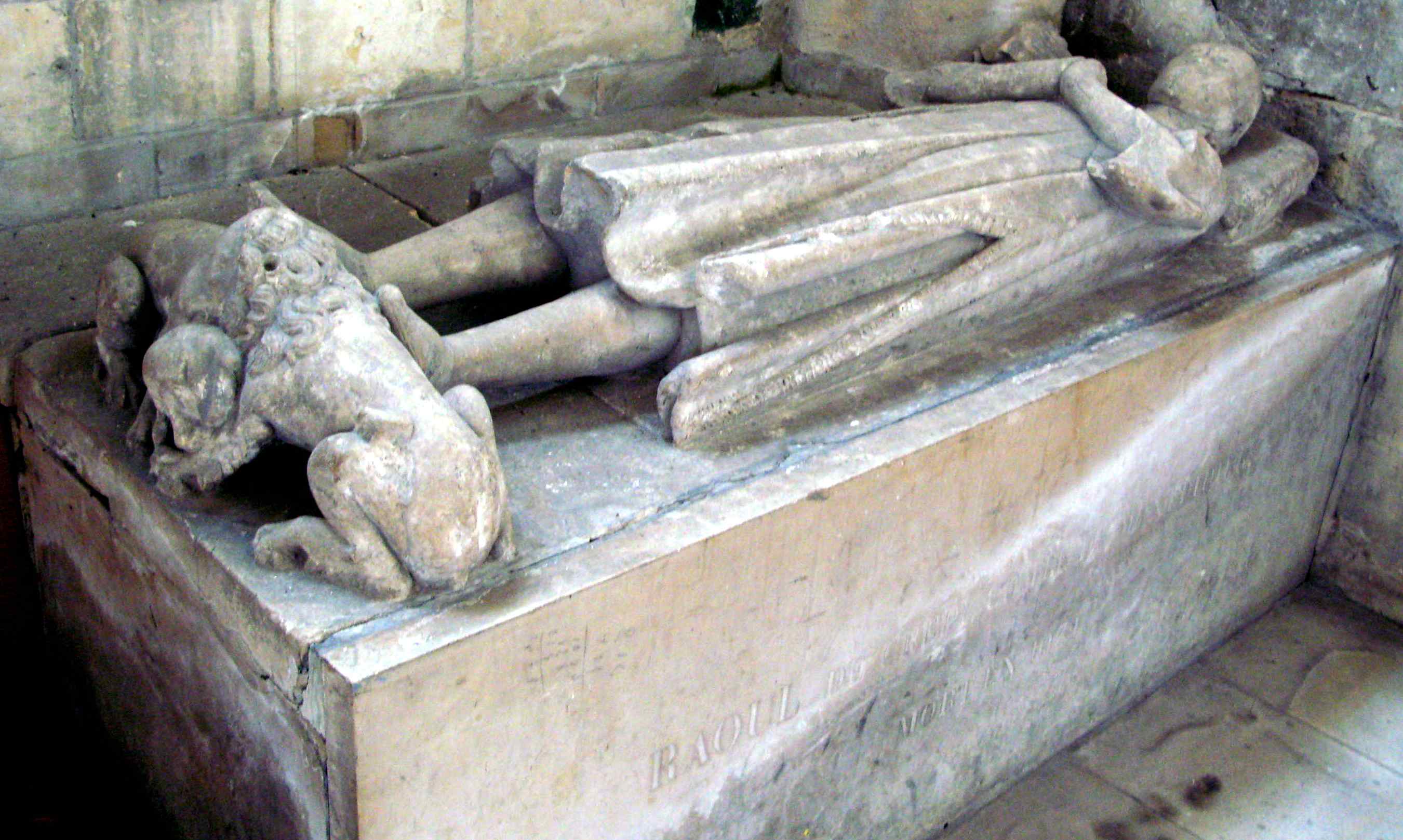 |
|
The now empty tomb of Raoul in the church
of Saint-Pierre in Montdidier, Somme, France. His body was later
moved to Crépy.
|
in the church of Saint-Pierre, Montdidier,
Somme, France. Nearly two years later, on 22 March 1076, Raul's body was
exhumed and moved to the priory
of Saint-Arnoul at Crépy and placed in a double grotto near the tomb
of his first wife, Aelis.
De S. Simone Comite et Monachio in Acta
Sanctorum Septembris vol 8 p722 (ed. G. H. Pertz, 1851)
Locum
autem primæ sepulturæ Rodulfi fuisse Montem-Desiderii, testatur
S. Simon in Charta pro Crispeiensi ecclesia, Audiatur etiam
ipsemet: Ego Simon Dei Gratia comes … Radulphum patrem meum de
Montesiderio, jam per tres annos post sui dissolutionem corporis ibi
jacentem, apportari feci, et ecclesiæ sancti Aruulphi, quæ … in
castello Crespeiaci … fundata est, in qua etiam ex aqua et Spiritu
sancto renatus fuerat, reddidi; ibique … collocare feci.
This roughly translates as:
But the
place of Rodolfo's first burial was Monte-Desiderio, testifies St.
Simon in the Charter for the church of Crépy, Let us also hear
himself: I Simon, by the grace of God, count … caused my father
Ralph to be brought from Montesiderio, who had been lying there for
three years after the dissolution of his body, and I returned him to the
church of St. Aruulf, which was founded … in the castle of Crépy, in
which he had also been reborn from water and the Holy Spirit; and there
… I caused him to be placed.
p727
In
nomine sanctæ et individuæ Trinitatis, Patris, et Filii et Spiritus
sancti. Amen. Omnis, qui semetipsum intelligit, hominem duabus
naturis, anima videlicet rationali et corpore constare cognoscit. Qua
in re saluberrimum esse videtur, parti utrique digne, quæ sua sunt,
providere. Et quia justum est de resurrectione cogitare, valde
necessarium est pro peccatis offerre: unde beatus Augustinus, animas,
inquit, defunctorum posse relevari pietate suorum viventium.
Quapropter ego SIMON, Dei gratia comes, de salute animæ
meæ, immo et patris mei, venerabilis comitis Radulphi, præcavens in
futurum, præsentis vitæ dies nihil esse conspiciens, atque mentem pro
posse in consideratione æternitatis figens, supradictum Radulphum
patrem meum de Montedesiderio, jam per tres annos post sui
dissolutionem corporis ibi jacentem, apportari * feci et ecclesiæ
sancti Arnulphi, quæ ab eodem et ab antecessoribus suis in castello
Crespeiaci honorifico schemate fundata est, in qua etiam ex aqua et
Spiritu sancto renatus fuerat, reddidi: ibique more antiquorum, juxta
sepulchrum matris meæ, uxoris suæ, nec non et prædecessorum nostrorum
cum psalmis et orationibus in spelunca duplici collocare feci.
This roughly translates as:
In the name of
the holy and indivisible Trinity, the Father, and the Son, and the Holy
Spirit. Amen. Everyone who understands himself knows that man consists
of two natures, namely the rational soul and the body. In this matter it
seems most salutary to provide for each part worthily, which is its own.
And because it is just to think of the resurrection, it is very
necessary to offer for sins: whence blessed Augustine says, the souls of
the dead can be relieved by the piety of their living. Wherefore I, SIMON,
count by the grace of God, for the salvation of my soul, and indeed of
my father, the venerable count Ralph, taking precautions for the future,
seeing that the days of this present life are nothing, and fixing my
mind as much as possible on the consideration of eternity, caused the
aforesaid Ralph, my father, from Montedesiderio, who had been lying
there for three years after the dissolution of his body, to be brought
and returned to the church of Saint Arnulf, which was founded by him and
his predecessors in the castle of Crépy according to an honorable plan,
in which he had also been reborn from water and the Holy Spirit: and
there, in the manner of the ancients, I caused him to be placed in a
double grotto, with psalms and prayers, near the tomb of my mother, his
wife, and also of our predecessors.
- Chronica Albrici Monachi Trium Fontium in Monumenta Germaniæ Historica SS 23 p793
(ed. G. H. Pertz, 1851); De S. Simone Comite et Monachio in Acta
Sanctorum Septembris vol 8 pp717-718 (ed. G. H. Pertz,
1851); La France dans sa splendeur vol 2 p30
(Pierre Louvet, 1674); Mémoires pour l’histoire du Vermandois vol
1 p623 (Louis-Paul Colliette, 1771); Medieval
Lands (RAOUL de Valois); wikipedia
(Ralph IV of Valois)
- La France dans sa splendeur vol 2 p30
(Pierre Louvet, 1674); Medieval
Lands (RAOUL de Valois); wikipedia
(Ralph IV of Valois)
- De S. Simone Comite et Monachio in Acta
Sanctorum Septembris vol 8 pp717-718 (ed. G. H. Pertz,
1851); Histoire généalogique de la maison royale de
France vol 1 p51 (Anselme de Sainte-Marie, 1726); Mémoires pour l’histoire du Vermandois vol
1 p624 (Louis-Paul Colliette, 1771); Histoire de Bar-sur-Aube page xiv (Henri d’Arbois de Jubainville, 1859);
Anne de Russie, reine de France p55 (Le
Vicomte de Caiz de Saint Aymour, 1896); Medieval
Lands (RAOUL de Valois); wikipedia
(Ralph IV of Valois)
- De S. Simone Comite et Monachio in Acta
Sanctorum Septembris vol 8 pp717-718 (ed. G. H. Pertz,
1851); La France dans sa splendeur vol 2 p30
(Pierre Louvet, 1674); Mémoires pour l’histoire du Vermandois vol
1 p624 (Louis-Paul Colliette, 1771); Medieval
Lands (RAOUL de Valois); wikipedia
(Ralph IV of Valois)
- Mémoires pour l’histoire du Vermandois vol
1 pp624-625 (Louis-Paul Colliette, 1771); Anne de Russie, reine de France pp55-58
(Le Vicomte de Caiz de Saint Aymour, 1896); Medieval
Lands (RAOUL de Valois); wikipedia
(Ralph IV of Valois)
- Mémoires pour l’histoire du Vermandois vol
1 p624 (Louis-Paul Colliette, 1771)
- Hugonis Floriacensis Modernorum Regum Francorum
Actus in Monumenta Germaniæ
Historica SS 9 p389 (ed. G. H. Pertz, 1851); The ecclesiastical history of England and Normandy
by Ordericus Vitalis vol 1 p456n (trans. Thomas Forester,
1853); Mémoires pour l’histoire du Vermandois vol
1 p624 (Louis-Paul Colliette, 1771); Anne de Russie, reine de France pp53-62
(Le Vicomte de Caiz de Saint Aymour, 1896); Medieval
Lands (ANNA Iaroslavna); wikipedia
(Anne of Kiev)
- The ecclesiastical history of England and Normandy
by Ordericus Vitalis vol 1 p456 (trans. Thomas Forester,
1853); Mémoires pour l’histoire du Vermandois vol
1 p623-625 (Louis-Paul Colliette, 1771); Medieval
Lands (RAOUL de Valois); wikipedia
(Ralph IV of Valois)
- The ecclesiastical history of England and Normandy
by Ordericus Vitalis vol 2 pp407-408 (trans. Thomas
Forester, 1853); Mémoires pour l’histoire du Vermandois vol
1 p623-625 (Louis-Paul Colliette, 1771); Anne de Russie, reine de France pp53-62
(Le Vicomte de Caiz de Saint Aymour, 1896); Medieval
Lands (RAOUL de Valois); wikipedia
(Ralph IV of Valois)
- Cartulaires de l'abbaye de Molesme
vol 2 p21 (ed. Jacques Laurent, 1911); De S. Simone Comite et Monachio in Acta
Sanctorum Septembris vol 8 pp726-728 (ed. G. H. Pertz,
1851); The ecclesiastical history of England and Normandy
by Ordericus Vitalis vol 2 p407n (trans. Thomas
Forester, 1853); Medieval
Lands (RAOUL de Valois); wikipedia
(Ralph IV of Valois)
- De S. Simone Comite et Monachio in Acta
Sanctorum Septembris vol 8 p722 (ed. G. H. Pertz, 1851);
The ecclesiastical history of England and Normandy
by Ordericus Vitalis vol 2 p407n (trans. Thomas
Forester, 1853); Medieval
Lands (RAOUL de Valois); wikipedia
(Ralph IV of Valois)
Return to Chris Gosnell's Home Page
If you have any comments, additions or modifications to the information on this page, please feel free to email me.
Created and maintained by: chris@ocotilloroad.com
