Herbertines
Adalbert I
Heribert II
a
daughter of Robert I, king of France
Gerberge
of Lorraine
Count of Vermandois and abbot of
the monastery of Saint Quentin
This charter, created by Adalbert and dated 954, documents him as count and
abbot, and is witnessed by his wife, Gerbergæ. In the charter that follows,
Adalbert is specifically referenced as abbot of Saint Quentin "ALBERTVS
Abbas Monaſterij S. Quintini Martyr".
Augusta Viromanduorum regestum veterum charta pp30-31
(Claude Hémeré, 1643)
IN
nom. P. & F. & Sp. S. ADALBERTVS Comes &
Abbas. Notum fit cunƈtis S. Matris Eccleſiæ filiis tam præſentibus
quam futuris, quod ad noſtram acceſſerunt præſentiam quidam ex
fidelibus noſtris Gerbertus ſcilicet & Anſerus
miles eius & Bernerus Abbas cellæ Humolarienſ. poſtulantes
vt quandam commutationem quam inter ſe fecerant noſtra authoritate
firmaremus, de terra ſcilicet S. Quintini, quæ iacetin villa quæ
dicitur Fraxiniasus & de terra S. Mariæ & S.
Hunnegundis quæ iacet in villa quæ dicitur Fontanas: quibus
inter ſe benè conuenientibus, quod petebant facere decernentes, hanc
chartam fieri iuſſimus & manu propria firmauimus: Et ſi quis, quod
nequaquam futurum credimus, contra hanc cautionem inſurgere, &
hanc violare tentauerit, in primis iram Dei omnipotentis incurrat,
& C. auri libras exſoluat, & eius contentioſa repetitio inanis
fiat. ſ. Adalberti Comitis ſ. Gerbergæ vxoris eius. ſ. Gijonis
Cuſtodis. ſ. Rotberti Decani ſ. Balduini præpoſiti. ſ,
Eurardi Presbyteri. Criſpini, Anſelmi, Albrici Diaconorum. Gerberei
Goteranni, Gerardi, Hitdradi, Anſeri vaſallorum. Aƈtum in Monasterio
S. Quintini, au. incarnat. Dom. 954. indiƈtio 12. Albricus
Cancellarius recognouit & ſubſcripſit.
This roughly translates as:
IN the name of
P. & F. & Sp. S. ADALBERT Count & Abbot. It is known to all
the sons of Holy Mother Church, both present and future, that certain of
our faithful, namely Gerbertus & Anserus his soldier
& Bernerus Abbot of the cell of Humolarienses, have come to
our presence. asking that we confirm a certain exchange which they had
made between themselves by our authority, of the land of St. Quintin,
which lies in the town called Fraxiniasus and of the land of St.
Mary and St. Hunnegund which lies in the town called Fontanas:
which being well agreed upon between them, deciding what they asked to
do, we ordered this charter to be made and confirmed with our own hand:
And if anyone, which we believe will never happen, should attempt to
rise up against this caution and violate it, let him first incur the
wrath of God Almighty, and let him forfeit 100 pounds of gold, and let
his contentious request be rendered void. Signed Count Adalbert Signed Gerbergæ his wife. Signed Custodian of Gijón.
Signed Dean Robert Signed Presiding over Baldwin. Signed Priest Eurard.
Deacons Crispin, Anselm, and Albric. Gerberei Goteranni, Gerardi,
Hitdradi, Anseri vassals. Autumn in the Monastery of S. Quintini, in the
year of the incarnation of our Lord 954. indiction 12. Albricus
Chancellor recognized & subscribed.
This charter, created by Adalbert's son, Heribert III, describing himself as
abbot of the monastery of Saint Quentin and count, is also witnessed by
Adalbert. The charter was likely created in 987 or 988, a transitional
period in which Adalbert, who died shortly thereafter, had relinquished
control of the county to Heribert.
Augusta Viromanduorum regestum veterum charta pp33-34
(Claude Hémeré, 1643)
Heriberti 3. Comitis Viroman. gratam habentis eleemoſynam Arpardi
& Frideburgis collatam in Humolarienſ. viuente adhuc
Alberto. Ex archiuis eorumdem.
IN nom. S. & indiuid. Trinitatis P. & F. & & Sp. S.
Ego HERIBERTVS gratia Dei, teſtis Chriſti Quintini
Monaſterii Abbas, & Comes dictus … ſ. Adalberti Comitis manu
ipſius faƈtum. ſ. Heriberti filii eius. ſ. Ermengardis vxoris eius. ſ.
Odonis nepotis …
This roughly translates as:
Heribert 3.
Count of Vermandois. having grateful alms of Arpard and Frideburg in
Humolarie. Albert still living. From the archives of the same.
In the name of the holy and indivisible Trinity, of the Father and of
the Son and of the Holy Spirit. I, Heribert, by the grace of God,
witness of Christ, abbot and count of the monastery of Quentin, said. …
Sign of Count Adalbert made by his own hand. Sign of Heribert his son.
Sign of Ermengarde his wife. Sign of Odo his nephew.
La France dans sa splendeur vol 2 p18
(Pierre Louvet, 1674)
Albert
I. du nom; Comte de Vermondois, eut de Gerberge fille de Gilbert Duc
de Lorraine, Herbert III. ſon ſucceſſeur, Othon decedé ſans lignée,
Luidulphe Evêque de Noyon, que les Sieurs de ſainte Marthe donnent à
Herbert II. Guy Comte de Soiſſons, & Giſle femme du Comte Arnoul.
This roughly translates as:
Albert
I, the first of that name, Count of Vermandois, had by Gerberga
(daughter of Gilbert, Duke of Lorraine): Herbert III, his successor;
Otho, who died without issue; Luidulf, Bishop of Noyon (whom the
Messieurs de Sainte-Marthe attribute to Herbert II); Guy, Count of
Soissons; and Gisela, wife of Count Arnulf.
Louis-Paul Colliette describes Adalbert's family and character, and his
establishment of the Abbey of Saint Prix in the family castle where his
father had imprisoned Charles the Simple for so many years.
Mémoires pour l’histoire du Vermandois vol 1
pp477-478 (Louis-Paul Colliette, 1771)
ALBERT,
premier du nom, apporta dans le gouvernement du Vermandois, dont il ſe
ſaiſit après la mort d’Hébert II, des mœurs plus douces, & des
vertus plus pacifiques, que n’y avoit montré ſon pere. Tel qu’un voyageur qui jouit
tout-à-coup d’un ciel pur & ſerain, après la diſparution de la
tempête, & qui voit avec joie la nature, attriſtée par les pluies
& l’orage, reprendre ſes fleurs, s’en parer encore, & ſe
rembellir au retour d’un ſoleil clair & ſans nuages; ainſi le
leƈteur va être ravi des vertus civiles & ſociables d’Albert Ier;
& enchanté des grandes œuvres de ſa piété & de l’équitable
adminiſtration de ſa régence, va oublier les traits hideux qui
l’avoient affligé dans la vie de ſon impétueux prédéceſſeur. Avec une
grande ame, mais modérée; un cœur bon, mais droit; & un eſprit
vaſte & éclairé, mais ami de la regle & du devoir, Albert
ſoutint magniquement l’excellence de ſon origine & de ſa dignité;
jamais il n’en laiſſa courber la grandeur & l’autorité ſous les
loix injuſtes de la rébellion, de l’injustice & de l’avidité.
Inviolablement attaché à la piété dont il faiſoit ſon principal
exercice, il n’oublia pas dans sa ſouveraineté ſa dépendance de nos
Rois. Il les reſpeƈta, les honora, les craignit. Hélas! on n’eſt
fidele ſujet que quand on eſt bon chrétien. Il ne parut maître de ſes
vaſſaux, que pour faire régner plus rigidement les loix parmi eux. Il
ne fut plus élevé & plus diſtingué que les autres Seigneurs ſes
voiſins, & peut-être plus puiſſant qu’eux que pour en défendre
ceux qui étoient opprimés, contre les violences des méchans. Dans une
plus grande élévation, il donna des exemples plus frappans de toutes
fortes de vertus, & ne ſe erut l’héritier d’immenses biens, que
pour en diſtrribuer davantage aux pauvres, & en plus de lieux.
Quatre monaſteres, ſitués dans ſon comté que ce Seigneur a fondés,
rétablis ou dotés preſqu’en entier de ſon propre patrimoine,
témoigneront à jamais ſa ſainte prodigalité.
Quelques auteurs ont écrit qu’Albert avoit été marié avec une
fille anonyme de Gilbert, ce célébre Duc de Lorraine, dont nous avons
parlé pluſieurs fois au livre précédent, & dont nous avons auſſi
rapporté la généalogie. Le fait eſt très-croyable, parce que la
famille de ce Seigneur Lorrain étoit fort liée à celle d’Hébert II,
comte de Vermandois, & que les grands intérêts que leurs maiſons
ſoutenoient de concert, donnent lieu d’y ſoupçonner des alliances
réciproques entr’elles. D’ailleurs Albert, qui prit femme en la
famille de Louis d’Outre Mer, n’a pu le faire qu’après ſa
réconciliation avec ce Roi, & après la mort d’Hébert II ſon pere;
enfin tout au plutôt en 943. Or ce mariage eût été conclu bien tard
pour Albert, ſi Gerberge de France eût été ſa premiere femme. Il y a
plus d’apparence qu’on n’avoit pas attendu ſi long-temps à marier un
héritier prochain d’une ſi célébre maiſon. Il étoit donc entré dans
celle de Lorraine d’abord; mais il avoit perdu ſon épouſe, quand il
prit la fille de Louis IV. Il ne paroît pas qu’il ait eu d’enfans de
la fille du Lorrain, ou bien ils moururent de bonne heure; car ceux
que nous connoiſſons être iſſus d’Albert, le ſont en même temps de
Gerberge de France, ſa ſeconde femme. Cette Dame étoit par conſéquent
ſœur de Lothaire qui devint Roi de France. Albert en eut quatre
garçons: Hébert, troisieme du nom, qui le remplaça; Othon de
Vermandois; Lindulfe, qui fut fait Evêque de Noyon; & Gui, qui fut
le Tréſorier de cette église.
This roughly translates as:
ALBERT,
the first of that name, brought to the governance of Vermandois, which
he seized following the death of Herbert II, a gentler disposition and
more pacific virtues than his father had ever displayed there. Like a
traveler who suddenly enjoys a pure and serene sky after the storm has
passed and who watches with joy as nature, previously saddened by rain
and tempest, once again puts forth her blossoms, adorns herself anew,
and grows beautiful once more beneath the return of a clear, cloudless
sun, so too, will the reader be delighted by the civil and social
virtues of Albert I. Enchanted by the great works of his piety and the
equitable administration of his regency, the reader will forget the
hideous traits that had so distressed him in the life of Albert’s
impetuous predecessor. Possessing a great yet temperate soul, a good yet
upright heart, and a vast and enlightened mind, one ever devoted to
order and duty, Albert magnificently upheld the excellence of his
lineage and his high office; never did he suffer their grandeur and
authority to bow beneath the unjust laws of rebellion, injustice, or
avarice. Inviolably attached to piety, which he made the principal
practice of his life, he never, amidst the exercise of his own
sovereignty, forgot his fealty to our Kings. He respected them, honored
them, and held them in awe. Alas! One can be a truly faithful subject
only when one is a good Christian. He asserted his mastery over his
vassals solely to ensure that the laws reigned among them with greater
rigor. He was raised above and distinguished from his neighboring lords,
and perhaps rendered more powerful than they, solely so that he might
defend the oppressed among them against the violence of the wicked.
Elevated to a higher station, he provided even more striking examples of
every virtue; indeed, he regarded himself as the heir to his immense
fortune only so that he might distribute even more of it to the poor,
and across a wider territory. Four monasteries situated within his
county, which this lord founded, restored, or endowed almost entirely
from his own patrimony, will stand forever as a testament to his holy
generosity.
Some authors have written that Albert was married to an unnamed
daughter of Gilbert, that celebrated Duke of Lorraine whom we have
mentioned several times in the preceding book, and whose genealogy we
have also recounted. This claim is highly plausible, for the family of
this Lorrainese lord was closely allied with that of Herbert II, Count
of Vermandois; moreover, the significant interests that their respective
houses pursued in concert give ample grounds to suspect that reciprocal
alliances existed between them. Furthermore, Albert, who eventually took
a wife from the family of Louis d’Outremer, could not have done
so until after his reconciliation with that King, and after the death of
his father, Herbert II; in short, this could not have occurred any
earlier than the year 943. Now, had Gerberga of France been his first
wife, this marriage would have taken place remarkably late in Albert’s
life. It is far more probable that no one would have waited so long to
arrange the marriage of the immediate heir to so illustrious a house. He
had, therefore, first entered into an alliance with the House of
Lorraine; he had, however, already lost that spouse by the time he took
the daughter of Louis IV as his wife. It does not appear that he had any
children by the daughter of the Lorrainer, or else they died young; for
those whom we know to be descended from Albert are, at the same time,
descended from Gerberge of France, his second wife. This lady was,
consequently, the sister of Lothair, who became King of France. Albert
had four sons by her: Herbert, the third of that name, who succeeded
him; Otho of Vermandois; Lindulf, who was appointed Bishop of Noyon; and
Guy, who served as the Treasurer of that church.
pp481-484
Les Comtes de Vermandois avoient demeuré juſqu’alors un peu au-deſſus
des rives de la Somme, hors de la ville capitale de leur gouvernement,
près d’un lieu que nous appellons Rôcourt. Le lieu qu’ils habitoient
s’appelloit en Latin Broïlus, d’un nom dont la racine eſt
inconnue, & ſemble aux Savans ſignifier un endroit ombrageux &
planté d’arbres ou de bois. C’eſt celui préciſément où nous voyons
maintenant bâties la chapelle & la ferme de ſaint Prix. La
ſituation de leur palais, poſé ſur une petite éminence en recevoit
plus d’agrémen;t & les eaux avec les bois, dont elle étoit bordée,
en compoſoient un ſéjour délicieux. Le corps-de-logis étoit grand
& vaſte. Les cours, les jardins & les enclos étoient entourés
de murailles, & défendus, ſelon l’usage de ces temps, par de
petites tours dans leſquelles on poſoit des troupes, pour interdire
toute entrée dans les lieux de la demeure du Comte. C’étoit dans
l’enceinte du palais de ces Seigneurs qu’eux & les Barons, leurs
conſeillers, décidoient les affaires qu’on leur déféroit. On appelloit
placita les cauſes qui étoient de petite importance: celles qui
étoient plus conſidérables, s’appelloient mallei. C’eſt ainſi
que les auteurs traduiſent ces deux mots contenus dans la charte
d’Albert Ier, de l’an 986, quand ils ſont en oppoſition
l’un à l’autre. Là étoient les priſons dans leſquelles on jettoit les
criminels.
Ce fut dans une de celles qui y étoient conſtruites qu’Hébert
II avoit fait enfermer Charles le Simple. La mémoire d’un
traitement ſi barbare étoit odieuſe à Albert, & lui avoit rendu
inſupportable le lieu qui avoit été autrefois le témoin des cris, des
pleurs & des tourmens de ſon Roi. Il voulut quitter cette demeure
qui rappelloit ſans ceſſe à son eſprit de ſi triſtes images; mais il
réſolut, en l’abandonnant, de la conſacrer à jamais par un pieux
établissement qui lui en fit oublier, & aux ſiécles futurs, s’il
étoit poſſible, toute la laideur & l’impureté. Il appella des
moines de ſaint Bénoit, & les fixa dans ſon palais dont il leur
fit préſent. Il leur donna encore pluſieurs autres biens dont le
détail eſt renfermé dans la charte qu’il fit expédier, en leur faveur,
long-temps après qu’il les eur établis dans ſa maiſon comtale. Ces
religieux étoient d’une extrême abſtinence: ils ne vivoient que
d’herbes & de poiſſons, de laitages & des choſes les plus
viles. … Voilà par quels ſaints ſolitaires le pieux Comte fit
remplacer le palais que ſon pere avoit fouillé par des excès ſi
énormes.
Le nouveau monaſtere prit le nom d’abbaye de ſaint Prix.
… Le comte Albert ayant fondé ſa nouvelle abbaye, le Chapitre de ſaint
Quentin s’empreſſa d’enrichir l’égliſe des moines des reliques de
ſaint Prix; il leur donna l’omopłate du corps de ce Saint, & ne
s’en conſerva que le crâne qu’il a fait renfermer depuis peu dans un
magnifique reliquaire. C’eſt de ce précieux don que le monaſtere
nouveau a pris le nom diſtinctif qu’il porte encore, & qu’il s’eſt
appellé l’abbaye de ſaint Prix.
This roughly translates as:
Until
that time, the Counts of Vermandois had resided slightly above the banks
of the Somme, outside the capital city of their domain, near a place we
now call Rôcourt. The site they inhabited was known in Latin as Broïlus,
a name of unknown etymology which scholars believe signifies a shady
spot, planted with trees or woodland. It is precisely upon this site
that we now see built the chapel and farm of Saint-Prix. The location of
their palace, situated atop a small eminence, lent it greater charm;
indeed, the surrounding waters and woodlands combined to create a truly
delightful residence. The main residential building was large and
spacious. The courtyards, gardens, and grounds were enclosed by walls
and, in accordance with the customs of the era, defended by small
towers, wherein troops were stationed to prevent any unauthorized entry
into the Count’s private quarters. It was within the precincts of this
noble palace that the Counts, together with the Barons who served as
their counselors, adjudicated the various matters brought before them.
Cases of minor importance were termed placita; those of greater
significance were called mallei. Such is the interpretation
scholars apply to these two terms, which appear in a charter issued by
Albert I in the year 986, when the words are cited in contradistinction
to one another. It was there, too, that the prisons were
located—dungeons into which criminals were cast.
It was within one of these very cells, constructed upon the
premises, that Herbert II had caused Charles the Simple to be
imprisoned. The memory of such barbaric treatment was odious to Albert,
and had rendered unbearable to him the very place that had once borne
witness to the cries, tears, and torments of his King. He wished to
depart from this dwelling, which ceaselessly called forth such sorrowful
images in his mind; yet, upon abandoning it, he resolved to consecrate
it forever through a pious foundation, one that might cause him, and
future ages if possible, to forget all its ugliness and impurity. He
summoned monks of Saint Benedict and settled them within his palace,
which he bestowed upon them as a gift. He further endowed them with
various other properties, the details of which are set forth in the
charter he had drawn up in their favor, long after he had first
established them within his comital residence. These religious men
practiced extreme abstinence; they subsisted solely on herbs, fish,
dairy products, and the humblest of fare. … Thus did the pious Count
replace the palace which his father had defiled through such heinous
excesses with the presence of these holy solitaries.
The new monastery assumed the name of the Abbey of Saint Prix.
… Once Count Albert had founded his new abbey, the Chapter of Saint
Quentin hastened to enrich the monks' church with relics of Saint Prix;
they presented them with the scapula of the Saint’s body, retaining for
themselves only his skull which they have but recently enshrined within
a magnificent reliquary. It is from this precious gift that the new
monastery derived the distinctive name it bears to this day, coming to
be known as the Abbey of Saint Prix.
The Encyclopaedia Britannica is dismissive
of Adalbert I's relevance.
The Encyclopaedia Britannica 11th edition vol
27 p1024 (ed. Hugh Chisholm, 1911)
VERMANDOIS.
… Albert I., Herbert III., Albert II., Otto and Herbert IV., were
unimportant.
8 or 9 September 987
Mémoires pour l’histoire du Vermandois vol 1
pp546-547 (Louis-Paul Colliette, 1771)
Albert le Pieux mourut en 987; car une charte de cette année,
ſous-ſignée de lui, eſt la derniere qui faſſe mention de ſon ſeing:
une autre du mois de Février de l’année ſuivante, n’eſt ſouſcrite
ſeulement que de ſon fils Hébert III. Ce fut le neuvieme de Septembre
qu’il mourut, felon le nécrologe de l’abbaye du
Mont-Saint-Quentin-ſous-Péronne; ce fut le huitieme du même mois, dit
celui de l’égliſe de ſaint Quentin, qui ajoute qu’au jour de
l’anniverſaire de ce Comte, ſa tombe doit être couverte d’un drap
mortuaire, & ornée de quatre chandeliers & de quatre cierges
qui brûleront pendant les vigiles & la meſſe des Trépaſſés qu’on
chantera pour lui. Sa ſépulture eſt dans l’égliſe de ſaint Quentin; on
ne fait maintenant en quel endroit . . . . VIIIâ die
Septembris, obiit Albertus, comes. Et eâdem die Oſtiarii debent
parare tumbam ejus de uno pallio, & ponere quatuor candelabra in
circuitu tumba, cum quatuor cereis; & debent ardere in vigiliis
& miſſa defunƈtorum. Lorſque l’uſage des paſts ſuccéda à la
vie commune dans cette même égliſe, il est marqué dans le même
nécrologe, qu’au jour de la mort du Comte Albert, il y avoit feſtin. .
. . Epulum ſolemne eſt, & tres ſolidi pauperibus erogati in
eleemoſinam, pro animá Alberti, comitis.
Cette ſépulture, ces prieres & ces paſts, étoient les
juſtes effets de la reconnoiſſance que les chanoines de ſaint Quentin
devoient à la mémoire d un généreux Seigneur qui leur avoit fait tant
de bien pendant ſa vie; d’un religieux Abbé qui avoit fait l’ornement
de leur compagnie, par la douceur de ſes mœurs, ſa tendre piété, &
ſon amour pour la bonne diſcipline; d’un puiſſant Comte qui, dans le
ſiécle de fer où il vivoit, toujours ſoumis à ſes Rois, reſpeƈté de
ſes voiſins, pere de ſes vaſſaux, & la terreur des méchans, ne
paroît nulle part s’être éçarté du plus exaƈt devoir; d’un bon frere,
bon fils & bon pere; d’un Souverain enfin, dont les charités
immenſes, répandues ſur tant d’égliſes & de monaſteres au dedans
& au dehors de ſa domination, avoient établie la preuve ſenſible
de la grandeur de ſon ame, de ſon détachement du monde, de ſes deſirs
pour la vraie gloire & le ſolide bonheur qui l’attendoit dans le
Ciel.
This roughly translates as:
Albert the
Pious died in 987; for a charter of that year, bearing his
signature, is the last to make mention of his seal. Another charter,
dated February of the following year, bears the signature solely of his
son, Hébert III. He died on the ninth of September, according to the
necrology of the abbey of Mont-Saint-Quentin-sous-Péronne; however, the
necrology of the church of Saint-Quentin states that he died on the
eighth of the same month, adding that on the anniversary of this Count’s
death, his tomb is to be draped with a funeral pall and adorned with
four candlesticks and four wax tapers, which are to burn during the
vigils and the Mass for the Dead celebrated in his memory. His remains
lie interred within the church of Saint-Quentin, though their exact
location is no longer known. . . . On the 8th day of September,
Albert, count, died. And on the same day the Ushers must prepare his
tomb from one pall, and place four candelabra around the tomb, with
four candles; and they must burn at the vigils and mass for the dead.
When the practice of holding commemorative feasts succeeded the communal
way of life within this same church, it is recorded in the same
necrology that, on the day of Count Albert’s death, a banquet was held.
. . . There is a solemn feast, and three solidi are given to the
poor in alms, for the soul of count Albert.
This burial, these prayers, and these feasts were the just
expressions of the gratitude that the canons of Saint-Quentin owed to
the memory of a generous Lord who had bestowed so many benefits upon
them during his lifetime; of a devout Abbot who had been the ornament of
their community through the gentleness of his manners, his tender piety,
and his love for sound discipline; of a powerful Count who, in the Iron
Age in which he lived, ever submissive to his Kings, respected by his
neighbors, a father to his vassals, and the terror of the wicked,
appears nowhere to have deviated from the strictest duty; of a good
brother, a good son, and a good father; and, finally, of a Sovereign
whose immense charities, lavished upon so many churches and monasteries
both within and beyond the bounds of his dominion, had established
tangible proof of the greatness of his soul, of his detachment from the
world, and of his yearning for the true glory and enduring happiness
that awaited him in Heaven.
in the church of Saint-Quentin,
county of Vermandois, France
- Flodoardi annales in Monumenta
Germaniæ Historica SS 3 p399 (ed. G. H. Pertz, 1839); Histoire
généalogique de la maison royale de France vol 1 pp49-50
(Anselme de Sainte-Marie, 1726); Mémoires pour l’histoire du Vermandois vol
1 p402 (Louis-Paul Colliette, 1771); Medieval
Lands (ADALBERT); wikipedia
(Adalbert I, Count of Vermandois)
- Histoire généalogique de la maison royale de
France vol 1 pp49-50 (Anselme de Sainte-Marie, 1726); Mémoires pour l’histoire du Vermandois vol
1 p402 (Louis-Paul Colliette, 1771)
- Augusta Viromanduorum regestum veterum charta pp30-31
(Claude Hémeré, 1643); Histoire généalogique de la maison royale de
France vol 1 p50 (Anselme de Sainte-Marie, 1726); Mémoires pour l’histoire du Vermandois vol
1 p402 (Louis-Paul Colliette, 1771); Mémoires pour l’histoire du Vermandois vol
1 pp477-478 (Louis-Paul Colliette, 1771); Medieval
Lands (ADALBERT); wikipedia
(Adalbert I, Count of Vermandois)
- La France dans sa splendeur vol 2 p18
(Pierre Louvet, 1674); Histoire généalogique de la maison royale de
France vol 1 p50 (Anselme de Sainte-Marie, 1726); Mémoires pour l’histoire du Vermandois vol
1 p402 (Louis-Paul Colliette, 1771); Mémoires pour l’histoire du Vermandois vol
1 p478 (Louis-Paul Colliette, 1771); Medieval
Lands (ADALBERT); wikipedia
(Adalbert I, Count of Vermandois)
- Augusta Viromanduorum regestum veterum charta pp30-31
(Claude Hémeré, 1643); Histoire généalogique de la maison royale de
France vol 1 p50 (Anselme de Sainte-Marie, 1726); Mémoires pour l’histoire du Vermandois vol
1 pp477-478 546
(Louis-Paul Colliette, 1771); Medieval
Lands (ADALBERT); wikipedia
(Adalbert I, Count of Vermandois)
- Augusta Viromanduorum regestum veterum charta pp30-31
(Claude Hémeré, 1643); Augusta Viromanduorum regestum veterum charta pp33-34
(Claude Hémeré, 1643); Mémoires pour l’histoire du Vermandois vol
1 pp477-478 pp481-484
(Louis-Paul Colliette, 1771); The Encyclopaedia Britannica 11th edition vol
27 p1024 (ed. Hugh Chisholm, 1911); Medieval
Lands (ADALBERT); wikipedia
(Adalbert I, Count of Vermandois)
- Mémoires pour l’histoire du Vermandois vol
1 pp546-547 (Louis-Paul Colliette, 1771) citing the necrology of
the abbey of Mont-Saint-Quentin-sous-Péronne and the necrology of Saint
Quentin; wikipedia
(Adalbert I, Count of Vermandois)
- Mémoires pour l’histoire du Vermandois vol
1 pp546-547 (Louis-Paul Colliette, 1771)
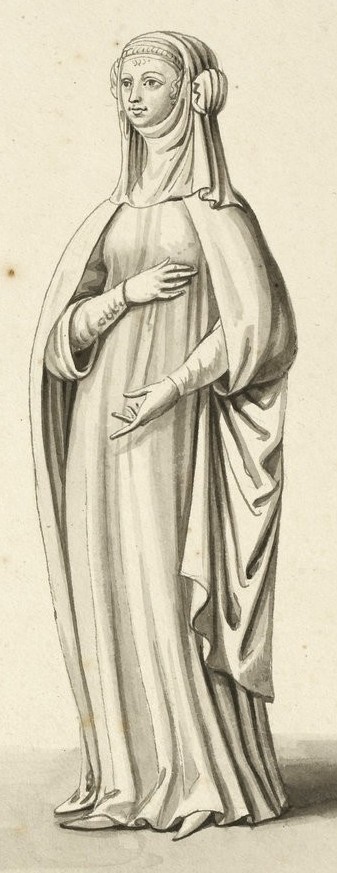
Adele of Meaux
 |
|
Adele of Meaux
This illustration was based on the effigy on her tomb.
The note to the illustration reads "Adèle de Vermandois, femme de
Geoffroy Grisegonelle, Comte d'Anjou, mort en 987.
Sous Lothaire.
de sont tombeau, à coté de grand autel de l'église de St.
aubin d'angers dont elle est la fondatrite" which roughly
translates as "Adèle of Vermandois, wife of Geoffrey Grisegonelle,
Count of Anjou, died in 987.
Under Lothair.
Her tomb is located next to the high altar of the church of St.
Aubin in Angers, of which she was the founder."
|
Robert of Meaux
Adelaide
Geoffroy
"Grisegonelle"
Cartulaire de l'abbaye de Saint-Aubin d'Angers
vol 1 pp7-10 (Bertrand de Broussillon, 1903)
III.
(A. 3.) — 974, 6 mars, Angers. — CHARTE PAR LAQUELLE LA
COMTESSE ADÈLE FAIT DON A SAINT-AUBIN DE SES DOMAINES HÉRÉDITAIRES
ET DE TOUS SES ACQUÊTS. (Original avec croix autographes aux
Archives de Maine-et-Loire, H. 100, 73.)
Carta donationis quam fecit Adela, Andegavensis comitissa, Sancto
Albino de curte que nominatur Undanis villa, in pago Belvacensi, et
de Insula Montis, prope civitatem Andecavam, cum capella Sancti
Hilarii et de ecclesia de Regina et de ecclesia Alodos et de quinque
arpennis vinee in prospectu civitatis Andecave1.
Cum pervigiles nos obitus nostri adventum expectare jubeat
Dominus tunc potissimum vigilare debemus quando nobis vicinius
imminere mortem cognoscimus. Idcirco in Evangelio hortatur et incertam
horam sui adventus demonstrat cum dicit: « Videte, vigilate, quoniam
nescitis qua hora Dominus veniet ». Precavendum est igitur; et, ut
Sapientia dicit: « Quodcumque possumus in Dei servitio et pro ejus
amore agendum; quia post mortem nemo in infernum confitebitur Domino,
nec locus bona operandi restabit; sed quod quisque ad presens executus
fuerit, illic certam recipiet vicissitudinem sive boni sive mali ».
Quapropter ego Adela, nequaquam meorum actuum confidentiam
habens, sed in solius Dei misericordia totam spem et confidentiam
ponens et sanctorum ejus suffragia deposcens, in extremis
circumvallantibus angustiis constituta, ad ipsius Redemptoris Nostri
pietatem et ejus dilectissimi antistitis Albini pre ceteris
confugiens, res hereditarias mei juris quas vel a parentibus seu a
seniore meo Gauzfredo comite adquirere potui, ipsi sancti confessori
Albino contrado, sperans et pro certo credens, ut legitur: « Non
habentes velamen amplexentur lapides, ipsius juvamine a peccatorum
nexibus eripi et æterne vite remunerationem me posse promereri ».
Dono igitur illi curtem a parentibus traditam, sitam in pago
Belvacinse, que vocatur Hundanis villa, cum terris cultis et incultis,
villulis, mancipiis utriusque sexus, pratis, silvis, aquis aquarumque
discursibus, molendinis, et cum duabus ecclesiis, unam in honore
sanctae Dei genitricis Mariae constructam, alteram in honore sancti
Aniani.
Quicquid ergo in jamdictam curtem habere visa sum quesitum et
inquisitum totum pro anime meae remedio Sancto Albino trado atque
condono.
Concedo etiam illi insulam, sitam in pago Andegavo, quam in
dotalitium mihi senior contulit, venerandus scilicet comes Gauzfredus,
que Mons vocatur, cum omnibus que ad eam pertinent, cum terris
videlicet cultis et incultis, silvis, pratis, pischariis, mancipiis
utriusque sexus, et cum capella in honore sancti Hylarii fabricata.
Condono namque jam sepius dicto confessori item aliam ecclesiam
in pago Andegavo cum villula in qua fore conspicitur et cum mercato et
vicaria, cum terris cultis et incultis, molendinis, aquis aquarumque
discursibus, quae vocatur Peregrina, et cum omnibus que ad eam
pertinent.
Simul ergo concedo prefixe Sancto Albino monachisque ibi Deo
sedule obsecundantibus arpennos quinque et dimidium de vineis in
prospectu Andegave civitatis, et cellarium in suburbio ejusdem,
quatinus ejus adjuta precibus caelestis regni beatitudine frui merear
cum sanctis omnibus.
Si quis vero fuerit ex parentibus meis val amicis, quod fieri
non credo, si filius, vel filia hanc donationem contradicere
temptaverit, in primis iram Dei omnipotentis et sancti Albini
incurrat; deinde, judiciaria cogente potestate, auri libras centum
multat, componat et quod repetit non evindicet; sed hec donatio
inconvulsa omni tempore permaneat.
Signum Gauzfredi comitis.
Signum Fulconis, filii ejus.
Signum Gauzfredi, filii ejus.
Ego Gauzfredus, assertor et roborator hujus donationis, notum
esse volo omnibus quia in nostra confirmatione et fidelium nostrorum
calumpnia ex supradicta ecclesia Peregrina et ea que ad ipsam
pertinent orta est a quodam Raynardo, qui ad suum beneficium pertinere
testatus est. Unde statuimus ut abbas jamdicti cœnobii Sancti Albini,
Albertus nomine, ex suo libras quatuor argenti daret et, tam de
ecclesia quam de mansulo quodam, Croiaco nomine, et omnibus que ad
ipsam pertinent ut supra jam dictum est, supradictus Raynardus, cum
consensu senioris sui, Odonis comitis, prefatam donationem firmam
adsentiret.
Et ut haec donatio perhennem obtineat vigorem, statuimus censum
annuatim solidos duos illi persolvere vel successoribus ejus, nec a
prefato loco amplius requiratur.
Signum Raynardi calumpniatoris.
Signum Raynaldi, episcopi Andegavensis.
Signum Raynaldi vicecomitis, patris ejus.
Signum Sulpitii.
Signum Heriberti comitis.
Signum Gauzfredi vicecomitis.
Signum Harduini, episcopi Turonensis.
♱ Signum Odonis comitis, qui hanc donationem fieri jussit.
Data mense martio, anno vicesimo tertio regnante Lothario rege,
in placito publico Andegavis civitatis,
Rotbertus scripsit et subscripsit.
Anno ab incarnatione Domini D CCCC LXXIIII,
indictione I, II nonas supradicti
mensis.
(1) On trouve des fragments de cette charte à la page 39 des Preuves
de l’Histoire de la Maison de Vergy, de Du Chesne, et dans dom
Morice (Preuves de l’Histoire de Bretagne, I, 349).
This roughly translates as:
III. (A. 3.) — 974, 6 March, Angers. — CHARTER BY WHICH COUNTESS
ADELE DONATED HER INHERITED DOMAINS AND ALL HER ACQUISITIONS TO
SAINT-AUBIN. (Original with autograph crosses in the Archives
of Maine-et-Loire, H. 100, 73.)
A charter of donation made by Adela, countess of Anjou, to Saint
Albinus of the court called Undanis villa, in the village of Belvaux,
and of the Island of Monts, near the city of Anjou, with the chapel of
Saint Hilary and the church of Regina and the church of Alodos and
five acres of vineyard in the prospect of the city of Anjou1.
When the Lord commands us to be vigilant in awaiting the coming
of our death, we must be especially vigilant when we realize that death
is approaching us. For this reason, in the Gospel, he exhorts us and
shows the uncertain hour of his coming when he says: “Watch, watch, for
you do not know at what hour the Lord will come.” We must therefore be
careful; and, as Wisdom says: “Whatever we can do in the service of God
and for his love, we must do; because after death no one will confess to
the Lord in hell, nor will there be a place left for doing good; but
whatever each one has done up to the present time, he will receive there
a certain reward, whether good or evil.”
Therefore, I, Adela, by no means having confidence in my own
actions, but placing all my hope and confidence in the mercy of God
alone and asking for the prayers of his saints, placed in extreme
surrounding distress, taking refuge above all else in the piety of our
Redeemer himself and his most beloved bishop Albinus, I bequeath to the
holy confessor Albinus the hereditary things of my right which I was
able to acquire either from my parents or from my elder count Gauzfred,
hoping and believing for certain, as it is written: "Without a veil let
the stones embrace, that with his help I may be rescued from the bonds
of sins and merit the reward of eternal life." Therefore, I give him a
farmstead handed down by his parents, situated in the village of
Belvain, which is called the Hundanis villa, with cultivated and
uncultivated lands, hamlets, serfs of both sexes, meadows, forests,
waters and watercourses, mills, and with two churches, one built in
honor of the holy Mother of God Mary, the other in honor of Saint Anian.
Therefore, whatever I have been seen to have in the
aforementioned farmstead, acquired and searched, I give and forgive
entirely to Saint Albinus for the healing of my soul.
I also grant him an island, situated in the village of Anjou,
which my elder brother, namely the venerable count Gauzfred, who is
called the Mountain, gave to me as a dowry, with all that pertains to
it, namely cultivated and uncultivated lands, forests, meadows,
fisheries, serfs of both sexes, and with a chapel built in honor of
Saint Hilary.
For I also grant to the confessor already mentioned another
church in the village of Anjou, with a small village in which it is seen
to be located, and with a market and a vicarage, with cultivated and
uncultivated lands, mills, waters and watercourses, which is called
Peregrina, and with all that pertains to it.
At the same time, therefore, I grant to Saint Albinus and the
monks there who diligently obey God, five and a half acres of vineyards
in the prospect of the city of Anjou, and a cellar in the suburb of the
same, of which, with the help of his prayers, I may deserve to enjoy the
bliss of the heavenly kingdom with all the saints.
If, however, any of my parents or friends, which I do not believe
will happen, if a son or daughter attempts to contradict this donation,
let him first incur the wrath of Almighty God and Saint Albinus; then,
by the coercive power of the judiciary, let him fine himself one hundred
pounds of gold, make amends, and not enforce what he repeats; but let
this donation remain unshaken at all times.
Sign of Count Gauzfred.
Sign of Fulk, his son.
Sign of Gausfred, his son.
I Gausfred, assertor and reinforcer of this donation, want it to
be known to all that in our confirmation and that of our faithful, the
calumny of the aforementioned church of Peregrine and that which
pertains to it arose from a certain Raynard, who testified that it
pertained to his benefice. Wherefore we decree that the abbot of the
aforementioned monastery of Saint Albinus, Albert by name, should give
four pounds of silver from his own money and, both for the church and
for a certain manse, Croiac by name, and for all that pertains to it as
has been said above, the aforementioned Raynard, with the consent of his
senior, Count Odo, should assent to the aforementioned donation.
And that this donation may have lasting force, we decree that an
annual tax of two solidi be paid to him or his successors, and that no
further demand be made from the aforementioned place.
Sign of Raynard the calumniator.
Sign of Raynald, bishop of Anjou.
Sign of viscount Raynald, his father.
Sign of Sulpitius.
Sign of Count Heribert.
Sign of viscount Gauzfred.
Sign of Harduin, bishop of Tours.
♱ Sign of Count Odo, who ordered this donation to be made.
Dated in the month of March, in the twenty-third year of the
reign of King Lothair, in a public plea of the city of Anjou,
Robert wrote and subscribed.
In the year of the incarnation of the Lord 974, indiction 1, 2
day before Nones of the aforementioned month [6 March].
(1) Fragments of this charter can be found on page 39 of Du
Chesne’s Preuves de l’Histoire de la Maison de Vergy, and in Dom
Morice (Preuves de l’Histoire de Bretagne, I, 349).
Recueil d'annales angevines et vendômoises
pp1-2 (Louis Halphen, 1903)
ANNALES SANCTI ALBINI ANDEGAVENSIS
DCCCCLXXIV.—Rainaldus episcopus ordinatur et
Adela comitissa in ejus presencia, presente etiam Harduino Turonensi
archiepiscopo et marito suo Gauffrido, Undanis Villam, Alodos, Insulam
Montis et Peregrinam Sancto Albino dedit1.
1. Voir la charte dans le Cartul. de Saint-Aubin, éd.
Bertrand de Broussillon, no 3: charte de la comtesse Adèle,
du 6 mars 974, souscrite, entre autres, par son mari, le comte d’Anjou
Geoffroy Grisegonelle, et par l’archevéque de Tours, Hardouin.
This roughly translates as:
ANNALS OF SAINT ALBINI OF ANJOU
974.—Rainald was ordained bishop and countess Adela in his
presence, in the presence also of Hardouin, archbishop of Tours, and her
husband Geoffrey, gave the Villa of Undanis, Alodes, the Island of Monts
and Peregrine to Saint Albini.
1. See the charter in the Cartul. de Saint-Aubin, ed.
Bertrand de Broussillon, no. 3: charter of countess Adèle, dated 6 March
974, subscribed, among others, by her husband, the count of Anjou
Geoffroy Grisegonelle, and by the archbishop of Tours, Hardouin.
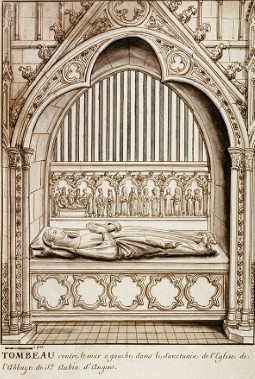 |
The tomb of Adele of Meaux in the abbey
of Saint Aubin, in Angers,
France
The illustration is noted "TOMBEAU contre le mur a gauche dans le
Sanctuaire de l'Eglise de l'Abbaye de St Aubin d'Angers." which
roughly translates to "TOMB against the wall on the left in the
Sanctuary of the Church of the Abbey of St Aubin d'Angers."
|
in the abbey
of Saint Aubin, in Angers,
France
Adelaide de Vermandois
Heribert IV
Adele
of Valois
Hugh
de Vermandois
Renaud
II, Count of Clermont-en-Beauvaisis
Renaud was the son of Hugh II de Creil and Marguerite de Ramerupt. He was a
crusader in the army of Adelaide's first husband, Hugh. After Adelaide's
death. Renaud married Clemence de Bar, widow of the count of Dammartin.
Countess of Vermandois, in her
own right
Adelaide succeeded to Vermandois as a result of the disinheritance of her
brother Odo, and on her father's death, her husband, Hugh, became count of
Vermandois in right of Adelaide.
Adelaide was the last ruler of the Carolingian line of Vermandois and a
pivotal figure in the transition of power to the Capetian dynasty. As a
sovereign countess, she navigated the turbulent politics of the First
Crusade and managed the transition of her county from the ancient line of
Charlemagne to the sons of the king of France.
Adelaide was the daughter of Herbert IV, count of Vermandois. When her
father died in 1080, the county should have passed to her brother, Odo the
Insane. However, Odo was disinherited by the council of barons due to his
mental instability. To secure her position, Adelaide married Hugh the Great,
the younger son of king Henry I of France and Anne of Kiev. This marriage
effectively merged the last Carolingian stronghold with the rising Capetian
royal house.
Adelaide’s life was deeply affected by the First Crusade. Her
husband, Hugh, was one of the primary leaders of the expedition. During
Hugh’s long absences in the East (1096–1098 and 1101), Adelaide ruled
Vermandois and Valois as a sovereign countess. She managed the local
economy, resolved legal disputes (as seen in the charters below), and
maintained the defense of her territories. After Hugh died in Tarsus in
1101, Adelaide continued to rule alongside her eldest son, Raoul. In 1103,
Adelaide married Renaud II, count of Clermont. This second marriage created
friction with her son Raoul, who was reaching his majority and wished to
rule the paternal inheritance of Vermandois alone. Despite these internal
family dynamics, Adelaide remained an active political actor, often
appearing in charters to validate the donations and legal decisions of her
sons.
In the first of these two charters created by Adelaide, dated 1114, she
names her sons, Raoul, Henry, and Simon. If William is correctly also her
son, he presumably died before 1114.
Cartulaire de l'Abbaye de Saint-Corneille de
Compiègne vol 1 pp70-2 (ed. E. Morel, 1904)
XXXIV
Adela comitissa Viromandensis, de quibusdam hominibus nostris
manumissis.
EGO, Adela, Dei gratia Viromandorum comitissa, filius
quoque meus Radulphus, universis sancte Dei ecclesie filiis, salutem
et pacem bonam. Ad removendam oblivionis nubem, ad reprimendam veri
cum falso, falsi cum vero confusionem, appertioribus veterum gestorum
testimoniis uti non possumus, quam his que apicibus litterarum
insigniuntur. Proptereaque, ne, supervenientibus novis, oblivioni
tradatur, factam inter nos et sancte Compendiensis ecclesie canonicos
cujusdam calumnie disceptationem describi voluimus. Ego siquidem Adela
predicta, comitissa, et filius meus Radulphus, comes, Olrici uxorem
filiosque ejus et filias calumniabamur et ad famulatum nostrum servili
conditione eos usurpare nitebamur; ad quod canonici supranominate
Compendiensis ecclesie, ex adverso insurgentes, murumque justitie pro
familia ecclesie opponentes, nunc precibus, nunc nos ad causam
vocando, resistebant, et quos longo temporis intervallo ecclesia
singulari dominatu quiete possidebat ita usurpari non licere verbis
astruebant; sicque diu lite protracta, tandemque familiari
investigatione luce veritatis reperta, ego mater confessa sum me
oberrasse, et voluntate et assensu filiorum meorum, Radulphi, Henrici,
Symonis simulque consilio meorum magnatum, Roberti de Tornella, Ade
qui Rabies dicitur, Vuenrici castellani, multorumque aliorum
prescriptam calumniam plane et ex toto dimisi; et quia injuste
ecclesiam inquietaveram, dato in manu prepositi ecclesie Odonis
scilicet emendationis vadimonio, culpam emendavi. Insuper Olricum
patrem, Falcardum ejus fratrem, omnino manu missos, plane ecclesie in
perpetuum habendos dedimus et concessimus. Et ut hoc donum et doni
concessio rata et inconvulsa sine contradictione vel aliqua
retractatione permanerent, omnium predictorum assertores et tutores
nos futuros esse contra omnem usurpatorem, fide data, promisimus et
impressione autentica nostri sigilli corroborari curavimus. Hujus rei
testes sunt: Hildierus, Odo prelibate ecclesie Compend. prepositi
miles, Ibertus de Divione, Odo Brito, Godefridus, Ingelrannus Rabies,
Robertus de Turnella, Adan Rabies, Elinandus, Vuernerus multique alii
cujuscumque conditionis, Radulphus Dalphinus Iberti frater. Actum
Montisderii consulari thalamo, anno Dominice Incarnationis millesimo
centesimo quartodecimo, indictione septima, anno consecrationis regis
Ludovici sexto.
…
XXXV
De altaribus Metivillaris, Faverolis, Prunastri, concessis.
IN nomine sancte et individue Trinitatis, Patris et
Filii et Spiritus sancti. Amen. Ego Adela, Viromandensis comitissa,
filiique mei, videlicet Radulphus comes, atque Henricus, universis
sancte Dei ecclesie cultoribus, tam futuris quam et presentibus,
certum fieri volumus, quia Helinandus, miles, dignitatis nostre
presentiam adiit, humiliter obsecrans, quatinus tria altaria que sunt
apud Mesvillare et Faverolas et Pronastrum, que pro sua suique filii
Sagalonis anima et sue uxoris sancte Dei Compendiensi ecclesie
concesserat, et nos pariter, a quorum descendebant beneficio, eidem
ecclesie concederemus. Illius igitur petitioni, quia nobis multum bene
placuit, benigne condescendentes, predicta altaria jam ab illo
Helinando ditioni nostre resignata, ea lege ut ei adquiesceremus, pro
anima mariti mei, Hugonis comitis, et mea, pro animabus etiam filiorum
meorum, scilicet Radulphi comitis et Henrici, sepenominate
Compendiensi ecclesie, quemadmodum a nobis petierat, ipso etiam
Helinando, quantum in ipso erat, concedente, quicquid nostrum erat et
ad nos pertinebat, integre et liberrime in perpetuo habendum, ego et
filii, scilicet Radulfus, comes, atque Henricus, dedimus et firmiter
concessimus; et ut in posterum absque contradictione seu qualibet
retractatione habeat, teneat et possideat, fide nostra interposita,
quatinus hujus largitionis semper erimus auctores et contra omnium
usurpatorum violentiam defensores, memoriales litteras fieri
precepimus, et eas nostrarum signis personarum suffultas, auctoritate
et sigilli nostri impressione corroboravimus. Hujus autem veritatis
testimonium perhibentes affuerunt:
Signum Radulphi, S. comitisse, S. Henrici, signum Ermentrudis,
uxoris Helinandi. Clerici: Odo decanus, Johannes cantor, Ivo, alius
Ivo, Odardus, Hildierus, Milo, Gunduinus, Drogo, Eugubrandus, Symon
filius comitisse, Radulfus. Actum, anno Incarnationis Dominice Mo
Co XIIIIo, indictione septima, anno vero
consecrationis regis Ludovici sexto. Milites: Ibertus, Robertus,
Lisiardus, Gaufridus, Symon, Adam, Drogo, Fulco, Odo, Godefridus,
Ingelrannus, Werno, Baidelo, Rogerus, Richardus, Wenricus de Roia,
Radulfus, Paganus, Wido.
This roughly translates as:
XXXIV
Adela countess of Vermandois, concerning certain of our men
having been manumitted.
I, Adela, by the grace of God countess of the Vermandois, and also my
son Raoul, to all the sons of the holy church of God, good health and
peace. To remove the cloud of forgetfulness, and to repress the
confusion of truth with falsehood and falsehood with truth, we cannot
use clearer testimonies of old deeds than those which are distinguished
by the strokes of letters. And therefore, lest it be handed over to
oblivion by new events supervening, we wished to have written down the
dispute of a certain claim made between us and the canons of the holy
church of Compiègne. Indeed I, the aforesaid Adela, countess, and my son
Raoul, count, were claiming the wife of Olric and his sons and
daughters, and we were striving to usurp them into our servitude under a
servile condition; against which the aforementioned canons of the church
of Compiègne, rising up in opposition, and setting up a wall of justice
for the family of the church, were resisting, now by prayers, now by
calling us to a legal case, and they were affirming with words that it
was not permitted to thus usurp those whom the church had quietly
possessed by singular lordship for a long interval of time. And thus the
dispute having been protracted for a long time, and at last the light of
truth having been found through familiar investigation, I, the mother,
confessed that I had erred, and with the will and assent of my sons,
Raoul, Henry, and Simon, and at the same time with the counsel of my
magnates, Robert of Tournelle, Adam who is called Rabies [the Mad],
Wenric the castellan, and many others, I plainly and entirely dismissed
the aforewritten claim; and because I had unjustly disturbed the church,
having given a pledge of emendation into the hand of the provost of the
church, namely Odo, I made amends for the fault. Moreover, we have given
and conceded Olric the father, and Falcard his brother, entirely
manumitted, to be had by the church plainly in perpetuity. And so that
this gift and the concession of the gift might remain valid and unshaken
without contradiction or any retraction, we have promised, faith having
been given, that we would be the future assertors and protectors of all
the aforesaid against every usurper, and we took care to have it
corroborated by the authentic impression of our seal. The witnesses of
this matter are: Hildier; Odo the knight of the provost of the
aforementioned church of Compiègne; Ibert of Dijon; Odo the Breton;
Godfrey; Enguerrand Rabies; Robert of Tournelle; Adam Rabies; Elinand;
Werner; and many others of whatever condition; [and] Raoul the Dauphin,
brother of Ibert. Enacted in the consular chamber [hall of the count] of
Montdidier, in the year of the Lord's Incarnation one thousand one
hundred and fourteen, the seventh indiction, in the sixth year of the
consecration of king Louis.
…
XXXV
Concerning the conceded altars of Mévillers, Faverolles,
[and] Prunoy.
In the name of the holy and undivided Trinity, Father and Son and Holy
Spirit. Amen. I, Adela, countess of the Vermandois, and my sons, namely
Raoul, count, and also Henry, wish it to be made certain to all
cultivators of the holy church of God, both future and present, that
Helinand, a knight, approached the presence of our dignity, humbly
beseeching that we likewise might concede to the holy church of God at
Compiègne the three altars which are at Mévillers and Faverolles and
Prunoy, which he had conceded for the soul of himself and of his son
Sagalo and of his wife; [altars] which were held as a benefit from us.
Therefore, kindly condescending to his petition because it was very
pleasing to us, we—the aforesaid altars having already been resigned
into our power by that Helinand on the condition that we would acquiesce
to him—for the soul of my husband, Hugh the count, and my own, [and]
also for the souls of my sons, namely Raoul the count and Henry, have
given and firmly conceded to the often-named church of Compiègne, just
as he had asked of us, and with Helinand himself conceding as much as
was in his power, whatever was ours and pertained to us, to be held in
its entirety and most freely in perpetuity. And so that [the church] may
have, hold, and possess it in the future without contradiction or any
retraction, our faith having been pledged that we shall always be the
authors of this bounty and defenders against the violence of all
usurpers, we have ordered memorial letters to be made, and having
supported them with the signs of our persons, we have corroborated them
by the authority and impression of our seal. Moreover, those present as
witnesses of this truth were:
The sign of Raoul; [Sign] of the countess; [Sign] of Henry; the
sign of Ermentrude, wife of Helinand. Clerics: Odo the dean, John the
cantor, Ivo, another Ivo, Odard, Hildier, Milo, Gunduin, Drogo,
Eugubrand, Simon the son of the countess, Raoul. Enacted in the year of
the Lord’s Incarnation 1114, the seventh indiction, in the sixth year of
the consecration of king Louis. Knights: Ibert, Robert, Lisiard,
Godfrey, Simon, Adam, Drogo, Fulk, Odo, Godfrey, Enguerrand, Werner,
Baidelo, Roger, Richard, Wenric of Roye, Raoul, Payne, Guy.
Genealogiae
Scriptoris Fusniacensis in Monumenta
Germaniæ Historica SS 13 p253 (1881)
7. Nunc ad Hugonem Magnum revertamur. Hugo cognomento Magnus, frater
Philippi regis Francorum, de Adelaide comitissa Veromandensium genuit
Radulfum comitem Veromandie et Henricum de Chauni et Simonem episcopum
Noviomensem et filias. De quarum una Bonefacius marchio genuit
Bonefacium archidiaconum Noviomensem et filios et filias; quarum una
nupsit Guilelmo de Monte-pessulano. Secunda filia Hugonis Magni ex
Radulfo de Baugenci peperit Simonem eiusdem loci principem. Tercia
filia ex Ioifrido de Firmitate-Galceri genuit uxorem Simonis de
Oisiaco. Quarta filia nupsit comiti de Meslent, cui peperit filios,
quorum unus successit patri in comitatu, alter vero comitatem tenuit
de Cirecestre.
This roughly translates as:
7. Now
let us return to Hugh the Great. Hugh, surnamed the Great, brother of
Philip, king of the Franks, begat by Adelaide, countess of the
Vermandois: Ralph, count of Vermandois; Henry of Chauny; Simon, Bishop
of Noyon; and several daughters. From one of these daughters, Boniface
the marquess begat Boniface, archdeacon of Noyon, as well as other sons
and daughters; one of these daughters married William of Montpellier.
The second daughter of Hugh the Great, by Ralph of Beaugency, gave birth
to Simon, lord of that same place. The third daughter, by Geoffrey of La
Ferté-Gaucher, begat the wife of Simon of Oisy. The fourth daughter
[Isabel] married the count of Meulan, to whom she bore sons: one of
these succeeded his father in the county [Meulan], while the other held
the earldom of Leicester (Cirecestre).
De
Genere Comitum Flandrensium, Notae Parisienses in Monumenta
Germaniae Historica SS 13 p257 (1881)
Comes Herbertus3 genuit Odonem et Adelam sororem. Odo fuit
fatuus et indiscretus. Barones Viromandenses rogaverunt regem, ut
Adelam daret Hugoni le Magne, fratri eiusdem regis; quod factum est. …
De predicto comite Hugone et predicta Adela uxore sua exivit comes
Radulfus, Simon Noviomensis episcopus, dominus Henricus de Chaumont et
quatuor filie; de quibus quidam marchıo Lumbardie4 unam
habuit, secundam5 dominus Baugenciaci6, tertiam7
comes Mellenti8, quartam comes Garentie9. Hugone
autem comite mortuo, comes de Claro-monte10 duxit Adelam
comitissam in uxorem et ex ea unam filliam11 habuit. Comes
siquidem Carolus Flandrie cum illa filia matrimonium contraxit.
3) Viromandensis. 4) Bonifacius. 5) Mathildem. 6) Radulfus. 7)
Elisabeth. 8) Robertus. 9) Guillelmus II. 10) Rainaldus. 11)
Margaretam.
This roughly translates as:
Count
Herbert3 fathered Odo and his sister Adela. Odo was insane
and rash. The barons of Vermandois asked the king to give Adela to Hugh
the Great, the brother of the same king; which was done. … From the
aforesaid count Hugh and his wife Adela came count Ralph, Simon bishop
of Noyen, lord Henry of Chaumont and four daughters; of whom a certain
marquis of Lombardy4 had one, the lord of Baugencia6
the second5, the count of Mellent8 the third7,
the count of Warenne9 the fourth. But when count Hugh died,
the count of Claremont10 took the countess Adela as his wife
and had one daughter11 by her. Count Charles of Flanders
indeed contracted marriage with that daughter.
3) Vermandois. 4) Boniface. 5) Mathilde. 6) Ralph. 7) Elizabeth. 8)
Robert. 9) William II. 10) Rainald. 11) Margaret.
Mémoires pour l’histoire du Vermandois vol 1
p625 (Louis-Paul Colliette, 1771)
La Comteſſe Adéle de Vermandois obtint le Valois, par l’abdication
volontaire qu’en avoit faite à Hébert IV, Simon, ſon oncle maternel,
lorſqu’il renonça en 1077 au monde, pour ſe renfermer dans le
monaſtere du Mont-Jura. Elle eut encore du même Simon le comté
d’Amiens, dont elle dépoſſéda les Sires de Coucy, & qu’elle céda,
après la mort du Comte ſon pere, à une fille appellée Marguerite,
qu’elle eut dans un ſecond mariage avec Regnault, comte de Clermont
& d’Auvergne.
This roughly translates as:
Countess
Adèle de Vermandois acquired the Valois through the voluntary abdication
of it made to Herbert IV by Simon, her maternal uncle, when he renounced
the world in 1077 to seclude himself within the monastery of Mont-Jura.
From the same Simon, she also received the County of Amiens, of which
she dispossessed the Lords of Coucy, and which she ceded, after the
death of her father the Count, to a daughter named Marguerite, whom she
bore during her second marriage to Regnault, count of Clermont and
Auvergne.
The Encyclopaedia Britannica 11th edition vol
27 p1024 (ed. Hugh Chisholm, 1911)
VERMANDOIS.
… In 1077 the last male of the first house of Vermandois, Herbert IV.,
received the countship of Valois in right of his wife. He died soon
afterwards, leaving his inheritance to his daughter Adela, whose first
husband was Hugh the Great, the brother of king Philip I. Hugh was one
of the leaders of the first crusade, and died in 1102 at Tarsus in
Cilicia. The eldest son of Hugh and Adela was count Raoul (Rudolph) I. (c.
1120-1152), who married Alix of Guyenne, sister of the queen, Eleanor,
and had by her three children: Raoul (Rudolph) II., the Leper (count
from 1152-67); Isabelle, who possessed from 1167 to 1183 the countships
of Vermandois, Valois and Amiens conjointly with her husband, Philip of
Alsace, count of Flanders; and Eleanor.
The Complete Peerage vol 12 part 1 p496
(George Edward Cokayne, enlarged by Geoffrey H. White, 1953)
Hugh DE
CRÉPI (styled “the Great”), COUNT OF VERMANDOIS(d)
(yr. s. of HENRY I, KING OF FRANCE),
by Adelaide, da. and h. of Herbert, COUNT OF VERMANDOIS
and VALOIS.
(d) Orderic, vol. iii, p. 362.
28 September, probably in 1120
Canonicus secularis et regularis p271
(Joannem Couterot, 1674)
inter
quas inſignis eſt illa Viromandis Eccleſiæ, quam San-Quintinianis
dederat Adela Comitiſſa Viromandenſis, ut colligitur ex Obituario
illius Eccleſiæ 4. Kal. Oƈtob.
This roughly translates as:
Among which is
notable that of the Church of Vermandois, which Adela, Countess of
Vermandois, had given to the San Quintinians, as is gathered from the
Obituary of that Church on the 4th day before Kalends of October [28
September].
- De Genere Comitum Flandrensium, Notae Parisienses
in Monumenta Germaniae Historica SS 13
p257 (1881); The Encyclopaedia Britannica 11th edition vol
27 p1024 (ed. Hugh Chisholm, 1911); The Complete Peerage vol 12 part 1 p496
(George Edward Cokayne, enlarged by Geoffrey H. White, 1953); wikipedia
(Adelaide, Countess of Vermandois)
- wikipedia
(Adelaide, Countess of Vermandois)
- Genealogiae Scriptoris Fusniacensis in Monumenta Germaniæ Historica SS 13 p253
(1881); De Genere Comitum Flandrensium, Notae Parisienses
in Monumenta Germaniae Historica SS 13
p257 (1881); The Encyclopaedia Britannica 11th edition vol
27 p1024 (ed. Hugh Chisholm, 1911); Medieval
Lands (HUGUES de France); wikipedia
(Hugh, Count of Vermandois)
- Cartulaire de l'Abbaye de Saint-Corneille de
Compiègne vol 1 p71 (ed. E. Morel, 1904); Genealogiae Scriptoris Fusniacensis in Monumenta Germaniæ Historica SS 13 p253
(1881); De Genere Comitum Flandrensium, Notae Parisienses
in Monumenta Germaniae Historica SS 13
p257 (1881); The Encyclopaedia Britannica 11th edition vol
27 p1024 (ed. Hugh Chisholm, 1911); Medieval
Lands (HUGUES de France); wikipedia
(Hugh, Count of Vermandois)
- De Genere Comitum Flandrensium, Notae Parisienses
in Monumenta Germaniae Historica SS 13
p257 (1881); Mémoires pour l’histoire du Vermandois vol
1 p625 (Louis-Paul Colliette, 1771); Medieval
Lands (ADELAIS de Vermandois); wikipedia
(Adelaide, Countess of Vermandois); Renaud details from Medieval
Lands (RENAUD [III] de Clermont) and wikipedia
(Renaud II, Count of Clermont-en-Beauvaisis)
- De Genere Comitum Flandrensium, Notae Parisienses
in Monumenta Germaniae Historica SS 13
p257 (1881); Mémoires pour l’histoire du Vermandois vol
1 p625 (Louis-Paul Colliette, 1771); Medieval
Lands (RENAUD [III] de Clermont); wikipedia
(Adelaide, Countess of Vermandois)
- wikipedia
(Adelaide, Countess of Vermandois)
- Cartulaire de l'Abbaye de Saint-Corneille de
Compiègne vol 1 pp70-2 (ed. E. Morel, 1904); Genealogiae Scriptoris Fusniacensis in Monumenta Germaniæ Historica SS 13 p253
(1881); De Genere Comitum Flandrensium, Notae Parisienses
in Monumenta Germaniae Historica SS 13
p257 (1881); Mémoires pour l’histoire du Vermandois vol
1 p625 (Louis-Paul Colliette, 1771); Medieval
Lands (ADELAIS de Vermandois); wikipedia
(Adelaide, Countess of Vermandois)
- Canonicus secularis et regularis p271
(Joannem Couterot, 1674) citing the necrology of San Quentin; probable
year from wikipedia
(Adelaide, Countess of Vermandois)
Ermengarde
Heribert III
- Adalbert II
- Othon ( ? - 1045)
- Guy
Ermengarde witnessed this charter, created by Heribert III, likely in 987 or
988. The charter is also witnessed by their son, Heribert.
Augusta Viromanduorum regestum veterum charta pp33-34
(Claude Hémeré, 1643)
Heriberti 3. Comitis Viroman. gratam habentis eleemoſynam Arpardi
& Frideburgis collatam in Humolarienſ. viuente adhuc
Alberto. Ex archiuis eorumdem.
IN nom. S. & indiuid. Trinitatis P. & F. & & Sp. S.
Ego HERIBERTVS gratia Dei, teſtis Chriſti Quintini
Monaſterii Abbas, & Comes dictus … ſ. Adalberti Comitis manu
ipſius faƈtum. ſ. Heriberti filii eius. ſ. Ermengardis vxoris eius. ſ.
Odonis nepotis …
This roughly translates as:
Heribert 3.
Count of Vermandois. having grateful alms of Arpard and Frideburg in
Humolarie. Albert still living. From the archives of the same.
In the name of the holy and indivisible Trinity, of the Father and of
the Son and of the Holy Spirit. I, Heribert, by the grace of God,
witness of Christ, abbot and count of the monastery of Quentin, said. …
Sign of Count Adalbert made by his own hand. Sign of Heribert his son.
Sign of Ermengarde his wife. Sign of Odo his nephew.
Augusta Viromanduorum pp104-105 (Claude
Hémeré, 1643)
HERIBERTVS3. Alberto ſucceſſit in Comitatum
Viromanduor. regimenque Monaſterij San-quintinienſis, pietatem &
ipſe imitatus patris: qui & ſacras ædes beneficiis cumulatiſſime
ditauerit, & in vicina cœnobia ſæpe ſeceſſerit præſertim vero in
Humolarienſe, quo animum ab omni rerum terrenarum tumultu liberiorem
orationi intenderet. vt eſt in eius charta. Vxorem Ermengardem
naƈtus eſt, qui fuit cumulus domeſticæ felicitatis, ingenii ſibi,
naturæq; conſonantis: cuius largæ & munificæ eleemoſynæ cum in
Viromandiæ Monachos, vt leges in chartis Othonis. Tum etiam in
Baſilicam maiorem San-quintini extiterunt: de quibus Noſtri in veteri
Martyrol. ad 9. Maij. Eodem die obyt ERMENGARDIS
Comitiſſa, qua dedit Eccleſia Couſtauillam. donauit eidem quoq;
Eccleſiæ Heribertus Cinceniæum prædium. Regeſti pag. 25.
& Stabulas. ad diera 30. Auguſti eiuſdem Necrologii.
This roughly translates as:
HERIBERTUS
3 succeeded Albert to the County of Vermandois and the government of the
Monastery of Saint Quentin, imitating the piety of his father: who also
enriched the sacred house with benefactions in abundance, and in the
neighboring monastery he often went to Humolariense, in order to free
his mind from all the turmoil of earthly things and to concentrate on
prayer. as is in his charter. He had a wife Ermengarde, who was
the sum of domestic happiness, wit, and nature; consonant: whose large
and generous alms were given to the Monks of Veromandois, as is the law
in the charters of Otto. Then also the greater Basilica of Saint
Quentin arose: of whom Our Lord in the old Martyrology on 9 May. On
the same day dies ERMENGARDE, Countess, who
gave Coutauilla to the Church. Heribert also gave to the same
Church the estate of Cinceniæ. Regestrum page 25. & Stabulas.
on the 30th of August, the same Obituary.
Mémoires pour l’histoire du Vermandois vol 1
p547 (Louis-Paul Colliette, 1771)
Hébert III … épouſé Hermengarde. Cette digne Comteſſe mit le comble au
bonheur d’Hébert. Avec une haute naiſſance & de grands biens
qu’elle fit entrer dans la maiſon de ſon mari, elle lui apporta encore
une ſympathie d’humeur & de tempérament la plus parfaite. Leurs
liens, formés par le Ciel, donnerent aux deux époux des jours
tranquilles & heureux.
This roughly translates as:
Hébert
III married Hermengarde. This worthy Countess crowned Hébert’s
happiness. Possessing both noble lineage and substantial wealth, which
she brought into her husband’s house, she further endowed him with a
perfect harmony of temperament and disposition. Their bonds, forged in
Heaven, granted the couple days of tranquility and happiness.
p558
Othon étoit le ſecond des trois enfans d’Hébert III &
d’Hermengarde; leur troiſieme fut Gui. Nous croyons, contre le
ſentiment d’un historien de Soiſſons, qu’on doit l’attribuer à Hébert
III, plutôt qu’à Albert Ier. … Albert IIe du
nom, qui ſuccéda immédiatement à ſon pere Hébert III, étoit donc le
premier de ſes enfans. Hébert III mourut le vingt-neuvieme jour du
mois d’Août, felon l’ancien nécrologe de ſaint Quentin. C’étoit sans
doute en l’année 1014, au plus tard; car il eſt conſtant par la charte
(27) qu’Albert II accorda le premier de Février de l’an 1015, en
faveur de l’abbaye de ſaint Prix, que ce dernier Comte gouvernoit déjà
le Vermandois. La Comteſſe Hermengarde ne mourut qu’après l’an 1035.
Nous la voyons encore ſous-ſignée dans une charte qu’on rapportera
ſous cette année-là. Le même nécrologe de l’église de ſaint Quentin
place ſon décès au neuvieme jour de Mai. . . . . Eâdem die (IX
Maii) obiit Hermengardis Comitiſſa quæ dedit eccleſiæ Couſtavillam.
This roughly translates as:
Otho was
the second of the three children of Herbert III and Ermengarde; their
third child was Guy. Contrary to the opinion of a historian from
Soissons, we believe that he should be attributed to Herbert III rather
than to Albert I. … Albert II, the second of that name, who immediately
succeeded his father Herbert III, was therefore the eldest of his
children. Herbert III died on the twenty-ninth day of August, according
to the ancient necrology of Saint-Quentin. This occurred undoubtedly in
the year 1014, at the very latest; for it is established by the charter
(27) which Albert II granted on the first of February, 1015, in favor of
the Abbey of Saint-Prix, that the latter Count was already governing
Vermandois. Countess Ermengarde did not die until after the year 1035.
We find her name still affixed to a charter that will be cited under
that specific year. The same necrology of the Church of Saint-Quentin
places her death on the ninth day of May. . . . . On the same day
(May 9th), Countess Ermengarde died; she was the one who gave
Coustaville to the Church.
9 May, after the year 1035
- Augusta Viromanduorum regestum veterum charta p34
(Claude Hémeré, 1643); Mémoires pour l’histoire du Vermandois vol
1 pp547-548 (Louis-Paul Colliette, 1771); Histoire généalogique de la maison royale de
France vol 1 p50 (Anselme de Sainte-Marie, 1726); Mémoires pour l’histoire du Vermandois vol
1 p547 (Louis-Paul Colliette, 1771); Medieval
Lands (HERIBERT [IV]); wikipedia
(Herbert III, Count of Vermandois)
- Histoire généalogique de la maison royale de
France vol 1 pp50-51 (Anselme de Sainte-Marie,
1726); Mémoires pour l’histoire du Vermandois vol
1 p558 (Louis-Paul Colliette, 1771); wikipedia
(Herbert III, Count of Vermandois)
- Augusta Viromanduorum pp104-105
(Claude Hémeré, 1643); Augusta Viromanduorum regestum veterum charta pp33-34
(Claude Hémeré, 1643); Mémoires pour l’histoire du Vermandois vol
1 pp547 p558
(Louis-Paul Colliette, 1771); Medieval
Lands (ERMENGARDIS)
- Augusta Viromanduorum pp104-105
(Claude Hémeré, 1643); Mémoires pour l’histoire du Vermandois vol
1 p558
(Louis-Paul Colliette, 1771) citing the necrology of Saint Quentin
Heribert I
Pepin of
Vermandois
Count of Vermandois
and lay-abbot of Saint-Quentin,
succeeding his father in the 890's, and count of Soissons
In 877, Herbert and his brother Pépin were among those sent by emperor
Charles the Bald to prepare for a meeting between the pope and emperor.
Annales Bertiniani p136 (1883)
[877]
Nunciavit etiam inter alia isdem Adalgarius imperatori, quoniam
Iohannes papa obviam illi Papiam veniret. Quapropter praemisit Odacrum
secundi scrinii notarium, Goiramnum comitem et Pippinum atque
Heribertum1, ad procuranda ipsius papae servitia.
1) Filii Pippini supra a. 834, p. 9. memorati, nepotes Bernhardi regis
Italiae.
This roughly translates as:
[877] Among
other things, Adalgius also reported to the emperor that pope John was
coming to meet him at Papias. Therefore, he sent ahead Odacrum, the
notary of the second cabinet, count Goiramn, and Pepin and Heribert1,
to procure the services of the pope himself.
1) The sons of Pepin, mentioned above in a. 834, p. 9., were grandsons
of Bernard, king of Italy.
Heribert and Pépin were with Charles the Simple at his coronation in 893.
Regionis
Chronicon in Monumenta Germaniæ
Historica SS 1 p605 (ed. G. H. Pertz, 1826)
892. … Odone rege in Aquitania commorante, Francorum principes ex
permaxima parte ab eo deficiunt, et agnetibus Folcone episcopo,
Heriberto4 et Pippino comitibus, in Remorum civitate
Carolus filius Hludowici, ex Adalheide regina, ut supra meminimus,
natus, in regnum elevatur.5
4) Heribertus et Pippinus nepotes Bernardi, regis Italiae, fuerunt. 5)
Carolus rex coronatus est die 28. mensis Ianuarii anni 893. Non
advertit Regino auctorum a quo haec exscripsit (?) annum inchoare a
paschate. BOUQUET.
This roughly translates as:
892. …
While king Odo was residing in Aquitaine, the Frankish princes for the
most part defected from him, and with the help of bishop Falco, counts
Heribert4 and Pippin, Charles, the son of Louis, born of
queen Adalhide, as we have mentioned above, was raised to the kingdom in
the city of Reims.5
4) Heribert and Pippin were grandsons of Bernard, King of Italy. 5) King
Charles was crowned on the 28th of January in the year 893. The author
from whom he copied this (?) does not note that the year begins at
Easter. BOUQUET.
In 896, Heribert killed Raoul, brother of count
Baldwin II, who had been expelled earlier that year from the countship
of Vermandois
Annales Vedastini pp77-78 (ed. B. de
Simson, 1909)
Anno Domini DCCCXCVI. Odo rex in Francia biemavit, Karolus vero rex
supra Mosellam. Exhinc hi qui cum Karolo erant Balduinum infestum
habuere, et ubique depraedationes agebantur ab eis. Nam omnia castella
tulerat eis Odo rex, excepto Remis. Igitur per varia placita totus hic
annus pertransiit. Odo rex placitum cum suis fidelibus habuit, volens
partem regni, quam eius fideles tenuerant, Karolo concedere. Sed
Rodulfus comes omne illud placitum disrupit; unde Heribertus et
Herkengerus, omnibus iam perditis, contulerunt se ad regem Odonem,
paucique relicti sunt cum Karolo. Post haec Odo rex castrum Sancti
Quintini et Perronam obsedit hominesque Rodulfi inde eiecit. Fulcho'
vero archiepiscopus, qui adhuc favebat partibus Karoli, circumventus a
fidelibus Odonis et, licet invitus, venit ad regem et de omnibus quae
ei rex iussit satis illi fecit. Karolus vero hoc audito secessit in
regnum Zuendebolchi.
Ac per idem tempus iterum Nortmanni cum duce Hundeo nomine et
quinque barchis iterum Sequanam ingressi; et dum rex ad alia intendit,
magnum sibi et regno malum accrescere fecit. Rodulfus vero in ira
commotus propter castella perdita, dum depraedari non cessat abbatiam
sancti Quintini, ab Heriberto in bello occiditur.
This roughly translates as:
In the
year of our Lord 896. King Odo reigned in France, but Charles reigned
over the Moselle. From then on those who were with Charles held Baldwin
in hostility, and everywhere they were plundered by them. For king Odo
had taken all the castles from them, except Reims. Therefore this whole
year passed by various pleas. King Odo held a plea with his faithful,
wishing to concede the part of the kingdom which his faithful had held
to Charles. But count Rudolf broke up all that plea; whereupon Heribert
and Herkenger, all now lost, went to king Odo, and a few were left with
Charles. After this king Odo besieged the castle of Saint-Quentin and
Perron and drove Rudolf's men out of there. But Archbishop Fulk, who
still favored the parties of Charles, was surrounded by the faithful of
Odo and, although unwillingly, came to the king and satisfied him with
all that the king had ordered him to do. Charles, however, having heard
this, retired to the kingdom of Zwendebolch.
And at the same time the Northmen, with a leader named Hundeus
and five ships, again entered the Seine; and while the king was intent
on other things, he caused great evil to increase for himself and his
kingdom. But Rodolph, moved with anger because of the lost castles,
while he did not cease to plunder the abbey of St. Quintin, was killed
in battle by Heribert.
La France dans sa splendeur vol 2 pp15-16
(Pierre Louvet, 1674)
Herbert I. du nom, Seigneur de Peronne & de S. Quentin en
Vermandois, ſuivit premierement la fortune & le party du Roy
Charles le Simple, contre les Princes de la Maiſon d’Anjou Ducs de
France, puis ſe rangea de leur côté lors que Eudes Comte de Paris ſe
fit declarer Roy. Il fut tué en ſuite par les artifices du Comte de
Flandres; l’an 902. en haïne de ce qu’il avoit tué ſon frere Raoul,
Comte de Cambray.
This roughly translates as:
Herbert I, the
first of that name, Lord of Péronne and Saint-Quentin in Vermandois,
initially followed the fortunes and cause of King Charles the Simple
against the Princes of the House of Anjou (Dukes of France), but
subsequently sided with them when Odo, Count of Paris, had himself
declared King. He was subsequently killed through the machinations of
the Count of Flanders in the year 902, out of vengeance for having slain
the Count's brother, Raoul, Count of Cambrai.
Mémoires pour l’histoire du Vermandois vol 1
p399 (Louis-Paul Colliette, 1771)
TOUT
favoriſoit à faire paſſer ſur la tête d’Hébert Ier, le
comté de Vermandois & la puiſſance de Pépin, après ſa mort. Depuis
pluſieurs années, ce Pere, en prudent politique, l’avoit aſſocié à ſon
gouvernement. Hébert étoit donc connu des peuples & des grands
vaſſaux du Vermandois, & faiſi déjà de l’autorité comme d’une
ſucceſſion avitine. Qui eût penſé à l’en dépoſſéder, ou l’eût ofé
faire? Charles-le-Chauve & les Rois ſubſéquens pouvoient
d’ailleurs avoir conſenti au duumvirat & à l’hérédité dans la
maiſon de Pépin.
This roughly translates as:
Everything conspired to ensure that, upon his death, the county of
Vermandois, along with the power wielded by Pepin, would pass to his
son, Herbert I. For several years prior, the father, acting as a prudent
statesman, had associated him with his own governance. Herbert was,
therefore, well known to the populace and the great vassals of
Vermandois, and had already taken hold of authority as if it were an
ancestral inheritance. Who would have thought to dispossess him of it,
or who would have dared to do so? Moreover, Charles the Bald and the
kings who succeeded him may well have consented to this dual rule and to
the principle of hereditary succession within the House of Pepin.
pp407-408
Hébert Ier fut Comte de Vermandois & Abbé de l’égliſe
de ſaint Quentin. Avoir poſſédé l’une dignité, c’étoit avoir obtenu
l’autre; elles reſterent inſéparables pendant pluſieurs ſiécles. Ce
Prince paroît avoir été d’abord un Seigneur religieux & ami de la
paix. Dès qu’il fut à la tête de ſon gouvernement, & qu’il eut
commencé à conduire ſeul le comté de Vermandois, il s’appliqua
ſérieuſement à la bonne adminiſtration de l’égliſe de ſaint Quentin.
Il fit reconſtruire un lieu propre à renfermer les corps des deux
ſaints Patrons de cette baſilique. Notre province étoit alors
tranquille de la part des Normands; & le feu de la guerre qui
venoit de dévaſter les pays de Reims, de Laon & du Vermandois,
avoit été porté, dès le mois de Mai 893, en Bourgogne par le Roi
Eudes, qui y étoit allé attaquer Charles, le fils de Louis le
Begue. L’ouvrage d’Hébert Ier fut terminé en cette
année; c’étoit la ſeptieme depuis qu’on l’avoit commencé. On ſe
rappelle ici que la belle égliſe bâtie par Fulrade, avoit été
totalement incendiée par les Normands, dix ans auparavant: il n’en
étoit reſté que quelques édifices dont on a parlé plus haut, & les
murs du temple incendié; dans l’enceinte deſquels on avoit dépoſé les
reliques des deux Saints. Hébert avoit donc achevé d’en faire
redreſſer les débris, & avoit bâti ſur les fondemens anciens, qui
n’étoient pas heureuſement calcinés, une égliſe décente. Il ne pouvoit
commencer ſa régence ſous des auſpices plus louables.
This roughly translates as:
Herbert
I was Count of Vermandois and Abbot of the Church of Saint-Quentin. To
have held the one dignity was to have obtained the other; they remained
inseparable for several centuries. This Prince appears to have been,
initially, a pious lord and a lover of peace. As soon as he stood at the
head of his government, and had begun to rule the county of Vermandois
single-handedly, he applied himself earnestly to the proper
administration of the church of Saint-Quentin. He commissioned the
reconstruction of a fitting shrine to house the bodies of the two patron
saints of that basilica. Our province was, at that time, free from the
threat of the Normans; indeed, the fires of war, which had just
devastated the lands of Reims, Laon, and Vermandois, had been carried
into Burgundy as early as May 893 by king Odo, who had gone there to
attack Charles, the son of Louis the Stammerer. Herbert I’s undertaking
was completed that very year, the seventh since its inception. It is
worth recalling here that the magnificent church built by Fulrad had
been completely consumed by fire at the hands of the Normans ten years
earlier; nothing remained of it save for a few structures mentioned
previously, and the charred walls of the burnt temple, within the
precincts of which the relics of the two Saints had been deposited.
Herbert had, therefore, completed the restoration of the ruins, erecting
a seemly church atop the ancient foundations, which, fortunately, had
not been calcified by the heat. He could not have commenced his regency
under more laudable auspices.
pp409-412
Le Comte de Paris, Eudes, ſe maintenoit ſur le trône de France
depuis neuf ans qu’il y étoit monté. Charles. que l’on a depuis
ſurnommé le Simple, à cauſe de ſon exceſſive bonté, &
des malheurs dans leſquels elle l’a entraîné, ne put enfin ſupporter
que ſon autorité demeurât plus long-temps dans les mains de ſon
ennemi. Il fit entendre ſon droit à toute la France, & ſe forma
de puiſſans partis pour reprendre ſa couronne. Le Comte Hébert
favoriſa les intérêts de ce Prince, & s’en déclara ouvertement
le protecteur.
… Le Comte de Flandre Baudoin II, & Raoul, Comte de Cambrai, ſon
frere, tous deux fils de Baudoin Bras-de-fer, embraſſerent
le même parti. Nous ne voyons pas que cette confédération eut encore
produit aucun heureux effet en faveur de Charles le Simple,
lorſqu Hébert, en abandonnant tacitement la défenſe de ſon
Souverain, & ſe liguant contre lui, ſe rendit coupable du crime
de félonie. Il oſa même conſommer peu après ſa perfidie avec éclat,
en épouſant la fille de Robert II, Comte de Paris, le frere d’Eudes,
& en adoptant ouvertement les ſentimens de ces rebelles.
Cette infidélité devint la ſource d’une haine implacable que
le Comte de Flandre conçut contre celui de Vermandois. Raoul de
Cambrai, frere de ce Seigneur, enleva à Hébert, en l’année 897, (les
annales de ſaint Vaſt diſent en 895) les villes de Péronne & de
Saint-Quentin. Cette derniere place étoit commandée par le fils d’un
nommé Thierry, qu’Hébert y avoit établi Gouverneur. Les Angevins,
qui avoient été précédemment protégés par Hébert, ne purent ſouſſrir
que ſes poſſeſſions fuſſent uſurpées par ſes ennemis. Ils
appellerent les Normands à ſon ſecours. Ces fiers deſcendans de
ceux-mêmes qui avoient auparavant ravagé le Vermandois, firent
bientôt après rentrer dans les mains du Comte les villes qu’on lui
avoit enlevées. Les mêmes annales de ſaint Vaſt diſent que le Roi
Eudes vint faire en perſonne le ſiege des villes de Péronne & de
Saint-Quentin, & qu’il en chaſſa lui - même les troupes de Raoul
de Cambrai. Ce Seigneur voulut tirer vengeance des proteƈteurs
d’Hébert; il s’arma contre les Angevins, & fut tué dans un leger
combat qu’il leur avoit livré. Des auteurs ont écrit qu’il reçut le
coup, qui l’attéra des mains du Comte de Vermandois.
Les heureux ſuccès du Comte de Paris ne pouvoient l’aveugler
ſur les légitimes prétentions de Charles à la couronne des François.
Eudes régnoit depuis dix ans, lorſqu’il remit enfin à ce Prince le
ſceptre qui lui étoit inconteſtablement dû par le droit de ſa
naiſſance. Auſſi-tôt après cette abdication, Charles ſe fit ſacrer
une ſeconde fois à Reims par l’archevêque Foucault: c’étoit en l’an
898. Tous les Seigneurs les plus conſidérables du royaume devoient
ſe rendre préſens à cette céromonie. Le Comte de Flandre cependant,
quoique parent du Roi, ne s’y trouva point. Irrité contre Hébert qui
y aſſiſtoit en perſonne, il refuſa de ſe rencontrer avec l’homicide
de ſon frere Raoul. Robert, Comte de Paris, étoit auſſi venu à
Reims. Il y fut infiniment gracieuſé de Charles qui, trop bon pour
ſe reſſouvenir des outrages qu’il avoit reçus de ſon frere Eudes, ne
s’attacha qu’à le traiter en favori. Les autres Grands du Royaume
firent alors hommages de leurs fiefs au Roi, & lui prêterent
leurs ſermens de fidélité.
… Soit par l’effet d’une politique qui ſe plie aux divers
événemens, ſoit par la crainte du ſupplice qu’il ſçavoit avoir
mérité, ſoit enfin par le repentir de ſa révolte. Hébert s’étoit
retourné vers ſon légitime Souverain. Charles le Simple,
plus bienfaiſant, & peut-être plus mol que vindicatif, l’avoit
reçu en grace. Il le revêtit de nouveau du comté de Péronne.
C’étoit-là le premier titre de Pépin & d’Hébert, ſous lequel on
doit comprendre toutes les poſſeſſions du comté de Vermandois. Ces
faveurs, accordées par le Roi à ſon ancien ennemi, déplurent au
Comte de Flandre, & attiſerent ſa haine contre celui de
Vermandois: elle alloit éclater par de nouveaux excès: on crut
devoir l’éteindre par l’engagement d’Alix, fille du Comte Hébert,
qu’on promit de faire épouſer à Arnoul, le fils du Comte de Flandre.
… Les fiançailles de la fille d’Hébert avec Arnoul, l’héritier
du Comte de Flandre, n’avoient point opéré de changement ſolide dans
les eſprits de cette derniere famille, trop aigrie contre la
premiere. La mort d’un frere tendrement aimé, les villes de Péronne
& de Saint-Quentin entre les mains d’Hébert, la bienveillance
parfaite du Roi Charles, dont ce Seigneur étoit honoré, lorſque lui
Comte de Flandre étoit peu conſidéré de ce Prince ſon parent,
c’étoient aurant de griefs que Baudoin ne pouvoit paſſer à ſon
ennemi. Il réſolut de l’immoler enfin à ſon reſſentiment: il le fit
làchement aſſaſſiner en l’an 902, par un ſatellite nommé Alduin,
qu’il avoit engagé à commettre ce crime.
This roughly translates as:
Eudes,
Count of Paris, had maintained himself upon the throne of France for
the nine years that had passed since his accession. Charles, whom
posterity has since nicknamed the Simple, on account of his
excessive good nature and the misfortunes into which it led him, could
at length no longer endure seeing his authority remain in the hands of
his enemy. He proclaimed his rights throughout France and rallied
powerful factions to his cause in order to reclaim his crown. Count
Herbert championed the interests of this Prince and openly declared
himself his protector.
… Baldwin II, Count of Flanders, and his brother, Raoul, Count of
Cambrai, both sons of Baldwin Bras-de-fer, embraced the same
cause. We find no evidence that this confederation had yet yielded any
favorable results for Charles the Simple when Herbert, by
tacitly abandoning the defense of his Sovereign and conspiring against
him, rendered himself guilty of the crime of felony. Shortly
thereafter, he even dared to consummate his perfidy in a most
conspicuous manner by marrying the daughter of Robert II, Count of
Paris, the brother of Eudes, and by openly adopting the sentiments of
these rebels.
This act of disloyalty became the source of an implacable
hatred that the Count of Flanders conceived against the Count of
Vermandois. Raoul of Cambrai, the brother of the former nobleman,
seized the towns of Péronne and Saint-Quentin from Herbert in the year
897 (though the annals of saint Vaast place the event in 895). This
latter stronghold was under the command of the son of a certain
Thierry, whom Herbert had appointed as its governor. The Angevins, who
had previously been protected by Herbert, could not tolerate seeing
his possessions usurped by his enemies. They called upon the Normans
to come to his aid. These proud descendants of the very men who had
earlier ravaged the Vermandois soon succeeded in restoring to the
Count the towns that had been wrested from him. The same annals of
saint Vaast state that King Odo came in person to lay siege to the
towns of Péronne and Saint-Quentin, and that he himself drove out the
troops of Raoul of Cambrai. This lord sought to exact vengeance upon
Herbert’s protectors; he took up arms against the Angevins and was
killed in a minor skirmish he had fought against them. Some authors
have written that he received the blow that struck him down at the
hands of the Count of Vermandois.
The Count of Paris’s successes, however fortunate, could not
blind him to Charles’s legitimate claims to the crown of the Franks.
Eudes had reigned for ten years when he finally handed over to this
Prince the scepter that was indisputably his by right of birth.
Immediately following this abdication, Charles had himself consecrated
a second time at Reims by archbishop Foucault; this took place in the
year 898. All the most prominent lords of the realm were expected to
attend this ceremony. The Count of Flanders, however, though a kinsman
of the King, did not appear. Incensed at Hébert, who was present in
person, he refused to be in the same company as the slayer of his
brother, Raoul. Robert, Count of Paris, had also come to Reims. There,
he was treated with the utmost graciousness by Charles, who, too
good-natured to dwell on the insults he had suffered at the hands of
Robert’s brother, Eudes, focused solely on treating him as a favorite.
The other great lords of the realm then paid homage for their fiefs to
the King and swore their oaths of fealty.
… Whether as a result of a political pragmatism that adapts to
shifting circumstances, or out of fear of the punishment he knew he
deserved, or finally, out of remorse for his rebellion, Hébert had
turned back toward his legitimate Sovereign. Charles the Simple,
more benevolent, and perhaps more yielding than vindictive, had
received him back into his good graces. He reinvested him with the
county of Péronne. This had been the original title held by both Pepin
and Hébert, a designation understood to encompass all the possessions
of the County of Vermandois. These favors, granted by the King to his
former enemy, displeased the Count of Flanders and inflamed his hatred
against the Count of Vermandois; this hatred was on the verge of
erupting in fresh acts of violence, and it was deemed necessary to
extinguish it through the betrothal of Alix, daughter of Count
Herbert, whom it was promised would be given in marriage to Arnoul,
the son of the Count of Flanders.
… The betrothal of Hébert’s daughter to Arnoul, heir to the
Count of Flanders, had brought about no lasting change in the
sentiments of the latter family, which remained too embittered against
the former. The death of a dearly beloved brother; the towns of
Péronne and Saint-Quentin held in Hébert’s hands; and King Charles’s
perfect favor, with which that lord was honored, while he himself, the
Count of Flanders, was held in scant regard by that prince, his
kinsman, these were so many grievances that Baldwin could not overlook
in his enemy. He resolved, at last, to sacrifice him to his vengeance:
in the year 902, he had him basely assassinated by a henchman named
Alduin, whom he had incited to commit the crime.
p416
Comment conſidérerons-nous donc Hébert Ier? Il fut certes
un Seigneur illuſtre par ſa naiſſance & ſes alliances, par ſa
puiſſance & ſon crédit. Il eut le génie de ſon temps; beaucoup de
barbarie dans les mœurs, & des vices qu’on ne conciliera jamais
facilement avec quelques marques éclatantes qu’il a données de piété.
Sa religion, éclipſée par les vices, paroît toujours en déroute. Avec
les égaremens de ſon ſiécle, dont il ne fut pas ſe garantir, Hébert Ier
eut un eſprit farouche, ardent, indomptable. Sa cupidité réparoit ſes
pertes, & ſon faſte, par les biens de l’Egliſe. Uſurpateur &
vain tout-à-la-fois, il faiſoit ſervir à ſes vues ambitieuſes le ſacré
& le profane. Les circonſtances des temps & ſes paſſions
violentes, régloient ſes procédés. Le vieux levain de haine conçue
contre la Maiſon régnante, il l’entretint toujours en ſon cœur, &
en tranſmit l’amertume à ſes deſcendans. Aujourd’hui attaché à ſon Roi
par un motif, il l’abandonnoit le lendemain par une autre cauſe, prêt
encore à changer au premier mouvement d’une autre impulſion.
Disons-le: il parut ne connoître, ni devoir, ni vertu. Sa fin tragique
n’ôta qu’un monstre au monde.
This roughly translates as:
How,
then, shall we regard Hébert I? He was, to be sure, a Lord illustrious
by birth and by his alliances, by his power and his influence. He
possessed the spirit of his age, much barbarity in his manners, and
vices that one can never easily reconcile with the few striking proofs
of piety he occasionally displayed. His faith, eclipsed by his vices,
appears to be in perpetual disarray. Along with the moral aberrations of
his century, from which he failed to guard himself, Hébert I possessed a
fierce, fiery, and indomitable spirit. His avarice replenished his
losses and funded his ostentation, doing so at the expense of Church
property. At once a usurper and a vain man, he bent both the sacred and
the profane to serve his ambitious designs. The circumstances of the
times, combined with his own violent passions, dictated his conduct. He
constantly harbored within his heart the old leaven of hatred conceived
against the reigning House, and he bequeathed its bitterness to his
descendants. One day bound to his King by a certain motive, he would
abandon him the next for a different cause, ever ready to shift
allegiance at the slightest impulse. Let us speak plainly: he appeared
to acknowledge neither duty nor virtue. His tragic end merely rid the
world of a monster.
The Encyclopaedia Britannica 11th edition vol
27 p1024 (ed. Hugh Chisholm, 1911)
VERMANDOIS,
a French countship composed originally of the two burgraviates
(chatellenies) of St Quentin (Aisne) and Peronne (Somme). Herbert I.,
the earliest of its hereditary counts, was descended in direct male line
from the emperor Charlemagne, and was killed in 902 by an assassin in
the pay of Baldwin II., count of Flanders.
902, assassinated by a man named
Alduin, hired by Baldwin II of Flanders
Regino of Prüm, writing circa 906, in comments added to the obituary of king
Bernard of Italy under the year 818, mentions that Bernard's grandson
Heribert had killed count Rodulf, which event occured in 896 and that
Heribert was killed not long after by a supporter (also named Baldwin) of
Rodulf's brother Baldwin II of Flanders, but Heribert continues to appear in
the Annales Vedastini until they end in 900.
Regionis
Chronicon in Monumenta Germaniæ
Historica SS 1 p567 (ed. G. H. Pertz, 1826)
Bernhardus
filius Pippini, rex Italiae, Aquis evocatus ad imperatorem dolo
capitur, et primo oculis, post vita privatur. Habuit autem iste
Bernhardus filium nomine Pippinum, qui tres liberos genuit,
Bernhardum, Pippinum et Heribertum; qui Heribertus Rodulfum comitem,
filium Balduini interfecit nostris temporibus, et non multum post
occisus est a Balduino, satellite Balduini, fratris Rodulfi, qui
Balduinus hucusque in Flandris ducatum tenet.
This roughly translates as:
Bernard, the
son of Pepin, king of Italy, was summoned to the emperor at Aquis and
was captured by trickery, and at first he was blinded, then deprived of
his life. This Bernard had a son named Pepin, who fathered three
children, Bernard, Pepin, and Heribert; Heribert killed count Rudolf,
son of Baldwin in our times, and not long after was killed by Baldwin, a
vassal of Baldwin, brother of Rudolf, which Baldwin still holds the
duchy in Flanders.
- Regionis Chronicon in Monumenta
Germaniæ Historica SS 1 p567 (ed. G. H. Pertz, 1826); Généalogies angevines du XIe siècle in Mélanges d'archéologie et d'histoire vol 20
p207 (René Poupardin, 1900); The
Henry Project: The Ancestors of King Henry II of England (Heribert I);
Medieval
Lands (HERIBERT I)
- Mémoires pour l’histoire du Vermandois vol
1 p399 (Louis-Paul Colliette, 1771); The
Henry Project: The Ancestors of King Henry II of England (Heribert I);
Medieval
Lands (HERIBERT I); wikipedia
(Herbert I, Count of Vermandois)
- Annales Bertiniani p136 (1883); Regionis Chronicon in Monumenta
Germaniæ Historica SS 1 p605 (ed. G. H. Pertz, 1826); La France dans sa splendeur vol 2 pp15-16
(Pierre Louvet, 1674); Mémoires pour l’histoire du Vermandois vol
1 p399 pp407-412
(Louis-Paul Colliette, 1771); The
Henry Project: The Ancestors of King Henry II of England (Heribert I);
Medieval
Lands (HERIBERT I); wikipedia
(Herbert I, Count of Vermandois)
- Regionis Chronicon in Monumenta
Germaniæ Historica SS 1 p567 (ed. G. H. Pertz, 1826); La France dans sa splendeur vol 2 pp15-16
(Pierre Louvet, 1674); Mémoires pour l’histoire du Vermandois vol
1 p412 (Louis-Paul Colliette, 1771); The Encyclopaedia Britannica 11th edition vol
27 p1024 (ed. Hugh Chisholm, 1911); The
Henry Project: The Ancestors of King Henry II of England (Heribert I)
Heribert II
Heribert I
a
daughter of Robert I, king of France
Some sources (e.g. La France dans sa splendeur vol 2 p17
(Pierre Louvet, 1674)) name this daughter as Hildebrande, but the original
source of this is unknown and is not fully accepted by modern historians.
Count of Vermandois,
Soissons and
Meaux, and
lay-abbot of Saint-Quentin
and Saint-Médard
de Soissons
Herbert inherited the titles of count of Soissons, count of Vermandois, and
the positions of lay-abbot of St. Quentin and St. Médard de Soissons
(entitling him to the income of those estates) from his father in 907. His
marriage with a daughter of king Robert I of France brought him the county
of Meaux, and he acquired the county of Beauvais on the death of his
relative, count Bernard.
In 923, using false promises of safe conduct, Heribert captured king Charles
the Simple, who remained a captive for the rest of his life.
Flodoardi
annales in Monumenta Germaniæ Historica
SS 3 pp371-2 (ed. G. H. Pertz, 1839)
Anno 923
… Tumque Karolo trans Mosam refugiente, Rodulfum cuncti regem eligunt.
Rodulfus filius Richardi rex apud urbem Suessonicam constituitur. Et
Heribertus comes Bernardum, consobrinum suum, cum aliis legatis,
consilium quod per illos agebatur, ut fertur, ignorantibus, ad Karolum
dirigit. Qui ab eisdem sacramentis persuasus, ad Heribertum cum paucis
proficiscitur, quique eum in castello suo super Somnam apud Sanctum
Quintinum suscepit, indeque his qui cum eo venerant remissis, Karolum
in quandam munitionem suam, quae vocatur Castellum Theoderici, super
Maternam fluvium deduci fecit, ibique illum, subministratis victui
necessariis, sub custodia detinuit;
This roughly translates as:
In the year 923
… And when
Charles fled across the Meuse, they all chose Rudolph as king. Rudolph,
Richard's son, was established as king at the city of Soissons. And
Count Herbert sent his cousin Bernard, with other ambassadors, to
Charles, who, as is said, were unaware of the plan which was being
carried out by them. The latter, persuaded by the same oaths, went with
a few to Herbert, who received him in his castle on the Somme at Saint
Quintin, and from there, having dismissed those who had come with him,
he had Charles led to a certain fortress of his, which is called
Theoderic's Castle, on the river Materne, and there, having supplied him
with the necessary provisions, he detained him under guard;
Historiarum Glabri Rodulphi in Recueil
des historiens des Gaules et de la France vol 8 pp238-9
(1871)
CAROLUS
Hebes habebat unum inter regni sui Primates quemdam Heribertum, cujus
ex sacro fonte filium susceperat: qui tamen ei calliditate sua
certissimè suspectus esse potuisset, si non excogitatæ fraudis
simultas intervenisset. Cùm enim decrevisset idem Heribertus prædictum
Regem deeipere, fingens cujusdam deliberandi occasionem negotii,
qualiter illum, ut postmodùm fecit, demulcendo in unum castrorum
suorum introduceret, ac vinculatum carceri manciparet: tandem verò à
quibusdam suggestum est Regi ut cautissimè se ageret, ne Heriberti
involveretur fraudibus. Dumque ille ex hoc, quod audierat, credulus
cautelam sibi de Heriberto adhibere decrevisset, contigit una die
nimis expeditè eumdem Heribertum cum suo filio in Regis Palatium
devenire. Surgens itaque Rex ei osculum porrexit: ille verò toto se
humilians corpore, osculum Regis suscepit. Deinde cùm ejus filium
osculatus fuisset, stansque juvenis, quamvis conscius fraudis, novus
tamen calliditatis, Regi minimè semet supplicaret; pater cernens, qui
propter adstabat, valenter alapam collo juvenis intulit; Seniorem,
inquiens, et Regem erecto corpore osculaturum non debere suscipere
quandoque scito. Quod intuens Rex cunctiquè qui aderant, abhinc
deceptionis fraudisque adversùs Regem Heribertum expertem crediderunt.
Videns quoque Regem contra se placatum, nihilominùs rogabat attentiùs
ut ad se veniens negotium deliberaturus, quod dudum poposcerat. Statim
verò Rex promisit se quò vellet iturum. Designato igitur die venit Rex
ubi Heribertus rogaverat, tenuem etiam ducens exercitum amicitiæ
gratia. Qui nimiùm pomposè die primo ab eo susceptus: in secundo autem
quasi ex jussu Regis præcepit idem Heribertus ut universi, qui cum
Rege venerant, ad propria redirent, veluti ipse cum suis obsequio
Regis sufïiceret. Illi quoque, audito Heriberto, recesserunt,
ignorantes quòd Regem in vinculis reliquissent. Tenuit enim Heribertus
vinctum prædictum Regem usque in diem mortis suæ;
… Jam enim prædictus Heribertus morte crudeli obierat: nam cùm diutino
excruciatus languore ad vitæ exitum propinquaret, atque à suis tam de
salute animæ, quàm de suæ domûs dispositione interrogaretur, omninò
nihil aliud respondebat nisi hoc solummodò verbum; Duodecim fuimus
qui traditionem Caroli jurando consensimus: hocque plurimùm
repetens expiravit.
This roughly translates as:
CHARLES the Simple had one of the Primates of his kingdom, a certain
Heribert, whose son he had received from a sacred source: who, however,
could very certainly have been suspected of him by his cunning, if the
conspiracy of a contrived fraud had not intervened. For when the same
Heribert had decided to deceive the aforesaid King, feigning an occasion
for some deliberation of business, how, as he afterwards did, he would
introduce him by flattery into one of his camps, and bind him to prison:
at length it was suggested to the King by some that he should act very
cautiously, lest Heribert should be involved in the frauds of Heribert.
And while he, believing what he had heard, had decided to take
precautions against Heribert, it happened one day that the same Heribert
with his son arrived very hastily at the King's Palace. So the King rose
and gave him a kiss: but he, humbling himself with his whole body,
received the King's kiss. Then, when he had kissed his son, and the
young man, though aware of the fraud, yet new to cunning, was standing
there begging the King in the least; seeing this, the father, who was
standing by, gave the young man a strong slap on the neck; saying that he
should not accept the elder, and that he should kiss the King with his
erect body, knowing that he should not do so. Seeing which, the
King and all who were present believed that King Heribert, who had been
previously opposed to deception and fraud, had never been deceived.
Seeing also that the King had been appeased against him, he nevertheless
begged him more earnestly that he would come to him and discuss the
matter, which he had long requested. The King immediately promised that
he would go wherever he wished. So on the appointed day, the King came
where Heribert had asked, leading a small army out of friendship. Who
was received by him very pompously on the first day: but on the second,
as if by order of the King, the same Heribert ordered that all who had
come with the King should return to their own, as if he himself and his
own were sufficient to serve the King. They also, having heard Heribert,
withdrew, unaware that they had left the King in chains. For Heribert
held the aforesaid King bound until the day of his death;
… For the aforesaid Heribert had now died a cruel death: for when,
tormented by long languor, he was nearing the end of his life, and was
questioned by his own people both about the health of his soul and about
the disposition of his house, he answered nothing else but this one
word; There were twelve of us who agreed to the surrender of Charles
by oath: and repeating this many times, he expired.
La France dans sa splendeur vol 2 pp16-18
(Pierre Louvet, 1674)
Herbert II. du nom continua la poſterité, & ſuivit le trouble émeu
par les Grands de France, & la conſpiration faite contre le Roy
Charles le Simple; car il aſſiſta Robert Duc, & puis Roy de
France, même à la bataille de Soiſſons où il étoit un des premiers de
ſon armée. Robert y ayant été tué, Charles tâcha d’attirer le Comte de
ſon party, comme étant l’un des plus puiſſans Princes de ſon Etat:
Mais s’étant par trop fié à ſes careſſes, & l’étant venu trouver
en petite compagnie à S. Quentin, le Comte l’arreſta & l’envoya
priſonnier à Château Thierry, puis ſe jetta dans le party de Raoul,
qui ſe fit declarer Roy, avec lequel il eut enſuite de grands demeſlés
pour la Comté de Laon, qu’il vouloit avoir pour Eudes ſon fils, quoy
que le Roy Raoul l’eût de-ja donné à Rotgar, neanmoins il ne laiſſa
pas de s’en ſaiſir, & de la fortifier, & s’allia du Comte de
Flandres, auquel il fit épouſer ſa fille. Il avoit épouſé Hildebrande,
ſœur de Robert Duc de France, qui fut declaré Roy, de laquelle il eut
onze enfans, qui partagerent entre eux ſes Etats aprés ſa mort. C’est
le ſentiment de Mrs de Sainte Marthe, mais le Pere Labbe ne
leur en donne que ſept; ſçavoir, Albert I, du nom, Comte de
Vermandois, Herbert Comte de Troyes, aprés ſon frere Robert Comte de
Meaux, que Meſſieurs de Sainte Marthe mettent devant Herbert, Eudes
fait Comte de Viennois par Hugues Roy d’Italie lequel s’empara
d’Amiens l’an 944. il eſt mis le premier de tous par Meſſieurs de
Sainte Marthe, qui le font Seigneur de Ham & de Château Thierry, à
qui Loüis d’Outremer commit la garde de la ville de Laon, &
diſent, qu’il mourut devant ſon Pere. Le cinquiéme fut Hugues
Archevêque de Rheims, mis au quatriéme rang de vant Eudes par leſdits
Sieurs de Sainte Marthe; puis deux Filles, dont l’aînée nommée Adelle
ou Alix, femme d’Arnoul le Grand, Comte de Flandres; & Letgarde la
puiſnée ſeconde femme de Guillaume Duc de Normandie, puis mariée à
Thibaud le Tricheur, Comte de Blois & de Chartres. Les Sieurs de
Sainte Marthe mettent encore ces quatre autres, qui ſont Luidulphe
Evêque de Noyon, Gilbert Comte de Soiſſons, Renaud Comte de Rheims,
& une autre fille mariće au Seigneur de Montagu.
This roughly translates as:
Herbert
II continued the lineage and joined the turmoil stirred up by the Greats
of France, as well as the conspiracy formed against King Charles the
Simple; for he supported Robert, first Duke, and subsequently King, of
France, even at the Battle of Soissons, where he ranked among the
foremost leaders of his army. After Robert was killed in that battle,
Charles endeavored to win the Count over to his own side, recognizing
him as one of the most powerful princes in his realm. However, having
placed too much trust in Charles’s overtures, and having gone to meet
him at Saint-Quentin accompanied by only a small retinue, the Count
seized him and sent him as a prisoner to Château-Thierry. He then threw
his support behind Raoul, who had himself proclaimed King; subsequently,
he became embroiled in major disputes with Raoul over the County of
Laon, a territory he sought to secure for his son, Eudes, even though
King Raoul had already bestowed it upon Rotgar. Nevertheless, he
proceeded to seize the county and fortify it, and formed an alliance
with the Count of Flanders, to whom he gave his daughter in marriage. He
had wed Hildebrande, sister of Robert, Duke of France (who was later
proclaimed King), by whom he had eleven children, who divided his
domains among themselves following his death. This is the view held by
the Messieurs de Sainte-Marthe; however, Father Labbe attributes only
seven children to him. Namely: Albert I of that name, Count of
Vermandois; Herbert, Count of Troyes, succeeding his brother Robert,
Count of Meaux (whom the Messieurs de Sainte-Marthe place ahead of
Herbert); and Odo, created Count of the Viennois by Hugh, King of Italy,
who seized Amiens in the year 944. Odo is listed first of all by the
Messieurs de Sainte-Marthe, who identify him as Lord of Ham and
Château-Thierry, to whom Louis IV (d’Outremer) entrusted the
guardianship of the city of Laon, and who state that he died before his
father. The fifth child was Hugh, Archbishop of Reims, whom the
aforementioned Messieurs de Sainte-Marthe place in the fourth rank,
ahead of Odo; followed by two daughters: the eldest, named Adela or
Alice, wife of Arnulf the Great, Count of Flanders; and Liutgarde, the
younger daughter, second wife of William, Duke of Normandy, who later
married Theobald the Trickster, Count of Blois and Chartres. The
Messieurs de Sainte-Marthe further list four others: Liudulf, Bishop of
Noyon; Gilbert, Count of Soissons; Renaud, Count of Reims; and another
daughter, who married the Lord of Montagu.
Mémoires pour l’histoire du Vermandois vol 1
pp423-426 (Louis-Paul Colliette, 1771)
le
Comte de Vermandois s’étoit trouvé décidé dès long-temps, par les
engagemens de ſa naiſſance & de ſes alliances, pour le parti qu’il
devoit ſuivre. Au milieu des faƈtions qui s’étoient formées contre le
Roi Charles, il ne ſe reſſouvenoit que trop auſſi de la haine & de
la vengeance qu’il devoit à la branche régnante des Carlovingiens,
pour avoir fait mourir Bernard ſon biſaïeul, après l’avoir expulſé du
royaume d’Italie. Enfin, ce Seigneur portoit dans ſon cœur avide,
& dans ſon eſprit turbulent & amateur de la nouveauté, le
motif déterminatif de toutes ſes actions. Il aſſiſta aux opérations
dont on vient de parler, & y abjura ſon légitime maître, pour s’en
créer un autre.
Il ne s’en tint point à ce forfait. Après la mort de
l’archevêque Hérivée, il s’appliqua à tirer, des troubles qu’il avoit
occaſionnés, tout le profit qui pouvoit lui en revenir pour ſa maiſon.
Seulfus, auparavant chanoine & archi-diacre de Reims, homme
ambitieux, mais d’ailleurs habile & entendu dans les matieres
eccléſiaſtiques & ſéculieres, avoit été élu & ſacré en la
place d’Hérivée par les ſoins du Roi Robert. Il y étoit extrêmement
molesté par Odon, le frere du défunt Archevêque, & Hérivée, neveu
du même Prélat, tous deux Seigneurs de Châtillon & de Bazoches.
Deſtitué du ſecours dont il avoit beſoin pour repouſſer les violences
de ces adverſaires, Seulfus invoqua celui du Comte de Vermandois.
Hébert vola vers lui, & fit bientôt Odon & Hérivée ſes
priſonniers. On prétend que le principal reſſentiment de Seulfus
contre ces Seigneurs venoit du trop conſtant attachement qu’il voyoit
en eux pour Charles que le rebelle Archevêque vouloit leur faire
ſacriſier à Robert. Ce dernier Roi pardevant qui on conduiſit les
priſonniers, les fit jetter ſéparément dans les chaines qu’ils
garderent juſqu à ſa mort. Hébert fut chargé de veiller ſur Odon. Le
jeune Hérivée fut envoyé à Paris. Le moindre avantage qu’Hébert acquit
par cette viƈtoire, dut être la dépouille de ces deux feudataires de
l’égliſe de Reims. Mais on ajoute que Seulfus ne borna pas à cette
récompense ſa reconnoiſſance envers le Comte défenſeur; comme auſſi
que celui-ci ne voulut pas ſans doute ſe contenter de quelques ſimples
fiefs. Ils convinrent de préparer conjointement les eſprits, & de
les ménager en faveur de Hugues de Vermandois, fils d’Hébert, pour le
ſiege archiepiſcopal de Reims, quand, par la mort, la retraite ou les
infirmités de Seulfus, il ſeroit néceſſaire d’y pourvoir.
… Le combat fut fanglant. Charles y tua lui-même Robert d’un
coup de lance.
… Le temps étoit trop précieux aux Seigneurs confédérés, pour
différer plus long-temps de prévenir les brouilleries qui pouvoient
naître parmi eux au ſujet de l’élection d’un nouveau Roi. Ils ſe
hâterent de donner un ſucceſſeur à Robert. Leur choix tomba ſur Raoul
de Bourgogne, fils de Richard, Duc de cette province, & le gendre
de Robert.
Les prétentions d’Hébert au ſceptre n’étoient pas plus mal
fondées que celles du jeune Duc de Bourgogne, dit Aimoin; mais on ſe
garda bien de lui donner la préférence ſur ce Seigneur. Hébert étoit
univerſellement haï de l’armée à cauſe de ſon inhumanité & de ſon
caraƈtere perfide. D’autre côté, Hugues, le fils de Robert, paroiſſoit
encore trop jeune pour être chargé du poids d’une couronne. Hébert
fut-il content de cette éleƈtion, ou en conçut-il quelque
reſſentiment, qu’il cacha en ruſé politique? Ou, pourvu qu’il ſatisfit
uniquement ſon caraƈtere méchant & artificieux, s’inquiétoit-il
peu à l’avantage de qui ſes crimes puſſent tourner? Nous ne le pouvons
dire: ce qui eſt certain, c’eſt que, dès cet événement nouveau, il
ajouta, ſans pudeur, de nouvelles ſcélérateſſes à celles qu’il avoit
déjà commiſes. Sous le prétexte d’une paix ſincere qu’il feignit de
conclure avec Charles le Simple, il tendit des piéges à ſa
foibleſſe, & ſuborna, par une odieuſe diſſimulation, ce Prince
trop crédule. Hébert étoit de retour en ſa ville capitale. De là il
envoya vers le Roi des députés, pour le convier à ſe rendre à
Saint-Quentin: il le fit aſſurer en même temps par eux, qu’il vouloit
s’en remettre à ſa clémence royale, & le reconnoître déſormais
pour ſon maître. Bernard, comte de Senlis, parent d’Hébert, étoit à la
tête de l’ambaſſade; & ce Seigneur ne ſoupçonnoit pas même la
noirceur de la trame qu’on lui faiſoit ourdir. Charles, de ſon côté,
crut que les proteſtations qu’on lui faiſoit, étoient vraies. Il
renvoya la plus grande partie des gens qui l’accompagnoient; & ſe
rendit, preſque ſans cortége, au château d’Hébert dans la ville de
Saint-Quentin. Ce traître ſe ſaiſit, ſans obſtacle, de la perſonne
ſacrée de ſon Prince. Il avoit un autre fort ſur la Marne, appellé
Château-Thierry: il y fit conduire ſon priſonnier; & après avoir
ordonné qu’on ne le laiſſat pas manquer de ce qui étoit néceſſaire à
la vie, il courut incontinent porter la nouvelle de la réuſſite de ſon
artifice au Roi Raoul en Bourgogne.
This roughly translates as:
the Count of
Vermandois had long since found his course, regarding the faction he was
bound to follow, determined by the obligations of his birth and his
alliances. Amidst the factions that had formed against King Charles, he
remembered all too well the hatred and vengeance he owed to the reigning
branch of the Carolingians for having put to death Bernard, his
great-great-grandfather, after expelling him from the kingdom of Italy.
Ultimately, this Lord carried within his avaricious heart, and his
turbulent spirit, ever enamored of novelty, the decisive motive behind
all his actions. He took part in the proceedings just described, and
there renounced his legitimate master in order to set up another.
He did not stop at this single crime. After the death of
archbishop Hérivée, he set himself to extracting from the disturbances
he had instigated every possible advantage that might accrue to his own
house. Seulfus, formerly a canon and archdeacon of Reims, an ambitious
man yet one otherwise skilled and knowledgeable in both ecclesiastical
and secular affairs, had been elected and consecrated to succeed Hérivée
through the efforts of King Robert. In this office, he was subjected to
severe harassment by Odo, the late archbishop’s brother, and by Hérivée,
the nephew of the same Prelate, both of whom were Lords of Châtillon and
Bazoches. Deprived of the support he needed to repel the violent
aggressions of these adversaries, Seulfus appealed to the Count of
Vermandois for aid. Herbert hastened to his side and soon took both Odo
and Hérivée prisoner. It is alleged that Seulfus’s primary grievance
against these lords stemmed from the unwavering loyalty he observed in
them toward Charles, a loyalty the rebellious Archbishop sought to
compel them to sacrifice in favor of Robert. The latter King, before
whom the prisoners were brought, ordered them to be cast separately into
chains, which they wore until his death. Herbert was charged with
keeping watch over Odo. The young Heriveus was sent to Paris. The least
of the rewards Herbert gained from this victory must surely have been
the spoils of these two vassals of the church of Reims. Yet it is added
that Seulfus did not limit his gratitude toward the defending Count to
this recompense alone; nor, doubtless, was the Count himself content to
settle for a few mere fiefs. They agreed to work jointly to sway public
opinion and to cultivate support in favor of Hugh of Vermandois,
Herbert’s son, for the archiepiscopal see of Reims, whenever the time
should come to fill that office, whether through Seulfus’s death,
retirement, or infirmity.
… The battle was a bloody one. Charles himself slew Robert with a
single lance-thrust.
… Time was too precious to the confederate Lords to delay any
longer in forestalling the discord that might arise among them regarding
the election of a new King. They hastened to name a successor to Robert.
Their choice fell upon Rudolph of Burgundy, son of Richard, Duke of that
province, and Robert’s own son-in-law.
Herbert’s claims to the scepter were no less well-founded than
those of the young Duke of Burgundy, notes Aimoin; yet great care was
taken to ensure that he was not given precedence over that nobleman.
Hébert was universally detested by the army on account of his inhumanity
and his perfidious character. On the other hand, Hugh, the son of
Robert, still appeared too young to bear the weight of a crown. Was
Hébert content with this election, or did he harbor some resentment
toward it, a resentment he concealed with the cunning of a shrewd
politician? Or, provided only that he could gratify his own wicked and
deceitful nature, did he care little to whose advantage his crimes might
ultimately redound? We cannot say; what is certain, however, is that
immediately following this new turn of events, he shamelessly added
fresh acts of villainy to those he had already committed. Under the
pretext of a sincere peace, which he feigned to be concluding with
Charles the Simple, he laid snares for the King’s weakness and,
through odious dissimulation, ensnared that all-too-credulous Prince.
Hébert had returned to his capital city. From there, he dispatched
envoys to the King to invite him to come to Saint-Quentin; at the same
time, he had them assure the King that he wished to cast himself upon
his royal clemency and henceforth acknowledge him as his sovereign.
Bernard, count of Senlis, a kinsman of Hébert, stood at the head of this
embassy; yet even this nobleman harbored not the slightest suspicion
regarding the blackness of the plot he was being made to weave. Charles,
for his part, believed the protestations made to him to be genuine. He
dismissed the greater part of his retinue and proceeded, almost entirely
without escort, to Hébert’s castle within the city of Saint-Quentin.
This traitor seized, without hindrance, the sacred person of his Prince.
He possessed another stronghold on the Marne, called Château-Thierry;
thither he had his prisoner conveyed, and, having given orders that he
should be supplied with all the necessities of life, he immediately
hastened to carry the news of the success of his stratagem to King Raoul
in Burgundy.
The Encyclopaedia Britannica 11th edition vol
27 p1024 (ed. Hugh Chisholm, 1911)
VERMANDOIS,
a French countship composed originally of the two burgraviates
(chatellenies) of St Quentin (Aisne) and Peronne (Somme). … Herbert II.
(902-943), a man absolutely devoid of scruples, considerably increased
the territorial power of the house of Vermandois, and kept the lawful
king of France, the unlucky Charles the Simple, prisoner for six years
23 February 943
Flodoardi
annales in Monumenta Germaniæ Historica
SS 3 p389 (ed. G. H. Pertz, 1839)
Anno 943
… Heribertus comes obiit, quem sepelierunt apud sanctum Quintinum
filii sui; et audientes Rodulfum, filium Rodulfi de Gaugliaco, quasi
ad invadendam terram patris eorum advenisse, aggressi eundem
interemerunt. Quo audito, rex Ludowicus valde tristis efficitur.
This roughly translates as:
In the year 943
… Count
Heribert died, whom his sons buried at the house of Saint Quintin; and
hearing that Rodolfo, the son of Rodolfo de Gaugliaco, had come as if to
invade their father's land, they attacked him and killed him. Hearing
this, King Louis became very sad.
"Nouvelle
recherches sur les personnages de Raoul de Cambrai" in Romania
vol 38 p229n (A. Longnon, 1909)
4. L’obit du comte Herbert est indiquè au 7 des calendes de mars (= 23
février), dans les nécrologes de l’église métropolitaine de Reims,
comme en ceux de l’abbaye de Saint-Remy de la même ville, où sa
présence s’explique par le fait qu’Herbert de Vermandois était au
moment de sa mort administrateur du temporel de l’archevêché pour son
fils, le jeune archevêque Hugues. Pour l’église métropolitaine, je
renverrai à la publication faite par Varin (Archives législatives
de la ville de Reims, seconde partie. Statuts, t. I, p.
70). En ce qui regarde Saint-Remv de Reims, on peut recourir aux
extraits que les religieux de Saint-Germain des Prés ont faits d’un
obituaire aujourd’hui perdu (ms. latin 12781 de la Bibliothèque
nationale, fo 177 vo)
This roughly translates as:
4.
The obituary of Count Herbert is recorded on the 7th day before the
Kalends of March (February 23rd) in the necrologies of the metropolitan
church of Reims, as well as in those of the Abbey of Saint-Remy in the
same city, where his presence is explained by the fact that Herbert of
Vermandois was, at the time of his death, administrator of the temporal
affairs of the archbishopric for his son, the young Archbishop Hugh. For
the metropolitan church, I refer to the publication by Varin (Archives
législatives de la ville de Reims, second part. Statuts,
vol. I, p. 70). Regarding Saint-Remy of Reims, one can consult the
extracts made by the monks of Saint-Germain des Prés from an obituary
now lost (Latin manuscript 12781 of the Bibliothèque nationale, folio
177 verso).
Mémoires pour l’histoire du Vermandois vol 1
pp457-458 (Louis-Paul Colliette, 1771)
Les
Comtes de Paris & de Vermandois reconnurent Louis, & ſe
donnerent à lui, en la préſence du Roi de Germanie, le principal
auteur de cette réconciliation.
Hébert venoit de faire alors une paix, qu’il ne lui fut plus
donné de rompre. Sa vie tumultueuſe & agitée finit en 943. Si l’on
en croit Raoul dit Glaber, & plusieurs auteurs qui l’ont
peut-être copié, le Comte de Vermandois mourut du ſupplice qu’il
s’étoit bien attiré. Il fut pendu ſur la montagne qui, de cette
circonſtance, porte encore à préſent le nom d’Hébert; laquelle eſt
ſituée entre la ville de Laon & celle de Saint-Quentin. C’étoit le
digne châtitiment dont Louis d’Outremer avoit cru devoir punir
le tortionnaire & l’homicide de ſon pere Charles le Simple;
ſon ennemi propre & déclaré, & le fléau de tout ſon voiſinage.
Frodoard, auteur contemporain, quoique défavorable à ce Seigneur,
rapporte ſimplement que ſes enfans lui donnerent la ſépulture, après
ſa mort, dans la ville de Saint-Quentin. Æmilius en dit autant, &
combat fortement le bruit vulgaire de la mort funeſte d’Hébert, par la
ſeule raiſon que le parti de ce Comte étoit trop puiſſant pour qu’il
eût ſouffert impunément que le Roi eût tiré de ce Seigneur une
vengeance ſi éclatante. D’ailleurs, ſon fils Albert jouit conſtamment
d’un grand crédit à la Cour de Louis d’Outremer, ſous les yeux
duquel il recueillit la riche ſucceſſion de ſon pere Hébert. Enfin,
les Comtes de Meaux & de Troyes, ſes autres enfans, dont on va
parler, poſſéderent auſſi de l’eſtime & de la confiance du Roi
Lothaire. Ces raiſons ne décident de rien. Le ſupplice d’Hébert étoit
trop mérité, pour qu’on en puiſſe dire qu’il n’ait pas eu lieu; &
nos Rois étoient alors trop foibles, pour qu’ils aient pu empêcher les
deſcendans de ce Seigneur, de lui ſuccéder dans ſes biens & ſes
dignités, & leur aient refuſé les entrées & les diſtinƈtions
de la Cour.
Voilà le pour & le contre d’un fait affez important pour
qu’il ſoit approſondi. Claude Emmeré a cru peut-être venger l’honneur
de ſa patrie, en ſauvant de l’infamie un de ſes Comtes le plus
diſtingué. Et pour y réussir, il a rejetté le témoignage poſitif de Glaber:
il a interprêté le ſec récit de Frodoard, & a embraſſé ouvertement
l’imagination trop raiſonnée d'Æmilius. Tout ce détail étoit inutile
vis-à-vis d’une piece qui le détruit, & qui nous force à donner
notre croyance aux auteurs qui ont écrit qu’Hébert II avoit été
violemment défait par l’ordre de Louis.
Hébert fut enterré, dit Frodoard, par ſes enfans, dans la ville
de Saint-Quentin; cela eſt exaƈtement vrai: & ce fut dans la
chapelle de Notre-Dame la Bon [Bonæ Dominæ]; c’eſt ce
que cet écrivain n’a pas ajouté. Cette église très-ancienne, détruite
en 1760, & confondue alors dans la ſacristie de la baſilique de
ſaint Quentin dont elle étoit voiſine, est le lieu de la ſépulture de
nos premiers Comtes. C’eſt dans ſon ſein qu’on peut croire qu’Hébert Ier
& Pépin, les ancêtres d’Hébert II, ont été inhumés; car on
n’enterroit pas encore communément dans les égliſes. Celle de ſaint
Quentin, la plus conſidérable du lieu, ne pouvoit donc, ſelon l’uſage
de ces temps, prêter une ſépulture à ces Seigneurs: il falloit
cependant un endroit diſtingué pour y faire repoſer leurs cendres;
mais au lieu de faire porter le cadavre du Comte dans le cimetiere
commun de la ville, on aura jugé plus à propos de l’enterrer dans la
chapelle dont on parle, laquelle alors étoit déjà en partie
abandonnée. On n’éleva point de mauſolée ſur ſa tombe; la pratique de
ces ornemens n’étoit pas encore généralement introduite en ces
ſiécles. Mais ſur la foſſe même du Comte dont on finit l’hiſtoire, on
poſa une pierre qui le repréſentoit avec une corde au cou. Claude
Emmeré a été à portée de la voir mille fois, & s’il y eût porté
les yeux, il en eût conclu ce que nous oſons affirmer, que la mort
d’Hébert fut tragique & violente.
This roughly translates as:
The Counts of
Paris and Vermandois acknowledged Louis and pledged their allegiance to
him in the presence of the King of Germany, the principal architect of
this reconciliation.
Hébert had just concluded a peace, one which he was never again
permitted to break. His tumultuous and turbulent life came to an end in
943. If one is to believe Raoul, known as Glaber, and several
other authors who may well have copied him, the Count of Vermandois met
his end through a form of execution he had richly deserved. He was
hanged upon the hill which, by virtue of this very circumstance, still
bears the name of Hébert to this day; this hill is situated between the
towns of Laon and Saint-Quentin. It was a fitting retribution, one with
which Louis d’Outremer deemed it necessary to punish the
tormentor and murderer of his own father, Charles the Simple;
his own sworn and declared enemy, and the scourge of the entire
surrounding region. Flodoard, a contemporary author, albeit one
generally unfavorably disposed toward this Lord, simply records that,
following his death, his children laid him to rest in the town of
Saint-Quentin. Æmilius states the same, and vigorously refutes the
popular rumor regarding Hébert’s gruesome demise, arguing on the sole
grounds that the Count’s faction was far too powerful to have permitted
the King to exact such a conspicuous act of vengeance upon this Lord
with impunity. Moreover, his son Albert consistently enjoyed
considerable influence at the court of Louis d’Outremer, under
whose very eyes he inherited the vast estate of his father, Hébert.
Finally, the Counts of Meaux and Troyes, his other children, of whom we
shall speak shortly, likewise enjoyed the esteem and confidence of King
Lothair. These arguments settle nothing. Hébert’s punishment was too
well-deserved to allow for any claim that it never took place; and our
Kings were, at that time, too weak to have been able to prevent the
descendants of this Lord from succeeding him in his estates and
dignities, or to have denied them access to, and distinctions within,
the Court.
Such are the arguments for and against a matter of sufficient
importance to warrant thorough investigation. Claude Emmeré perhaps
believed he was vindicating the honor of his homeland by saving one of
its most distinguished Counts from infamy. To achieve this, he rejected
the positive testimony of Glaber; he placed his own
interpretation upon the terse account of Flodoard; and he openly
embraced the overly rationalized conjecture of Æmilius. All this
detailed argumentation was rendered futile by the existence of a
document that refutes it, a document that compels us to place our
credence in those authors who recorded that Hébert II was violently put
to death by order of Louis.
Hébert was buried, so states Flodoard, by his children in the
city of Saint-Quentin; this is strictly accurate. The burial took place,
specifically, in the chapel of Notre-Dame la Bon [Bonæ Dominæ];
a detail, however, that this writer failed to add. This venerable
church, demolished in 1760 and subsequently incorporated into the
sacristy of the basilica of saint Quentin, to which it stood adjacent,
served as the burial ground for our earliest Counts. It is within its
hallowed precincts that we may reasonably presume Hébert I and Pépin,
the ancestors of Hébert II, to have been interred. For at that time,
burial within churches was not yet a common practice. The church of
saint Quentin, the most prominent in the locality, could not, therefore,
in accordance with the customs of the era, provide a burial place for
these noblemen. Nevertheless, a distinguished site was required in which
to lay their remains to rest; yet, rather than having the Count’s body
carried to the town’s common cemetery, it was deemed more fitting to
inter him within the aforementioned chapel, a structure which, by then,
had already fallen partly into disuse. No mausoleum was erected over his
grave; indeed, the custom of adorning tombs with such monuments had not
yet become generally established during those centuries. Instead,
directly upon the grave of the Count,, whose story we now conclude—was
laid a stone slab depicting him with a rope around his neck. Claude
Emmeré had ample opportunity to view it a thousand times; and had he but
cast his eyes upon it, he would have drawn the very conclusion we now
venture to assert: that Hébert’s death was both tragic and violent.
Heribert's lands and inheritances were distributed amongst his sons in 946.
Flodoardi
annales in Monumenta Germaniæ Historica
SS 3 p393 (ed. G. H. Pertz, 1839)
Anno 946 quidam motus inter filios Heriberti comitis agitantur pro
hereditatum distributione suarum. Qui tamen, Hugone principe avunculo
ipsorum mediante, pacantur, divisis sibi, prout eis competens visum
est, rebus.
This roughly translates as:
In the year 946
certain movements were stirred up among the sons of count Heribert over
the distribution of their inheritances. However, through the mediation
of their uncle Prince Hugh, they were pacified, dividing their property
among themselves as seemed appropriate.
in the Chapel of Notre-Dame (known
as "La Bon"), in the monastery
of Saint Quintin, Vermandois, France
- Généalogies angevines du XIe siècle in Mélanges d'archéologie et d'histoire vol 20
p207 (René Poupardin, 1900); The
Henry Project: The Ancestors of King Henry II of England (Heribert II);
Medieval
Lands (HERIBERT II)
- The
Henry Project: The Ancestors of King Henry II of England (Heribert II);
Medieval
Lands (HERIBERT II)
- La France dans sa splendeur vol 2 pp17-18
(Pierre Louvet, 1674); Généalogies angevines du XIe siècle in Mélanges d'archéologie et d'histoire vol 20
p207 (René Poupardin, 1900); Mémoires pour l’histoire du Vermandois vol
1 pp461-462 (Louis-Paul Colliette, 1771); Guy from Histoire de la ville de Soissons vol 2 p3
( Claude Dormay, 1664); The
Henry Project: The Ancestors of King Henry II of England (Heribert II);
Medieval
Lands (HERIBERT II); wikipedia
(Herbert II, Count of Vermandois)
- The
Henry Project: The Ancestors of King Henry II of England (Heribert II);
Medieval
Lands (HERIBERT II); wikipedia
(Herbert II, Count of Vermandois)
- Flodoardi annales in Monumenta
Germaniæ Historica SS 3 pp371-2 (ed. G. H. Pertz, 1839);
Historiarum Glabri Rodulphi in Recueil
des historiens des Gaules et de la France vol 8 pp238-9
(1871); Mémoires pour l’histoire du Vermandois vol
1 pp423-426 (Louis-Paul Colliette, 1771); The
Henry Project: The Ancestors of King Henry II of England (Heribert II);
Medieval
Lands (HERIBERT II); wikipedia
(Herbert II, Count of Vermandois)
- Flodoardi annales in Monumenta
Germaniæ Historica SS 3 p389 (ed. G. H. Pertz, 1839); Annales S. Quintini Vermandensis in Monumenta Germaniæ Historica SS 16 p508
(ed. G. H. Pertz, 1839) has the year of Heribert's death as 946; exact
date from the necrology of the church of Reims - see "Nouvelle
recherches sur les personnages de Raoul de Cambrai" in Romania
vol 38 p229n (A. Longnon, 1909); also see Obits
mémorables in Revue Mabillon vol 6
p273 which shows the death date of "VII Kal Mar" [23 February] for
"Heribertus comes" although the source notes there ascribe the date to
Heribert I, not Heribert II; Mémoires pour l’histoire du Vermandois vol
1 pp457-458 (Louis-Paul Colliette, 1771); inheritance distribution
from Flodoardi annales in Monumenta
Germaniæ Historica SS 3 p393 (ed. G. H. Pertz, 1839); The Encyclopaedia Britannica 11th edition vol
27 p1024 (ed. Hugh Chisholm, 1911); The
Henry Project: The Ancestors of King Henry II of England (Heribert II);
wikipedia
(Herbert II, Count of Vermandois)
- Flodoardi annales in Monumenta
Germaniæ Historica SS 3 p389 (ed. G. H. Pertz,
1839); Mémoires pour l’histoire du Vermandois vol
1 pp457-458 (Louis-Paul Colliette, 1771); The
Henry Project: The Ancestors of King Henry II of England (Heribert II)
Heribert III
Adalbert I
Gerberge
of Lorraine
Ermengarde
- Adalbert II
- Othon ( ? - 1045)
- Guy
Count of Vermandois and abbot of
the monastery of Saint Quentin.
This charter, created by Heribert III describing himself as abbot of the
monastery of Saint Quentin and count, is also witnessed by his father, count
Adalbert. The charter was likely created in 987 or 988, a transitional
period in which Adalbert, who died shortly thereafter, had relinquished
control of the county to Heribert. The charter is also witnessed by his son,
Heribert and his wife Ermangarde.
Augusta Viromanduorum regestum veterum charta pp33-34
(Claude Hémeré, 1643)
Heriberti 3. Comitis Viroman. gratam habentis eleemoſynam Arpardi
& Frideburgis collatam in Humolarienſ. viuente adhuc
Alberto. Ex archiuis eorumdem.
IN nom. S. & indiuid. Trinitatis P. & F. & & Sp. S.
Ego HERIBERTVS gratia Dei, teſtis Chriſti Quintini
Monaſterii Abbas, & Comes dictus … ſ. Adalberti Comitis manu
ipſius faƈtum. ſ. Heriberti filii eius. ſ. Ermengardis vxoris eius. ſ.
Odonis nepotis …
This roughly translates as:
Heribert 3.
Count of Vermandois. having grateful alms of Arpard and Frideburg in
Humolarie. Albert still living. From the archives of the same.
In the name of the holy and indivisible Trinity, of the Father and of
the Son and of the Holy Spirit. I, Heribert, by the grace of God,
witness of Christ, abbot and count of the monastery of Quentin, said. …
Sign of Count Adalbert made by his own hand. Sign of Heribert his son.
Sign of Ermengarde his wife. Sign of Odo his nephew.
Augusta Viromanduorum pp104-105 (Claude
Hémeré, 1643)
HERIBERTVS3. Alberto ſucceſſit in Comitatum
Viromanduor. regimenque Monaſterij San-quintinienſis, pietatem &
ipſe imitatus patris: qui & ſacras ædes beneficiis cumulatiſſime
ditauerit, & in vicina cœnobia ſæpe ſeceſſerit præſertim vero in
Humolarienſe, quo animum ab omni rerum terrenarum tumultu liberiorem
orationi intenderet. vt eſt in eius charta. Vxorem Ermengardem
naƈtus eſt, qui fuit cumulus domeſticæ felicitatis, ingenii ſibi,
naturæq; conſonantis: cuius largæ & munificæ eleemoſynæ cum in
Viromandiæ Monachos, vt leges in chartis Othonis. Tum etiam in
Baſilicam maiorem San-quintini extiterunt: de quibus Noſtri in veteri
Martyrol. ad 9. Maij. Eodem die obyt ERMENGARDIS
Comitiſſa, qua dedit Eccleſia Couſtauillam. donauit eidem quoq;
Eccleſiæ Heribertus Cinceniæum prædium. Regeſti pag. 25.
& Stabulas. ad diera 30. Auguſti eiuſdem Necrologii.
This roughly translates as:
HERIBERTUS
3 succeeded Albert to the County of Vermandois and the government of the
Monastery of Saint Quentin, imitating the piety of his father: who also
enriched the sacred house with benefactions in abundance, and in the
neighboring monastery he often went to Humolariense, in order to free
his mind from all the turmoil of earthly things and to concentrate on
prayer. as is in his charter. He had a wife Ermengarde, who was
the sum of domestic happiness, wit, and nature; consonant: whose large
and generous alms were given to the Monks of Veromandois, as is the law
in the charters of Otto. Then also the greater Basilica of Saint
Quentin arose: of whom Our Lord in the old Martyrology on 9 May. On
the same day dies ERMENGARDE, Countess, who
gave Coutauilla to the Church. Heribert also gave to the same
Church the estate of Cinceniæ. Regestrum page 25. & Stabulas.
on the 30th of August, the same Obituary.
Louis-Paul Colliette names Heribert's wife and gives us the date of his
death, citing the necrology of Saint Quentin
Mémoires pour l’histoire du Vermandois vol 1
pp547-548 (Louis-Paul Colliette, 1771)
Hébert III ſon fils & ſon ſucceſſeur, élevé ſous les yeux de fes
auguſtes parens, en avoit reçu les mêmes inclinations à toutes fortes
de vertus. Comme eux, il honora les ſaints religieux voués à Dieu dans
les monaſteres; comme eux, il les viſitoit fréquemment, & leur fit
des donations très-avantageuses; comme eux, il aima ſur-tout, &
par une préférence héréditaire, l’égliſe de ſaint Quentin, dont il
porta le titre de Comte-Abbé. Il avoit épouſé Hermengarde.
Cette digne Comteſſe mit le comble au bonheur d’Hébert. Avec une haute
naiſſance & de grands biens qu’elle fit entrer dans la maiſon de
ſon mari, elle lui apporta encore une ſympathie d’humeur & de
tempérament la plus parfaite. Leurs liens, formés par le Ciel,
donnerent aux deux époux des jours tranquilles & heureux.
Un don des plus recommandables que fit Hébert III à l égliſe de
ſaint Quentin, fut celui de la terre de Cincenny. Ce village eſt ſitué
dans le diocese de Laon, affez près de la ville de Chauny. Les
chanoines y acquirent le droit de mairie, en 1221. La deſtination de
Cincenny étoit pour l’entretien du luminaire de leur temple. Le vieux
nécrologe de leur égliſe nous apprend qu’Hébert lui avoit encore donné
d’autres biens ſitués au village d’Eſtaves. . . . . IV calendas
Septembris, obiit Heribertus comes qui dedit nobis Stabulas.
… Outre les biens attachés à ſon comté, Hébert III en poſſédoit
encore d’autres en 988. Ces derniers faiſoient, par leur collection,
un comté qu’il appelle, dans une charte latine de cette année; Comitatus
Otinenſis. S’ils ne lui étoient pas venus de la dot de ſon
épouſe, on pourroit penſer qu’il les avoit acquis par la ceſſion de
cette partie de terres de l’évêché de Verdun, que le Comte Geoffroy
avoit tranſportées par ſon fils Adalberon, évêque de cette ville, à
notre Comte, pour le prix de ſa délivrance, ainſi que nous l’avons
raconté ſous l’an 986, no. 95.
This roughly translates as:
Hébert
III, his son and successor, raised under the watchful eyes of his
illustrious parents, had inherited from them the same inclination toward
every kind of virtue. Like them, he honored the holy religious men who
had dedicated themselves to God within the monasteries; like them, he
visited them frequently and bestowed upon them most generous donations;
and like them, he loved above all, and with a hereditary preference, the
Church of Saint Quentin, of which he bore the title of Count-Abbot.
He had married Hermengarde. This worthy Countess crowned Hébert’s
happiness. Possessing both noble lineage and substantial wealth, which
she brought into her husband’s house, she further endowed him with a
perfect harmony of temperament and disposition. Their bonds, forged in
Heaven, granted the couple days of tranquility and happiness.
One of the most noteworthy gifts Hébert III bestowed upon the Church of
Saint Quentin was the estate of Cincenny. This village is situated
within the diocese of Laon, quite close to the town of Chauny. The
canons acquired the rights of lordship over the village in 1221. The
revenues from Cincenny were designated for the maintenance of the
lighting within their church. The ancient necrology of their church
informs us that Hébert had also granted them other properties located in
the village of Estaves . . . . On the 4th day before the calends of
September [29 August], count Heribert, who gave us the Stables,
died.
… In addition to the estates attached to his county, Hébert III
possessed other holdings as well in 988. Collectively, these latter
properties constituted a county—which he refers to, in a Latin charter
of that same year, as the County Otini. Had these lands not come to him
as part of his wife’s dowry, one might surmise that he had acquired them
through the cession of that portion of the lands belonging to the
Bishopric of Verdun, lands which Count Godfrey had transferred, through
his son Adalberon (the Bishop of that city), to our Count as the price
of his own release, as we recounted under the year 986, no.
95.
p556
Hébert III ſut ſe faire redouter. Si nous ne voyons pas qu’il ait eu
de guerre avec ſes voiſins, autre que l’Evêque de Cambrai, c’eſt ſans
doute parce que l’amour de ce Comte pour la paix le retenoit dans le
devoir, & que ſes ennemis étoient très-perſuadés que cet amour ne
partoit pas d’un principe de foibleſſe ou de puſillanimité, & que
nul guerrier n’eſt plus terrible que le pacifique qu’une juſte
indignation a armé. Roger, évêque de Beauvais, vint ſe mettre ſous la
garde du Comte de Vermandois, & crut, à l’ombre de ſa proteƈtion,
n’avoir rien à appréhender de ſes ennemis. Hébert la lui accorda
volontiers. C’eſt lors de ce refuge que ce Prélat partagea, en faveur
d’Othon le fils de ce Seigneur, la vicomté de Monchy, dont il donna
l’autre moitié à ſon égliſe de ſaint Pierre de Beauvais en 1022.
This roughly translates as:
Hébert
III knew how to make himself feared. If we find no record of his having
waged war against his neighbors, save for the Bishop of Cambrai, it is
doubtless because this Count’s love of peace kept him steadfast in his
duty, and because his enemies were firmly convinced that this love did
not stem from any principle of weakness or pusillanimity, but rather
from the truth that no warrior is more formidable than the man of peace
whom righteous indignation has driven to arms. Roger, Bishop of
Beauvais, sought refuge under the guardianship of the Count of
Vermandois, trusting that, beneath the shelter of his protection, he
would have nothing to fear from his enemies. Hébert willingly granted
him this sanctuary. It was during this period of refuge that the Prelate
partitioned the Viscounty of Monchy, granting a share to Otho, the
Count’s son, while bestowing the remaining half upon his own church of
saint Peter of Beauvais, in the year 1022.
p558
Othon étoit le ſecond des trois enfans d’Hébert III &
d’Hermengarde; leur troiſieme fut Gui. Nous croyons, contre le
ſentiment d’un historien de Soiſſons, qu’on doit l’attribuer à Hébert
III, plutôt qu’à Albert Ier. … Albert IIe du
nom, qui ſuccéda immédiatement à ſon pere Hébert III, étoit donc le
premier de ſes enfans. Hébert III mourut le vingt-neuvieme jour du
mois d’Août, felon l’ancien nécrologe de ſaint Quentin. C’étoit sans
doute en l’année 1014, au plus tard; car il eſt conſtant par la charte
(27) qu’Albert II accorda le premier de Février de l’an 1015, en
faveur de l’abbaye de ſaint Prix, que ce dernier Comte gouvernoit déjà
le Vermandois. La Comteſſe Hermengarde ne mourut qu’après l’an 1035.
Nous la voyons encore ſous-ſignée dans une charte qu’on rapportera
ſous cette année-là. Le même nécrologe de l’église de ſaint Quentin
place ſon décès au neuvieme jour de Mai. . . . . Eâdem die (IX
Maii) obiit Hermengardis Comitiſſa quæ dedit eccleſiæ Couſtavillam.
This roughly translates as:
Otho was
the second of the three children of Herbert III and Ermengarde; their
third child was Guy. Contrary to the opinion of a historian from
Soissons, we believe that he should be attributed to Herbert III rather
than to Albert I. … Albert II, the second of that name, who immediately
succeeded his father Herbert III, was therefore the eldest of his
children. Herbert III died on the twenty-ninth day of August, according
to the ancient necrology of Saint-Quentin. This occurred undoubtedly in
the year 1014, at the very latest; for it is established by the charter
(27) which Albert II granted on the first of February, 1015, in favor of
the Abbey of Saint-Prix, that the latter Count was already governing
Vermandois. Countess Ermengarde did not die until after the year 1035.
We find her name still affixed to a charter that will be cited under
that specific year. The same necrology of the Church of Saint-Quentin
places her death on the ninth day of May. . . . . On the same day
(May 9th), Countess Ermengarde died; she was the one who gave
Coustaville to the Church.
The Encyclopaedia Britannica is dismissive
of Heribert III's relevance.
The Encyclopaedia Britannica 11th edition vol
27 p1024 (ed. Hugh Chisholm, 1911)
VERMANDOIS.
… Albert I., Herbert III., Albert II., Otto and Herbert IV., were
unimportant.
29 August 1014
- Augusta Viromanduorum regestum veterum charta p34
(Claude Hémeré, 1643); Histoire généalogique de la maison royale de
France vol 1 p50 (Anselme de Sainte-Marie, 1726); Mémoires pour l’histoire du Vermandois vol
1 p402 (Louis-Paul Colliette, 1771); Medieval
Lands (HERIBERT [IV]); wikipedia
(Herbert III, Count of Vermandois)
- Histoire généalogique de la maison royale de
France vol 1 p50 (Anselme de Sainte-Marie, 1726); Medieval
Lands (HERIBERT [IV]); wikipedia
(Herbert III, Count of Vermandois)
- Augusta Viromanduorum regestum veterum charta p34
(Claude Hémeré, 1643); Mémoires pour l’histoire du Vermandois vol
1 pp547-548 (Louis-Paul Colliette, 1771); Histoire généalogique de la maison royale de
France vol 1 p50 (Anselme de Sainte-Marie, 1726); Mémoires pour l’histoire du Vermandois vol
1 p547 (Louis-Paul Colliette, 1771); Medieval
Lands (HERIBERT [IV]); wikipedia
(Herbert III, Count of Vermandois)
- Histoire généalogique de la maison royale de
France vol 1 pp50-51 (Anselme de Sainte-Marie,
1726); Mémoires pour l’histoire du Vermandois vol
1 p558 (Louis-Paul Colliette, 1771); wikipedia
(Herbert III, Count of Vermandois)
- Augusta Viromanduorum regestum veterum charta pp33-34
(Claude Hémeré, 1643); Histoire généalogique de la maison royale de
France vol 1 p50 (Anselme de Sainte-Marie, 1726); Mémoires pour l’histoire du Vermandois vol
1 pp547-548 p556
(Louis-Paul Colliette, 1771); wikipedia
(Herbert III, Count of Vermandois)
- Augusta Viromanduorum pp111-112
(Claude Hémeré, 1643); Augusta Viromanduorum regestum veterum charta pp33-34
(Claude Hémeré, 1643); Mémoires pour l’histoire du Vermandois vol
1 pp547-548 p556
p558
(Louis-Paul Colliette, 1771); The Encyclopaedia Britannica 11th edition vol
27 p1024 (ed. Hugh Chisholm, 1911); Medieval
Lands (HERIBERT [IV]); wikipedia
(Herbert III, Count of Vermandois)
- Augusta Viromanduorum pp104-105
(Claude Hémeré, 1643); Histoire généalogique de la maison royale de
France vol 1 p50 (Anselme de Sainte-Marie, 1726); exact
day from Mémoires pour l’histoire du Vermandois vol
1 p547 p558
(Louis-Paul Colliette, 1771) citing the necrology of Saint Quentin; wikipedia
(Herbert III, Count of Vermandois)
Heribert IV
Othon
Pavia
Adele
of Valois
De
Genere Comitum Flandrensium, Notae Parisienses in Monumenta
Germaniae Historica SS 13 p257 (1881)
Comes Herbertus3 genuit Odonem et Adelam sororem. Odo fuit
fatuus et indiscretus. Barones Viromandenses rogaverunt regem, ut
Adelam daret Hugoni le Magne, fratri eiusdem regis; quod factum est.
3) Viromandensis.
This roughly translates as:
Count
Herbert3 fathered Odo and his sister Adela. Odo was insane
and rash. The barons of Vermandois asked the king to give Adela to Hugh
the Great, the brother of the same king; which was done.
3) Vermandois.
Count of Vermandois and count of
Valois
Heribert succeeded to Vermandois after the death of his father in 1045, and
then became count of Valois in right of his wife, Adele, after their
marriage in 1077.
Heribert IV was a regional aristocrat in Northern France and the last
male-line ruler of the Carolingian dynasty. His tenure was characterized by
the consolidation of the territories of Vermandois and Valois and the
eventual transfer of these lands to the Capetian royal house through the
marriage of his daughter. He was a member of the Herbertian branch of the
Carolingian family, descending from Bernard of Italy, a grandson of
Charlemagne. By the mid-11th century, the Herbertians were the only branch
of the dynasty still holding a sovereign county in France.
Heribert succeeded his father, Otto of Vermandois, in 1045. His early
reign was occupied with maintaining the administrative integrity of the
county of Vermandois, centered on the fortress of Saint-Quentin. The most
notable territorial change during Herbert's rule occurred in 1077. He had
married Adela of Valois, the daughter of Raoul IV of Vexin. When his
brother-in-law, Simon of Crépy, abdicated his secular titles to enter a
monastery, Heribert claimed the county of Valois jure uxoris (in
right of his wife). This acquisition significantly expanded his jurisdiction
into the Vexin and Amiénois regions, making him a major landholder in
Picardy. However, this expansion also brought him into closer administrative
and legal contact with the Capetian kings of France, who sought to limit the
independence of such powerful border territories.
Heribert's later years were marked by a break in traditional
primogeniture. He had two children: Odo, his only son and legal heir and a
daughter, Adelaide. According to contemporary accounts and subsequent legal
actions, Odo was judged mentally unfit to manage the county, so Heribert
bypassed Odo in the succession, favoring his daughter Adelaide. To ensure
the security of the inheritance against neighboring rivals, Heribert
arranged for Adelaide to marry Hugh the Great, the younger son of king Henry
I of France.
Heribert IV died around 1081 and control of the Vermandois and Valois
territories passed to Hugh through his marriage to Adelaide. Odo was
formally disinherited by the barons of the county following Heribert's
death, later receiving only small estates under the guardianship of his
sister and brother-in-law.
Five of Heribert's charters are printed in Augusta Viromanduorum regestum veterum charta pp36-39
(Claude Hémeré, 1643). The first of these, dated 1047, is in his capacity as
abbot and rector of the monastery of Saint Quentin although he does sign it
as "abbot and count". The remaining charters are dated 1075 and 1076 in
which he styles himself as count of Vermandois. In one, he mentions his
forefather, Adalbert ("prædeceſſor noſter ALBERTVS", and in another,
transcribed below, he names his mother, father and paternal grandmother.
Augusta Viromanduorum regestum veterum charta pp38-39
(Claude Hémeré, 1643)
Eiuſdem, confirmantis eleemoſynam Othonis patris & Ermengardis
auiæ in Humolarienſ. Charta ciuſdem loci.
IN nomine S. & indi Trini Ego Comes HERIBERTVS, materque mea Pauia
fidelibus noſtris præſentibus abſentibſsque notum fieri volumus, quod
Pater meus Oтнo, eius genitrix auia mea Ermengardis in villa
quæ Brenoſt appellatur quoddam ſibi allodium collato emerunt
pretio illud ſibi diſtrahente quodam villæ eiuſdem, homine Ernoldo:
huius ſiquidem alodii parte non longo poſt tempore auia mea dono dedit
B. Mariæ Dei genitrici pro remedio animæ ſuæ, præſente VValeranno,
omnique ſibi commiſſa congregatione fratrum. Meus autem Pater
ſimiliter, ſua tantum ſibi viuenti retenta, poſt diſceſſum vero eius
in poteſtatem Monachorum penitus tranſitura, eiſque perpetualiter
manſura. Illoque iudicio Dei prævento, nobiſque ſubtraƈto omni bonæ
voluntatis aſſenſu approbamus votum quod vita plenus voluntariè vouit
Deo. Et illam conuentionem quam de præfato prædio habuit Abbati &
Monachis cius ſtabilem firmamque Eccleſiæ eſſe iubemus. Et ne forte
quod abſit ab hac die & deinceps res conceſſa Eccleſiæ aliquam
calamitatem poſſit pati, donationem eiuſdem beneficii contra
poſterorum infidias munimus noſtri authoritate ſcripti: quippe non
ſine multorum teſtimonio, quorum diuerſa nomina teſtatur præſens
adnotatio. Qui interfuerunt & laudauerunt. Odo miles. Ioſcelinus
Canonicus fratris mei. Robertus Peronenſis. VValzelinus
Calniacenſis, VValierus pedagogus meus. Ex parte autem Abbatis
Rainardus maior Humolatienſ. Rogerus maior Merulficurtis. Ioannes
maior de Fraxiniaco, & multi alii fideles noſtri. Sine
data.
This roughly translates as:
The
same, confirming the alms of Otho father and Ermengarde grandmother in
Humolarie. Charter of the same place.
IN the name of the Holy Trinity, I, Count HERIBERTVS, and my mother
Pauia, wish to make known to our faithful present and absent, that my
father Otho, his mother my grandmother Ermengarde, in the village called
Brenost, having collected a certain allotment there, bought it at a
price, while a certain man of the same village, Ernold, was there, and
not long afterwards my grandmother gave part of this allotment as a gift
to the Blessed Virgin Mary, the mother of God, for the healing of her
soul, in the presence of Waleranno, and all the congregation of brothers
there. But my Father, in like manner, retained only his while he lived
there, but his inheritance will pass entirely into the power of the
monks, and will remain with him perpetually. And with that judgment of
God prevented, and with all the assent of good will withdrawn from us,
we approve the vow which he voluntarily vowed to God, full of life. And
we order that the agreement which he had of the aforesaid estate to the
Abbot and the monks here be stable and firm for the Church. And lest
perhaps, from this day and henceforth, the thing granted to the Church
may suffer some calamity, we secure the gift of the same benefit against
the treachery of posterity by our written authority: indeed not without
the testimony of many, whose various names are attested in the present
note. Who were present and praised. Odo the knight. Joscelinus Canon,
my brother. Robert of Peronne. Walzelinus of Calnia, Walierus my
teacher. But on the part of the Abbot, Rainard mayor of Humolatien.
Roger mayor of Merulficurtis. John mayor of Fraxiniaco, and many other
of our faithful. Without date.
Louis-Paul Colliette tells us of Heribert's family, the visit of the French
king Henri I to Vermandois, how Heribert is credited with codifying the laws
and ordinances in Vermandois, with such success that the practice was copied
in neighbouring counties and principalities, and about the disinheritance of
Heribert's son, Eudes, in favour of his daughter, Adelaide.
Mémoires pour l’histoire du Vermandois vol 1
p623 (Louis-Paul Colliette, 1771)
Le ſeizieme Comte-Abbé de Saint-Quentin fut Hébert IV, Ce Seigneur,
deſcendant de Pépin IV, & le dernier Comte de Vermandois de ſa
race, prit les rênes du gouvernement de cette province après la mort
d’Othon ſon pere. Il épousa Adéle, que d’autres nomment Hildébrante,
fille de Raoul II [aliàs Raoul III] comte de Crépy en Valois,
& ſeigneur de pluſieurs autres villes, châteaux & comtés. Comes
Criſpeius, Creſpienſis, Creſpeïcus, Vadenſis.
This roughly translates as:
The
sixteenth Count-Abbot of Saint-Quentin was Herbert IV. This nobleman, a
descendant of Pepin IV, and the last Count of Vermandois of his line,
assumed the reins of government of this province following the death of
his father, Otto. He married Adela, whom others call Hildebranda, the
daughter of Ralph II [alias Ralph III], count of Crépy and
Valois, and lord of several other towns, castles, and counties. Count
Crispeius, Crespensis, Crespeïcus, Vadensis.
pp625-626
Parmi les excellentes qualités qui brillerent en Hébert IV, ſon
inſigne piété envers les Saints le rendit infiniment illuſtre. La
collégiale des chanoines de la ville de Roye, au diocese d’Amiens, que
ce Comte a fondée & dotée, conjointement avec ſon épouſe,
célébrera à jamais la générosité de ce couple fidele.
… L’attachement d’Hébert IV à la perſonne ſacrée de nos Rois,
éclata ſur-tout par les ſoumiſſions que ce Comte témoigna à Henri Ier.
Soit que ce Roi, en revenant de la conférence qu’il avoit eue à Metz
avec l’Empereur, & en laquelle Hébert l’avoit peut-être
accompagné, eût pris ſans deſſein ſa route par le Vermandois; ſoit que
ce Prince en fût venu viſiter le Comte ſur l’humble invitation qu’il
lui en auroit faite, il eſt prouvé qu’en cette année Henri l’honora de
ſa préſence, & qu’il paſſa, avec toute ſa Cour, quelques jours en
la ville de Saint-Quentin, chez Hébert IV. Il en fut reçu dans ſon
palais avec toutes les démonſtrations du reſpeƈt le plus ſincere &
le plus dévoué à la Majeſté Royale. Hébert ſe dévêtit devant ſon
Prince de toute ſon autorité; la lui remit, & ne ſembla la
reprendre des mains de ſon Souverain qu’après qu’il fut parti de la
capitale de ſon comté. Tel fut l’hommage le plus parfait que le plus
reſpeƈtueux Seigneur rendit jamais à nos Rois.
La présence du Roi Henri dans le Vermandois, fut la ſource de
mille graces pour les églises de ce comté. Il ne ceſſa de les orner
& enrichir pendant tout le temps qu’il daigna reſter dans le
palais d’Hébert.
This roughly translates as:
Among
the excellent qualities that shone forth in Hébert IV, his signal piety
toward the Saints rendered him infinitely illustrious. The collegiate
church of canons in the town of Roye, situated in the diocese of Amiens,
which this Count founded and endowed jointly with his wife, shall
forever celebrate the generosity of this faithful couple.
… Hébert IV’s attachment to the sacred person of our Kings was
manifested above all through the acts of submission this Count
demonstrated toward Henry I. Whether the King, upon returning from the
conference he had held in Metz with the Emperor (a meeting to which
Hébert may perhaps have accompanied him), had taken his route through
Vermandois quite by chance; or whether the Prince had come specifically
to visit the Count following a humble invitation extended by the latter;
it is a matter of record that, in that year, Henry honored him with his
presence and spent, together with his entire Court, several days in the
town of Saint-Quentin, as the guest of Hébert IV. He was received in the
Count’s palace with every demonstration of the most sincere and devoted
respect for Royal Majesty. In the presence of his Prince, Hébert
divested himself of all his authority; he surrendered it to the King,
and appeared to reclaim it from his Sovereign’s hands only after the
latter had departed from the capital of his county. Such was the most
perfect homage that the most respectful of lords ever rendered to our
Kings.
King Henry’s presence in Vermandois proved to be the source of a
thousand favors for the churches of that county. He ceased not to adorn
and enrich them throughout the entire time he deigned to remain within
Hébert’s palace.
pp655-657
Le
peuple, devenu libre, demanda des loix: car les uſages & les
coutumes, qu’une loi conſtante & publique n’a point rédigés,
expoſent les habitans des lieux à des interprétations incertaines, qui
deviennent pour eux la ſource d’une infinité de querelles &
d’altercations. Les juges & les peuples, qu’un droit fixe ne
conduit pas, varient auſſi ſouvent dans leurs déciſions. Il faut donc,
pour borner l’aveugle paſſion des ſujets, leur préſenter, comme dans
un tableau, la regle qu’ils doivent écouter & ſuivre; &, pour
empêcher les Juges de trébucher, & de rendre la juſtice
arbitraire, il convient de leur mettre en main un code qui les
éclaire, & leur donne le principe des oracles ſuivis qu’ils
doivent prononcer. Ce fut pour procurer ces avantages à ſes ſujets
& à leurs juges, qu’Hébert IV fit dreſſer un recueil de loix &
d’ordonnances. Elles regardoient également la ville capitale & les
autres peuples répandus dans ſon comté. Tous devoient s’en rapporter à
la teneur du code pour le réglement des conteſtations qui pouvoient
ſurvenir entr’eux. Ainſi firent les autres Seigneurs dans leurs
principautés: & de là eſt venue cette multitude de coutumes que
l’on voit encore aujourd’hui dans les villes, les bourgades, &
même dans les villages.
… Hébert IV a la gloire d’être cet heureux & ſage
légiſlateur, qui, par des regles certaines & conſtantes que ſa
prudence avoit diƈtées, & que ſon autorité avoit confirmées, a ſu
défendre les corps & les biens de ſes vaſſaux contre la malignité
& l’envie, pires que la ſervitude qu’ils venoient de quitter. Ce
ſont ces décrets qui forment le fond & l’essence des us & des
pratiques renfermés dans ce que nous appellons à préſent le
coutumier de la province de Vermandois. Ces décrets parurent ſi
équitables & ſi ſages, qu’ils furent adoptés dès ces temps par les
habitans des provinces voiſines & qu’ils devinrent la regle
générale de leur conduite dans les cas où l’usage & les
conventions particulieres des lieux n’étoient pas contraires. De là
vint l’empire de la coutume de Vermandois dans la Thiérache, le
Laonnois, le Rémois, le Soiſſonnois, le Valois, le Beauvaiſis, le
Noyonnois & l’Amiénois. Ainſi le Vermandois & les provinces
voiſines furent inſtruites & rendues heureuſes par la prudence
& les ſages conſeils d’Hébert IV. C’eſt par cette raiſon que
quelques écrivains ont fait honneur, quoiqu’à tort, à ce Seigneur de
l’établissement primordial de la Commune de Saint-Quentin. Nous
n’avons pas ces loix & ces paƈtions même, telles qu’elles furent
prononçées par ce nouveau Solon; mais nous en avons la ſubſtance &
le précis dans la charte de Philippe-Auguste qui voulut bien les
rédiger encore, & les confirmer par ſon autorité royale.
… On ne ſait pas la date de la mort d’Hébert IV, qui paroît être
de vers 1081. Mais, long temps avant ſon dernier jour, ce Seigneur
avoit réglé la ſucceſſion de ſes biens dans ſa famille, & ſes
aumônes en faveur des pauvres & des églises. Une charte de
l’abbaye de Vermand … à laquelle étoit attaché un ſcel, à forme ronde,
repréſentant au milieu un échiquier, entouré de quatre armoiries qui
figurent des fleurs de lys ſans nombre, trois bandes & trois
chevrons, avec quelques lettres grécaniſées: cette charte,
diſons-nous, nous apprend les dernieres diſpoſitions ordonnées par le
Comte de Vermandois. On peut la regarder vraiment comme ſon testament.
Et pour ne parler ici que de ce qui concerne la famille
d’Hébert IV, il avoit eu de ſon épouſe un fils & une fille, Eudes
& Adéle. Soit que la nature, défavorable à cet aîné, l’eut
maltraité, même dans le corps, … ſoit que la même nature, l’eut privé
encore de la force d’eſprit & de raiſon qui eſt nécessaire dans un
chef des peuples, (quelques hiſtoriens l’ont rapporté, & l’ont
pour cela ſurnommé l’Inſenſe,) ſoit que l’envie, avide de ſes
immenſes poſſeſſions, eut conſpiré contre ſon bonheur & ſes droits
les plus légitimes, (cette paſſion ne fut-elle pas de tous les temps?)
ſoit que le jeune Eudes eut nourri toutes ſes préventions déjà ſi
oppoſées à ſes vrais intérêts, par une conduite irréguliere &
rébelle aux ſages avis & aux ordres de ſon pere, (l’acte cité en
fait foi,) ſoit enfin, comme l’ont ajouté quelques écrivains, que les
principaux Feudataires ou Barons des Comtes de Vermandois, las de
porter le joug impérieux d’une maiſon trop puiſſante, souvent ennemie
de ſes Rois, & devenue trop redoutable, euſſent engagé Philippe Ier
à faire paſſer ſur la tête de ſon frere les titres & les biens de
cette famille réunie à celle de Valois, Eudes avoit été déclaré inepte
à gouverner les ſujets que ſon pere lui devoit laiſſer. Dès avant ſon
teſtament de 1059, Hébert avoit fait cette diſpoſition; il ne fit que
la réitérer dans cet inſtrument, parce que l’obstination de ſon fils
dans le mal étoit trop perſévérante. Que ſavons-nous auſſi ſi
l’alliance qu’Eudes l’Inſenſé avoit contraƈtée depuis
long-temps, n’avoit pas été un de ces motifs puiſſans qui indiſpoſent
irréconciliablement des parens contre leurs enfans? Car les écrivains
anciens ne ſe ſont pas affez clairement expliqués ſur les vraies
cauſes d’une exhérédation la plus marquée, qui soit dans l’hiſtoire.
This roughly translates as:
The people,
having gained their freedom, demanded laws; for usages and customs—which
have not been codified by a constant and public law—expose the
inhabitants of a region to uncertain interpretations, which become for
them the source of an infinity of quarrels and altercations. Judges and
the populace alike, when not guided by a fixed body of law, vary just as
frequently in their decisions. It is therefore necessary—in order to
curb the blind passions of the subjects—to present to them, as if in a
painting, the rule they must heed and follow; and—to prevent judges from
stumbling and from rendering justice arbitrary—it is fitting to place in
their hands a code that enlightens them and provides the guiding
principles for the authoritative rulings they are called upon to
pronounce. It was to secure these advantages for his subjects and their
judges that Hébert IV commissioned the compilation of a collection of
laws and ordinances. These applied equally to the capital city and to
the other communities scattered throughout his county. All were required
to defer to the tenor of this code for the settlement of any disputes
that might arise among them. The other lords followed suit within their
own principalities; and from this practice arose that multitude of
customs still to be found today in cities, market towns, and even
villages.
… Hébert IV holds the distinction of being that fortunate and wise
legislator who—through certain and constant rules dictated by his
prudence and confirmed by his authority—knew how to defend the persons
and property of his vassals against malice and envy, forces even worse
than the servitude they had just cast off. It is these decrees that form
the foundation and essence of the customs and practices contained within
what we now call the customary law of the province of Vermandois.
These decrees appeared so equitable and wise that, even in those early
times, they were adopted by the inhabitants of neighboring provinces and
became the general rule of their conduct in cases where local usage and
specific agreements did not dictate otherwise. From this stemmed the
dominion of the custom of Vermandois throughout Thiérache, Laonnois,
Rémois, Soissonnais, Valois, Beauvaisis, Noyonnais, and Amiénois. Thus,
Vermandois and its neighboring provinces were enlightened and rendered
prosperous through the prudence and wise counsel of Hébert IV. It is for
this reason—albeit erroneously—that some writers have credited this Lord
with the primordial establishment of the Commune of Saint-Quentin. We do
not possess these specific laws and covenants exactly as they were
promulgated by this "new Solon"; yet we retain their substance and
summary in the charter of Philip Augustus, who saw fit to codify them
once again and confirm them by his royal authority.
… The exact date of Herbert IV’s death remains undetermined,
though it appears to have occurred around 1081. However, long before his
final day, this Lord had settled the succession of his estates within
his family, as well as his charitable bequests to the poor and to the
Church. A charter from the Abbey of Vermand … bears an attached seal of
circular form. At its center, this seal depicts a chessboard motif,
encircled by four escutcheons displaying a profusion of fleurs-de-lis,
three bands, and three chevrons, alongside several stylized Greek
letters; this charter, we say, reveals to us the final dispositions
ordained by the Count of Vermandois. It may truly be regarded as his
last will and testament.
And, to speak here solely of matters concerning Herbert IV’s
immediate family, he had, by his wife, a son and a daughter: Odo and
Adele. Whether Nature, unkind to this eldest son, had dealt with him
harshly, even physically … whether that same Nature had further deprived
him of the strength of mind and reason requisite in a leader of men (as
some historians have reported, thereby dubbing him "the Insane")
… whether Envy, coveting his immense possessions, had conspired against
his happiness and his most legitimate rights (for has not this passion
existed in all ages?), whether the young Eudes had fueled all these
prejudices, already so inimical to his true interests, through a course
of conduct irregular and rebellious against his father’s wise counsel
and commands (as the cited document attests), or whether, finally, as
some writers have added, the principal Feudatories or Barons of the
Counts of Vermandois, weary of bearing the imperious yoke of a house
grown too powerful (and often hostile to its Kings), had prevailed upon
Philip I to transfer the titles and estates of this family, now united
with that of Valois, onto the head of his brother: whatever the cause,
Eudes had been declared unfit to govern the subjects his father was
otherwise bound to bequeath to him. Even prior to his testament of 1059,
Herbert had enacted this provision; in this later instrument, he merely
reiterated it, for his son’s obstinacy in wrongdoing had proven all too
unyielding. Moreover, how are we to know whether the alliance that Eudes
the Madman had long since contracted was not one of those
powerful motives that irreconcilably alienate parents from their
children? For ancient writers have not explained themselves with
sufficient clarity regarding the true causes of what remains one of the
most striking cases of disinheritance in all of history.
p674
L’expulſion d’Eudes du Comté de Vermandois, ſit tomber ſur ſa ſœur
Adéle l’opulente ſucceſſion d’Hébert IV & d’Adéle de Crépy, leurs
parens communs. Cette tranſportation fut jugée & approuvée par les
principaux Seigneurs de leurs provinces; & le Roi Philippe Ier
en confirma, par son autorité ſuprême, le décret. Ce Prince
favoriſoit en cela même ſenſiblement ſon frere Hugues, auquel la
Comteſſe de Vermandois portoit ſes biens & ſes dignités, par une
ſuite de l’alliance qu’elle avoit contraƈtée avec lui.
This roughly translates as:
The
expulsion of Odo from the County of Vermandois caused the opulent
inheritance of Herbert IV and Adele of Crépy, their common kinsfolk, to
devolve upon his sister, Adele. This transfer was adjudicated and
approved by the principal lords of their provinces, and King Philip I,
by virtue of his supreme authority, confirmed the decree. In doing so,
the King significantly favored his own brother, Hugh, upon whom the
Countess of Vermandois bestowed her estates and dignities as a
consequence of the alliance she had contracted with him.
The Encyclopaedia Britannica is dismissive of
Heribert's relevance.
The Encyclopaedia Britannica 11th edition vol
27 p1024 (ed. Hugh Chisholm, 1911)
VERMANDOIS.
… Albert I., Herbert III., Albert II., Otto and Herbert IV., were
unimportant. In 1077 the last male of the first house of Vermandois,
Herbert IV., received the countship of Valois in right of his wife. He
died soon afterwards, leaving his inheritance to his daughter Adela,
whose first husband was Hugh the Great, the brother of king Philip I.
1081
Church of San Quentin, county of
Vermandois, France
This was requested in Heribert's will.
This testamentary document, is dated 1059. In it, he names his wife,
"Alida", and his children Eudon and Alida.
Histoire de l'Abbaye Notre-Dame de Vermand
pp10-14 (Georges Lecocq, 1875)
Dans
l’intervalle (1059), Herbert IV légua à l’abbaye des biens nombreux,
en une charte que l’on peut considérer, à juste titre, comme son
testament; voici ce document important:
Jesu Christo Domino nostro in cœlis triumphante, cum æterno
patre et spiritu sancto: Nicolao papâ nostro sanctissimo in terris
Ecclesiam gubernante: Henrico Augusto in Alemaniis imperante: Henrico
rege nostro adhuc gloriose in Galliis regnante: ejusdemque Domini
nostri anno millesimo-quinquagesima nono, Ego Herbertus Vermandensium
et Vadascorum comes, videns labilis hujus mansionis instabilitatem,
spe ad supernæ beatitudinis immortalitatem inhians, ut amplior mihi
portio detur in terrâ viventium; constans sanâ mente, sanoque
consilio, et de consultu Alidæ conjugis meæ carissimæ, testamentum
meum condidi, jure Prœtorio, atque illud codicillorum vice valere
jubeo, si ei juris aliquid defuisse videbitur. Ego igitur Herbertus,
quamprimùm de hâc luce transiero, quia voce Dei cœlestia pro terrenis
et mansura pro caducis promissa sunt: do Ecclesiæ Sancti Quintini,
cujus advocatiam habeo et in quâ corpus meum (si ita clarissimæ uxori
meæ placuerit) subterrabitur cum pompå solemni, mansionalia mea apud
Attos et Dalonias, cum Ochis, Arpiniis, Forestagiis et Pascuaticis,
tam pro salute animæ meæ, quam præpotentissimorum progenitorum meorum,
hic, et alibi quiescentium. Dono insuper Ecclesiæ Vermandensi, cujus
et advocatiam habeo, mansos quatuor apud Berticortem, Martisvillam et
Spechias, cum huobis, areis, plaustris et aratris ab his
dependentibus. Et ut Deus omnipotens promptiùs me a peccatorum meorum
ligaminibus absolvat ex his quæ mihi Christus donavit jure
hæreditario, ipsis Ecclesiis sub meo dominio fundatis, unicuique
centum solidos post obitûs mei adrumationem enumerari volo: eâ lege ut
eæ communiter et privatim religiosissimè apud Deum pro nobis
interveniant. Ecclesiis autem quas speciali amore diligo, delego ex
superabundanti liberalitate quæ sequuntur: videlicet, Ecclesiæ sancti
Arnulfi in Cripeïo mansum unum cum appendiciis juxtà dictam ecclesiam
et centum solidos. Ecclesiæ itidem sancti Albini centum solidos.
Ecclesiæ Nantogili, in Foresto de Gombriis et Peis arpentas duas.
Ecclesiæ de Calniaco, ubi multa alia bona prius dederam ac
procuraveram, do mansa mea apud Terignias ac Flavias, Ecclesiæ de
Vivario, ubi castrum habeo in forestis meis contiguis, huobam unam.
Ecclesiæ Firmitati in honore sancti Sebastiani, arpentam unam in
foresto Resti. Ecclesiæ de Bistisiaco centum solidos. Ecclesiæ de Ferâ
apud Montignias absus tres cum areâ. Ecclesiæ Montis Nostræ-Dominæ
huobam unam in foresto Dulâ. Ecclesiæ Peronensis, apud Busuos et
Terincortem mansiones quatuor cum mancipiis. Ecclesiæ Cameracensi
centum solidos. Ecclesiæ sancti Petri ibidem absus quinque apud
Goïacum. Ecclesiæ sancti Vedasti Atrebatensis tria managia apud
Hanecortem. Item, trado omnibus comitatuum meorum parochiis unicuique
centum solidos. Do deindè Ecclesiæ sancti Quintini et Vermandensi vasa
argentea vigenti, patinas duas, candelabra quatuor, duo aurea ac duo
eburnea; calices, offertorios, duo thuribula, cruces, urceolos,
conchas, culatras et cervicalia, ac cuncta mea altarium ornamenta
atque armaturam meam militarem. Has autem donationes integre statim
post obitum volo esse firmatas ac traditas. Ne vero quis hæredum huic
meæ ultimæ voluntati contradicere præsumat, coram me advocari jussi
filium meum Eudonem quem diù consilio et bene placito meo rebellem,
Magnatum interventu, paulo ante in gratiam receperam; qui tandem meæ
voci obediens adstantibus filiis suis, Eudone, Elebando et Sohiro,
dixit et promisit se cum suis nihil unquam contra has elemosynas
tentaturum. Idemque promisit Alida sponsa mea cujus nutui ac
dispositioni omnia cœtera bona mea anteà ex amore per codicillum
reliqueram. Ad hæc etiam annuit Alida filia mea dilectissima.
Maledictus ergo sit qui hæc violare præsumpserit. In hujus donationis
et facti veritatem, hanc cartam propriâ manu subtùs signavi et
laterculi mei tesserarii impressione corroborari præcepi. Actum in
palatio meo feliciter. Amen.
Airius, cancellarius, scripsi et relegi.
This roughly translates as:
In the interim
(1059), Herbert IV bequeathed numerous properties to the abbey in a
charter that may rightly be regarded as his testament; here is this
important document:
Jesus Christ our Lord triumphant in heaven, with the eternal
Father and the Holy Spirit: Nicholas our most holy Pope governing the
Church on earth: Henry Augustus ruling in the Alemanni: Henry our King
still gloriously reigning in Gaul: and in the year of the same Lord one
thousand and fifty-nine, I Herbert, Count of Vermandois and Vadas,
seeing the instability of this unstable mansion, yearning with hope for
the immortality of heavenly bliss, that a larger portion may be given to
me in the land of the living; being of sound mind, sound counsel, and
with the advice of my dearest wife Alida, I have made my will, by
Praetorian law, and I command that it be valid in lieu of codicils, if
it should appear that any right has been lacking in it. I, therefore,
Herbert, as soon as I pass from this light, because by the voice of God
a heavenly for earthly and an eternal for transitory things have been
promised: I give to the Church of Saint Quintin, of which I have the
advowson and in which my body (if it pleases my most illustrious wife)
will be buried with solemn pomp, my mansions at Attos and Dalonias, with
Ochis, Arpiniis, Forestagii and Pascuatici, both for the salvation of my
soul and that of my most powerful ancestors, who rest here and
elsewhere. I also give to the Church of Vermand, of which I also have
the advowson, four mansions at Berticorte, Martisville and Spechias,
with the hovels, threshing floors, carts and ploughs depending on them.
And that God Almighty may more readily absolve me from the bonds of my
sins, from those which Christ has given me by hereditary right, I desire
that after my death the Churches founded under my dominion, each one
hundred solidi be listed: by this law that they may intercede with God
for us in common and private with the greatest piety before God. But to
the Churches which I love with special love, I choose out of
superabundant liberality the following: namely, to the Church of Saint
Arnulf in Cripeio one manse with the appendages next to the said church
and one hundred solidi. To the Church of Saint Albinus likewise one
hundred solidi. To the Church of Nantogil, two arpents [~acres] in the
Forest of Gombrieis and Peis. To the Church of Calniaco, where I had
previously given and procured many other goods, I give my manses near
Terignias and Flavias, to the Church of Vivario, where I have a castle
in my adjoining forests, one hide. To the Church of Firmitati in honor
of Saint Sebastian, one arpent in the forest of Resti. To the Church of
Bistisiaco one hundred solidi. To the Church of Fera at Montignias three
apses with an area. To the Church of Mont Nostra-Dominae one hut in the
forest of Dula. To the Church of Peronensis, four mansions with servants
at Busuo and Terincorte. To the Church of Cameracensi one hundred
solidi. To the Church of Saint Peter there five apses at Goiaco. To the
Church of Saint Vedasti of Atrebate three manages at Hanecort. Likewise,
I give to all the parishes of my counties one hundred solidi each. I
then give to the Church of Saint Quintin and Vermandense silver vessels
in force, two platters, four candelabra, two gold and two ivory;
chalices, offertories, two thuribles, crosses, urns, shells, cuirass and
headscarves, and all my altar ornaments and my military armor. But I
want these donations to be confirmed and handed over in their entirety
immediately after my death. Lest any heir presume to contradict this
last will of mine, I have ordered my son Eudon to be summoned before me,
whom I had received into favor a little while before, by divine counsel
and with my good pleasure, a rebel, through the intervention of
Magnatus; who at length obeyed my voice, with his sons, Eudon,
Elebandus, and Sohirus, present, and promised that he and his family
would never attempt anything against these alms. My spouse Alida, to
whose will and disposition I had previously left all my other goods out
of love by codicil, promised the same. My most beloved daughter Alida
also agreed to this. Cursed therefore be he who shall presume to violate
these. In truth of this gift and deed, I have signed this charter with
my own hand underneath and ordered it to be confirmed by the impression
of my small token. It was executed happily in my palace. Amen.
Airius, chancellor, wrote and read it.
- Heribert names his
father in a charter printed in Augusta Viromanduorum regestum veterum charta pp38-39
(Claude Hémeré, 1643); Histoire généalogique de la maison royale de
France vol 1 p51 (Anselme de Sainte-Marie, 1726); Mémoires pour l’histoire du Vermandois vol
1 p623 (Louis-Paul Colliette, 1771); Medieval
Lands (HERIBERT [VI]); wikipedia
(Herbert IV, Count of Vermandois)
- Heribert names his
mother in a charter printed in Augusta Viromanduorum regestum veterum charta pp38-39
(Claude Hémeré, 1643); Histoire généalogique de la maison royale de
France vol 1 p51 (Anselme de Sainte-Marie, 1726); Mémoires pour l’histoire du Vermandois vol
1 p623 (Louis-Paul Colliette, 1771); Medieval
Lands (HERIBERT [VI]); wikipedia
(Herbert IV, Count of Vermandois)
- Histoire de l'Abbaye Notre-Dame de Vermand
pp10-14 (Georges Lecocq, 1875); Mémoires pour l’histoire du Vermandois vol
1 p623 (Louis-Paul Colliette, 1771); Medieval
Lands (HERIBERT [VI]); wikipedia
(Herbert IV, Count of Vermandois)
- Histoire de l'Abbaye Notre-Dame de Vermand
pp10-14 (Georges Lecocq, 1875); De Genere Comitum Flandrensium, Notae Parisienses
in Monumenta Germaniae Historica SS 13
p257 (1881); Medieval
Lands (HERIBERT [VI]); wikipedia
(Herbert IV, Count of Vermandois)
- Mémoires pour l’histoire du Vermandois vol
1 pp655-657
(Louis-Paul Colliette, 1771); Medieval
Lands (HERIBERT [VI]); wikipedia
(Herbert IV, Count of Vermandois)
- Histoire de l'Abbaye Notre-Dame de Vermand
pp10-14 (Georges Lecocq, 1875); Mémoires pour l’histoire du Vermandois vol
1 p623 pp625-626
pp655-657
p674
(Louis-Paul Colliette, 1771); The Encyclopaedia Britannica 11th edition vol
27 p1024 (ed. Hugh Chisholm, 1911); Medieval
Lands (HERIBERT [VI]); wikipedia
(Herbert IV, Count of Vermandois)
- Mémoires pour l’histoire du Vermandois vol
1 p656 (Louis-Paul Colliette, 1771); wikipedia
(Herbert IV, Count of Vermandois)
- Histoire de l'Abbaye Notre-Dame de Vermand
pp10-14 (Georges Lecocq, 1875)
- Histoire de l'Abbaye Notre-Dame de Vermand
pp10-14 (Georges Lecocq, 1875)
Othon
Othon's name is also recorded as Otto and as Eudes
Heribert III
Ermengarde
Pavia
Count of Vermandois and abbot of
the monastery of Saint-Quentin.
Othon succeeded his brother, Adalbert II as count of Vermandois possibly as
early as 1015 and definitely by 1021.
Two of Othon's charters are printed in Augusta Viromanduorum pp111-112 (Claude
Hémeré, 1643), and a further four of his charters, dated 1030, 1035, 1043
and 1045 are printed in the register Augusta Viromanduorum regestum veterum charta pp35-36
(Claude Hémeré, 1643). Othon is documented both as count of Vermandois and
abbot of the monastery of Saint-Quentin.
In this charter, Othon's son, Heribert IV, names his father Otho and mother
Pavia, documenting the marriage of Othon and Pavia.
Augusta Viromanduorum regestum veterum charta pp38-39
(Claude Hémeré, 1643)
IN nomine S. & indi Trini Ego Comes HERIBERTVS, materque mea Pauia
fidelibus noſtris præſentibus abſentibſsque notum fieri volumus, quod
Pater meus Oтнo, eius genitrix auia mea Ermengardis in villa
quæ Brenoſt appellatur …
This roughly translates as:
IN the name of
the Holy Trinity, I, Count HERIBERTVS, and my mother Pauia, wish to make
known to our faithful present and absent, that my father Otho, his
mother my grandmother Ermengarde, in the village called Brenost …
Louis-Paul Colliette tells us of Othon's family and his donations to the
church.
Mémoires pour l’histoire du Vermandois vol 1
p605 (Louis-Paul Colliette, 1771)
Certainement Albert II n’exiſtoit plus en l’an 1021; … Othon, ſon
frere cadet, avoit recueilli toute ſa ſuccession, & il en étoit
paiſible poſſeſſeur dès cette année, en laquelle il ſe trouvoit à la
Cour du Roi Robert, & s’y ſouſcrivoit à ſes diplômes ſous la
qualité de Comte de Vermandois. Il y ajoutoit encore celle d’Abbé de
l’égliſe de ſaint Quentin, quand il parloit dans les chartes de ſa
province. Il épouſa Papia ou Pavia, de laquelle il eut deux fils,
Hébert qui le remplaça dans le gouvernement du Vermandois, & Othon
qui, dans diverſes chartes, eſt ſous-ſigné Otho ou Eudo.
This roughly translates as:
Albert
II certainly no longer existed in the year 1021; … Otho, his younger
brother, had inherited his entire estate, and he was in peaceful
possession of it as early as that year, at which time he was present at
the Court of King Robert, where he subscribed to the King’s charters
under the title of Count of Vermandois. He further added the title of
Abbot of the Church of Saint-Quentin whenever he appeared in charters
pertaining to his own province. He married Papia (or Pavia), by whom he
had two sons: Hébert, who succeeded him in the governance of Vermandois;
and Otho, who, in various charters, appears as a signatory under the
name Otho or Eudo.
p611
La mémoire du Comte de Vermandois, Othon, n’eſt parvenue juſqu’à nous,
que ſous les plus beaux titres de libéral & de magnifique envers
l’égliſe & ſes ſacrés miniſtres, les moines & les pauvres.
C’eſt ſous les heureux auſpices de la fondation de la collégiale de
Neſle, que ſon gouvernement s’annonça. Il va faire ſentir, en cette
année 1026, à Homblieres de nouveaux effets de ſa générosité. Richard
ce célébre abbé de cette maiſon, duquel nous avons déjà parlé
pluſieurs fois, obtint par l’autorité d’Othon, la reſtitution de la
terre de Cugny. C’eſt le préſent dont ce Prince l’honora en un jour de
la fête de ſaint Quentin.
This roughly translates as:
The
memory of Count Otho of Vermandois has come down to us solely under the
most noble titles: that of a man liberal and munificent toward the
Church and its sacred ministers, the monks and the poor. It was under
the auspicious sign of the founding of the Collegiate Church of Nesle
that his rule first made itself felt. In this year of 1026, he was to
bestow fresh proofs of his generosity upon Homblieres. Richard, that
celebrated Abbot of the house, of whom we have already spoken on several
occasions, secured, through Otho’s authority, the restitution of the
lands of Cugny. This was the gift with which the Prince chose to honor
him on the feast day of Saint Quentin.
The Encyclopaedia Britannica is dismissive of Otho's relevance.
The Encyclopaedia Britannica 11th edition vol
27 p1024 (ed. Hugh Chisholm, 1911)
VERMANDOIS.
… Albert I., Herbert III., Albert II., Otto and Herbert IV., were
unimportant.
25 May 1045
Augusta Viromanduorum pp111-112 (Claude
Hémeré, 1643)
Отно ſiue Odo. Viromanduor. Comes & Abbas Monaſterij S.
Quintini. Succeſſor Alberti 2. fratris, quem iniugatum &
improlem obiuiſſe colligimus ex hiſtoria ſupraſcripta. Othonis vxorem
PAPIAM ſiue Pauiam, liberos Heribertum,
& Odonem chartæ nominant, vno hoc præſertim poſteritati
cogniti, quod pius in diuos, & in ſacras domos liberalis ac
munificus extiterit, teſtatis eleemoſynis effusam eius beneficentiam,
quas videbis in Regeſto. aliarumque meminimus nos in vetuſto
Martyrolog. ad 8. cal. Iunij.
This roughly translates as:
Otho, or Odo,
Count and Abbot of the Monastery of St. Quintin. Successor to
Albert II, his brother, whom we gather from the above history died
unmarried and childless. Otho's wife, PAPIA, or Pavia,
and his children, Heribert and Odo, are named in the charters,
one of which is especially known to posterity, that he was pious and
liberal and generous in the divine and sacred houses, as evidence of his
effusive beneficence, which you will see in the Register. We also
remember him in the old Martyrology on the 8th day of the kalends of
June [25 May].
Recueil des historiens de la France: Obituaires de la
province de Sens vol 1 p318 (1902)
Abbaye
de Saint-Denis … [25] VII kal. [junii.] Ob. … Otto
comes (2)
(2) Peut-être le comte Othon de Vermandois, mort vers 1010.
This roughly translates as:
Abbey of Saint-Denis … 8th Kalends of June [25 May] Died … count Otto(2)
(2) Possibly Count Otho of Vermandois, who died around 1010.
- Histoire généalogique de la maison royale de
France vol 1 pp50-51 (Anselme de Sainte-Marie, 1726); Mémoires pour l’histoire du Vermandois vol
1 p402 (Louis-Paul Colliette, 1771); Medieval
Lands (EUDES); wikipedia
(Otto, Count of Vermandois)
- Histoire généalogique de la maison royale de
France vol 1 pp50-51 (Anselme de Sainte-Marie, 1726); Mémoires pour l’histoire du Vermandois vol
1 p402 (Louis-Paul Colliette, 1771); Medieval
Lands (EUDES); wikipedia
(Otto, Count of Vermandois)
- Augusta Viromanduorum regestum veterum charta pp38-39
(Claude Hémeré, 1643); Mémoires pour l’histoire du Vermandois vol
1 p605 (Louis-Paul Colliette, 1771); Histoire généalogique de la maison royale de
France vol 1 p51 (Anselme de Sainte-Marie, 1726); Medieval
Lands (EUDES); wikipedia
(Otto, Count of Vermandois)
- Augusta Viromanduorum pp111-112
(Claude Hémeré, 1643); Histoire généalogique de la maison royale de
France vol 1 p51 (Anselme de Sainte-Marie, 1726); Mémoires pour l’histoire du Vermandois vol
1 p605 p658
(Louis-Paul Colliette, 1771); wikipedia
(Otto, Count of Vermandois)
- Augusta Viromanduorum regestum veterum charta pp35-36
(Claude Hémeré, 1643); Histoire généalogique de la maison royale de
France vol 1 p51 (Anselme de Sainte-Marie, 1726); Mémoires pour l’histoire du Vermandois vol
1 p605 (Louis-Paul Colliette, 1771); Medieval
Lands (EUDES); wikipedia
(Otto, Count of Vermandois)
- Augusta Viromanduorum pp111-112
(Claude Hémeré, 1643); Augusta Viromanduorum regestum veterum charta pp38-39
(Claude Hémeré, 1643); Mémoires pour l’histoire du Vermandois vol
1 p605 p611
(Louis-Paul Colliette, 1771); The Encyclopaedia Britannica 11th edition vol
27 p1024 (ed. Hugh Chisholm, 1911); Medieval
Lands (EUDES); wikipedia
(Otto, Count of Vermandois)
- Augusta Viromanduorum pp111-112
(Claude Hémeré, 1643); Recueil des historiens de la France: Obituaires de
la province de Sens vol 1 p318 (1902); Medieval
Lands (EUDES); wikipedia
(Otto, Count of Vermandois)
Pavia
Othon
Augusta Viromanduorum pp111-112 (Claude
Hémeré, 1643)
Отно ſiue Odo. Viromanduor. Comes & Abbas Monaſterij S.
Quintini. Succeſſor Alberti 2. fratris, quem iniugatum &
improlem obiuiſſe colligimus ex hiſtoria ſupraſcripta. Othonis vxorem
PAPIAM ſiue Pauiam, liberos Heribertum,
& Odonem chartæ nominant
This roughly translates as:
Otho, or Odo,
Count and Abbot of the Monastery of St. Quintin. Successor to
Albert II, his brother, whom we gather from the above history died
unmarried and childless. Otho's wife, PAPIA, or Pavia,
and his children, Heribert and Odo, are named in the charters
In this charter, Othon's son, Heribert IV, names his father Otho and mother
Pavia, documenting the marriage of Othon and Pavia.
Augusta Viromanduorum regestum veterum charta pp38-39
(Claude Hémeré, 1643)
IN nomine S. & indi Trini Ego Comes HERIBERTVS, materque mea Pauia
fidelibus noſtris præſentibus abſentibſsque notum fieri volumus, quod
Pater meus Oтнo, eius genitrix auia mea Ermengardis in villa
quæ Brenoſt appellatur …
This roughly translates as:
IN the name of
the Holy Trinity, I, Count HERIBERTVS, and my mother Pauia, wish to make
known to our faithful present and absent, that my father Otho, his
mother my grandmother Ermengarde, in the village called Brenost …
Louis-Paul Colliette notes that some historians have claimed that Pavia was
the daughter of William, duke of Aquitaine, but this is not widely accepted.
Mémoires pour l’histoire du Vermandois vol 1
p605 (Louis-Paul Colliette, 1771)
Othon
… épouſa Papia ou Pavia, de laquelle il eut deux fils, Hébert qui le
remplaça dans le gouvernement du Vermandois, & Othon qui, dans
diverſes chartes, eſt ſous-ſigné Otho ou Eudo. Les
hiſtoriens ne nous avoient point expliqué de qui deſcendoit la
Comteſſe Papia, jusqu’au temps de l’hiſtoriographe de Cambrai, qui
nous aſſure que cette Dame étoit fille de Guillaume, duc d’Aquitaine,
ſurnommé Téte-d-étoupes.
This roughly translates as:
Otho … married
Papia (or Pavia), by whom he had two sons: Hébert, who succeeded him in
the governance of Vermandois; and Otho, who, in various charters,
appears as a signatory under the name Otho or Eudo.
Historians had not explained to us from whom Countess Papia was
descended until the time of the historiographer of Cambrai, who assures
us that this lady was the daughter of William, Duke of Aquitaine,
surnamed Towhead.
- Augusta Viromanduorum regestum veterum charta pp38-39
(Claude Hémeré, 1643); Mémoires pour l’histoire du Vermandois vol
1 p605 (Louis-Paul Colliette, 1771); Histoire généalogique de la maison royale de
France vol 1 p51 (Anselme de Sainte-Marie, 1726); Medieval
Lands (EUDES); wikipedia
(Otto, Count of Vermandois)
- Augusta Viromanduorum pp111-112
(Claude Hémeré, 1643); Histoire généalogique de la maison royale de
France vol 1 p51 (Anselme de Sainte-Marie, 1726); Mémoires pour l’histoire du Vermandois vol
1 p605 p658
(Louis-Paul Colliette, 1771); wikipedia
(Otto, Count of Vermandois)
- Augusta Viromanduorum pp111-112 (Claude
Hémeré, 1643); Augusta Viromanduorum regestum veterum charta pp38-39
(Claude Hémeré, 1643); Mémoires pour l’histoire du Vermandois vol
1 p605 (Louis-Paul Colliette, 1771); Medieval
Lands (PAVIA)
Pepin of Vermandois
Bernard
Cunigunda
Count of Péronne,
extending his control to the whole county
of Vermandois, of which he was the earliest of its hereditary counts
In 834, Pepin was named among the supporters of the emperor, Louis
the Pious in his dispute with his son, Lothair,
but in 840, as Lothair's forces advanced towards Pepin's possessions near
Paris, Pepin switched his allegiance to the invader.
Annales Bertiniani pp8-9 (1883)
834
… Hlotharius vero, cum de Parisio proficisceretur, in Provinciae urbem
Viennam pervenit, ibique commorans, multa incommoda illarum partium
hominibus intulit. Domnus autem imperator ut eum illic esse comperit,
misit legatos, qui ei nunciarent, quod omnia quae contra patrem egerat
illi concessisset, et ut cum pace aa eum reverteretur. Quod spernens,
venire distulit, sed in eadem pertinacia perduravit. Factum est autem,
cum sentirent qui fideles erant domno imperatori in Italia, Ratholdus
videlicet episcopus, Bonifacius comes, Pippinus3,
consanguineus imperatoris, aliique quam plures, quod coniugem eius
quidam inimicorum morti tradere vellent, miserunt sub omni celeritate
qui illam eriperent, ereptamque usque ad praesentiam domni imperatoris
in Aquis incolomem perduxerunt.
3) Filius Bernhardi regis Italiae; cf. Regin. a. 81
This roughly translates as:
834 … But
Lothair, when he was leaving Paris, arrived at the provincial city of
Vienna, and while he was there, he caused many inconveniences to the
people of those parts. But the lord emperor, when he found out that he
was there, sent ambassadors to tell him that he had forgiven him all
that he had done against his father, and that he should return to him in
peace. Scorning this, he delayed coming, but continued in the same
obstinacy. But it happened that when those who were faithful to the lord
emperor in Italy, namely Bishop Rathold, Count Boniface, Pepin3,
the emperor’s kinsman, and many others, felt that some of his enemies
wanted to hand over his wife to death, they sent with all speed to
rescue her, and after she had been rescued they brought her safely to
the presence of the lord emperor in Aquis.
3) Son of Bernard, king of Italy; cf. Regin. a. 81
Oct. 840
Meanwhile, Lothair was returning from the confrontation with Louis and
being joined by every man on this side of the Charbonnière. He thought
it best to cross the Meuse and advance as far as the Seine.7
On his way there Hilduin, abbot of St.-Denis, and Gerard, count of the
city of Paris, came and met him. They had broken their fealty and
defected from Charles. When Pepin, son of Bernard, king of the Lombards,
and others saw this treachery, like slaves they also chose to break
their word and disregard their oaths rather than give up their holdings
for a little while.8 That is why these men broke faith,
followed the example of those we mentioned already, and submitted to
Lothair.
7. Charles was in Aquitaine after October 10, 840. In the meantime
Lothair was punishing those who resisted him by confiscating their
benefices; BML, p. 435. The Meuse was the border of Charles's land.
8. Pepin is the son of Charlemagne's grandson Bernard who had been
blinded in 818.
Regionis
Chronicon in Monumenta Germaniæ
Historica SS 1 p567 (ed. G. H. Pertz, 1826)
Bernhardus
filius Pippini, rex Italiae, Aquis evocatus ad imperatorem dolo
capitur, et primo oculis, post vita privatur. Habuit autem iste
Bernhardus filium nomine Pippinum, qui tres liberos genuit,
Bernhardum, Pippinum et Heribertum; qui Heribertus Rodulfum comitem,
filium Balduini interfecit nostris temporibus, et non multum post
occisus est a Balduino, satellite Balduini, fratris Rodulfi, qui
Balduinus hucusque in Flandris ducatum tenet.
1) Filii Pippini supra a. 834, p. 9. memorati, nepotes
Bernhardi regis Italiae.
This roughly translates as:
Bernard, the
son of Pepin, king of Italy, was summoned to the emperor at Aquis and
was captured by trickery, and at first he was blinded, then deprived of
his life. This Bernard had a son named Pepin, who fathered three
children, Bernard, Pepin, and Heribert; Heribert killed count Rudolf,
son of Baldwin in our times, and not long after was killed by Baldwin, a
vassal of Baldwin, brother of Rudolf, which Baldwin still holds the
duchy in Flanders.
1) The sons of Pepin, mentioned above in a. 834, p. 9., were
grandsons of Bernard, king of Italy.
La France dans sa splendeur vol 2 p15
(Pierre Louvet, 1674)
[Bernard]
laiſſa un fils nommé Pepin comme ſon ayeul, à qui l’Empereur donna la
Comté de Vermandois, & qui a fait la ſouche des Comtes de ce
pays-là.
Pepin premier Comte de Vermandois eut trois fils, Bernard,
duquel on ne trouve que le nom. Herbert, qui a continue la poſterité,
Pepin Comte de Senlis.
This roughly translates as:
[Bernard] left
a son named Pepin, like his grandfather, to whom the Emperor granted the
County of Vermandois, and who became the progenitor of the Counts of
that region.
Pepin, the first Count of Vermandois, had three sons: Bernard, of
whom nothing remains but the name; Herbert, who carried on the lineage;
and Pepin, Count of Senlis.
Mémoires pour l’histoire du Vermandois vol 1
p366 (Louis-Paul Colliette, 1771)
Parut enſuite Pépin, quatrieme du nom, fils de Bernard, vers l’an 886.
Fondés ſur ce que quelques auteurs ont écrit que Pépin IV ne poſſéda
le comté de Vermandois qu’en partie, & ſur ce que nous favons
d’ailleurs que le Comte de Flandre, Baudoin Bras-de-fer, ne
l’eut pas non plus en entier, nous penſons que Pépin IV jouiſſoit de
tout ce que Baudoin n’avoit pas dans le Vermandois, & que Baudoin
n’occupa dans cette même province que ce qui n’avoit pas été donné à
Pépin. Le principal domaine de ce dernier Seigneur étoit à Péronne
& dans les environs de cette ville. C’eſt pourquoi ſes deſcendans
ont été appellés quelquefois Comtes de Péronne, long-temps après
qu’ils furent établis à Saint-Quentin, & qu’ils eurent commencé de
poſſéder le comté entier de Vermandois. Ce que Pépin IV poſſédoit dans
ce pays lui avoit été donné par Louis le Débonnaire, après la
mort de Bernard, pour dédommager, quoique bien foiblement, ce fils
infortuné, du royaume d’Italie dont il avoit privé ſon pere. Il paroît
que le Comte Teutricus, ſucceſſeur de Baudoin Bras-de-fer dans
le Vermandois, n’y eut pas une puiſſance plus étendue que celle
qu’avoit eue le Comte de Flandre, & que c’eſt lors de la mort de
Teutricus, que Pépin IV, jaloux de jouir du reſte d’un domaine
partagé, pouſſé peut-être encore par ſes enfans avides d’un plus ample
& plus riche établiſſement, ſecondé d’ailleurs dans ſes vœux par
les troubles dont le royaume étoit agité, ſe rendit le maître de tout
le comté de Vermandois, dont il avoit déjà une partie.
This roughly translates as:
Next
appeared Pepin, the fourth of that name and son of Bernard, around the
year 886. Based on the fact that some authors have written that Pepin IV
possessed the county of Vermandois only in part, and on the fact, known
to us from other sources, that the Count of Flanders, Baldwin Bras-de-fer,
did not hold it in its entirety either, we surmise that Pepin IV held
sway over all that Baldwin did not possess within Vermandois, and that
Baldwin occupied within that same province only those territories that
had not been granted to Pepin. The principal domain of this latter lord
lay in Péronne and the surrounding environs. For this reason, his
descendants were sometimes styled Counts of Péronne long after they had
established themselves in Saint-Quentin and had begun to hold the entire
county of Vermandois. The territories Pepin IV held in this region had
been granted to him by Louis the Pious following the death of Bernard;
this grant served, albeit as a meager compensation, to indemnify this
unfortunate son for the Kingdom of Italy, of which his father had been
deprived. It appears that Count Teutricus, Baldwin Bras-de-fer’s
successor in Vermandois, exercised no greater authority there than that
previously held by the Count of Flanders. It was, in fact, upon the
death of Teutricus that Pepin IV, eager to secure the remainder of this
divided domain, perhaps further urged on by his children, who were
covetous of a more extensive and opulent patrimony, and aided in his
ambitions by the civil unrest then convulsing the kingdom, succeeded in
making himself master of the entire county of Vermandois, of which he
already held a portion.
p370
Telle
étoit la face des affaires en France, à la fin du neuvieme ſiécle,
& au temps, à peu près, où mourut Pépin, comte de Vermandois. On
ne fait le jour, l’année, ni le lieu de ſa ſépulture. Il laiſſa quatre
enfans; une fille qui fut mariée à Robert II, comte de Paris; &
trois garçons, Bernard, Pépin V, & Hébert Ier du nom.
Celui-ci, l’aîné de tous, eut le Vermandois. On ne connoît pas la
poſtérité de Bernard, s’il en eut une. Pépin V, devenu Comte de Valois
ou de Senlis, ſe perpétua dans un fils nommé Bernard
This roughly translates as:
Such was the
state of affairs in France at the end of the ninth century, at
approximately the time when Pepin, Count of Vermandois, died. Neither
the day, the year, nor the place of his burial is known. He left behind
four children: a daughter, who married Robert II, Count of Paris; and
three sons; Bernard, Pepin V, and Herbert I. The latter, the eldest of
them all, inherited Vermandois. Bernard’s posterity, if indeed he had
any, remains unknown. Pepin V, having become Count of Valois or Senlis,
perpetuated his line through a son named Bernard.
about 892
Mémoires pour l’histoire du Vermandois vol 1
p368 (Louis-Paul Colliette, 1771)
Pépin, Comte de Vermandois, ne mourut qu’après l’an 892. Accablé
d’années & peut-être d’infirmités, il céda ſon comté à Hébert ſon
fils, qui le gouvernoit dès l’an 891, ſous le titre de Comte-Abbé de
S. Quentin; ou du moins, l’avoit-il aſſocié à ſon autorité.
This roughly translates as:
Pepin, Count of Vermandois, did not die until after
the year 892. Weighed down by years, and perhaps by infirmities,
he ceded his county to his son Herbert, who had been governing it
since 891 under the title of Count-Abbot of Saint-Quentin;
or at the very least,
he had associated him with his authority..
- Regionis Chronicon in Monumenta
Germaniæ Historica SS 1 p567 (ed. G. H. Pertz, 1826); La France dans sa splendeur vol 2 p15
(Pierre Louvet, 1674); The
Henry Project: The Ancestors of King Henry II of England
(Pépin/Pippin)
- Storia della città di Parma vol 1 p283
(Ireneo Affò, 1792); The
Henry Project: The Ancestors of King Henry II of England
(Pépin/Pippin)
- Regionis Chronicon in Monumenta
Germaniæ Historica SS 1 p567 (ed. G. H. Pertz, 1826); La France dans sa splendeur vol 2 p15
(Pierre Louvet, 1674); Mémoires pour l’histoire du Vermandois vol
1 p370 (Louis-Paul Colliette, 1771); The
Henry Project: The Ancestors of King Henry II of England
(Pépin/Pippin); Medieval
Lands (PEPIN)
- La France dans sa splendeur vol 2 p15
(Pierre Louvet, 1674); Mémoires pour l’histoire du Vermandois vol
1 p366 (Louis-Paul Colliette, 1771); The
Henry Project: The Ancestors of King Henry II of England
(Pépin/Pippin); Medieval
Lands (PEPIN); wikipedia
(Pepin I, Count of Vermandois)
- Annales Bertiniani pp8-9 (1883); Nithardi Hist. Lib. II in Monumenta
Germaniæ Historica SS 2 p656 (ed. G. H. Pertz, 1829); Nithard’s Histories Book II p143-4
(trans. Bernhard Walter Scholz, 1970); Regionis Chronicon in Monumenta
Germaniæ Historica SS 1 p605 (ed. G. H. Pertz, 1826); La France dans sa splendeur vol 2 p15
(Pierre Louvet, 1674); Mémoires pour l’histoire du Vermandois vol
1 p366 (Louis-Paul Colliette, 1771); The
Henry Project: The Ancestors of King Henry II of England
(Pépin/Pippin); Medieval
Lands (PEPIN); wikipedia
(Pepin I, Count of Vermandois)
- Mémoires pour l’histoire du Vermandois vol
1 p368 (Louis-Paul Colliette, 1771)
Robert of Meaux
Heribert II
a
daughter of Robert I, king of France
Adelaide
Ex Chronico Odorannus in Recueil
des historiens des Gaules et de la France vol 8 p237 (1871)
Anno
DCCCCLVI. … Gislebertus Comes Burgundionum obiit: et
honorem ejus cum filia, nomine Leudegarde, ex qua posteà à Radulpho
Divionensi Pipicus factus, Otho frater Hugonis Ducis recepit: aliam
verô filiam, nomine Werram, duxit in matrimonium Robertus Comes
Trecassinorum.
This roughly translates as:
In the year 956. … Gislebert Count of Burgundy died: and his honor was
received by Duke Hugh's brother Otho, with a daughter named Leudegarde,
from whom he was afterwards made Pipicus by Ralph of Divion: but another
daughter, named Werram, was married to Robert Count of Troyes.
Count of Meaux from 946 and
count of Troyes from 956
When his father's lands were partitioned in 946, Robert received Meaux as
his share. He became count of Troyes, by right of his wife, on the death of
his father-in-law Giselbert in 956.
Cartulaire de l'abbaye de Montiéramey in Collection des principaux cartulaires du diocèse de
Troyes vol 7 p19 (Charles Lalore, 1890)
14. — 6 août 959.
Placuit atque convenit inter gloriosum Trecassine urbis comitem
Rotbertum et Gratianum, abbatem monasterii Sancti Petri Dervensis …
Dedit itaque predictus comes partibus abbatis pratum unum. Pertinet
autum pratum illud de camera comitis de potestate Podenniaco. Ego
Rotbertus, comes, firmavi et fidelibus meis firmare precepi. Actum
Trecas civitate publice sub die VIII idus augusti, anno V, regnante
Lothario, rege Francorum. Signum Rotberti, gloriosissimi comitis. S.
Adelais, comitisse. S. Erberti, filii eorum. S. Walterii, vicecomitis.
Ego Goduinus levita, scripsi et subscripsi. — Vieux Cart. de
Montiéramey, ap. A. Duchesne, Histoire de la maison de Vergy,
Preuves p. 36.
This roughly translates as:
14. — 6 August 959.
It was agreed between Robert, the glorious count of Troyes, and
Gratian, abbot of the monastery of Saint Peter of Dervensis … The
aforementioned count therefore gave one meadow to the abbot’s share.
That meadow now belongs to the count’s chamber of Podenniac under the
power of Podenniac. I, Robert, count, have confirmed it and have ordered
my faithful to confirm it. Act publicly executed in the city of Troyes
on the 8th day of the Ides of August [6 August], in the 5th year of the
reign of Lothair, king of the Franks [959]. Signed by Robert, the most
glorious count. Signed Adelaide, countess. Signed Herbert, their son.
Signed Walter, viscount. I, Godwin, the levite, wrote and subscribed. —
Vieux Cart. de Montiéramey, by A. Duchesne, Histoire de la
maison de Vergy, Preuves p. 36.
Chronicon Frodoardi in Recueil
des historiens des Gaules et de la France vol 8 p208 (1871)
Anno DCCCCLII.
… Nepotes Hugonis Heribertus et Robertus interim in loco, qui dicitur
Mons-Felicis, sibi munitionem instruunt.
This roughly translates as:
In the year 952. … Meanwhile Hugh's nephews, Herbert and Robert, built
themselves a fortification in a place called Mont-Felicis.
pp211-3
Anno
DCCCCLIX. … Castrum Divionem Rotbertus Comes invadit,
Regis expulsis fidelibus. Quapropter accitus Bruno Regis ac Reginæ
petitione, in Burgundiam venit cum Lothariensibus, aliisque sibi
subditis populis: idemque castrum, sed et Trecas civitatem, quam
præfatus potiebatur Rotbertus, obsidione vallat.
… Anno DCCCCLX. … Divionem quamdam munitionem, quam
Regis Lotharii fideles tenebant, Rotbertus frater Heriberti fidelem
Regis se fallens, dolo ingressus invadit, regiis expulsis custodibus:
ad quam recipiendam Rex cum matre Regina profectus, ipsum obsidet
castrum. Bruno Præsul cum Lothariensibus et aliis sibi subditis illuc
adveniens, obsides à Rotberto accepit, quos Regi tradidit: quorum
unus, Odalrici Comitis filius, proditor comprobatus et judicatus,
atque decollatus est; alter vivus retentus.
… Anno DCCCCLXIII. … Catalaunensem urbem, Præsule
Gibuino egresso, Heribertus et Rotbertus fratres obsident:
explicitisque tandem nundinis, igne succendunt: milites, turre loci
quadam conscensa, liberantur.
This roughly translates as:
In the year 959. … Count Robert attacked Castle Divion, expelling the
King's loyalists. Therefore, summoned by the request of the King and
Queen, Bruno came to Burgundy with the Lotharians and other peoples
subject to him: and he besieged the same castle, and also the city of
Troyes, which the aforementioned Robert held.
… In the year 960. … A certain fortress of Divion, which was held by the
loyalists of King Lothar, Robert, the brother of Herbert, deceiving
himself to be loyal to the King, entered with deceit and attacked,
expelling the royal guards: to recover which the King set out with his
mother the Queen, and besieged the castle itself. Bruno the Presbyter,
arriving there with the Lotharians and other subjects of his, received
hostages from Robert, whom he delivered to the King: one of whom, the son
of Count Odalric, was proved a traitor and tried, and was beheaded; the
other was kept alive.
… In the year 963. … The brothers Heribert and Robert besieged the city of
Catalaun, after the departure of Bishop Gibuin: and at length they set it
on fire, and the soldiers, having climbed a certain tower of the place,
were freed.
after 19 June 966, when he witnessed
a charter of his son-in-law, count Geoffroy Grisegonelle.
Return to Chris Gosnell's Home Page
If you have any comments, additions or modifications to the information on this page, please feel free to email me.
Created and maintained by: chris@ocotilloroad.com